IndustryComparison
Top AI governance tools in 2026: nine platforms, two different jobs
Nine AI governance tools ranked for October 2026, split into runtime enforcement that controls AI traffic and GRC platforms that inventory and document it.
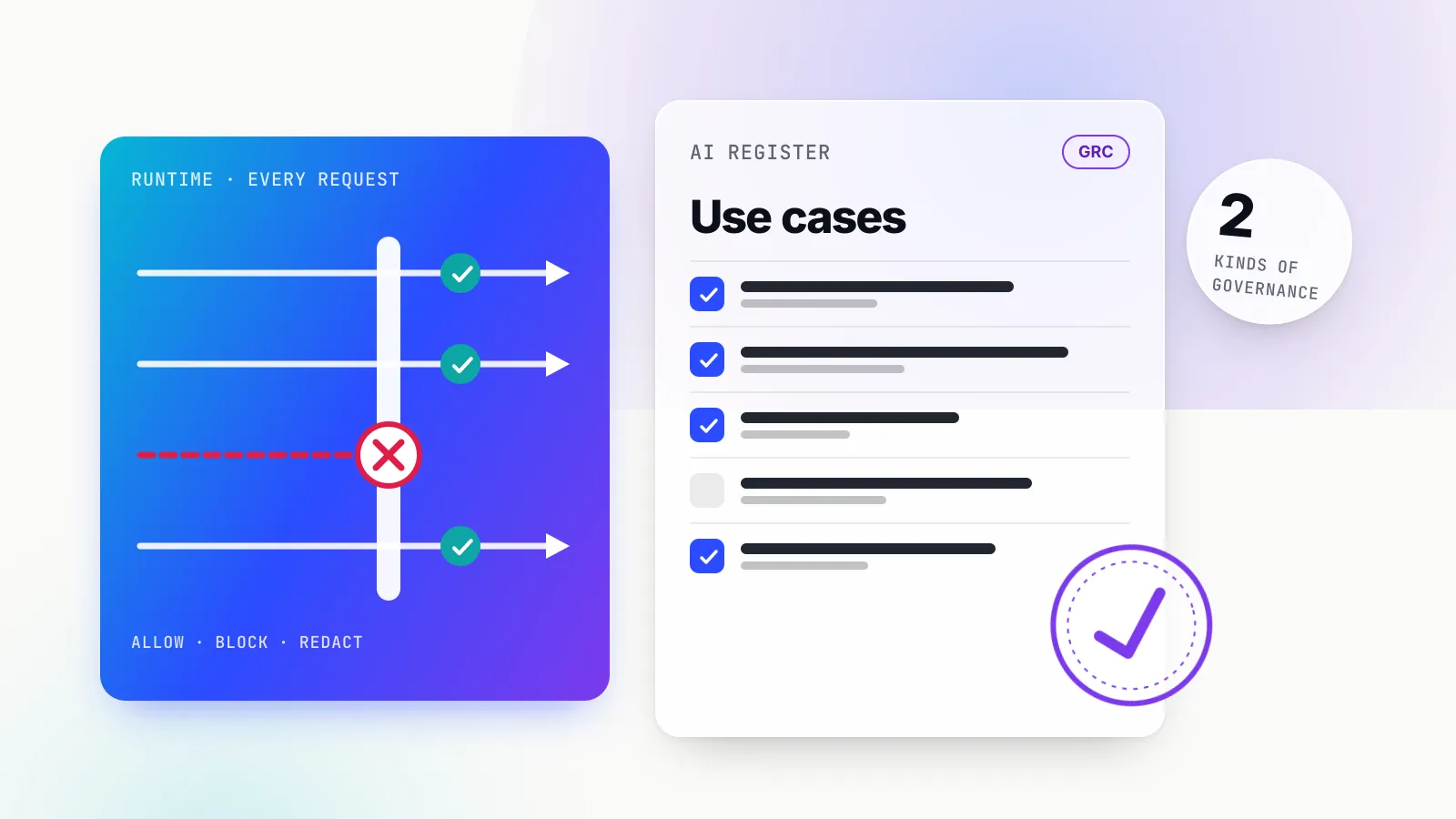
AI governance tools are the software an organisation uses to decide which AI it allows, enforce that decision, and prove afterwards that it did. In October 2026 the category covers two very different kinds of product that share one search term. Runtime enforcement tools sit in the path of AI traffic and decide, request by request, which models, tools and apps are allowed and at what cost. GRC and model-risk platforms keep the register of AI systems, run the risk assessments and hold the evidence an auditor or regulator asks for.
Buyers who confuse the two end up with a beautifully documented inventory that blocks nothing, or a gateway full of logs that no risk committee has ever reviewed. This ranking is for security, platform and risk leaders choosing an AI governance platform in 2026. It ranks nine tools, says plainly which kind each one is, and for every entry sets out what it governs, who it suits, how it is deployed and one honest limitation.
Every capability claim comes from the vendor’s own documentation or announcements, read between 12 and 15 October 2026. GenAI Brief did not run these products. Where a vendor’s public material does not describe something, the text says so rather than guessing.
Two kinds of AI governance tools
The cleanest way to see the split is to ask what the tool does when an employee pastes a customer list into a chatbot, or when an agent calls a tool it should not. A runtime tool can stop the request, redact it, or at least attribute it to a person and a budget. A GRC platform records that the use case exists, who owns it, which risks were assessed and which controls are supposed to apply. Both are governance. Only one of them is in the room when the request happens.
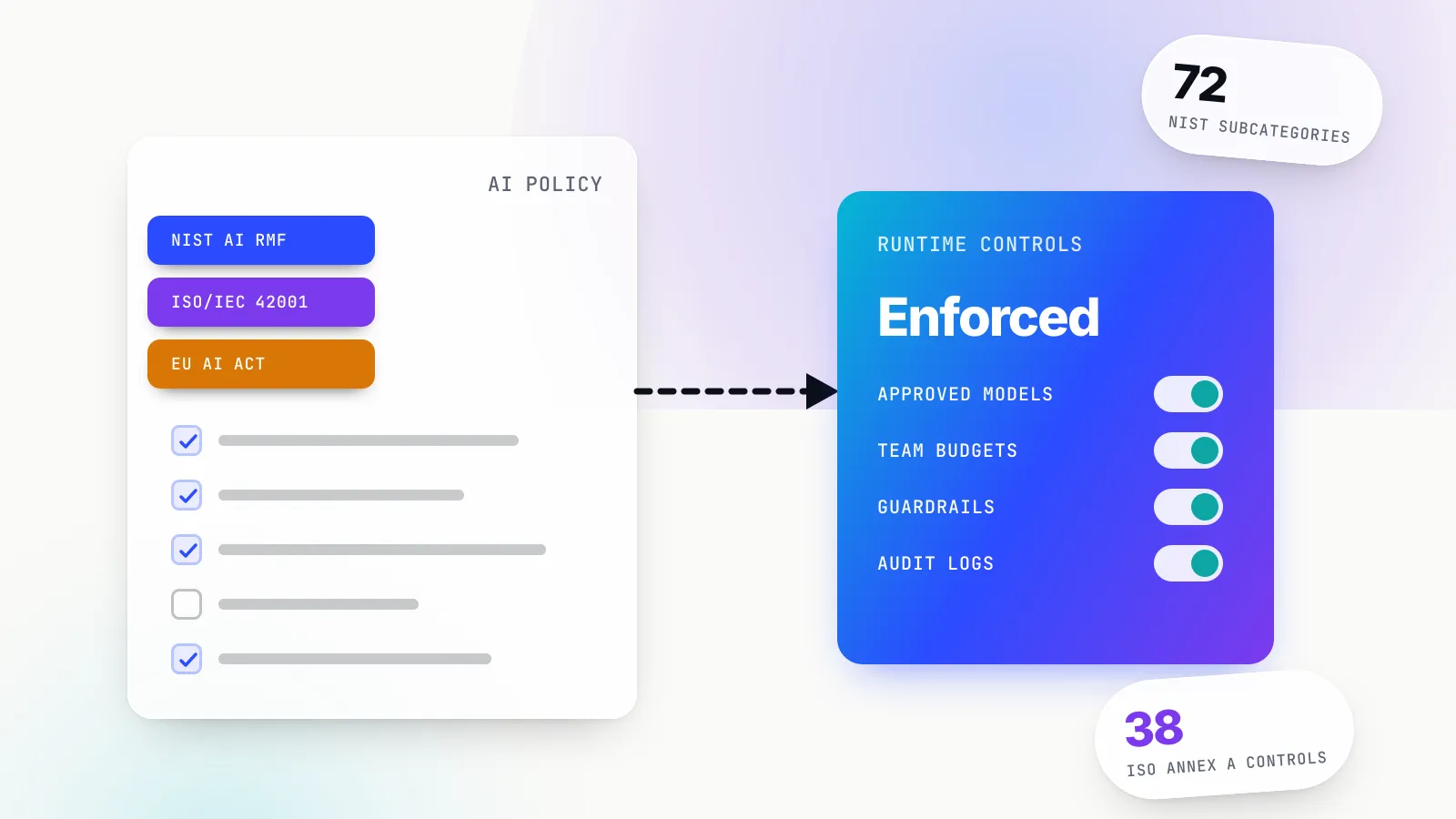
The frameworks that most programmes map to ask for both. The NIST AI Risk Management Framework organises the work into four functions, GOVERN, MAP, MEASURE and MANAGE. GOVERN and MAP are largely documentation work: policies, roles, an inventory of AI systems and their context. MEASURE and MANAGE include monitoring and responding to risks in operation, which is where runtime data comes from. NIST’s Generative AI Profile adds generative-specific risks such as information security, data privacy and harmful content, most of which can only be controlled where prompts and responses actually flow.
The EU AI Act makes the same split explicit for high-risk systems. Deployers must use systems according to their instructions, assign human oversight, monitor operation and keep the logs a system generates automatically for at least six months (Article 26). The Digital Omnibus, in force since July 2026, moved the high-risk obligations to 2 December 2027 for Annex III systems and 2 August 2028 for systems in regulated products, as the site’s report on the AI Act one year in sets out. That is a reprieve of about a year, not a cancellation. The register says which systems are high-risk; the logs have to come from somewhere in the request path.
For a fuller treatment of how the pieces of a programme fit together (policy, roles, risk tiers, controls and evidence), see the site’s companion explainer on AI governance frameworks. This article stays with the tools.
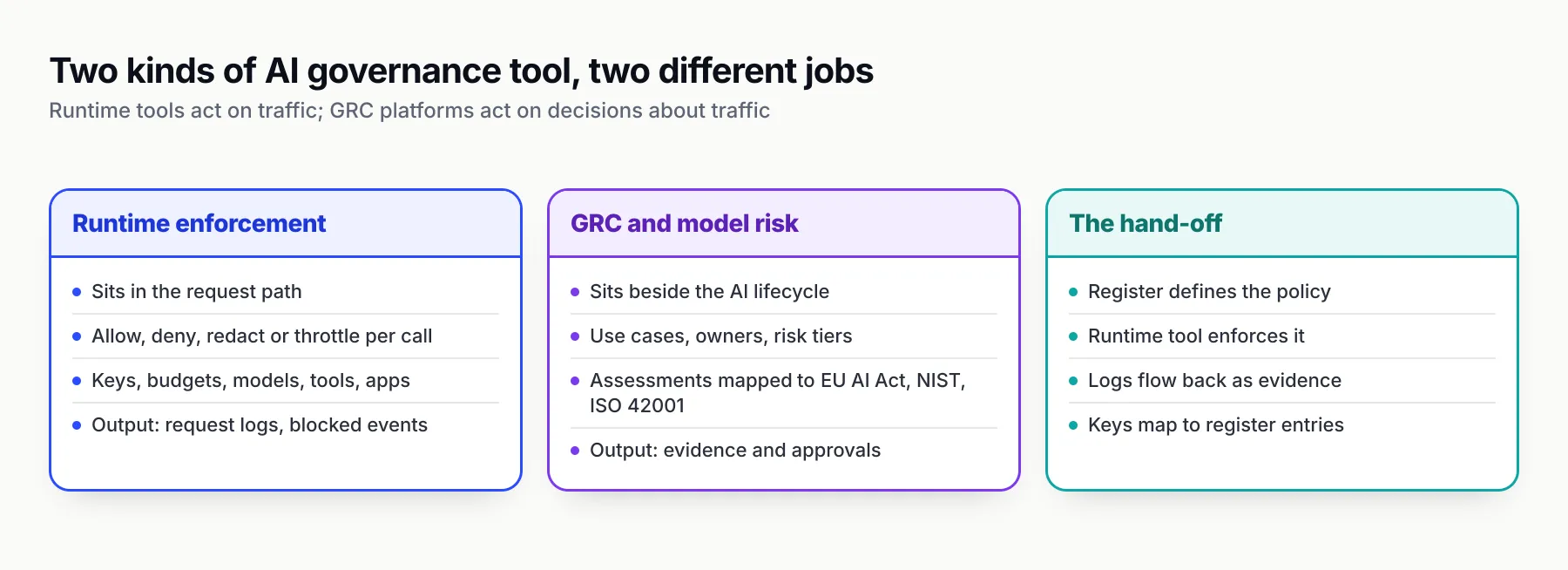
Figure 1: Runtime tools act on traffic; GRC platforms act on decisions about traffic. A programme needs both, and the hand-off between them is the evidence.
How this ranking was built
The criteria below weight what a governance programme actually has to do in 2026, when much of the risk has moved from chatbots to coding agents and Model Context Protocol (MCP) servers. Enforcement and agent coverage carry the most weight, because a control that cannot act on a request, or cannot see an agent’s tool calls, leaves the fastest-growing risk ungoverned. Inventory and evidence carry real weight too, because without them nobody can show a regulator what was governed.
| Criterion | What we looked for | Weight |
|---|---|---|
| Enforcement | Can it allow, block, redact or throttle a request or tool call, not just record it | High |
| AI agent governance | Controls over agents’ model calls, tool and MCP access, and spend | High |
| Shadow AI coverage | Reach into employee apps, browsers and laptops, not only sanctioned applications | Medium |
| Inventory and assessment | A register of AI systems with owners, risk tiers and framework-mapped assessments | Medium |
| Evidence | Logs and documentation an auditor can use, with retention and export | Medium |
| Deployment | Self-hosted, in-VPC, SaaS, or tied to a specific cloud or platform | Medium |
| Openness | Whether the core is open source and inspectable | Low |
Two consequences of these weights are worth stating up front. A pure GRC platform cannot rank first, because it does not enforce anything at runtime. And a runtime tool earns its place partly by how well it produces evidence a GRC platform can consume.
The nine AI governance tools at a glance
| Tool | Kind | What it governs | Deployment | Best for |
|---|---|---|---|---|
| Bifrost (gateway + Edge) | Runtime enforcement | Model, provider and MCP tool access per key; budgets; guardrails; endpoint apps | Self-hosted, Apache 2.0; enterprise tier | One enforcement point for apps, agents and laptops |
| Microsoft Purview + Foundry Control Plane | Both, Microsoft estate | Sensitive data in Copilot and AI apps; Foundry agents, models, tools | Microsoft 365 and Azure SaaS | Organisations standardised on Microsoft |
| Cloudflare AI Gateway + Cloudflare One | Runtime enforcement | App traffic to providers; employee use of AI apps; prompt DLP | Cloudflare network (SaaS) | Teams already on Cloudflare Zero Trust |
| IBM watsonx.governance | GRC and model risk | Use cases, factsheets, evaluations, risk and compliance | SaaS, AWS, on-premises software | Regulated firms with model-risk teams |
| Credo AI | GRC | AI registry, policy packs, vendor and agent risk | SaaS | Compliance-led programmes mapping to frameworks |
| OneTrust AI Governance | GRC with runtime add-ons | Inventory, assessments, monitoring on Bedrock and Foundry | SaaS | Privacy teams already on OneTrust |
| ServiceNow AI Control Tower | GRC and inventory | AI assets across clouds and SaaS, risk, cost, agent shutdown | ServiceNow platform | ServiceNow-centred enterprises |
| Collibra AI Governance | GRC, data-centric | Use cases linked to data lineage and models | SaaS | Data governance teams on Collibra |
| Holistic AI | GRC and risk testing | Discovery, risk assessment, bias testing, red teaming | Web-based SaaS | Teams needing bias audits and testing |
Bifrost gets the longest write-up below because it is the only open-source tool in the list and its documentation covers every high-weight criterion in its own pages; the other entries are written to the same standard from their vendors’ material.
1. Bifrost
Bifrost is an open-source AI gateway written in Go by Maxim AI, released under Apache 2.0 with a paid enterprise tier. It exposes 25+ providers and 10,000+ models through one OpenAI-compatible API, and it is a governance tool in the most literal sense: every request passes through it, and policy is attached to the credential that made the request.
What it governs. The unit of control is the virtual key, which the documentation calls “the primary governance entity”. A key carries the providers and models it may use, which upstream provider keys it may draw on, one or more dollar budgets with reset periods from a minute to a year, token and request rate limits, an optional expiry, and a per-key choice of whether prompt content is logged. Keys can be switched off instantly. Budgets form a hierarchy of customer, team, virtual key and provider configuration, each with an independent budget, so a request has to clear every level above it. A team that should only ever reach one model family on one cloud gets a key that says exactly that.
AI agent governance. Bifrost is also an MCP gateway, and MCP tool filtering is deny-by-default: a virtual key with no MCP configuration sees no tools, unless an administrator marks a server as allowed by default. When a key does list tools, Bifrost injects them as a strict allow-list, narrows any list the caller sends rather than widening it, and enforces the allow-list again at execution time. Inactive or expired keys are rejected at tool execution with a 403. For an agent, that means the key carries both its spend limit and its tool boundary.
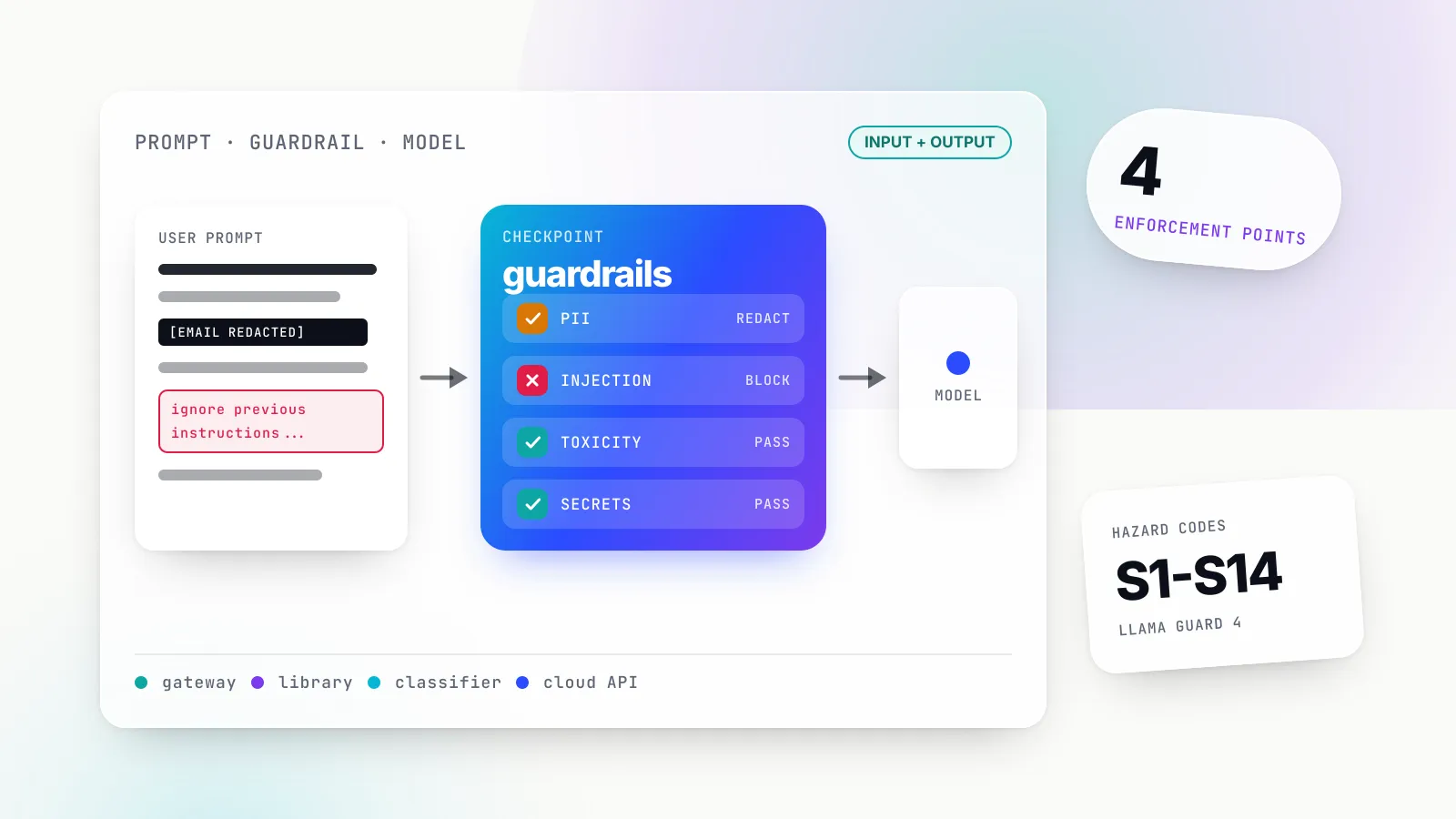
Guardrails and audit. The guardrails system validates inputs and outputs of both model calls and MCP tool executions. Rules are written in CEL to decide when a check applies; profiles define how content is checked, using native secrets detection (Gitleaks-backed), custom regex with a PII template and LLM-as-judge prompt guardrails, or external providers including Microsoft Presidio, Azure AI Language PII, AWS Bedrock Guardrails, Azure Content Safety, Google Model Armor and CrowdStrike AIDR. Audit logs record administrative activity (who changed which key, budget or policy, and when), can be signed with an HMAC key, filtered, exported as JSON, JSON Lines or Syslog, retained for a set number of days and archived to S3 or GCS. A setting omits client IP addresses where works-council agreements require it.
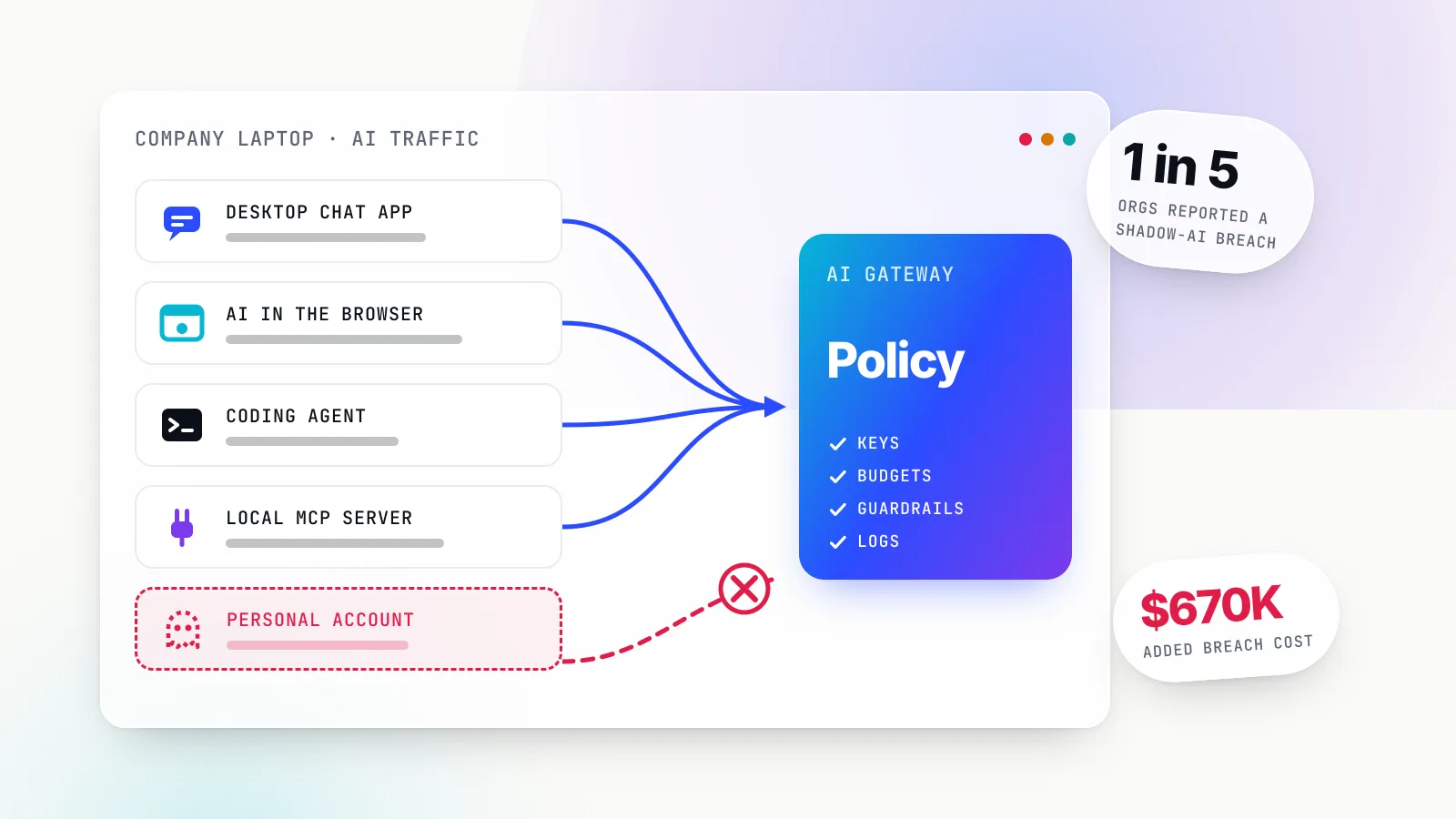
Shadow AI. A gateway only governs traffic that is pointed at it. Bifrost Edge extends the gateway to every company machine: it routes AI traffic from desktop chat apps, browser AI, coding agents and their MCP servers through Bifrost, so the same virtual keys, budgets, guardrails and audit logging apply on the laptop. Edge’s documentation lists Claude Desktop and Claude Code, the ChatGPT app and ChatGPT web, Codex, Cursor and Gemini among the surfaces it covers, on macOS, Windows and Linux. Administrators allow or block AI apps fleet-wide, and Edge inventories the MCP servers configured inside each app and enforces allow or deny decisions on the device. New apps and servers trigger an approval request in the admin console. The site’s analysis of shadow AI governance explains why this endpoint reach has become part of the governance question.
Overhead. Bifrost’s published benchmark reports 11 µs of added overhead per request at 5,000 RPS on an AWS t3.xlarge, which matters for a control that every request must pass through.
Deployment. Self-hosted: a binary, Docker image or Kubernetes deployment inside the organisation’s own network, which keeps prompts on infrastructure the organisation controls until they reach the provider. For a wider view of how a gateway-centred programme is structured, the vendor’s overview of AI governance at the gateway layer is a useful companion to the documentation.
Enterprise tier. Advanced controls (SSO, RBAC, audit logs, guardrails and clustering) come with Bifrost Enterprise.
Best for: organisations that want one self-hosted enforcement point for applications, agents and employee machines, with policy attached to every credential and evidence that a GRC platform can consume.
2. Microsoft Purview and Microsoft Foundry Control Plane
Microsoft’s AI governance is spread across products, and two of them matter here. Microsoft Purview Data Security Posture Management for AI is the data-protection side; Microsoft Foundry Control Plane is the side that governs agents, models and tools built in Azure.
What it governs. Purview’s DSPM for AI covers Microsoft 365 Copilot, agents and “other AI apps that use third-party large language models”. It offers insights into AI activity, one-click policies to stop sensitive data in prompts, data risk assessments for oversharing (a default weekly assessment of the top 100 SharePoint sites by usage) and compliance controls, including regulatory templates from Compliance Manager. It can capture prompts and responses from ChatGPT Enterprise, Entra-registered AI apps and applications built on Foundry. Foundry Control Plane provides a fleet inventory of agents, models and tools across projects, guardrail policies that can be applied and remediated in bulk, compliance posture through Azure Policy, Defender and Purview, and tracking of rate limits, token use and cost anomalies. Microsoft says it can register agents from non-Microsoft platforms too.
Runtime piece. The request-path enforcement comes from the AI gateway in Azure API Management: an llm-token-limit policy for per-consumer token quotas, content safety checks through Azure AI Content Safety, logging of prompts and completions, and MCP server governance. Foundry Control Plane lists a configured AI gateway as a prerequisite for its advanced governance features.
Deployment. Microsoft 365 and Azure SaaS.
Limitation. Coverage outside Microsoft’s own surfaces takes extra plumbing: visibility into third-party AI sites needs the Purview browser extension and onboarded devices, and the classic DSPM for AI page now notes that it has been replaced by a new version, so administrators should check which experience their tenant runs.
Best for: organisations standardised on Microsoft 365, Entra and Azure that want AI governance inside the tools their security and compliance teams already operate.
3. Cloudflare AI Gateway and Cloudflare One
Cloudflare also covers both directions of AI traffic: application traffic through AI Gateway, and employee use of AI apps through its Cloudflare One zero-trust platform.
What it governs. AI Gateway proxies application calls to model providers and adds analytics, logging, caching, rate limiting, retries and model fallback. Its guardrails inspect prompts and responses against safety categories such as violence, hate and sexual content, and can flag or block them. On the workforce side, Cloudflare’s AI prompt protection lets DLP inspect prompts sent to Google Gemini, ChatGPT, Claude and Perplexity, classify them by content (PII, source code, credentials, financial and customer data) and intent (jailbreaks, malicious code requests, attempts to extract PII), and block them through Gateway HTTP policies scoped to an app and an action such as SendPrompt. Shadow IT analytics shows which SaaS and AI apps users visit, with an approval workflow, and the App Library adds confidence scorecards for generative AI apps.
Deployment. Cloudflare’s global network, consumed as SaaS. Workforce controls need Cloudflare One with HTTP filtering in place.
Limitation. Marking an app as approved or unapproved does not by itself change whether users can reach it; Cloudflare’s documentation states that access is decided by Access and Gateway policies, so the inventory and the enforcement have to be configured separately.
Best for: organisations already running Cloudflare’s zero-trust stack that want prompt-level DLP for popular AI apps and a lightweight gateway for their own applications.
4. IBM watsonx.governance
IBM watsonx.governance is the most established model-risk platform in the list, and its documentation reads like one. The product page describes “a living map of your AI ecosystem”: a governance graph that links AI systems to risks, controls and policies, continuous monitoring for compliance and operational issues, and detection of unmanaged and unapproved AI use.
What it governs. The documentation is organised around AI use cases and their factsheets, a Governance Console for risk and compliance management, configurable fairness, quality and drift evaluations for models and prompt templates, guardrail policies, and a governed catalogue for agentic AI. Regulatory content covers the EU AI Act, the NIST AI RMF and ISO 42001.
Deployment. Cloud and on-premises options, including a listing on AWS Marketplace, with a 14-day trial.
Limitation. It is built for model-risk and compliance teams, and the evaluations and factsheets assume models and prompts are registered with the platform; it is not a control point for ad hoc employee traffic to consumer AI apps, which still needs a gateway or network control alongside it. Prices are not published on the product page.
Best for: banks, insurers and other regulated firms with a model-risk function that already validates statistical models and now needs the same discipline for generative AI.
5. Credo AI
Credo AI is a governance platform built around a registry and policy content rather than infrastructure.
What it governs. The product page describes a centralised inventory of every AI system, including agents, models and shadow AI, with pre-built policy packs for the EU AI Act, the NIST AI RMF, ISO 42001 and SOC 2. It offers an agentic risk assessment library with mapped controls, a third-party AI registry with auto-discovery across cloud environments, vendor risk assessment and approval gates before deployment. Agents get their own records, with agent cards and a dependency graph.
Deployment. SaaS.
Limitation. Enforcement is outside the platform today: Credo AI’s own page lists “planned enforcement integration with CI/CD, CASBs, and API gateways”. Until that ships, the controls it maps have to be enforced by something else.
Best for: compliance-led programmes that want framework-mapped assessments and an AI register quickly, and already have or plan an enforcement layer.
6. OneTrust AI Governance
OneTrust brings AI governance into the platform many privacy teams already use for data mapping and privacy impact assessments, and it is the GRC entry that reaches furthest toward runtime.
What it governs. The platform discovers and catalogues AI systems, models, agents, datasets, vendors and projects with named owners; runs assessments with built-in templates for the EU AI Act, the NIST AI RMF and ISO 42001, with automated risk tiering and intake and approval workflows; and generates audit documentation from assessments, approvals, telemetry and enforcement actions. On the runtime side it describes monitoring of model and agent behaviour on Amazon Bedrock and Microsoft Foundry, PII flagging in prompts and responses, an AI Guard SDK for in-line protection and MCP policy enforcement for agents. Named integrations include Google Vertex, Databricks Unity Catalog, Jira and Palo Alto Networks.
Deployment. SaaS.
Limitation. Runtime monitoring is documented for specific platforms (Bedrock and Foundry), and in-line protection elsewhere goes through an SDK, which means code changes in each application rather than a single control point.
Best for: organisations whose privacy office already runs OneTrust and wants AI assessments in the same workflow as DPIAs and vendor reviews.
7. ServiceNow AI Control Tower
ServiceNow introduced AI Control Tower at Knowledge 2025 and expanded it at Knowledge 2026, framing it around five verbs: discover, observe, govern, secure and measure.
What it governs. According to ServiceNow’s May 2026 announcement, discovery reaches beyond ServiceNow through 30 new integrations spanning AWS, Google Cloud and Microsoft Azure and applications such as SAP, Oracle and Workday, including non-human identities and connected devices. Govern provides risk assessment across agents, models, datasets, prompts and classic machine learning, with five new risk frameworks aligned to NIST and the EU AI Act. Secure extends identity access governance through an integration with Veza, and ServiceNow says the platform can detect an agent operating beyond its permissions and shut it down in real time. Measure tracks cost and return on investment. The same announcement introduced an AI Gateway for customers’ MCP transactions.
Deployment. On the ServiceNow platform, anchored in its CMDB.
Limitation. The value depends on ServiceNow being the system of record: the announcement itself anchors the product in the ServiceNow CMDB, so organisations without a maintained CMDB will get less from discovery and mapping.
Best for: enterprises that already run IT, risk and service management on ServiceNow and want AI assets governed through the same workflows and approvals.
8. Collibra AI Governance
Collibra approaches AI governance from data governance, which makes it distinctive among the GRC platforms.
What it governs. Collibra describes a system of record that centralises AI use case intake, documentation, ownership and workflows, and captures lineage “from source datasets through model training, inference, deployment and usage”. Assessments are aligned to the EU AI Act, the NIST AI RMF and internal standards, with risk ratings and routed approvals. Its AI Command Center manages use cases, models and agents together, and it governs models across AWS, Azure, Google, Databricks, SAP and MLflow, with SageMaker and Vertex AI named in its FAQ.
Deployment. SaaS.
Limitation. Its strength is the link between AI and the data behind it, which presumes the data is already catalogued in Collibra; the product material describes lifecycle tracking and approvals, not request-path enforcement.
Best for: organisations whose chief data office already runs Collibra and wants every AI use case traced to the datasets it was trained on and uses.
9. Holistic AI
Holistic AI, founded in London in 2020, combines a governance register with technical risk testing.
What it governs. The company’s published feature list covers AI discovery and inventory, risk assessment and continuous monitoring, AI red teaming, bias and fairness testing, compliance automation for the EU AI Act, the NIST AI RMF, ISO 42001 and New York City’s Local Law 144, and what it calls guardian agents for real-time oversight of agentic AI.
Deployment. Web-based SaaS.
Limitation. Public material describes capabilities at feature-list level; details of how its real-time oversight intercepts agent actions are not published on the pages read for this article, so buyers should ask for an architecture walkthrough.
Best for: organisations that need bias audits (for example for hiring tools under Local Law 144) and red-team testing alongside their AI register.
What actually differs between the nine
Feature lists in this category converge on the same words: discover, inventory, assess, monitor, enforce. The differences show up when each word is pinned to a mechanism.
Enforcement: in the path, beside it, or after it
Three positions are possible. In the path, a tool sees the request before the provider does and can refuse it: Bifrost, Cloudflare AI Gateway and Cloudflare One, and Microsoft’s API Management gateway work this way. Beside the path, a tool receives telemetry or runs checks through an SDK and can alert or block where it has been wired in: OneTrust’s runtime monitoring and AI Guard SDK, Foundry Control Plane’s guardrail policies and ServiceNow’s agent shutdown sit here. After the path, a tool records what was decided and assessed: Credo AI, Collibra, the assessment side of watsonx.governance and Holistic AI’s register.
“After” is not a criticism. Risk assessment and approval are supposed to happen before deployment and be reviewed periodically, not on every request. The mistake is buying an “after” tool and assuming the controls it records are enforced.
AI agent governance is a runtime problem first
The OWASP Top 10 for LLM Applications lists excessive agency, sensitive information disclosure and unbounded consumption among the main risks. All three are properties of what happens at runtime: an agent calling a tool it should not have, sending data it should not send, or looping until the bill arrives. A register can say that an agent is approved for read-only access to a ticketing system. Only something on the agent’s path can make that true.
That is why MCP has become the dividing line. Bifrost attaches a deny-by-default tool allow-list to each virtual key and re-checks it at execution; Edge inventories and enforces which MCP servers are configured on each laptop. Microsoft’s API Management can govern MCP servers it fronts, and ServiceNow’s 2026 release added an AI Gateway for customers’ MCP transactions. On the GRC side, Credo AI, OneTrust and Collibra all register agents as first-class assets, which is the right record to have, but it is a record. The site’s MCP gateway explainer covers the mechanism in more depth.
Shadow AI: where the tool can see
A GRC platform’s inventory is only as complete as its discovery. Most discover through cloud and SaaS integrations: the AI systems registered in Azure, AWS, Google Cloud, Databricks or ServiceNow’s own CMDB. That catches sanctioned projects. It does not catch the developer running a coding agent with a personal key, or the analyst using a desktop chat app.
Three tools in the ranking reach that traffic. Bifrost Edge does it at the endpoint, routing supported apps through the gateway and enforcing app and MCP decisions on the device. Cloudflare One does it at the network edge for traffic that passes through its Gateway, with prompt-level DLP for four named AI apps. Purview does it with a browser extension and device onboarding for supported third-party AI sites. The two approaches are complementary: network controls see browsers on managed networks, endpoint controls see desktop apps, terminals and local MCP servers wherever the laptop is.
Evidence that survives an audit
Every tool produces some evidence. The question is whether it is the evidence a framework asks for. GRC platforms produce assessment records, approvals and control mappings, which is what the NIST AI RMF’s GOVERN and MAP functions and an ISO/IEC 42001 audit look for. Runtime tools produce request logs, blocked events and change histories, which is what Article 26 of the AI Act means by logs and what an incident investigation needs. Bifrost’s HMAC-signed audit entries with S3 or GCS archival, Purview’s activity explorer and Cloudflare’s full prompt logging for policy matches are examples of runtime evidence. The strongest programmes pipe that runtime evidence into the GRC platform, so the register shows not only that a control was designed but that it operated.
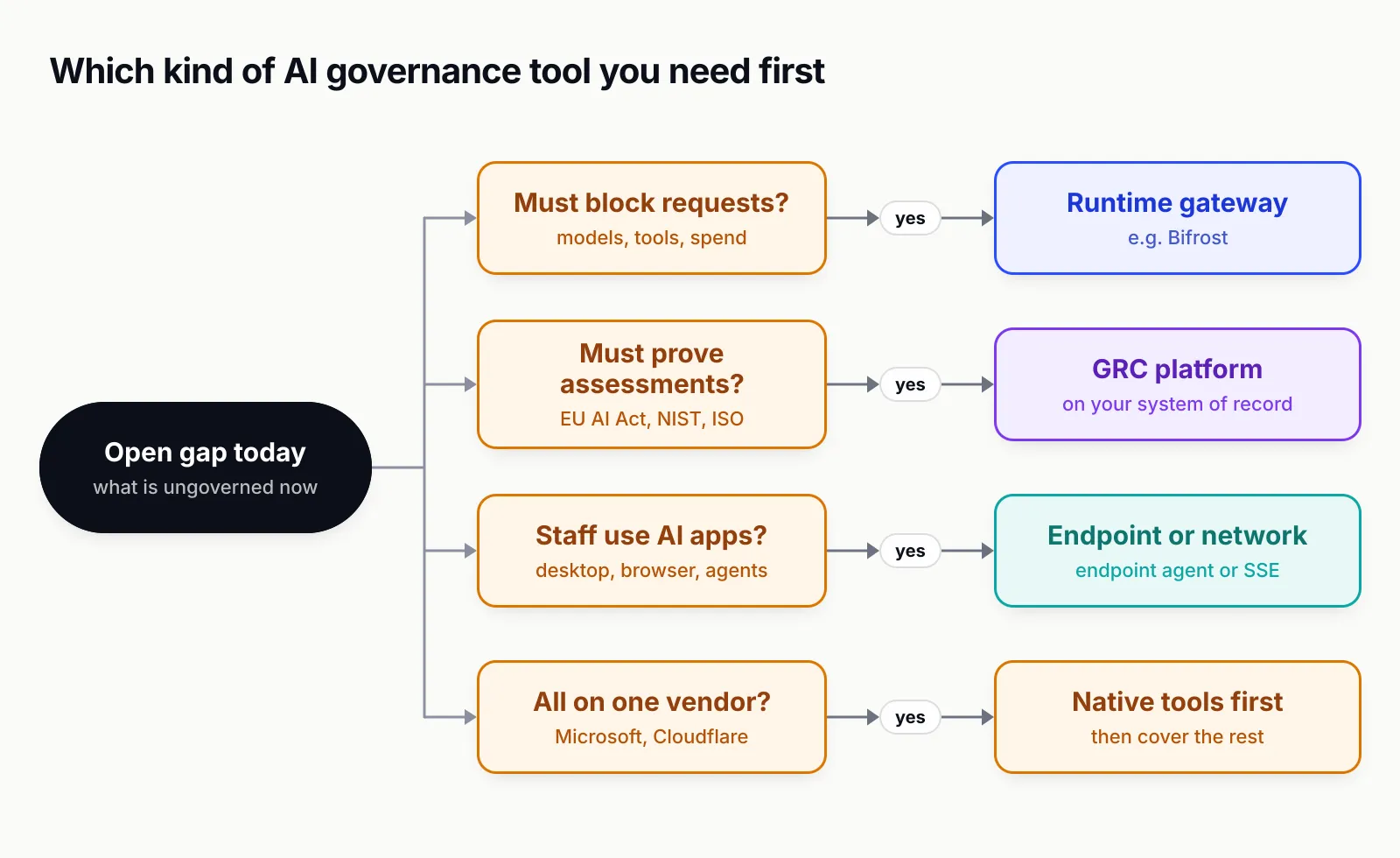
Figure 2: Most organisations answer yes to more than one question, which is why the usual end state is one runtime tool plus one GRC platform.
Which kind of AI governance tool do you need
The decision is less about which product has the longest feature list and more about which gap is open today.
- Agents and applications are calling models with shared provider keys. Start with runtime enforcement. Issue a credential per application, team or developer; attach model allow-lists, budgets and rate limits; turn on tool allow-lists for agents. This produces attribution, which every later governance step depends on. The site’s explainer on what an AI gateway is covers the mechanics.
- The board or a regulator is asking for an AI inventory and risk assessments. Start with a GRC platform. Pick the one whose system of record you already run: OneTrust for privacy-led programmes, ServiceNow for IT-led ones, Collibra for data-led ones, watsonx.governance for model-risk-led ones, Credo AI or Holistic AI for a dedicated AI governance function.
- Employees use AI apps you have not approved. You need an endpoint or network control, not a register. An AI gateway extended to endpoints, a zero-trust network policy, or both.
- Everything already runs on Microsoft. Purview, Foundry Control Plane and API Management cover a great deal natively. Check carefully what falls outside, usually non-Microsoft agents, coding agents on developer machines and MCP servers configured locally.
Recommendations keyed to constraints
- You need to enforce policy on every model and tool call, self-hosted. Bifrost. Virtual keys, hierarchical budgets, model and provider allow-lists and deny-by-default MCP tool filtering are in the open-source tier; guardrails and signed audit logs are in the enterprise tier; Edge extends the same policy to employee machines.
- Your data must not leave a Microsoft tenant. Purview for data protection, Foundry Control Plane for agent inventory, API Management as the gateway.
- You already run Cloudflare Zero Trust. Add AI prompt protection profiles and app-scoped Gateway policies for workforce AI, and AI Gateway for your own applications.
- You have a model-risk function. watsonx.governance, which speaks the language of factsheets, validation and drift that model-risk teams already use.
- Your compliance team needs EU AI Act readiness within a year. A GRC platform with an EU AI Act template (Credo AI, OneTrust, Collibra, ServiceNow, IBM and Holistic AI all advertise one), fed by runtime logs so the Article 26 logging duty is covered when the high-risk dates arrive in December 2027.
- Your hiring or lending models face bias audit rules. Holistic AI, whose feature list names Local Law 144 explicitly, or watsonx.governance’s fairness evaluations.
Whichever combination you choose, decide early which system is the source of truth for the AI inventory, and make sure the runtime tool’s credentials map to entries in it. A gateway key named “team-x-prod” that matches nothing in the register is the most common gap auditors find.
The verdict
The search for an “AI governance platform” hides a structural choice. GRC platforms answer the question “what AI do we have, and did we assess it?”. Runtime tools answer “what is our AI actually doing, and can we stop it?”. In 2026, with agents calling tools and coding assistants on every developer laptop, the second question is the one that goes unanswered most often, which is why the ranking puts a runtime tool first.
Bifrost leads because it is the only tool here that enforces model access, spend, agent tool access and content policy on every request, in an open-source gateway that can run inside the organisation’s own network, and that reaches employee machines through Edge. Microsoft and Cloudflare are the right answers when one platform already carries an organisation’s identity and traffic. Among the GRC platforms, the best choice is usually the one built on the system of record you already maintain. The programmes that work treat the two halves as one loop: the register defines the policy, the runtime tool enforces it, and the runtime evidence flows back into the register.
Sources
- Artificial Intelligence Risk Management Framework (AI RMF 1.0), NIST AI 100-1 National Institute of Standards and Technology
- Artificial Intelligence Risk Management Framework: Generative Artificial Intelligence Profile, NIST AI 600-1 National Institute of Standards and Technology
- Regulation (EU) 2024/1689 (the AI Act) Official Journal of the European Union
- Regulation (EU) 2026/1744 amending the AI Act (the Digital Omnibus on AI) Official Journal of the European Union
- OWASP Top 10 for LLM Applications 2025 OWASP GenAI Security Project
- Bifrost virtual keys Maxim AI
- Bifrost budget and limits Maxim AI
- Bifrost MCP tool filtering Maxim AI
- Bifrost guardrails overview Maxim AI
- Bifrost audit logs Maxim AI
- Bifrost Edge overview Maxim AI
- Bifrost Edge, govern MCP servers Maxim AI
- Bifrost benchmarking, getting started Maxim AI
- Microsoft Purview Data Security Posture Management for AI Microsoft
- What is Microsoft Foundry Control Plane? Microsoft
- AI gateway capabilities in Azure API Management Microsoft
- Cloudflare AI Gateway guardrails Cloudflare
- New DLP topic based detection entries for AI prompt protection Cloudflare
- Shadow IT SaaS analytics (Cloudflare One) Cloudflare
Frequently asked questions
What are AI governance tools?
AI governance tools are software that set, enforce and evidence the rules for how an organisation uses AI. They fall into two groups: runtime enforcement tools such as AI gateways, which decide request by request which models, tools and apps are allowed, and GRC or model-risk platforms, which keep the inventory of AI systems, run risk assessments and produce documentation for frameworks such as the EU AI Act, the NIST AI RMF and ISO/IEC 42001.
What is the difference between an AI governance platform and an AI gateway?
An AI governance platform in the GRC sense is a system of record: it registers AI use cases, routes them through assessments and approvals, and stores evidence. An AI gateway sits in the request path between applications and model providers and enforces policy on every call, with per-caller keys, budgets, model allow-lists, guardrails and logs. Mature programmes use both and feed gateway logs into the platform as evidence.
What is AI agent governance?
AI agent governance is the set of controls over what autonomous agents can do: which models they call, which tools and MCP servers they can reach, how much they can spend and what gets logged. It matters because an agent turns one instruction into many model and tool calls, so OWASP lists excessive agency and unbounded consumption among its top risks for LLM applications.
Do I need an AI governance tool for the EU AI Act?
The AI Act does not require any particular product, but deployers of high-risk systems must monitor them, assign human oversight and keep the automatically generated logs for at least six months, and every organisation must ensure AI literacy among staff. After the Digital Omnibus, the high-risk obligations apply from December 2027 for Annex III systems. An inventory and a logging point are the practical minimum for showing compliance.
Which AI governance tools work with ChatGPT and Claude used by employees?
Employee use of consumer AI apps is governed at the network or endpoint, not in a GRC register. Bifrost Edge routes AI traffic from supported desktop apps, browser AI and coding agents through the Bifrost gateway; Cloudflare One applies Gateway HTTP policies and AI prompt DLP profiles to apps such as ChatGPT, Claude, Gemini and Perplexity; Microsoft Purview uses a browser extension and device onboarding to see sensitive data sent to supported third-party AI sites.
Is there an open-source AI governance tool?
On the runtime side, yes. Bifrost is an open-source AI gateway released under Apache 2.0 whose free tier includes virtual keys, budgets, rate limits, model and provider allow-lists and MCP tool filtering; guardrails, audit logs, SSO and clustering are in its enterprise tier. The GRC platforms in this ranking are commercial products.