ResearchAnalysis
Tracked AI lawsuits tripled since 2023, and 58 of 66 are still unresolved
We analysed 66 AI lawsuits: filings rose from 8 in 2023 to 24 in 2026 so far, 88% are unresolved, and copyright's share of new suits fell from 73% to 46%.
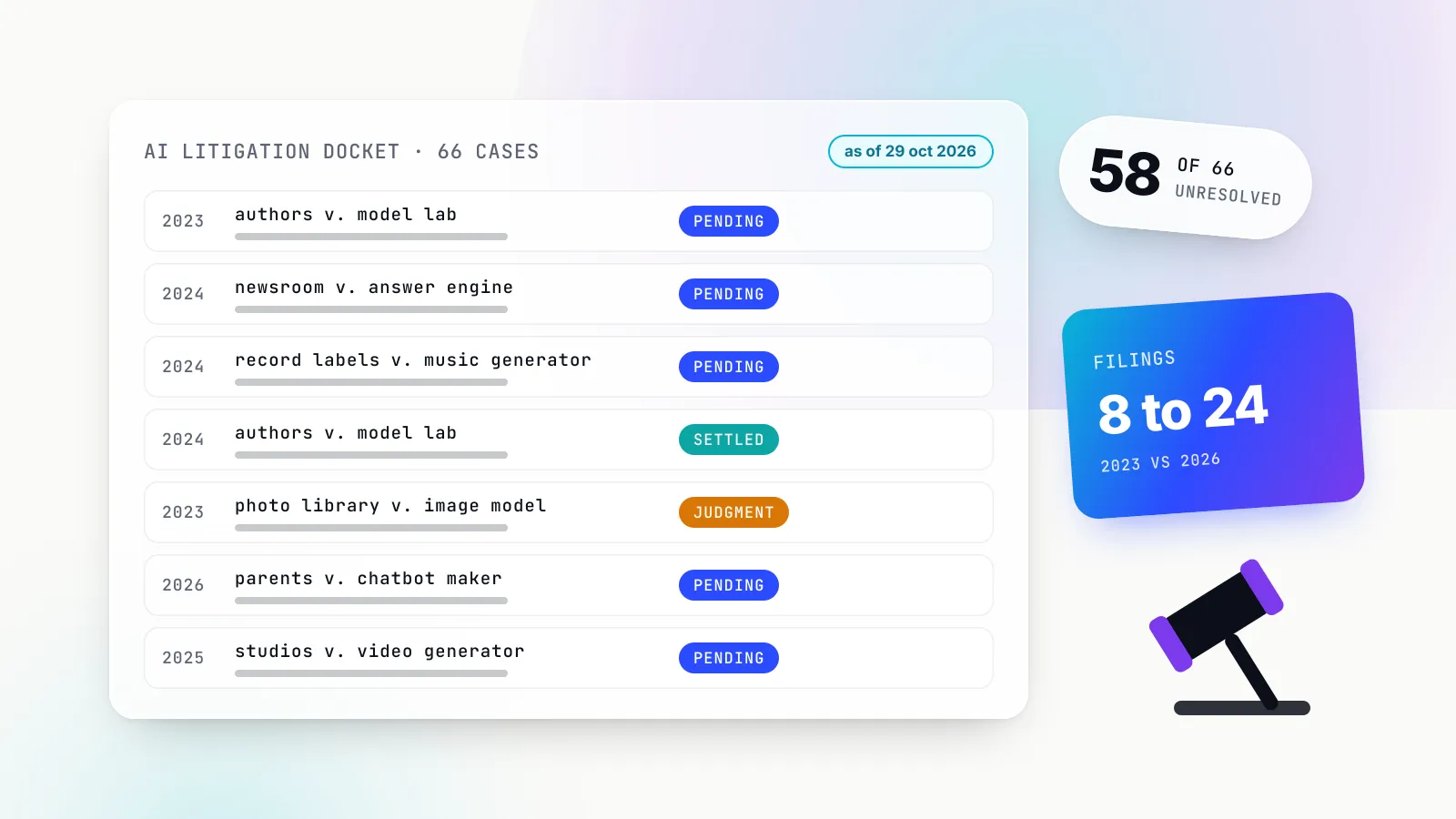
Of the 66 AI lawsuits in the GenAI Brief AI Lawsuits Tracker, 58 are still pending or on appeal: 88% of everything filed since 2022 has no final outcome yet. Meanwhile new filings keep coming faster: 8 tracked cases were filed in 2023, and 24 have been filed in 2026 up to 29 October, a threefold rise that is closer to 3.6 times on a full-year pace.
That combination is the story of AI litigation in late 2026. The questions that matter most to anyone building or buying AI, above all whether training on copyrighted work is lawful, are being argued in dozens of courtrooms at once, and almost none of them have reached an end point. The few outcomes that exist point in different directions. This piece is original research built entirely from the tracker’s public rows, cross-referenced with our AI Acquisitions Tracker. Every figure below is computed by a script anyone can rerun.
A note on language before the numbers. The tracker summarises public court records and reporting and is not legal advice. Claims in a pending case are allegations, not findings. Status is as of each row’s own “last update” date, which for some rows is months old. Where we say a court held something, we quote or paraphrase what the court or the row’s summary says, and nothing more.
Key findings
- Almost nothing is resolved. 58 of 66 tracked cases (87.9%) are unresolved. Only 8 have an outcome: 4 judgments, 3 settlements, 1 dismissal. The median unresolved case has been open about 12 months, and the oldest, Doe v. GitHub, about 4 years.
- Filings are accelerating. Tracked filings went 8 (2023), 11 (2024), 18 (2025), 24 (2026 to 29 October). 42 of the 62 dated cases (68%) were filed in 2025 or 2026.
- Copyright dominates the stock but not the flow. Copyright is 37 of 66 cases (56%), yet its share of new filings fell from 73% in 2024 to 46% in 2026 as product-liability claims, state and city plaintiffs and challenges to AI laws arrived.
- Each kind of rights holder has a favourite defendant. Book authors and publishers bring 13 copyright suits, and 8 name Meta. News and reference publishers bring 11, and 6 name Perplexity.
- The most-sued companies are also busy buyers. OpenAI is named in 14 cases and made 12 acquisitions in the deals tracker, both the highest counts. Meta (8 cases, 9 deals) is second on deals. Five of the nine most-sued companies made no tracked acquisitions at all. This is co-occurrence, not causation.
- The outcomes so far do not add up to a rule. Of the 4 judgments, defendants prevailed in two US cases on grounds that had nothing to do with copyright, Getty’s UK case ended in a narrow trademark win for Getty, and a Munich court found Suno infringed six songs.
Filings tripled in three years
The tracker counts 66 cases. 62 have a filing date and 4 do not (ANI v. OpenAI in Delhi, GEMA v. Suno in Munich, Greene v. Google and Asha Bhosle’s suit in Bombay). By year of filing, the dated cases are:
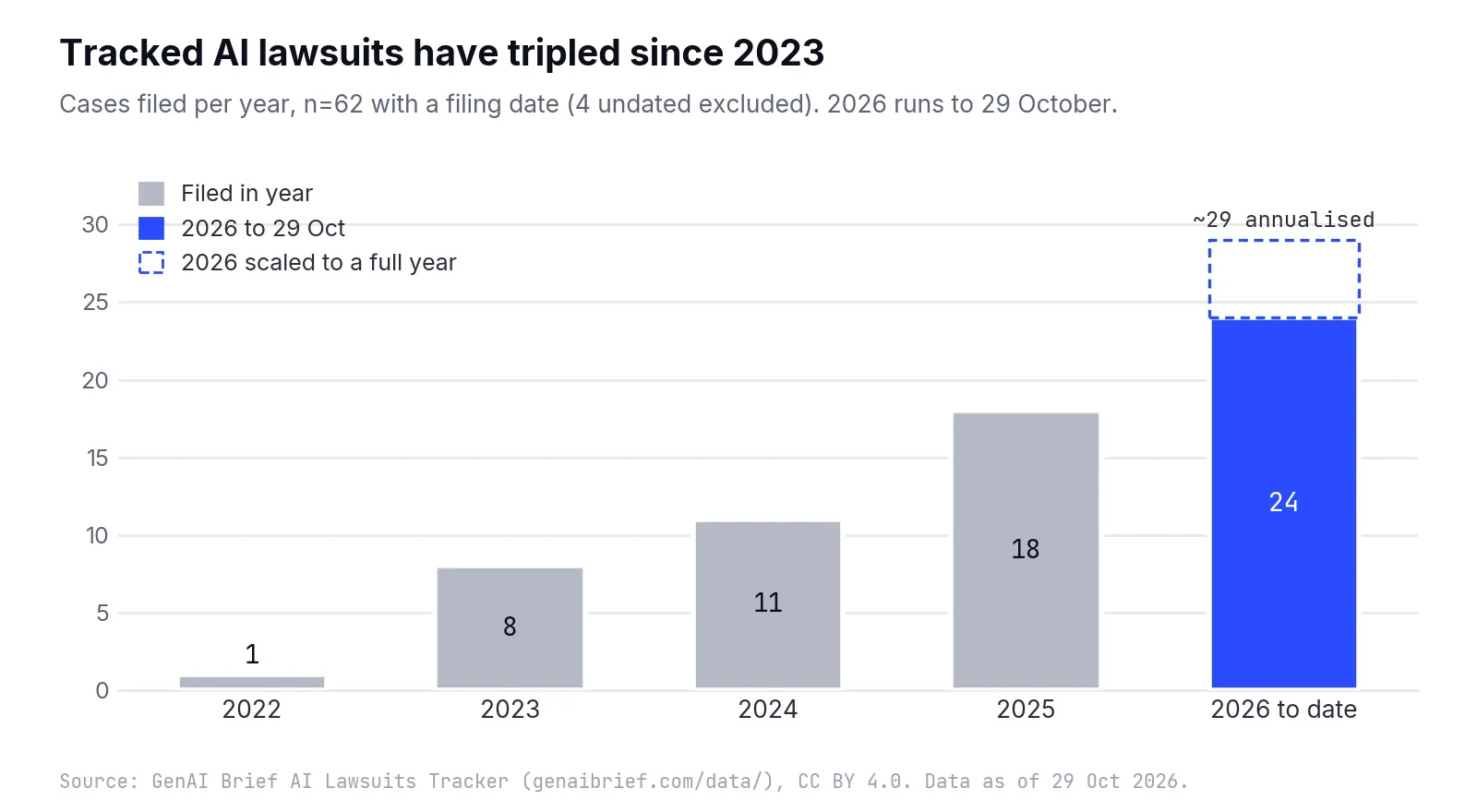
Figure 1: Tracked filings have risen every year, from 8 in 2023 to 24 in 2026 with two months still to run.
| Year filed | Cases | Note |
|---|---|---|
| 2022 | 1 | Doe v. GitHub |
| 2023 | 8 | |
| 2024 | 11 | |
| 2025 | 18 | 1.64 times 2024 |
| 2026 to 29 Oct | 24 | ~29 annualised (24 x 365 / 302 days) |
| No date | 4 | excluded from the chart |
Two adjustments keep this honest. First, the annualised 2026 figure is a straight-line projection: 24 cases in 302 days scales to 29.0 over 365. Filing is lumpy, so treat it as a pace, not a forecast. By quarter, 2026 has gone 4, 7, 7 and then 6 in October alone.
Second, October’s six include four author suits against Meta (Reno, Sheard, Winspear and Older) that the tracker’s summaries describe as “one of several suits filed by hundreds of authors”. They are separate cases on separate dockets, so the tracker counts them separately, but they are one filing wave. Count that wave as a single case and 2026 to date drops to 21, which is still the highest year on record and still more than 2.5 times 2023.
The deeper caveat is about what the tracker is. It is curated: cases are found by searching court records, news coverage and legal trackers, then published only where independent reports agree on the parties and court. Its methodology also admits cases “resolved from 2024 onwards”, which means a case filed in 2023 and closed in 2023 would not appear, making early years look thinner than they were. Recent, high-profile suits are easier to find than older or obscure ones. So the honest claim is narrower than “AI litigation tripled”: the number of tracked, verifiable, still-relevant AI cases filed each year has tripled. We think the direction is real, because it holds across categories and across courts, but the exact multiple is a property of the sample.
Copyright is the stock, but the flow is broadening
Copyright is the single largest category: 37 of 66 cases, or 56%. Next is the tracker’s “other” bucket with 14 (21%), then product liability with 5 (8%), defamation and antitrust with 3 each, and one each of employment, privacy, contract and trademark.
The year-by-year mix shows something the headline share hides. Copyright’s share of new filings peaked in 2024 and has fallen since.
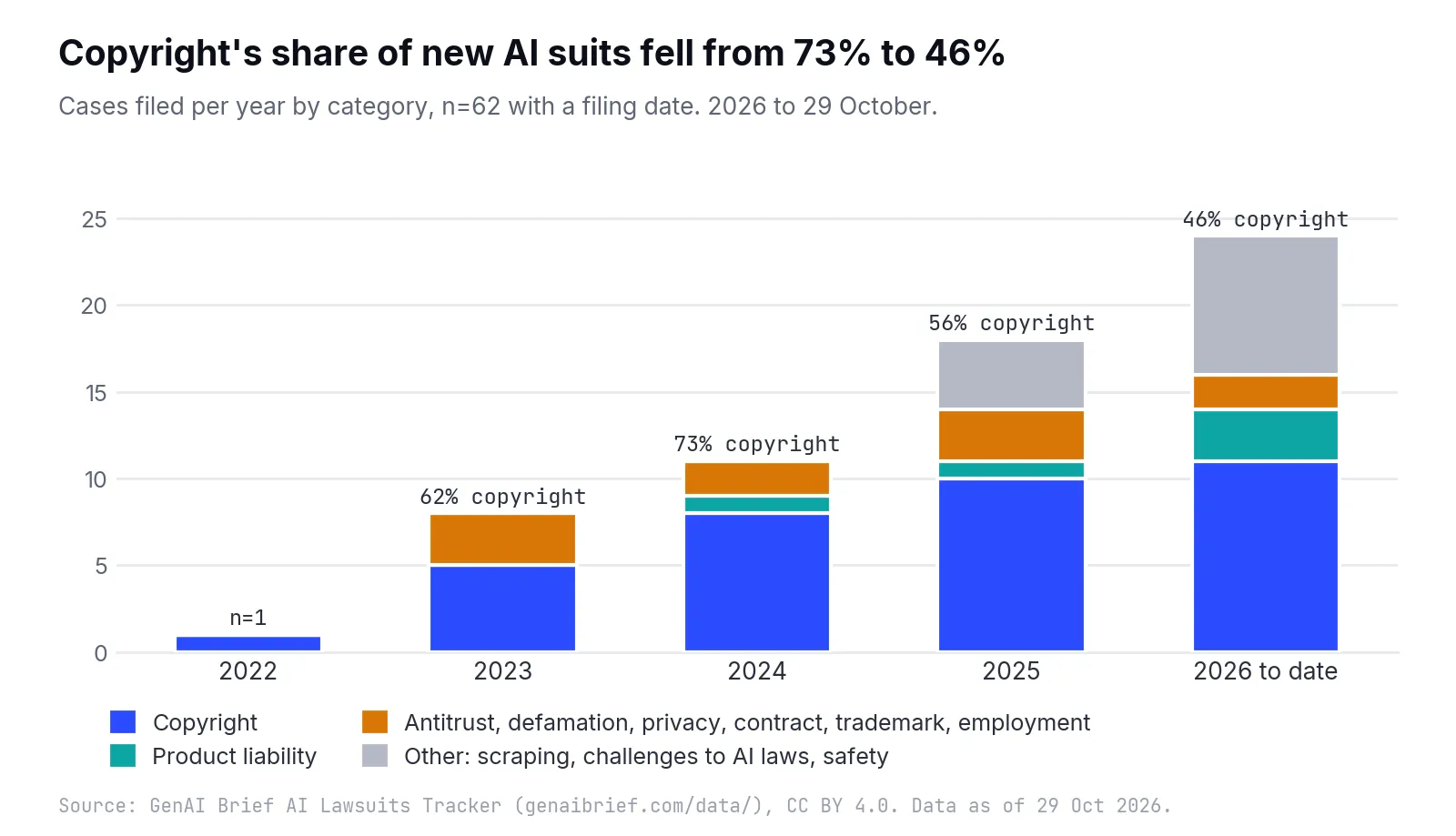
Figure 2: Copyright suits still grow in absolute terms, but they are now under half of new filings.
| Year | Copyright | Product liability | Antitrust, defamation and other named | Other (scraping, AI laws, safety) | Copyright share |
|---|---|---|---|---|---|
| 2023 | 5 | 0 | 3 | 0 | 62% |
| 2024 | 8 | 1 | 2 | 0 | 73% |
| 2025 | 10 | 1 | 3 | 4 | 56% |
| 2026 to date | 11 | 3 | 2 | 8 | 46% |
2022 has a single case (copyright) and is left out of the table.
What is filling the gap? Three things stand out in the rows.
Product liability over chatbot conversations. All five product-liability cases are wrongful-death or injury claims about what a chatbot said to a user. Garcia v. Character Technologies was filed in October 2024, Raine v. OpenAI in August 2025, and then three in 2026: Gavalas v. Google in March, Turner-Scott v. OpenAI in May and Wan v. OpenAI on 27 October. The Wan complaint was filed as an add-on case to a California coordinated proceeding (JCCP No. 5431), according to the row’s summary, which suggests more of these will be grouped together.
Governments as plaintiffs. Three cases are brought by a state or city, and all three were filed in 2026: Kentucky’s attorney general against Character.AI (January), Baltimore against xAI and SpaceX over Grok-generated sexualised images (March), and Pennsylvania against Character.AI over chatbots presenting as licensed medical professionals (May). Before 2026 the tracker has no government plaintiffs at all.
AI companies suing governments. The traffic also runs the other way. xAI has sued Colorado over its algorithmic-discrimination law and Minnesota’s attorney general over a ban on AI “nudification” tools; the Eighth Circuit blocked the Minnesota law in October 2026 while xAI’s appeal proceeds. These are constitutional challenges, so they land in the “other” bucket, and they are a new kind of case: the AI company as plaintiff testing the rules rather than defending its training data.
For builders, the shift matters more than the count. Copyright exposure sits mostly with the companies that train foundation models. Product-liability and consumer-protection exposure sits with anyone who ships a conversational product to the public, including teams building on someone else’s model. Our guide to an AI governance framework covers the runtime controls that this second wave of suits is, in effect, asking about.
58 of 66 cases have no outcome
Here is the status of every tracked case, as of each row’s last update.
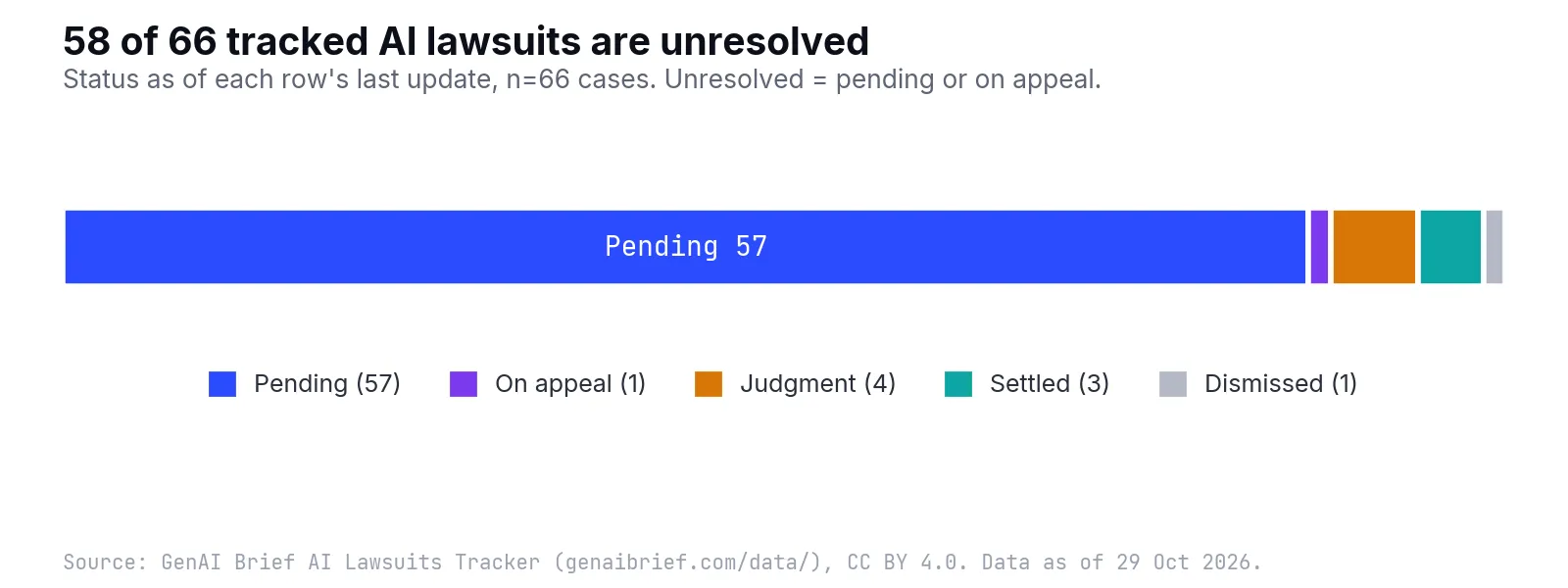
Figure 3: Seven in eight tracked AI lawsuits are still unresolved.
| Status | Cases | Share |
|---|---|---|
| Pending | 57 | 86% |
| On appeal | 1 | 2% |
| Judgment | 4 | 6% |
| Settled | 3 | 5% |
| Dismissed | 1 | 2% |
| Unresolved (pending + appeal) | 58 | 87.9% |
| Resolved | 8 | 12.1% |
“Pending” in the tracker is strict. Its methodology says a ruling on a motion, such as a partial fair-use decision, is described in the summary “while the case stays pending”, and “judgment” is used only for a decision on the merits. That is why Kadrey v. Meta, where the court granted Meta summary judgment on fair use as to the thirteen named authors, is still pending: other claims remain. By our reading of the summaries, 15 of the 58 unresolved rows record a ruling on a motion or an interim order, so “pending” does not mean “nothing has happened”. It means nothing final has.
How old the unresolved cases are
Age is measured from the filing date to 29 October 2026. Where a row gives only a month, we place the filing on the 15th; where it gives only a year, on 1 July. 55 of the 58 unresolved cases have a filing date.
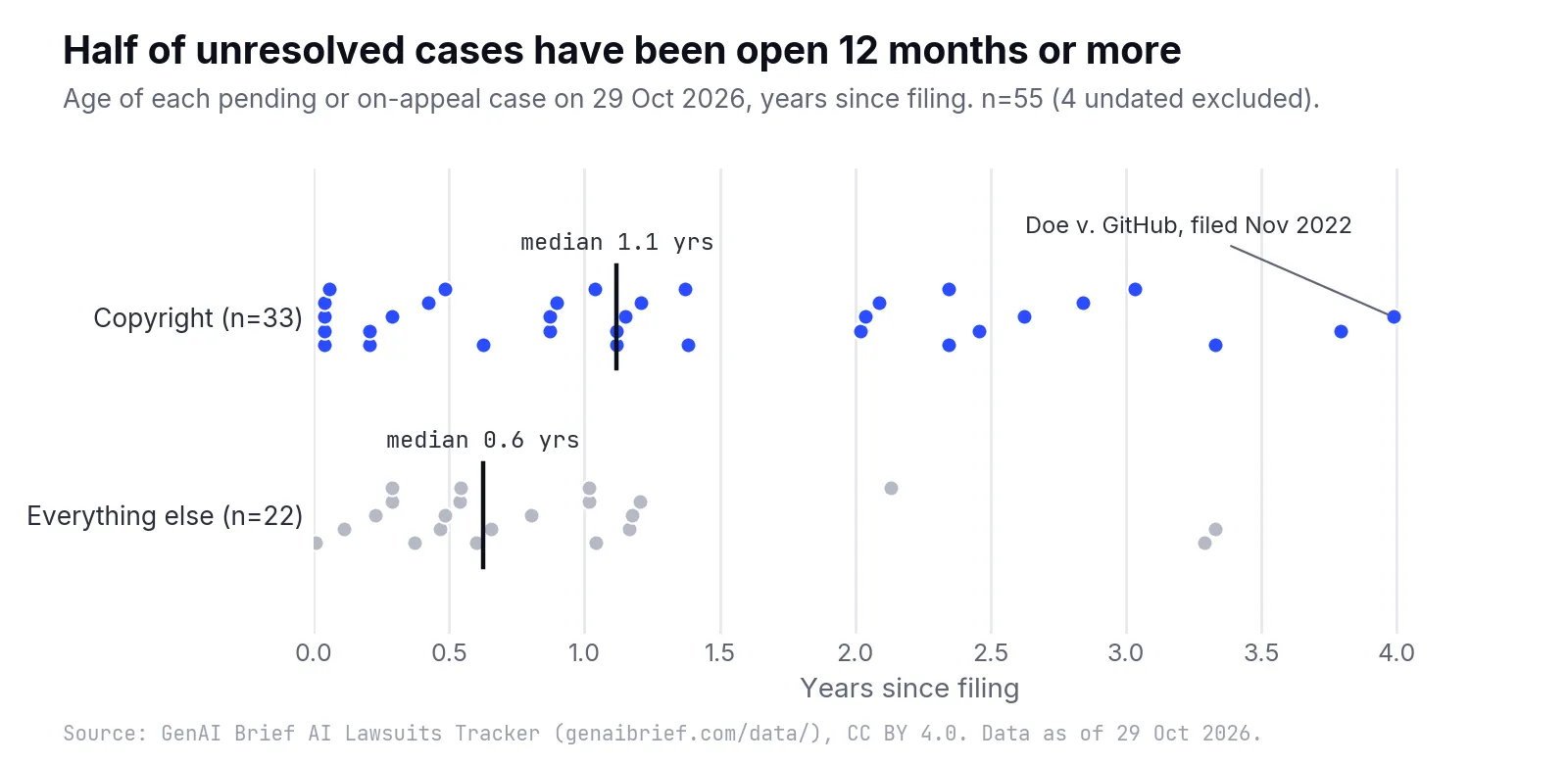
Figure 4: The median unresolved case is a year old; copyright cases are older because they started earlier.
| Measure | Value |
|---|---|
| Unresolved cases with a filing date | 55 |
| Median age | 1.02 years (about 12 months) |
| Mean age | 1.22 years |
| Open 1 year or more | 28 (51%) |
| Open 2 years or more | 15 (27%) |
| Open 3 years or more | 6 (11%) |
| Median age, copyright (n=33) | 1.12 years |
| Median age, everything else (n=22) | 0.63 years |
The oldest unresolved cases are a who’s who of the first generation of AI copyright claims:
| Case | Filed | Age (years) | Last recorded development |
|---|---|---|---|
| Doe v. GitHub | Nov 2022 | 4.0 | Sept 2026: Ninth Circuit affirmed dismissal of DMCA claims; licence and contract claims remain |
| Andersen v. Stability AI | Jan 2023 | 3.8 | Aug 2024: copyright and trademark claims allowed to proceed |
| Mobley v. Workday | 2023 | 3.3 | Class-certification hearing set for March 2027 |
| Kadrey v. Meta | 2023 | 3.3 | June 2025: partial summary judgment for Meta on fair use |
| Battle v. Microsoft | Jul 2023 | 3.3 | Arbitration compelled and case stayed (Oct 2024) |
| Huckabee v. Meta | Oct 2023 | 3.0 | No later development recorded |
| NYT v. Microsoft and OpenAI | Dec 2023 | 2.8 | Sept 2026: cross-motions for summary judgment on fair use filed |
Two cautions on reading age. A young median partly reflects the acceleration: half of the unresolved cases were filed in the last year, so of course they are young. And the tracker’s status is only as fresh as each row. 15 unresolved rows record no development for more than 12 months, and one (Battle v. Microsoft) has no last-update date at all. Some of those cases may have moved without the tracker catching it; others are genuinely stalled, stayed or waiting on a related case.
For comparison, the seven resolved cases with both dates took a median of 1.78 years from filing to the row’s outcome date, from 0.7 years (xAI v. OpenAI, dismissed) to 2.8 years (Getty v. Stability AI in the UK). If the pending copyright cases follow anything like that timeline, many of the 2025 and 2026 filings will not reach a merits ruling before 2027 or 2028. That is a judgement from a small sample of seven, not a prediction.
Who brings copyright suits, and whom they sue
The 37 copyright cases come from six kinds of plaintiff. We assigned each row by hand from its plaintiff field, and the full mapping is printed by the analysis script so anyone can check or change it.
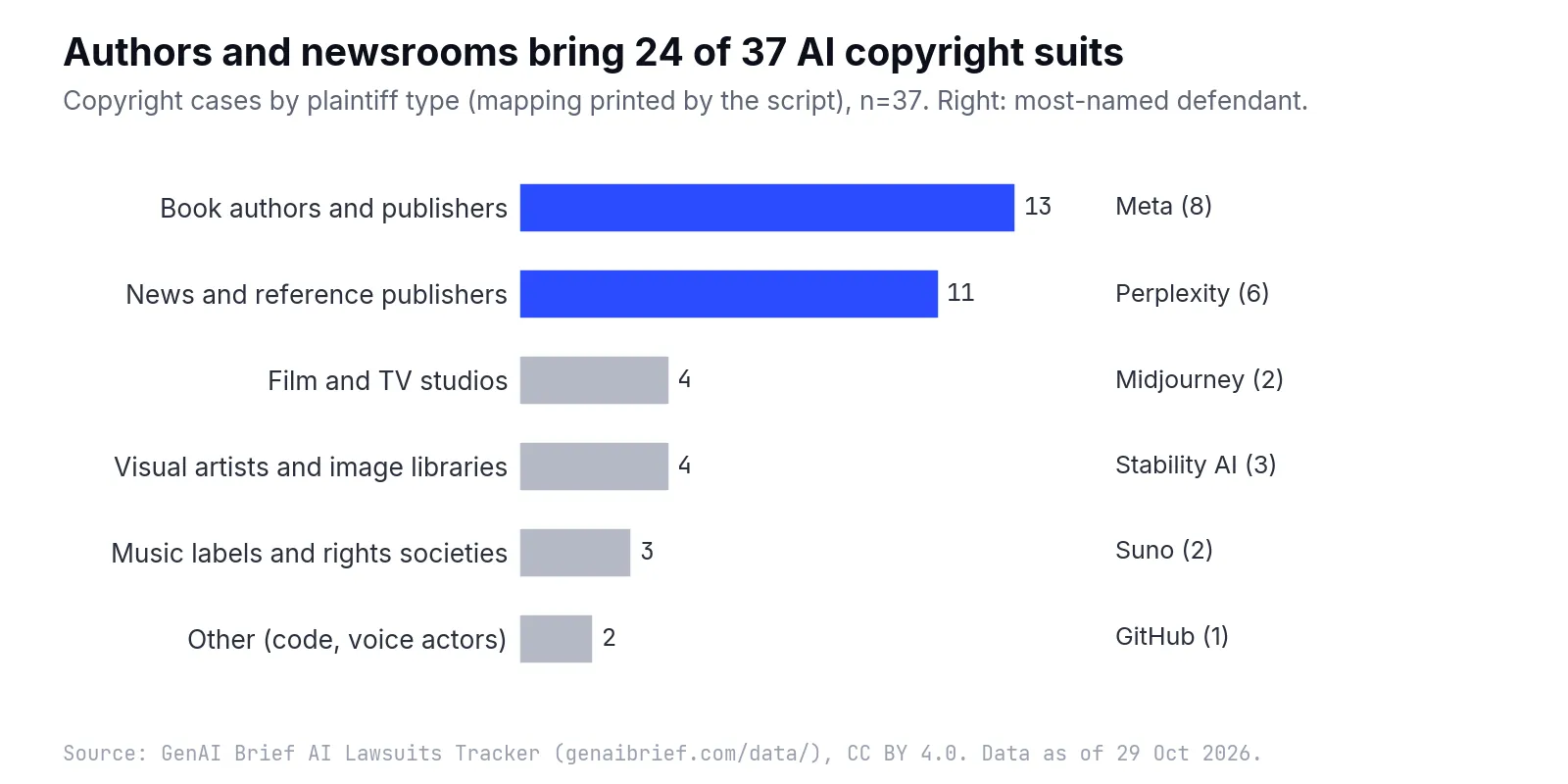
Figure 5: Authors and newsrooms bring 24 of 37 copyright suits, and each group concentrates on one defendant.
| Plaintiff type | Cases | Share of copyright | Most-named defendant |
|---|---|---|---|
| Book authors and publishers | 13 | 35% | Meta (8) |
| News and reference publishers | 11 | 30% | Perplexity (6), OpenAI (5) |
| Film and TV studios | 4 | 11% | Midjourney (2) |
| Visual artists and image libraries | 4 | 11% | Stability AI (3) |
| Music labels and rights societies | 3 | 8% | Suno (2) |
| Other (code, voice actors) | 2 | 5% | GitHub, Microsoft, OpenAI, Lovo (1 each) |
Two concentrations are worth spelling out.
Books and Meta. 8 of the 13 book cases name Meta: Kadrey (the Sarah Silverman and Ta-Nehisi Coates case), Huckabee, Farnsworth, the Elsevier and publishers’ suit that also names Mark Zuckerberg, and the four October 2026 suits. The rest are spread across Anthropic (Bartz), Microsoft (Bird, and Huckabee as a co-defendant), NVIDIA (Nazemian), Salesforce (Tanzer) and Google (Hachette). The four-suit October wave inflates Meta’s count; even counted once, Meta would still be the most-named defendant among book plaintiffs with five.
Why Meta? The rows do not say, and we will not guess at motive. What the court record does show is that the first big ruling went Meta’s way on narrow grounds. In Kadrey, the judge wrote that the ruling “does not stand for the proposition that Meta’s use of copyrighted materials to train its language models is lawful” and “stands only for the proposition that these plaintiffs made the wrong arguments and failed to develop a record in support of the right one” (order, page 5). A ruling that explicitly invites better-prepared plaintiffs is consistent with more plaintiffs arriving afterwards. That is a reading of timing, not proof of cause.
News and Perplexity. 6 of the 11 news and reference cases name Perplexity: Dow Jones and the New York Post, The New York Times, the Chicago Tribune, CNN, Britannica and Merriam-Webster, and Brazil’s Folha de S.Paulo. Perplexity is also named in Reddit’s scraping suit and in a suit by Mediaset’s film units in Rome, for 8 cases in all, every one filed from October 2024 onwards. OpenAI is named in 5 of the 11 news cases, including The New York Times’s suit, which the row records was consolidated into a multidistrict litigation in New York in April 2025.
The pattern is intuitive once laid out. Authors’ claims centre on training data, so they target labs that trained large models on book corpora. Newsroom claims increasingly centre on retrieval and output, the answer engine reproducing today’s journalism, so they target the products that do that most visibly.
Where the copyright cases are heard
Two US courts carry most of the load. The Northern District of California hosts 19 tracked cases (counting its San Jose division and the GitHub appeal row) and the Southern District of New York 16: together 53% of all 66. For copyright alone, New York leads with 14 to California’s 12, driven by the publisher suits. Five copyright cases sit outside the US entirely: Getty v. Stability AI in London, GEMA v. Suno in Munich, ANI v. OpenAI in Delhi, RTI v. Perplexity in Rome and Folha v. Perplexity in São Paulo. Two of those five have reached judgment. None of the 32 US copyright cases has; the only US copyright case resolved at all, Bartz v. Anthropic, settled. On this small sample, foreign courts have been the faster route to a merits ruling.
The most-sued companies, and how much they buy
Counting each company once per case, and leaving out individuals (such as Sam Altman or Mark Zuckerberg), government defendants and catch-all entries, the tracker names 35 distinct companies. Nine are named in three or more cases. We set each one’s case count next to its deal count in the AI Acquisitions Tracker, excluding the one terminated deal as that tracker’s own totals do.
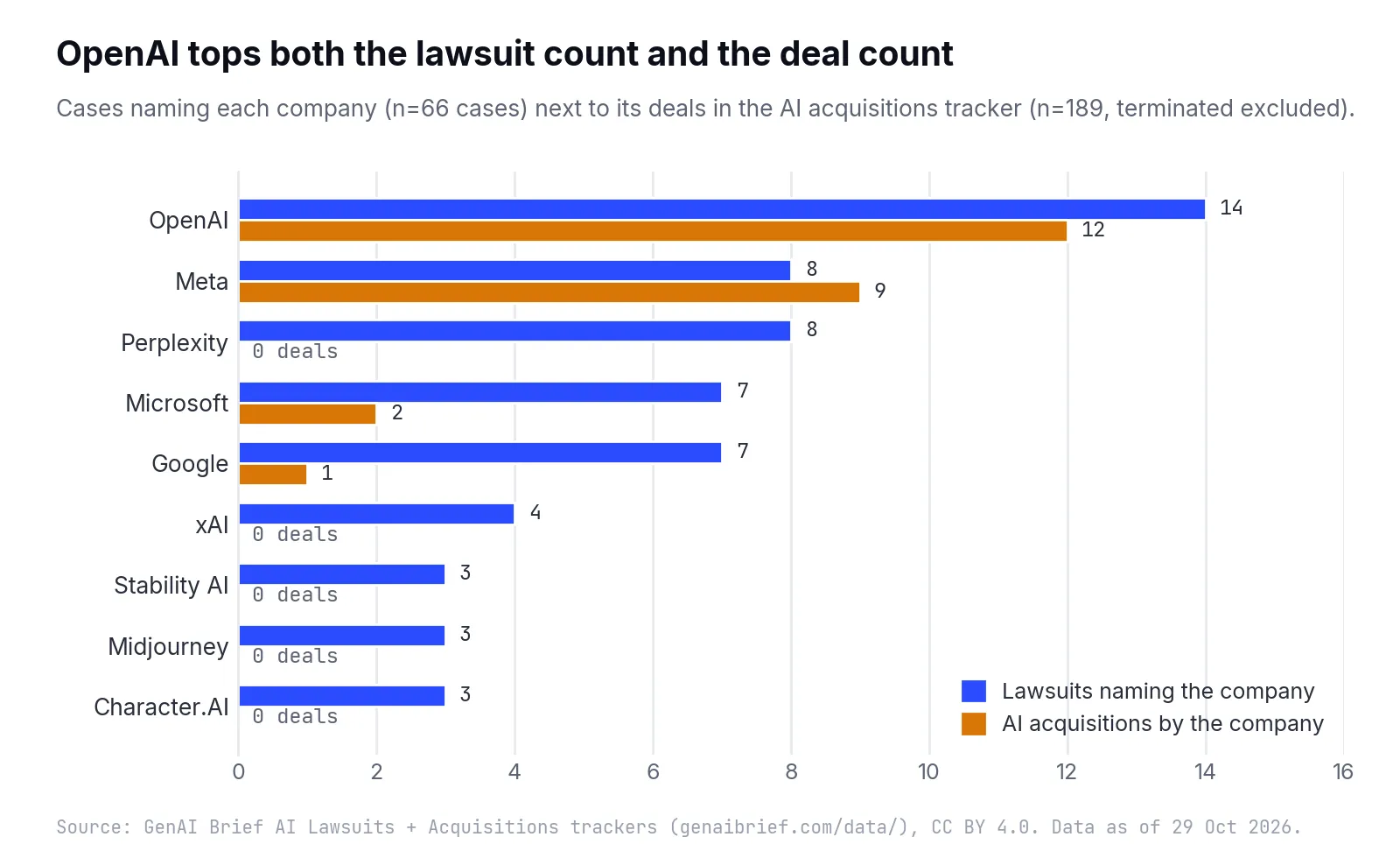
Figure 6: OpenAI leads both counts; the specialist model companies are sued often and buy nothing.
| Company | Cases naming it | Tracked AI acquisitions |
|---|---|---|
| OpenAI | 14 | 12 |
| Meta | 8 | 9 |
| Perplexity | 8 | 0 |
| Microsoft | 7 | 2 |
| 7 | 1 | |
| xAI | 4 | 0 |
| Stability AI | 3 | 0 |
| Midjourney | 3 | 0 |
| Character.AI | 3 | 0 |
OpenAI is named in 14 of 66 cases (21%). Its cases span almost every category: 6 copyright, 3 product liability, 2 antitrust and 1 each of defamation, contract and other. Of the 14, 11 are pending, 2 ended in judgments (Walters and Musk v. Altman, both described below) and 1 was dismissed (xAI’s trade-secrets suit). It is also the most active acquirer in the deals tracker with 12 deals. Meta made 9 tracked deals (10 including its terminated Manus deal).
The four largest platforms, OpenAI, Microsoft, Google and Meta, appear together in 31 of the 66 cases (47%), but account for only 24 of 189 tracked deals (13%). Ten companies appear on both lists; besides those four, they include Salesforce (1 case, 10 deals), Anthropic (2 cases, 5 deals) and NVIDIA (1 case, 5 deals).
What should a reader make of the overlap? Very little about cause. Being large, well funded and widely used makes a company both a natural acquirer and a natural defendant: rights holders sue the deepest pockets and the most visible products, and the same balance sheets fund acquisitions. The comparison is useful for a narrower reason. It shows that legal exposure and deal activity are concentrated in the same handful of firms, and that the specialist model companies (Perplexity, Stability AI, Midjourney, Character.AI) carry heavy litigation loads with no tracked acquisitions at all. For a startup considering a sale, the buyers most likely to call are also the companies with the most open litigation.
xAI is the most frequent plaintiff
One company stands out on the other side of the “v.”. xAI brings 6 of the 66 cases, more than any other plaintiff: suits against OpenAI (trade secrets, dismissed with prejudice in June 2026), a former engineer, Apple and OpenAI (antitrust), Colorado, Minnesota’s attorney general (on appeal) and an individual user. It is also named as a defendant in 4 more: the NAACP’s Clean Air Act suit over a power plant serving its data centre, a minor’s suit over AI-generated abuse material, Baltimore’s consumer-protection suit and the subscriber antitrust class action against four labs. That puts xAI on one side or the other of 10 tracked cases, 15% of the total. The acquisitions tracker records SpaceX’s deal for xAI in February 2026, so on a group basis that exposure now sits inside SpaceX.
The other repeat filers we checked are rights holders pursuing several AI companies, and none appears in more than two rows: The New York Times, Britannica, Getty, Disney, the major labels (UMG and others), Hachette and Elsevier each appear twice.
What the eight outcomes actually say
Eight cases have reached an outcome. Here they are in date order, described from each row’s summary and, where we could read it, the primary record. None of the four judgments in the data holds that training an AI model on copyrighted work is, in itself, infringement.
| Case | Category | Court | Outcome (row’s last update) |
|---|---|---|---|
| Walters v. OpenAI | Defamation | Gwinnett County Superior Court, Georgia | Judgment for OpenAI, May 2025 |
| Getty Images v. Stability AI | Copyright | High Court of England and Wales | Judgment, Nov 2025: secondary infringement claim failed; limited trademark findings for Getty |
| Garcia v. Character Technologies | Product liability | M.D. Fla. | Settled, Jan 2026, undisclosed terms |
| Musk v. Altman | Contract | N.D. Cal. | Jury found claims time-barred, May 2026 |
| xAI v. OpenAI (trade secrets) | Other | N.D. Cal. | Dismissed with prejudice, June 2026 |
| Bartz v. Anthropic | Copyright | N.D. Cal. | $1.5B class settlement, final approval July 2026 |
| GEMA v. Suno | Copyright | Munich Regional Court I | Judgment largely for GEMA, July 2026 (not final) |
| OpenEvidence v. Doximity | Other | D. Mass. | Settled, Oct 2026 |
Walters v. OpenAI. A radio host alleged ChatGPT fabricated claims that he had embezzled funds. In May 2025 the court granted OpenAI summary judgment, finding no defamatory statement, fault or damages shown. It is the only resolved defamation case, and the other two defamation suits (against Microsoft and Google) remain open.
Getty Images v. Stability AI (UK). Getty dropped its primary training claims during trial, according to the row’s summary. The approved judgment ([2025] EWHC 2863 (Ch)) concludes that “although Getty Images succeed (in part) in their Trade Mark Infringement Claim, my findings are both historic and extremely limited in scope. The Secondary Infringement Claim fails” (judgment, paragraph 757). The trademark findings rest on specific example images of iStock and Getty watermarks generated by older model versions; the court said it was “impossible to know how many” such watermarks had been generated in real life. Getty’s separate US case, filed in August 2025, is pending, with most claims allowed to proceed in April 2026.
Garcia v. Character Technologies. A mother alleged Character.AI chatbots contributed to her 14-year-old son’s suicide. The court rejected a First Amendment dismissal bid in May 2025 and the case settled in January 2026 on undisclosed terms. A settlement is not a finding of liability.
Musk v. Altman. Elon Musk alleged OpenAI, Sam Altman and Greg Brockman abandoned OpenAI’s founding nonprofit mission; Microsoft was added in 2024. After trial in the Northern District of California, a jury in May 2026 found the claims time-barred. The row notes Musk said he planned to appeal, so this outcome may not be the last word.
xAI v. OpenAI. xAI alleged OpenAI misappropriated its trade secrets. The court dismissed the case with leave to amend in February 2026 and with prejudice in June 2026.
Bartz v. Anthropic. Authors alleged Anthropic trained Claude on pirated copies of their books. In June 2025 the court’s order on fair use held that “the use of the books at issue to train Claude and its precursors was exceedingly transformative and was a fair use”, and that digitising purchased print books was also fair use, but that “Anthropic had no entitlement to use pirated copies for its central library”. The piracy question was headed for trial when the parties settled. The settlement website records that on 20 July 2026 the court granted final approval of the $1.5 billion class settlement, with first payments expected by 15 November 2026. Because it settled, there is no merits judgment on the pirated copies.
GEMA v. Suno. The German music rights society alleged Suno’s generator infringed works it manages. The Munich Regional Court’s press release of 31 July 2026 says the court “largely granted” (überwiegend stattgegeben) GEMA’s claims for an injunction, information and damages, covering six well-known songs, and that every factor in the US fair-use test, as framed in the Supreme Court’s Warhol decision, weighed against Suno. The court also states the judgment is not yet final (nicht rechtskräftig). This is the only judgment in the dataset that finds copyright infringement by an AI company, and it applies to six works.
OpenEvidence v. Doximity. OpenEvidence alleged Doximity impersonated doctors to extract information from its AI platform through prompt attacks. The parties settled in October 2026, with dismissal with prejudice to follow.
Reading the outcomes together
Three of the eight resolved cases are copyright cases, out of 37. They split three ways: a UK judgment where the copyright claim failed and narrow trademark findings went to the rights holder, a German judgment for the rights holder, and a US settlement that followed a ruling that training itself was fair use but pirated acquisition was not. Add the interim US rulings recorded in pending rows, Kadrey’s narrow win for Meta and the Delhi High Court’s refusal of an interim injunction against OpenAI in the ANI case (the row says the court found training “may fall within fair dealing at this stage”, and ANI has appealed), and the picture is consistent only in one respect: courts are separating how training data was obtained from what the model does with it.
That matches the US Copyright Office’s position. Its Part 3 report on generative AI training, released as a pre-publication version in May 2025, says “it is not possible to prejudge litigation outcomes” and that the Office “expects that some uses of copyrighted works for generative AI training will qualify as fair use, and some will not” (report, page 74). At one end it places noncommercial research that does not reproduce works in outputs; at the other, “the copying of expressive works from pirate sources in order to generate unrestricted content that competes in the marketplace, when licensing is reasonably available”. The resolved cases so far sit squarely inside that spectrum rather than settling where on it most commercial training falls.
What the data cannot tell us
Being precise about limits is part of the finding.
It is a sample, not a census. The tracker publishes only high-confidence cases where independent reports agree on the parties and court. Small cases, sealed matters, arbitrations and most non-English-language litigation are under-represented. Six of 66 cases are outside the US, which certainly understates litigation in Europe, India, China and elsewhere.
Consolidation hides volume. Consolidated cases appear once, under the lead case. The New York Times row stands for an MDL that, per the row, includes Daily News, The Center for Investigative Reporting, Ziff Davis, the Authors Guild and other authors. The tracker’s count of OpenAI cases would be considerably higher if each underlying complaint were a row. Conversely, the four October Meta suits are counted separately though they came in one wave. Counting conventions move the totals by several cases in each direction.
Status lags. Status is as of each row’s last update. 15 unresolved rows have no recorded development for more than a year. A case marked pending may have settled quietly.
Filing dates are imprecise. Several rows give only a month or a year, and four give none. Our age figures place month-only dates on the 15th and year-only dates on 1 July, which can move an individual case’s age by up to six months but barely moves the median.
Categories are the tracker’s, plaintiff types are ours. The category field is assigned by the tracker. The six copyright plaintiff types are our mapping; the script prints it row by row. Reasonable people could, for example, file RTI and Medusa Film under news (Mediaset is a broadcaster) rather than studios.
The acquisitions comparison is co-occurrence. The deals tracker starts in January 2025 and its methodology says 2025 is thinner than 2026. The lawsuit tracker starts in 2022. The two windows do not match, and neither count says anything about why a company buys or why it is sued.
Nothing here is a finding of wrongdoing. Only one judgment in the data (GEMA v. Suno, not yet final) finds that an AI company infringed copyright, and it concerns six songs. Every other claim described above is an allegation unless the text says a court held otherwise.
How to check our numbers
Every number in this article is printed, with a label, by one script:
python3 scripts/research/ai-lawsuits-2026-analysis.pyIt reads src/data/datasets/ai-lawsuits.json and src/data/datasets/ai-acquisitions.json, which hold the same rows as the public downloads at /data/ai-lawsuits.csv and /data/ai-acquisitions.csv, and writes all six charts. The exact rules:
| Figure | Source file | Filter or rule |
|---|---|---|
| Filings by year, category mix | ai-lawsuits.csv | Year from filed; 4 undated rows excluded; 2026 runs to 29 Oct; annualised = 24 x 365 / 302 |
| Status counts | ai-lawsuits.csv | status as published; unresolved = pending or appeal |
| Age of unresolved cases | ai-lawsuits.csv | Age to 29 Oct 2026; month-only dates on the 15th, year-only on 1 July |
| Copyright plaintiff types | ai-lawsuits.csv | category = copyright (37 rows); hand mapping printed by the script; the script asserts every row is mapped once |
| Defendant counts | ai-lawsuits.csv | One count per company per case; OpenAI entities (OAI, OAI International) merged; individuals, governments and catch-all entries excluded |
| Acquisition counts | ai-acquisitions.csv | Count by acquirer; terminated deals excluded (189 of 190) |
If you disagree with a mapping, edit the dictionary at the top of the copyright section and rerun. Corrections to the underlying rows, with a docket or source link, go to the address on the tracker page.
What this means for builders, buyers and founders
If you ship a chatbot to the public, the product-liability wave is your exposure, not the copyright one. Five wrongful-death or injury suits and three government consumer-protection suits, all but one filed since August 2025, are about what AI systems said to or generated for users. Logging, age-appropriate design, escalation to humans and refusal behaviour on self-harm and medical advice are what these complaints scrutinise. The EU is moving the same way through regulation, as our piece on the AI Act’s model rules one year in describes.
If you choose a model vendor, do not wait for the copyright question to be settled. On current timelines it will not be for years: the median unresolved case is a year old, the oldest is four, and the resolved copyright outcomes point in different directions across three countries. What the rulings so far agree on is that provenance matters. Ask vendors how training data was acquired and what indemnities they offer for outputs, and keep your own retrieval corpora licensed.
If you run a content business, the tracked suits show which theories are getting traction. Book plaintiffs have concentrated on acquisition from pirate sources, the issue on which Bartz ended in a $1.5 billion settlement. News plaintiffs have moved towards output and retrieval claims against answer engines. Both are live, neither is decided in the US, and a German court has now ruled for a rights holder on memorisation and output.
If you are a founder hoping to sell, look at the buyer’s docket. The companies most active in acquisitions are also those with the most open cases. That is not a reason to avoid them, but diligence will run both ways: a buyer with open training-data litigation will ask hard questions about your data, and you may want to ask how its own cases could affect your product after the deal closes.
The number to watch next is not filings, which will keep rising. It is the 58. When that number starts falling, through merits judgments in the New York consolidated case, the Getty and Andersen image cases or the music-label suits, the industry will finally have rules to build against rather than allegations to price in.
Sources
- AI Lawsuits Tracker (data and CSV) GenAI Brief
- AI Acquisitions Tracker (data and CSV) GenAI Brief
- Bartz v. Anthropic PBC, No. C 24-05417 WHA, Order on Fair Use (N.D. Cal. 23 June 2025) U.S. District Court, Northern District of California (via RECAP)
- Anthropic Copyright Settlement, current status of the settlement Court-appointed Settlement Administrator
- Kadrey v. Meta Platforms, Inc., No. 23-cv-03417-VC, Order on cross-motions for partial summary judgment (N.D. Cal. 25 June 2025) U.S. District Court, Northern District of California (via RECAP)
- Getty Images v Stability AI [2025] EWHC 2863 (Ch), approved judgment, conclusion Courts and Tribunals Judiciary (England and Wales)
- Pressemitteilung 16 vom 31.07.2026: Urteil GEMA gegen SUNO (Az. 42 O 763/25) Landgericht München I
- Copyright and Artificial Intelligence, Part 3: Generative AI Training (pre-publication version) U.S. Copyright Office
- Copyright and Artificial Intelligence (report index) U.S. Copyright Office
- Musk v. Altman et al, No. 4:24-cv-04722-YGR (case page) U.S. District Court, Northern District of California
Frequently asked questions
How many AI lawsuits are there in 2026?
The GenAI Brief AI Lawsuits Tracker lists 24 high-confidence cases filed in 2026 up to 29 October, out of 66 tracked since 2022. That is about 29 on a full-year pace, up from 8 filed in 2023. The tracker is a curated sample, so the true number of AI-related suits is higher.
How many AI copyright lawsuits have been decided?
Three of the 37 tracked copyright cases are resolved: Getty Images v. Stability AI in the UK (judgment, November 2025), GEMA v. Suno in Munich (judgment, July 2026, not yet final) and Bartz v. Anthropic (a $1.5 billion class settlement approved in July 2026). The other 34 are pending, though several have produced rulings on motions.
Which AI company has been sued the most?
OpenAI is named as a defendant in 14 of the 66 tracked cases (21%), covering copyright, product liability, antitrust, defamation and contract claims. Meta and Perplexity are next with 8 each, then Microsoft and Google with 7. Being named in a suit is an allegation, not a finding.
Is training AI on copyrighted books fair use?
US courts have split on the facts so far. In Bartz v. Anthropic a federal judge held training on lawfully acquired books was fair use but denied it for pirated library copies; in Kadrey v. Meta the judge ruled for Meta on the record before him but said the ruling does not make Meta's training lawful generally. The US Copyright Office expects some training uses to be fair and some not.
How long do AI lawsuits take?
The median unresolved case in the tracker has been open about 12 months, and 15 of 55 dated unresolved cases have run two years or more. The seven resolved cases with dates took a median of 1.8 years from filing to the recorded outcome. The oldest pending case, Doe v. GitHub, was filed in November 2022.
Who is suing AI companies over copyright?
Of 37 copyright cases, 13 come from book authors and publishers, 11 from news and reference publishers, 4 from film and TV studios, 4 from visual artists and image libraries, 3 from music labels and rights societies and 2 from others such as programmers and voice actors.