ModelsComparison
Best LLM for coding in October 2026: ten models ranked on the evidence
Opus 5.5, GPT-6.1 Sol, Gemini 4 Argon and seven more ranked on Terminal-Bench 4.0, DeepSWE and cost per task, with each score's harness and source.
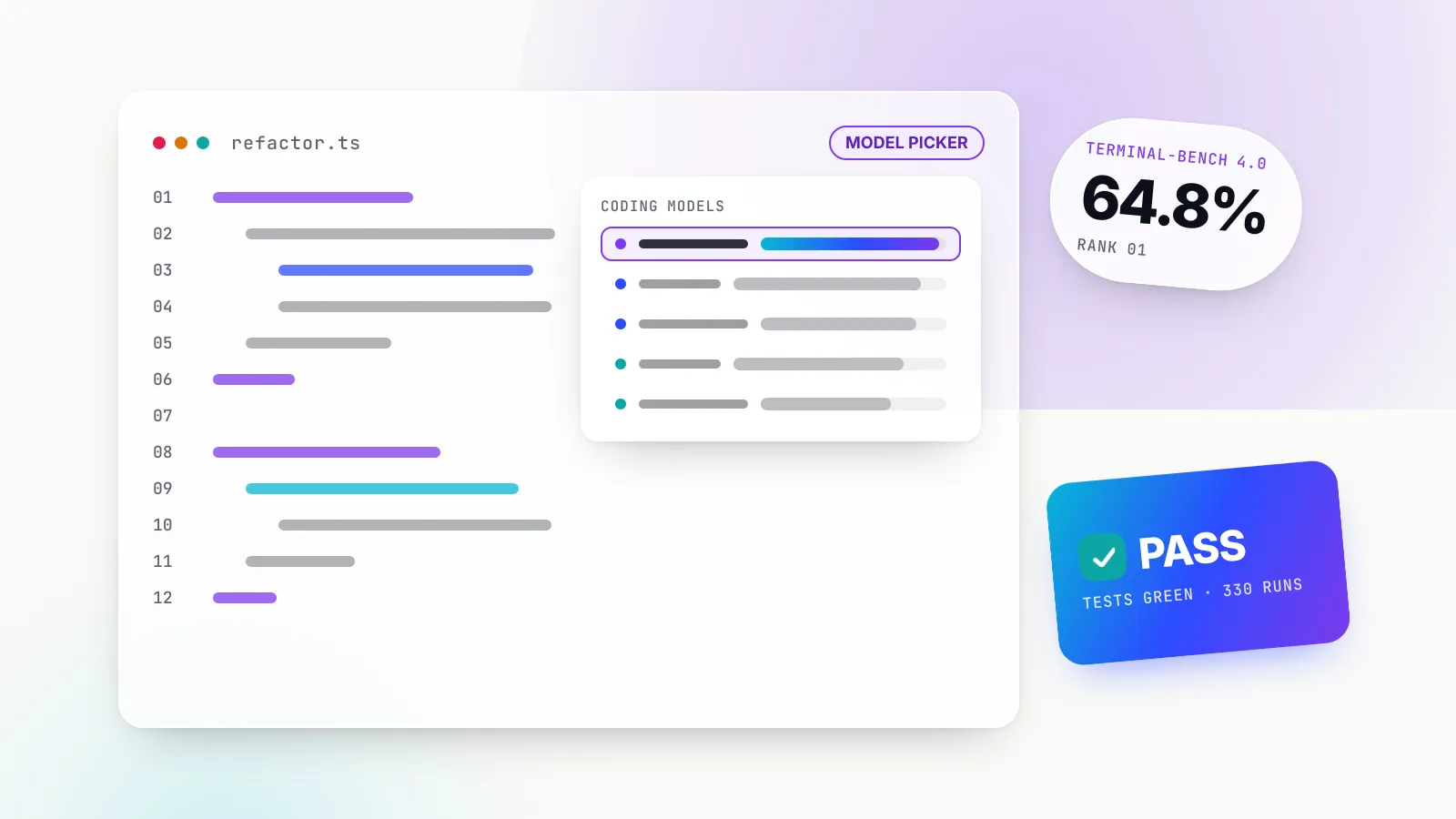
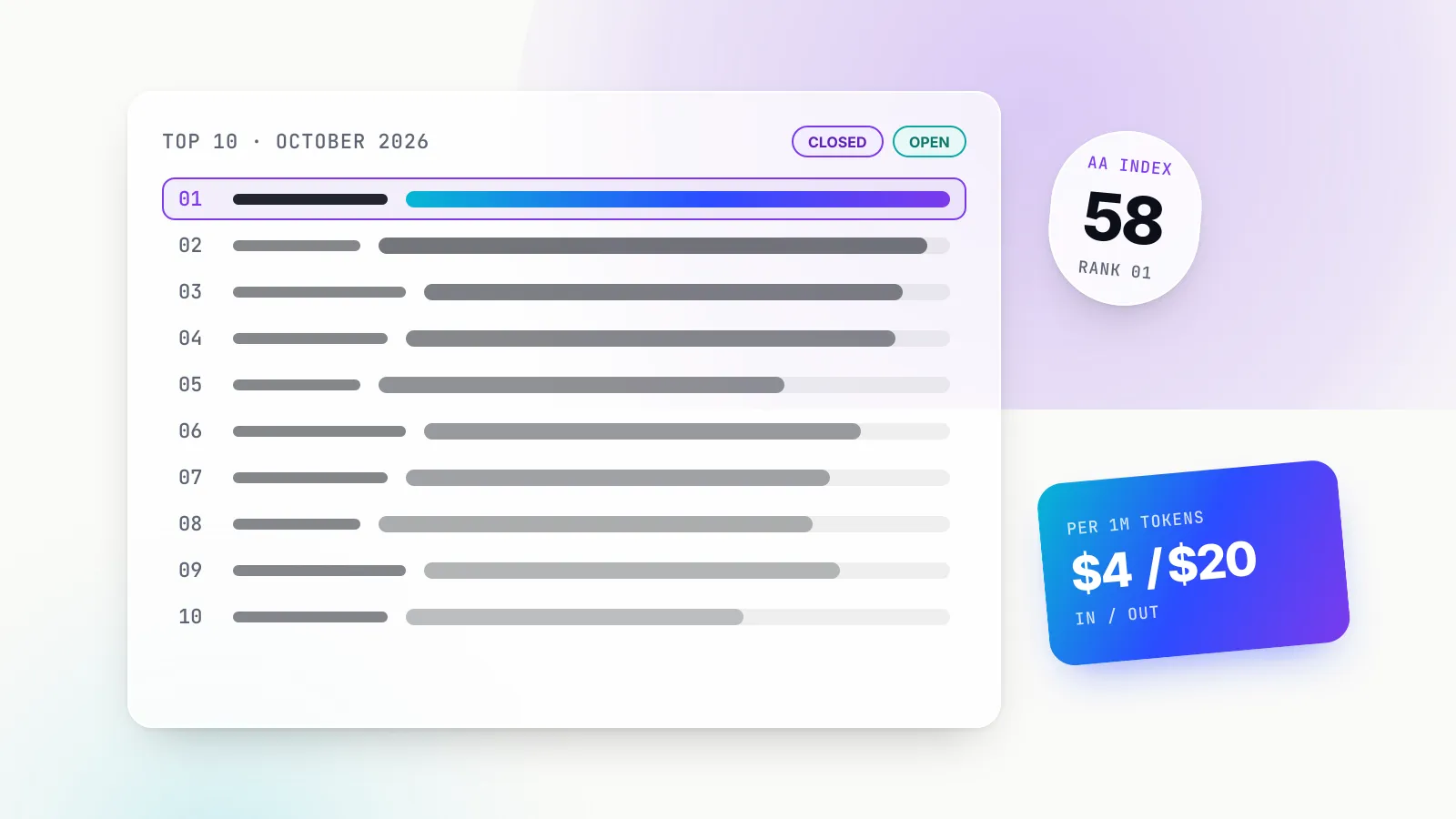
The best LLM for coding in October 2026 is Claude Opus 5.5, on the strength of the two leaderboards that still test current models under stated conditions. It leads Terminal-Bench 4.0 at 64.8 per cent and ties for first on Mercor’s DeepSWE v1.1 at 72.3 per cent. GPT-6.1 Sol is the best value: it ties Opus on DeepSWE and matches GPT-6 Astra on Terminal-Bench for roughly one seventh of Opus’s compute bill. DeepSeek V4.1 Flash and GLM-5.3 are the best open-weight options.
That answer comes with two qualifications that matter more than the order. First, the benchmarks most people search for (SWE-bench Verified, Aider’s polyglot leaderboard, LiveCodeBench) no longer cover any model released in the past six months, so a ranking built on them is a ranking of last year’s models. Second, the same model’s score moves by several points depending on which agent harness and effort setting ran it. A coding model is only as good as the loop around it.
This ranking is for engineers and engineering leads choosing a model, or a set of models, for coding agents, editor assistants and code review. It is narrower than our general top 10 AI models for October 2026, which weighs reasoning, chat and multimodal work, and it adds one model that ranking could not include: Gemini 4 Argon, which became generally available on 13 October. Every score below was read from the leaderboard or vendor page named next to it between 13 and 15 October 2026.
How we ranked the best AI coding models
We weighed five criteria, in this order.
- Independent agentic coding results. The Terminal-Bench 4.0 leaderboard, which runs each model inside a named agent harness, five trials per task, and publishes accuracy, pass@k and total cost. The DeepSWE v1.1 runs published by Mercor and Datacurve: 113 long-horizon tasks across 91 repositories and five languages, with fixes not sourced from existing public commits.
- Cost to complete the work. Terminal-Bench publishes the total dollar cost of each model’s 330 trials. We divide by 330 to get a cost per trial, which captures how many tokens a model actually spends, not just its rate card.
- List price per million tokens, from each vendor’s pricing page.
- Context and output limits, which bind on large refactors before intelligence does.
- Vendor-reported scores (SWE-bench Pro, CursorBench, FrontierCode, Terminal-Bench 2.1), used to describe strengths, never to break ties, and always labelled as the vendor’s.
The models had to be generally available to paying API customers on 15 October 2026. Where a model was run at several effort settings, we quote the setting the leaderboard lists as its best and say which one it was.
The benchmarks people search for have gone stale
A search for “llm benchmark” or “best llm for coding” still surfaces SWE-bench Verified, Aider polyglot and LiveCodeBench tables. All three were important. None of them can tell you anything about the models released since the summer.
SWE-bench Verified
SWE-bench Verified was the default coding benchmark for two years: 500 human-validated GitHub issues from Python repositories. In February 2026 OpenAI stopped reporting it, saying that at least 59.4 per cent of a hard subset of tasks it audited had tests that reject functionally correct fixes, and that frontier models could reproduce some original fixes from memory. The public SWE-bench leaderboards reflect that: the newest Verified entries are dated February 2026, led by Claude Opus 4.5-era systems at around 79 per cent, and no Claude 5, GPT-6 or Gemini 3.8 model appears.
SWE-bench Pro
Scale AI’s SWE-bench Pro was designed as the successor, with harder, multi-file tasks and a held-out commercial set. Its public leaderboard is real and standardised, but at the time of writing its newest entries are early-2026 models: Muse Spark 1.1 leads at 61.5 per cent on the public set, followed by gpt-5.4 at xhigh (59.1) and Claude Opus 4.6 (51.9). Current SWE-bench Pro numbers for October models come from vendors’ own runs. Alibaba’s Qwen3.8 model card, for instance, reports 67.7 per cent for Qwen3.8-Max on a “refined” version of the benchmark in the Claude Code harness. Those numbers are not comparable with Scale’s.
Aider polyglot and LiveCodeBench
Aider’s polyglot benchmark tests 225 Exercism exercises across C++, Go, Java, JavaScript, Python and Rust. Its leaderboard was last updated on 20 November 2025, and its top entry, GPT-5 at high effort with 88.0 per cent, dates from August 2025. With the leaders near 90 per cent, the benchmark has little room left to separate models. The LiveCodeBench leaderboard, built to resist contamination by using only problems published after a model’s cutoff, publishes data that ends with problems from April 2025.
Neither is a bad benchmark. Both measure single-file problem solving, which current models have largely mastered, rather than the multi-hour, multi-file agent work that now separates them. If you see a 2026 “best LLM for coding” table built on these, check the dates in the footnotes.
The live evidence: Terminal-Bench 4.0 and DeepSWE v1.1
Two benchmarks currently test October’s models in public, with conditions stated.
Terminal-Bench 4.0 gives an agent a container and a task (build a toolchain, fix a failing service, migrate a database) and grades the final state of the container with executable verifiers. Each leaderboard entry is a pair: an agent harness such as Claude Code, Codex, Grok Build or mini-SWE-agent, plus a model at an effort level. Each pair runs 330 trials, and the leaderboard reports accuracy, pass@2 to pass@5, total tokens and total cost.
DeepSWE v1.1 measures long-horizon software engineering in real repositories. Datacurve, which maintains it, grades only the agent’s committed patch in a fresh verifier container and records every task-defining test by name, so an agent that drops tests or exits early is marked as failing. Mercor publishes its own leaderboard of the same benchmark.
The table below is the core of the comparison. “TB 4.0” is Terminal-Bench 4.0 accuracy from the public leaderboard at the model’s best listed effort; “cost per trial” is the leaderboard’s total cost divided by 330. “DeepSWE” is Mercor’s figure where Mercor lists the model, otherwise Datacurve’s, as marked.
| Rank | Model | Price in / out per 1M | Context / max output | TB 4.0 (harness, effort) | Cost per trial | DeepSWE v1.1 |
|---|---|---|---|---|---|---|
| 1 | Claude Opus 5.5 | $4 / $20 | 1M / 128K | 64.8% (Claude Code, max) | $14.30 | 72.3% (Mercor) |
| 2 | GPT-6.1 Sol | $2 / $10 | 1.05M / 128K | 58.2% (Codex, max) | $1.92 | 72.3% (Mercor) |
| 3 | Claude Sonnet 5.5 | $2 / $10 | 1M / 128K | 61.8% (Claude Code, max) | $22.22 | Not listed |
| 4 | GPT-6 Astra | $10 / $50 | 1.05M / 128K | 58.2% (Codex, max) | $9.90 | 72.0% (Mercor) |
| 5 | Gemini 4 Argon | $2 / $10 to 30 Nov, then $4 / $20 | 1,048,576 shared | Not listed | Not listed | 77.9% (Google-reported) |
| 6 | Gemini 3.8 Flash | $0.75 / $3.75 to 31 Dec, then $1.50 / $7.50 | 1,048,576 / 65,536 | 19.1% (mini-SWE-agent, high) | $5.54 | 74% ± 1 (Datacurve) |
| 7 | DeepSeek V4.1 Flash | $0.30 / $1.20 peak, half off-peak | 1M / 384K | Not listed | Not listed | 71.7% (Mercor) |
| 8 | GLM-5.3 | $1.40 / $4.40 | 1M / 128K | 41.8% (Claude Code, max) | $8.27 | 69% ± 3 (Datacurve) |
| 9 | Kimi K3 | $3 / $15 | 1,048,576 | Not listed | Not listed | 69% ± 5 (Datacurve) |
| 10 | Grok 4.7 | $2 / $6 under 200K | 500K / no stated limit | 37.6% (Grok Build, xhigh) | about $11 | Not listed |
Prices from Anthropic, OpenAI, Google, DeepSeek, Z.ai, Moonshot and SpaceXAI. Grok 4.7’s cost is from a partial run (324 of 330 trials).
Three things stand out. Opus 5.5 leads on both independent boards, which no other model manages. GPT-6.1 Sol’s cost per trial is a seventh of Opus’s and a fifth of Astra’s at the same or nearly the same score. And the open-weight models are close to the leaders on DeepSWE, within a point of Opus for DeepSeek V4.1 Flash on Mercor’s run, but far behind on Terminal-Bench, where the best open model scores 23 points below Opus.
The ten, ranked
1. Claude Opus 5.5 (Anthropic)
What it is. Anthropic’s flagship, released on 22 September 2026, which Anthropic’s model overview describes as built “for long-running agentic coding and knowledge work”. It has a 1M-token context window, 128K output, adaptive thinking that is always on and a default effort of medium.
The evidence. First on the Terminal-Bench 4.0 leaderboard at 64.8 per cent in Claude Code at max effort, with pass@5 of 78.8 per cent. Tied first on Mercor’s DeepSWE v1.1 at 72.3 per cent. On its own launch page Anthropic reports 66.4 per cent on Terminal-Bench 4.0 at xhigh (±2.6), 54.4 per cent on FrontierCode v1.1 and 57.8 per cent on CursorBench 4.0, against 57.9, 53.3 and no result for GPT-6 Astra. Artificial Analysis, running Terminal-Bench 4.0 in its own setup, measured 59.6 per cent, level with Astra at xhigh.
The catch. Cost and speed. At max effort, Opus spent $4,719 on the leaderboard’s 330 trials, about $14.30 a trial. Artificial Analysis found it uses about 119,000 output tokens per task on its index at max, against about 27,000 for GPT-6 Astra. Anthropic’s own pitch is that Opus at default effort matches Astra on Terminal-Bench 4.0 for about 40 per cent of the cost, which is the setting most teams should start from.
Best fit. Planning, large refactors, unfamiliar codebases and any agent run where a wrong change costs more than the tokens.
2. GPT-6.1 Sol (OpenAI)
What it is. OpenAI’s mid-tier model, released at DevDay on 29 September 2026 and described on its models page as “near-Astra performance for complex work at lower cost”. It lists a 1.05M context window and 128K output at $2 in and $10 out, with cached input cut to $0.10.
The evidence. On Terminal-Bench 4.0 in Codex at max effort it scores 58.2 per cent, identical to GPT-6 Astra’s best, for $634 across 330 trials against Astra’s $3,267. On Mercor’s DeepSWE it ties Opus 5.5 at 72.3 per cent. OpenAI’s developer announcement reports 75.2 per cent on DeepSWE v1.1 at high effort, up from GPT-6 Sol’s best of 68.8 per cent, at a cost per task it puts about 76 per cent lower.
The catch. It trails Opus 5.5 by 6.6 points on Terminal-Bench, which is a lot of failed agent runs on hard terminal work. Its higher DeepSWE figure is OpenAI’s own; the independent runs put it level with Opus, not ahead.
Best fit. The default model for routine agentic edits, code review and CI fixes at volume, and the natural cross-vendor fallback for teams whose primary is Claude.
3. Claude Sonnet 5.5 (Anthropic)
What it is. Anthropic’s mid-tier model, released on 28 September 2026, at $2 in and $10 out with the same 1M context and 128K output as Opus. Anthropic positions it for “well-scoped everyday tasks, bug fixing, and fast iteration”.
The evidence. Second on Terminal-Bench 4.0 at 61.8 per cent in Claude Code at max effort, above both OpenAI models. Anthropic reports 70.6 per cent on Terminal-Bench 4.0, higher than its own figure for Opus, and 55.5 per cent on CursorBench 4.0, within about two points of Opus. Anthropic also notes that Sonnet 5.5 scores lower on FrontierCode at max effort (46.2 per cent) than at xhigh (52.1), because at max it more often ran Claude Code’s code-review skill, which caused timeouts and out-of-scope edits.
The catch. At max effort it is the most expensive model on the leaderboard per trial: $7,334 for 330 trials, or $22.22, more than Opus, because it spends far more tokens (19.4 billion total tokens against Opus’s 8.0 billion). The list price is half Opus’s; the bill at max effort is not.
Best fit. Everyday agent work at high or medium effort, where Anthropic says it beats Sonnet 5’s best score at a fraction of the cost. Escalate to Opus when it fails, rather than turning Sonnet up to max.
4. GPT-6 Astra (OpenAI)
What it is. OpenAI’s top model, described as the flagship for “complex reasoning and coding”, at $10 in and $50 out, the highest list price here.
The evidence. 58.2 per cent on Terminal-Bench 4.0 in Codex at max, and an almost flat curve below that: 57.9 per cent at both xhigh and high, and 54.2 at medium. At high it costs about $6.88 a trial. On Datacurve’s DeepSWE v1.1 run it is first at 74 per cent ± 3 (xhigh); on Mercor’s, 72.0 per cent.
The catch. GPT-6.1 Sol matches it on Terminal-Bench and on Mercor’s DeepSWE at a fifth of the list price. Astra’s case for coding now rests on the hardest tasks where a second frontier opinion helps.
Best fit. Escalation for tasks that both Opus and Sol fail, and evaluation work where you want a model from a different lab as a check. Run it at high; max buys little.
5. Gemini 4 Argon (Google)
What it is. Google’s new top model, announced on 30 September for cyber defenders and made generally available on 13 October 2026 as gemini-4-argon. Its model page lists a 1,048,576-token window shared between input and output, 65,536 output tokens by default and up to the full window with long decode. Introductory pricing is $2 in and $10 out until 30 November, rising to $4 and $20 from 1 December.
The evidence. Google’s announcement reports 77.9 per cent on DeepSWE v1.1, which would be the highest score on the benchmark, and a tied top score of 68 per cent on CWE-bench v1 for vulnerability remediation. Artificial Analysis scores it 53 on its Intelligence Index at high, at $1.99 per task.
The catch. Every coding number is Google’s own. Argon has been available for two days, and neither public leaderboard lists it yet. Google’s previous Flash model shows why that matters (see below). The introductory price doubles in six weeks.
Best fit. Worth a trial on your own repository now, especially for teams on Google Cloud or using Antigravity. We would not make it a default until an independent run confirms the DeepSWE claim.
6. Gemini 3.8 Flash (Google)
What it is. Google’s fast model, released on 2 September 2026 and described as “engineered for long-horizon software engineering”. It costs $0.75 in and $3.75 out until 31 December, then $1.50 and $7.50, with 65,536 output tokens.
The evidence. On Datacurve’s DeepSWE v1.1 run it scores 74 per cent ± 1 at high, statistically level with GPT-6 Astra and with the tightest interval on the board. That is the best coding score per dollar of any closed model we found.
The catch. On Terminal-Bench 4.0 it scores 19.1 per cent. The entry was run in mini-SWE-agent, a minimal open harness, rather than in Google’s own Antigravity agent, while the leaders ran in Claude Code and Codex. That gap is the clearest example on the leaderboard of how much the harness matters, and it is also a warning: a model that is strong in one loop can be weak in another. Google notes that 3.8 Flash “may use more tokens to maximize performance, especially at higher effort levels”.
Best fit. Fast inner loops, test generation, high-volume edits and repository-scale reading within a harness you have verified with it.
7. DeepSeek V4.1 Flash (DeepSeek)
What it is. The best open-weight coding model on independent evidence. A mixture-of-experts with 552 billion backbone parameters, 8 billion active in prefill and 16 billion in decode, a 1M context window and an MIT licence, per its model card. DeepSeek’s API serves it as deepseek-flash with up to 384K output.
The evidence. 71.7 per cent on Mercor’s DeepSWE v1.1, less than a point behind GPT-6 Astra and the only open model in Mercor’s top entries. The model card reports 74.2 per cent on DeepSWE in the mini-SWE harness, 90.6 on Terminal-Bench 2.1 and 31.2 on Terminal-Bench 4.0 (DeepSeek’s own harness).
The catch. Its self-reported Terminal-Bench 4.0 score is less than half of Opus’s leaderboard figure, and it has no independent Terminal-Bench entry yet. Peak-hour pricing applies during Chinese working hours (01:00 to 04:00 and 06:00 to 10:00 UTC on weekdays).
Best fit. The cheapest serious coding model to call ($0.30 in, $1.20 out at peak; half that off-peak, per DeepSeek’s pricing page), and the first one to try for self-hosted repository work.
8. GLM-5.3 (Z.ai)
What it is. Z.ai’s flagship, 753 billion parameters on its model card, with 1M context and 128K output per Z.ai’s guide. It costs $1.40 in and $4.40 out and is included in Z.ai’s GLM Coding Plan.
The evidence. The best open-weight model on the Terminal-Bench 4.0 leaderboard at 41.8 per cent in Claude Code at max, ahead of Grok 4.7 and Qwen3.8-Max. Datacurve’s DeepSWE run puts it at 69 per cent ± 3. Z.ai reports 88.2 on Terminal-Bench 2.1 and 66.9 on DeepSWE in mini-swe-agent.
The catch. A 23-point gap to Opus on Terminal-Bench, and a custom licence rather than MIT (the terms are compared in our open-weight model ranking). Its $8.27 per trial is not cheap, because it spent 8.7 billion tokens on the run.
Best fit. Teams that want an open model which already works well inside Claude Code, the harness most coding teams run.
9. Kimi K3 (Moonshot AI)
What it is. A 2.8-trillion-parameter mixture-of-experts with 104 billion active, 1M context and open weights under the Kimi K3 Licence, per its model card. The hosted API costs $3 in and $15 out on cache misses.
The evidence. Datacurve’s DeepSWE v1.1 run puts it at 69 per cent ± 5 at max effort. Moonshot reports 67.3 per cent on the official DeepSWE leaderboard with mini-SWE-agent, 67.5 with its own Kimi Code harness, and 88.3 on Terminal-Bench 2.1.
The catch. Moonshot’s own blog says its “overall performance still trails the most powerful proprietary models”. It is more expensive to call than GPT-6.1 Sol, and serving a 2.8T model yourself is a multi-node job.
Best fit. Self-hosted agent work for organisations below the licence’s revenue thresholds that want a second open model besides DeepSeek.
10. Grok 4.7 (SpaceXAI)
What it is. SpaceXAI’s frontier model, described in its release notes as built “for coding, agentic tasks, and knowledge work”. It has a 500K context window, no stated output limit and four effort levels. A Fast variant at double the price is available only in Cursor and Grok Build.
The evidence. 37.6 per cent on Terminal-Bench 4.0 in Grok Build at xhigh, nearly double its predecessor Grok 4.6’s 20.3 per cent. The output price of $6 per million tokens is the lowest among closed frontier models.
The catch. It trails every other closed frontier model on Terminal-Bench, and prices double above 200K prompt tokens.
Best fit. Output-heavy coding work inside Cursor or Grok Build, where the cheap output tokens matter.
Near misses
- Claude Fable 5.1 (Anthropic). 57.9 per cent on Terminal-Bench 4.0 at
xhighand max, below Opus 5.5, at $10 in and $50 out. Anthropic’s own documentation now tells developers to start with Opus. - Muse Wonder (Meta). Released on 12 October through the Meta Model API at $4 in and $20 out; a larger Wonder Full is limited to Meta’s Muse Code subscribers. Meta’s announcement claims “frontier coding performance” and Artificial Analysis scores Wonder at 52 on its index, but there is no independent coding leaderboard entry yet.
- Qwen3.8-Max (Alibaba). Alibaba reports 67.7 per cent on its refined SWE-bench Pro and 86.6 on Terminal-Bench 2.1 on the Qwen3.8 model card, but it scores 27.0 per cent on the Terminal-Bench 4.0 leaderboard in Claude Code and 57 per cent ± 3 on Datacurve’s DeepSWE.
- MiMo-V2.6-Pro (Xiaomi). MIT-licensed, 1.02 trillion parameters with 42 billion active; its model card reports 71.9 per cent on DeepSWE v1.1 and 34.9 on Terminal-Bench 4.0, without stating the harness. No independent coding run yet.
- Mistral. No current Mistral model appears on either independent leaderboard we used, so we could not rank one.
Why the same model gets three different scores
Opus 5.5 on Terminal-Bench 4.0 is 66.4 per cent in Anthropic’s launch post, 64.8 per cent on the public leaderboard and 59.6 per cent in Artificial Analysis’s run. None of these is wrong. They differ in four ways that every coding benchmark result hides in a footnote, and that our editorial on benchmarks as marketing covers at length.
The harness. A coding model does not edit files by itself. An agent harness (Claude Code, Codex, Grok Build, Kimi Code, mini-SWE-agent) decides how the repository is shown to the model, which tools it can call and when to stop. Vendors test in their own harness, which is tuned to their model. The Gemini 3.8 Flash entry above, 74 per cent on DeepSWE but 19.1 per cent on Terminal-Bench 4.0 in a generic harness, shows how far apart the results can be. Qwen’s model card says outright that its DeepSWE figure is “the highest of Claude Code and mini-SWE-agent”.
The effort setting. Every closed model here has an effort control, and the spread inside one model is larger than the spread between models. Opus 5 on Terminal-Bench 4.0 ranges from 34.9 per cent at low to 53.9 per cent at xhigh; Fable 5.1 from 43.3 to 57.9. Note too that more effort is not always better: Opus 5 scored lower at max (51.8) than at xhigh (53.9), and Sonnet 5.5 scored lower on FrontierCode at max than at xhigh.
The attempts. Terminal-Bench reports pass@1 as its headline but publishes pass@5. Opus 5.5 succeeds on 64.8 per cent of single attempts but on 78.8 per cent of tasks within five. A vendor that quotes best-of-k without saying so can add ten points.
The task set and version. Vendors currently cite Terminal-Bench 2.1, 3.0 and 4.0, and the gaps between versions are enormous: DeepSeek V4.1 Flash reports 90.6 on 2.1 and 31.2 on 4.0. A model card that reports only the easier version is telling you something.
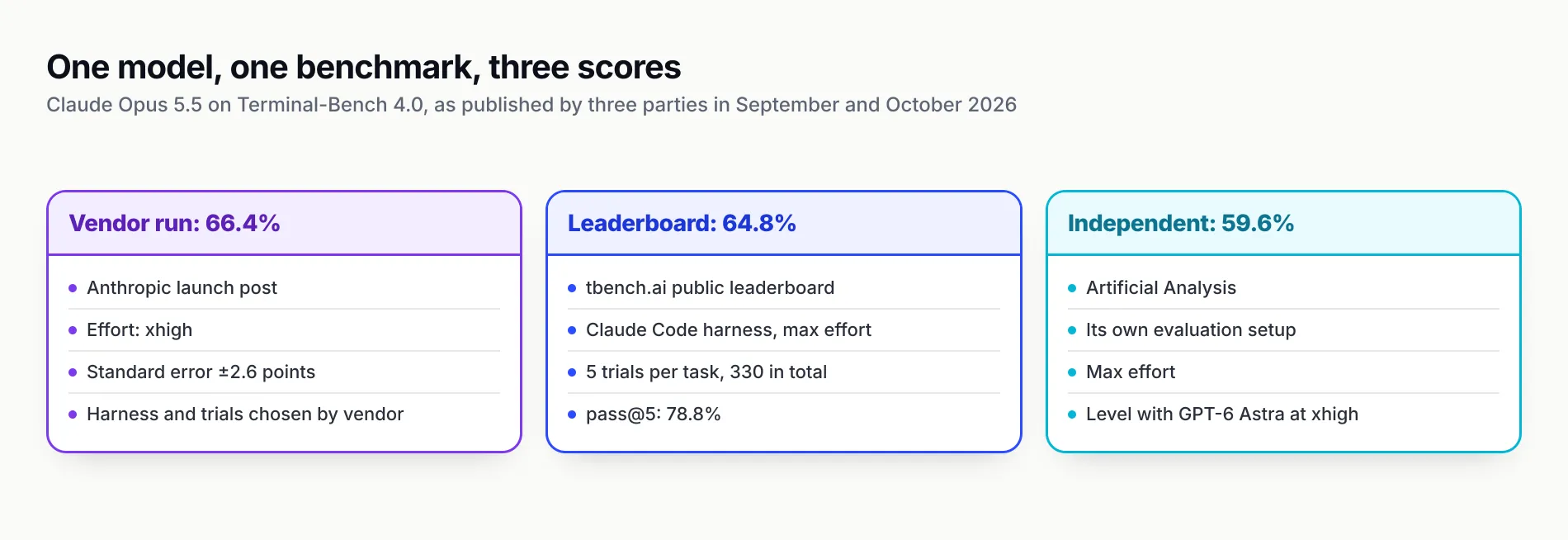
Figure 1: The same model on the same benchmark returns three different numbers. Compare scores only when the harness, effort and attempts match.
The practical consequence is that a public leaderboard can tell you which five models are worth testing, but not which one is best inside your agent, on your repository, at the effort you can afford. Our guide to reading a model card has a checklist for the footnotes.
Which model for which coding job
Coding is not one workload. A team using a coding agent all day makes at least four kinds of request, and they reward different models.
Planning and hard changes. Breaking down a feature, a cross-cutting refactor, a migration, debugging something nobody understands. These are few, long and expensive to get wrong. Opus 5.5 at high or xhigh is the strongest choice; GPT-6 Astra and Gemini 4 Argon are the second opinions.
Routine agentic edits. Implementing a planned change, fixing a failing test, addressing review comments, CI repairs. These are the bulk of agent traffic. GPT-6.1 Sol leads on cost per solved task; Sonnet 5.5 at high is the Anthropic option and runs well in Claude Code.
Fast loops and autocomplete. Inline completions, quick explanations, test scaffolding, small edits where latency matters more than depth. Here the right model is cheap and fast: Gemini 3.8 Flash, GPT-6 Luna ($0.10 in and $0.50 out, with 16.4 per cent on Terminal-Bench 4.0 for $72 across all 330 trials) or Claude Haiku 5.5 (from $0.10 in and $0.50 out, positioned by Anthropic for “high-volume, latency-sensitive tasks”).
Self-hosted or restricted code. Repositories that cannot leave your network. DeepSeek V4.1 Flash for the licence and the DeepSWE score, GLM-5.3 for Claude Code compatibility.
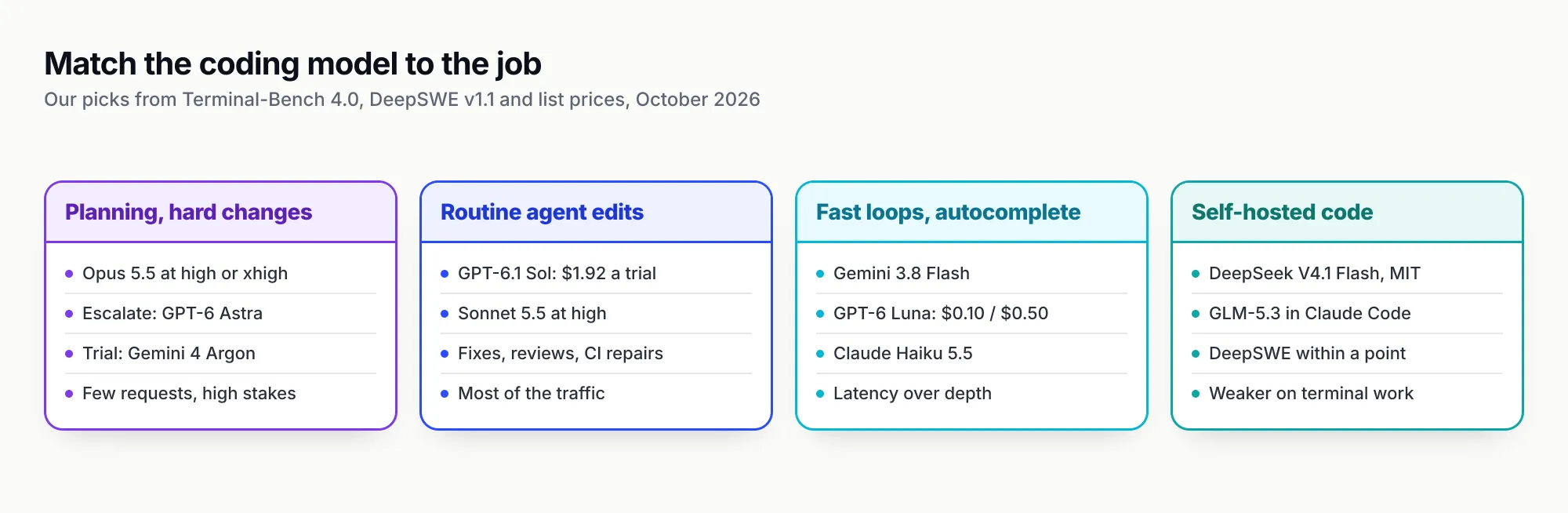
Figure 2: Match the model to the job. The expensive model belongs on the few requests where a wrong answer costs the most.
A worked example shows why this matters. Suppose a team runs 1,000 agent tasks a week, of which 100 are planning or hard changes and 900 are routine edits. Priced at the Terminal-Bench 4.0 cost per trial at max effort, running all 1,000 on Opus 5.5 would cost about $14,300 a week. Sending the 100 hard tasks to Opus and the 900 routine ones to GPT-6.1 Sol costs about $1,430 plus $1,728, or roughly $3,160, a 78 per cent saving, with the strongest model still on the work where it matters most. Real tasks are cheaper than benchmark tasks and effort settings will be lower, so treat the absolute numbers as illustrative; the ratio is what carries over.
Running several coding models in production
Once a team uses two or three models, the hard part stops being the choice and becomes the plumbing. Each coding agent expects one endpoint and one credential. Claude Code speaks Anthropic’s API, Codex CLI speaks OpenAI’s, and Gemini CLI speaks Google’s. Moving a team from Sonnet 5.5 to GPT-6.1 Sol for routine edits, or adding Gemini 4 Argon for a trial, should not mean reconfiguring every developer’s machine. And with a 7x spread in cost per trial between models of similar quality, spend has to be visible per model and per team.
The usual answer is an AI gateway between the agents and the providers. Our comparison of AI gateways for Claude Code, Codex and Cursor covers the options in detail. Bifrost, an open-source AI gateway written in Go by Maxim AI, is one widely used example, and its documentation maps directly onto the mixed-model pattern above.
- One endpoint for every agent. Bifrost exposes OpenAI-, Anthropic- and Gemini-compatible endpoints for coding agents. Its Claude Code guide sets
ANTHROPIC_BASE_URLto the gateway and maps Claude Code’ssonnet,opusandhaikualiases to any allowed model throughANTHROPIC_DEFAULT_SONNET_MODELand its siblings, so a team can point the “sonnet” slot at a different provider’s model without changing the agent. - Routing by task. Routing rules are CEL expressions evaluated per request on headers, parameters, budgets and organisational scope. The complexity router classifies each request as simple, medium or complex and publishes the tier as
complexity_tier, so a rule such ascomplexity_tier == "COMPLEX"can send planning-grade requests to Opus 5.5 and the rest to a cheaper model, “with no changes to your application”, in the docs’ words. - Fallbacks across vendors. Fallbacks move a failed request to the next provider in the chain after its retries, with each fallback getting its own retry budget, so an Anthropic rate limit can land on GPT-6.1 Sol instead of stalling an agent.
- Cost per model and per team. Virtual keys carry budgets with reset periods, token and request rate limits, and allowlists of providers and models. The built-in logs record tokens, cost and latency for every request, which is how a team finds out what the mixed setup actually costs.
As an LLM gateway, Bifrost supports Anthropic, OpenAI, Gemini, Vertex AI, Bedrock, xAI, DeepSeek and Mistral natively, with self-hosted models through vLLM or Ollama. Bifrost’s published benchmark reports 11 µs of added overhead per request at 5,000 requests per second on an AWS t3.xlarge, which is negligible next to agent turns that take tens of seconds. Advanced controls such as SSO, RBAC, audit logs, guardrails and clustering come with the enterprise tier.
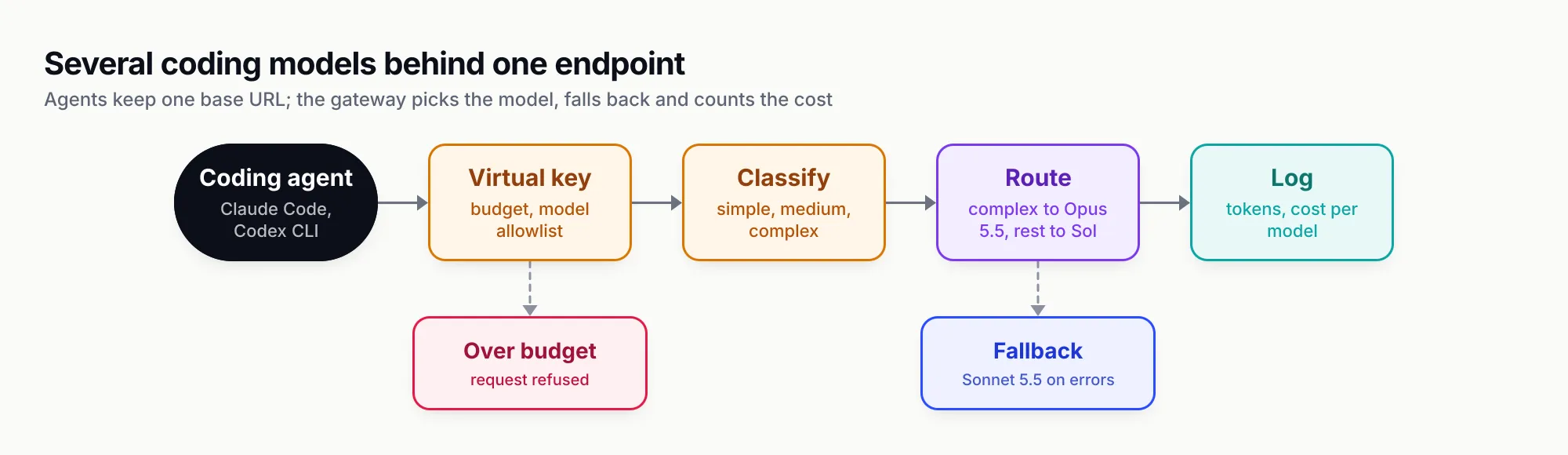
Figure 3: Model choice per task, fallback and cost accounting live in one place, so the agents on developers’ machines never change.
A gateway does not pick the models for you. Deciding that Sol is good enough for your routine edits is an evaluation question, answered by running both models on a sample of your own tasks. What the gateway changes is the cost of acting on the answer: next month’s re-ranking becomes a routing change, not a migration.
Recommendations by constraint
You want the best results and can pay for them. Opus 5.5 at high or xhigh for planning and hard changes, with Sonnet 5.5 at high for routine work inside Claude Code. Set a budget per developer; max effort is slow and expensive.
You want the most solved tasks per dollar. GPT-6.1 Sol as the default in Codex or any OpenAI-compatible agent, with Opus 5.5 as the escalation. On Terminal-Bench 4.0 this pairing covers the top of the leaderboard at a fraction of an all-Opus bill.
Latency matters most. Gemini 3.8 Flash, GPT-6 Luna or Claude Haiku 5.5 for completions and quick edits. Test Flash in your own harness before trusting its DeepSWE score.
Code cannot leave your network. DeepSeek V4.1 Flash first, GLM-5.3 second. Expect a large gap to the closed leaders on terminal-heavy agent work, and compare licences and hardware in our open-weight ranking.
You are on Google Cloud. Trial Gemini 4 Argon now while its introductory price lasts, and keep Opus 5.5 or Sol as a benchmark against it until independent results arrive.
What to watch, and what to do now
Three things will move this list before November. Independent Terminal-Bench and DeepSWE runs of Gemini 4 Argon and Muse Wonder will show whether their vendors’ claims hold. Argon’s price doubles on 1 December and Gemini 3.8 Flash’s on 1 January. And Terminal-Bench 4.0 is the only live benchmark separating the leaders by more than a few points; watch whether it starts to saturate the way SWE-bench Verified did.
The durable advice does not depend on who leads next month. Shortlist three models from the table, one strong, one cheap and one fast. Run each on 30 to 50 real tasks from your own repositories, in the agent your developers actually use, at the effort you would pay for, and record solved tasks per dollar. Then route each kind of work to the model that won it, and re-run the test when the leaderboard changes.
Scores, prices and availability are as published by the vendors and leaderboards named above between 13 and 15 October 2026; check current pages before deciding.
Sources
- Terminal-Bench 4.0 leaderboard Terminal-Bench
- DeepSWE v1.1 leaderboard Mercor
- DeepSWE v1.1, a revision of DeepSWE v1 Datacurve
- SWE-Bench Pro public leaderboard Scale AI
- SWE-bench leaderboards (Verified, Multilingual, Lite) SWE-bench
- Why SWE-bench Verified no longer measures frontier coding capabilities OpenAI
- Aider LLM leaderboards (polyglot benchmark) Aider
- LiveCodeBench leaderboard LiveCodeBench
- Artificial Analysis LLM leaderboard Artificial Analysis
- Claude Opus 5.5 analysis Artificial Analysis
- Introducing Claude Opus 5.5 Anthropic
- Introducing Claude Sonnet 5.5 Anthropic
- Claude models overview Anthropic
- OpenAI API models OpenAI
- GPT-6.1 Sol in the API: a meaningful step up in cost-performance OpenAI Developer Community
- Introducing Gemini 4 Argon Google
- Gemini API changelog Google
- Gemini 4 Argon model page Google
- Gemini API pricing Google
- Introducing Gemini 3.8 Flash and 3.8 Flash Cyber Google
- DeepSeek models and pricing DeepSeek
- DeepSeek-V4.1-Flash model card DeepSeek, via Hugging Face
- GLM-5.3 model card Z.ai, via Hugging Face
- GLM-5.3 guide Z.ai
- Z.ai pricing Z.ai
- Kimi K3 model card Moonshot AI, via Hugging Face
- Kimi K3 tech blog: open frontier intelligence Moonshot AI
- Qwen3.8-2.4T-A95B model card Qwen team, Alibaba, via Hugging Face
- xAI API release notes (Grok 4.7) SpaceXAI
- Introducing Muse Wonder Meta Superintelligence Labs
- MiMo-V2.6-Pro-RL model card Xiaomi, via Hugging Face
- Bifrost complexity router Maxim AI
- Bifrost routing rules Maxim AI
- Bifrost with Claude Code Maxim AI
- Bifrost fallbacks Maxim AI
- Bifrost virtual keys Maxim AI
Frequently asked questions
What is the best LLM for coding right now?
As of mid-October 2026, Claude Opus 5.5. It leads the public Terminal-Bench 4.0 leaderboard at 64.8 per cent (Claude Code harness, max effort) and ties GPT-6.1 Sol for first on Mercor's DeepSWE v1.1 at 72.3 per cent. It costs $4 in and $20 out per million tokens, and it is slow and token-hungry at maximum effort.
What is the best AI coding model for the money?
GPT-6.1 Sol. On Terminal-Bench 4.0 it scores 58.2 per cent, level with GPT-6 Astra, for about $1.92 per trial against $14.30 for Opus 5.5 and $9.90 for Astra. It lists at $2 in and $10 out per million tokens and ties Opus 5.5 on Mercor's DeepSWE run.
What is the best open-source LLM for coding?
DeepSeek V4.1 Flash is the strongest open-weight model on independent long-horizon coding (71.7 per cent on Mercor's DeepSWE v1.1) and is MIT-licensed. GLM-5.3 is the best open model on Terminal-Bench 4.0 at 41.8 per cent. Both trail the closed leaders on terminal work by a wide margin.
Is SWE-bench Verified still a useful LLM benchmark?
Not for choosing between current frontier models. OpenAI stopped reporting it in February 2026, citing flawed tests and training contamination, and the public SWE-bench Verified leaderboard has no entries for models released after early 2026. It still helps rule out weak models.
Which LLM benchmark should I trust for coding?
Prefer leaderboards that run every model under stated conditions and publish cost: Terminal-Bench 4.0 for terminal and agent work, and DeepSWE v1.1 for long-horizon repository changes. Treat vendor-reported scores as claims, check the harness and effort setting, and confirm on a sample of your own repository.
Should I use one coding model or several?
Most teams end up with two or three: a strong model for planning and hard changes, a cheaper one for routine edits and review, and a fast model for autocomplete and quick loops. A gateway lets coding agents switch between them without code changes and reports cost per model.