ModelsComparison
Top 10 AI models in October 2026, ranked by what they are good at
Claude Opus 5.5, GPT-6.1 Sol, Gemini 3.8 Flash, Kimi K3 and six more, ranked on independent evals, coding, context, price and speed, with every figure sourced and dated.
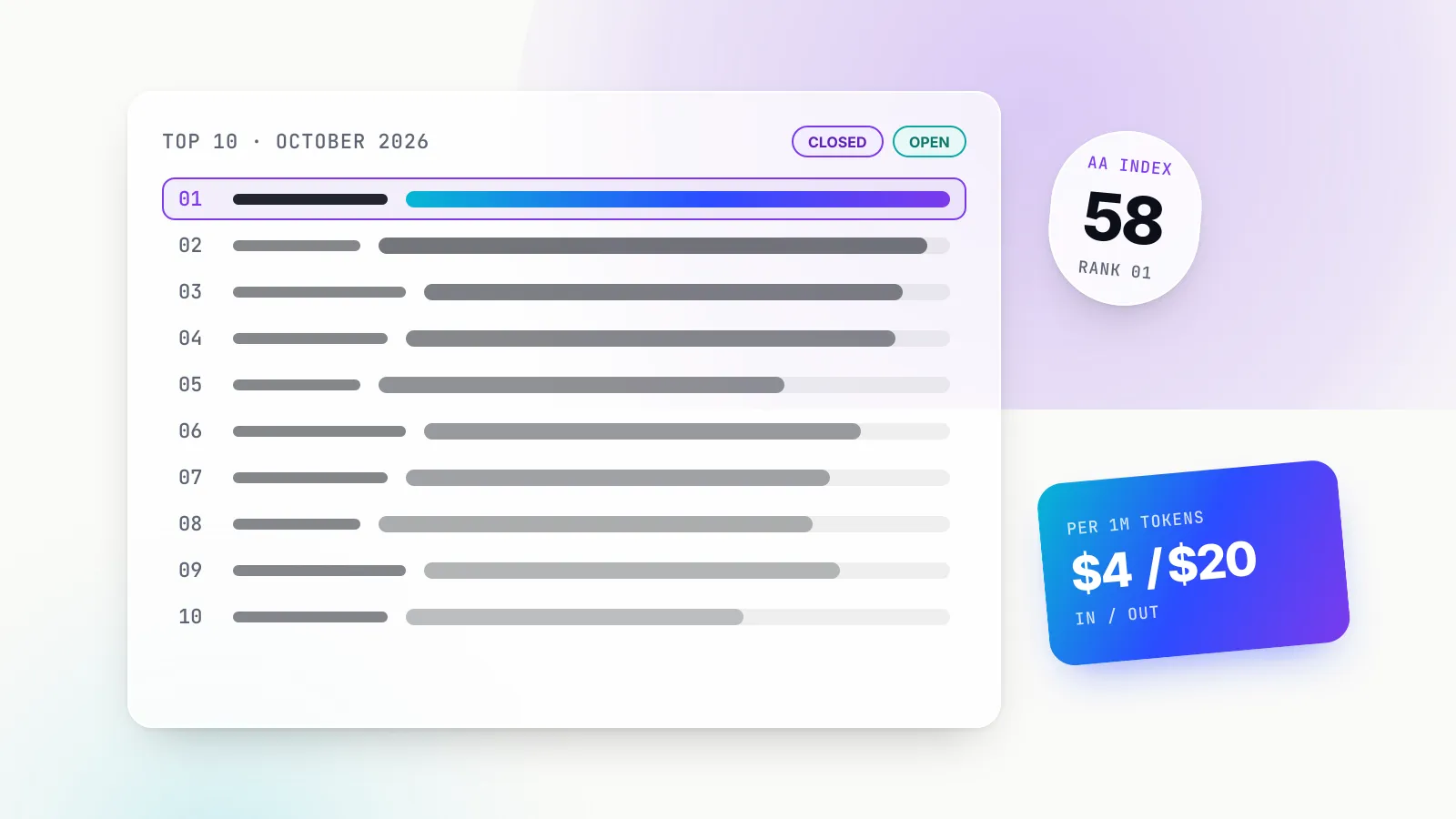
Ten models are worth shortlisting in October 2026, and they are not interchangeable. Claude Opus 5.5 is the strongest generally available model on independent measurement. GPT-6.1 Sol delivers most of that capability at a fraction of the cost per task. Gemini 3.8 Flash is the fastest model near the frontier. Three open-weight models (Qwen3.8-Max, Kimi K3 and DeepSeek V4 Pro) now trail the leaders by margins that matter less than their licences.
This ranking is for engineers and product leads choosing a model, or more often a set of models, for something that ships. It covers generally available models from Anthropic, OpenAI, Google, Meta, SpaceXAI (the former xAI), Alibaba, Moonshot and DeepSeek. Every price, context window and benchmark score below was read from the vendor’s own page or an independent leaderboard between 2 and 5 October 2026, and each is dated in the table. Prices and rankings move monthly; the inference price curve has not flattened.
One caveat governs everything that follows. Benchmark numbers are produced under conditions that vendors choose, and the same benchmark can return three different scores for the same model depending on who ran it. We explain how we handled that below, and the longer argument is in benchmarks are marketing now.
How we ranked
The ranking weighs six criteria, in this order of importance:
- Independent eval standing. The Artificial Analysis Intelligence Index (version 4.3, which averages agent, coding, general and scientific reasoning evaluations that Artificial Analysis runs itself) and the LMArena text leaderboard (Elo from blind pairwise human votes, updated 2 October 2026). Neither is perfect. Together they are harder to game than any single vendor-reported score.
- Coding and agentic ability. Where possible from a third-party run: Mercor’s and Datacurve’s DeepSWE v1.1 leaderboards. Vendor-reported scores (Terminal-Bench 4.0, OSWorld, SWE-bench Pro) are labelled as such.
- Context window. Usable input length and maximum output, from the vendor’s model page.
- Price per million tokens. List price from the vendor, plus Artificial Analysis’s measured cost to run its index (its “cost per task”), which captures how many tokens a model actually spends.
- Latency and throughput. Artificial Analysis’s median output tokens per second and time to first chunk.
- Availability. The model must be generally available to paying API customers on 5 October 2026. Restricted-access models are listed separately as near misses.
Where a vendor ships the same model at several reasoning-effort settings, we report the setting that scores highest on the index and note its cost. That flatters every model equally; a model run at medium effort will score lower and cost far less. Reading a model card with these conditions in mind is covered in how to read a model card.
The ten at a glance
| Rank | Model | Lab | Type and licence | Deployment | Best at |
|---|---|---|---|---|---|
| 1 | Claude Opus 5.5 | Anthropic | Closed | Claude API, Bedrock, Google Cloud, Microsoft Foundry | Long-running agentic coding and knowledge work |
| 2 | Claude Sonnet 5.5 | Anthropic | Closed | Same as Opus | Near-top intelligence at half Opus’s price |
| 3 | GPT-6 Astra | OpenAI | Closed | OpenAI API, ChatGPT, Codex | Hardest reasoning and computer-use tasks |
| 4 | GPT-6.1 Sol | OpenAI | Closed | OpenAI API, Azure, ChatGPT Work, Codex | Frontier quality at the lowest cost per task |
| 5 | Gemini 3.8 Flash | Closed | Gemini API, AI Studio, Gemini Enterprise | Speed and price near the frontier | |
| 6 | Muse Spark 1.3 | Meta | Closed | Meta Model API | Fast, cheap, multimodal, 1M context |
| 7 | Qwen3.8-Max | Alibaba | API model; base weights published under a bespoke licence | Alibaba Cloud Model Studio, or self-host the base weights | Strongest open-weight lineage; vision and video input |
| 8 | Kimi K3 | Moonshot AI | Open weights, Kimi K3 Licence | Kimi API, or self-host | Top open-weight model on human preference |
| 9 | Grok 4.7 | SpaceXAI | Closed | xAI API, Cursor, Grok Build | Coding at low output price |
| 10 | DeepSeek V4 Pro | DeepSeek | Open weights, MIT | DeepSeek API, or self-host | Cheapest capable model; permissive licence |
The numbers, sourced and dated
The table below is the core of the comparison. “AA index” is the Artificial Analysis Intelligence Index v4.3 at the model’s highest-scoring setting, read on 5 October 2026. “Arena” is the LMArena text Elo with its confidence interval, from the leaderboard updated 2 October 2026. Prices are standard API list prices per million tokens on 5 October 2026.
| Model | Input / output price | Context (in / max out) | AA index (setting) | AA cost per task | AA speed, tokens/s | Arena text Elo |
|---|---|---|---|---|---|---|
| Claude Opus 5.5 | $4 / $20 | 1M / 128K | 58 (max) | $5.98 | 93 | 1504 ± 9 (high) |
| Claude Sonnet 5.5 | $2 / $10 | 1M / 128K | 56 (max) | $7.67 | 139 | 1471 ± 10 (xhigh) |
| GPT-6 Astra | $10 / $50 | 1.05M / 128K | 53 (max) | $3.26 | 54 | 1477 ± 7 (max) |
| GPT-6.1 Sol | $2 / $10 | 1.05M / 128K | 52 (max) | $0.72 | 63 | 1483 ± 11 (max) |
| Gemini 3.8 Flash | $0.75 / $3.75 (to 31 Dec 2026) | 1,048,576 / 65,536 | 41 (high) | $1.24 | 249 | 1495 ± 5 (high, preliminary) |
| Muse Spark 1.3 | $1.25 / $4.25 | 1M | 48 (max) | $1.60 | 152 | 1494 ± 6 (max) |
| Qwen3.8-Max | $2 / $6 (Singapore) | 1M / 131,072 | 45 | $5.41 | 39 | 1482 ± 5 |
| Kimi K3 | $3 / $15 | 1,048,576 | 44 (max) | $2.00 | 34 | 1488 ± 5 (max) |
| Grok 4.7 | $2 / $6 (under 200K) | 500K | 46 (xhigh) | $3.74 | 81 | 1442 ± 8 (xhigh) |
| DeepSeek V4 Pro | $1.32 / $3.96 (peak) | 1M / 384K | 36 (0813, max) | $0.67 | 107 | 1464 ± 7 (0813, high) |
Sources for each row: Anthropic’s models overview; OpenAI’s models page; Google’s Gemini API pricing and 3.8 Flash model page; Meta’s Muse Spark page; Alibaba Cloud’s qwen3.8-max page; Moonshot’s Kimi K3 blog; SpaceXAI’s release notes; DeepSeek’s pricing page. Index, cost-per-task and speed figures are from Artificial Analysis; Elo from LMArena.
Three things stand out. First, the index and the arena disagree on order more than on membership: the same ten or so models fill the top of both, but Sonnet 5.5 is second on the index and 45th on the arena, while Gemini 3.8 Flash is eighth on the arena and well down the index. Second, list price and cost per task diverge sharply. Sonnet 5.5 has half Opus 5.5’s list price but a higher cost per task at maximum effort, because it spends more tokens getting there. GPT-6 Astra’s list price is two and a half times Opus’s, yet its measured cost per task is about half. Third, the open-weight models cluster between 36 and 45 on the index, close enough to the closed tier that licence and serving cost decide more than the score does.
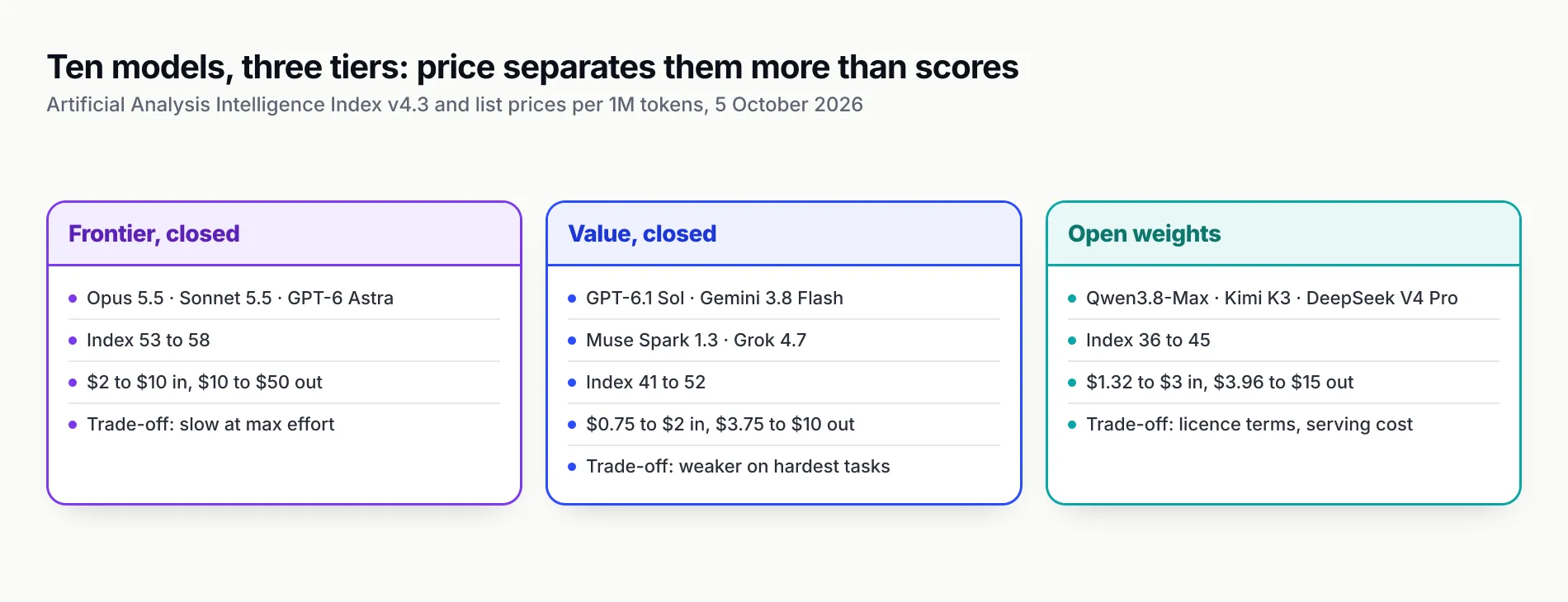
Figure 1: The ten split into three tiers. Within each tier, price and speed separate the models more than intelligence scores do.
The ten, ranked
1. Claude Opus 5.5 (Anthropic)
What it is. Anthropic’s mainstream flagship, released on 22 September 2026. Anthropic’s own documentation tells developers to start with Opus 5.5 “for most workloads”, reserving the more expensive Claude Fable 5.1 for “demanding reasoning and long-horizon agentic work”. It has a 1M-token context window, 128K maximum output, adaptive thinking that is always on, and a default effort of medium.
Strengths. It is first on the Artificial Analysis index at 58 (max effort), and its xhigh and high settings score 56 and 54, still above every non-Anthropic model. On LMArena it scores 1504 ± 9, inside the statistical top tier. On Mercor’s independent DeepSWE v1.1 leaderboard it ties for first at 72.3 per cent. Anthropic reports 66.4 per cent (±2.6) on Terminal-Bench 4.0 at xhigh effort, against 55.8 per cent for Fable 5.1 and 57.9 per cent for GPT-6 Astra, and 81.8 per cent (partial credit) on OSWorld 2.1. Pricing fell to $4 in and $20 out, from $5 and $25 on Opus 5, with cache reads at $0.20.
Limitations. At maximum effort it is slow: Artificial Analysis measured 680 seconds to first chunk on its index run, because the model thinks before it answers. Its cost per task at max ($5.98) is eight times GPT-6.1 Sol’s. Many of the headline scores are Anthropic’s own and use effort settings chosen per benchmark. The arena estimate rests on 4,552 votes, far fewer than older models, so its interval is wide.
Best fit. Long-running coding agents, large refactors and multi-step knowledge work where a wrong answer costs more than the tokens. Run it at medium or high for interactive use; the index still puts high at 54.
2. Claude Sonnet 5.5 (Anthropic)
What it is. The mid-tier Claude, released on 28 September 2026, described by Anthropic as “the best combination of speed and intelligence”. It shares Opus’s 1M context and 128K output limit at half the list price: $2 in, $10 out.
Strengths. It is second on the Artificial Analysis index at 56 (max effort), which puts it above GPT-6 Astra at a fifth of Astra’s list price. It is the fastest model in the top five at 139 output tokens per second. Anthropic reports 70.6 per cent on Terminal-Bench 4.0, above the 66.4 per cent it reports for Opus 5.5, and 1844 Elo on GDPval-AA v2.1, a professional-task evaluation, essentially level with Opus 5.5’s 1846. At medium effort Artificial Analysis recorded a first chunk in 1.23 seconds, which makes it viable for chat.
Limitations. The index score at max effort comes with the highest cost per task in the table, $7.67, because it spends many more tokens than Opus to reach a similar answer. Drop to high and the score falls to 47. On LMArena it sits at 1471 ± 10 with only 3,145 votes, well below Opus. Human raters, at least so far, prefer Opus’s answers.
Best fit. High-volume agentic and coding workloads that need near-Opus capability on a budget, run at high or xhigh rather than max. The usual pattern is Sonnet as the default with escalation to Opus for tasks that fail.
3. GPT-6 Astra (OpenAI)
What it is. OpenAI’s top model, released in early September 2026, which its models page describes as “our most capable model for the most demanding work”. Context is 1.05M tokens with 128K output, at $10 in and $50 out, the highest list price here.
Strengths. On Datacurve’s DeepSWE v1.1 run, Astra at xhigh is first at 74 per cent ± 3, and on Mercor’s leaderboard it scores 72.0 per cent, within a point of the leaders. It scores 53 on the Artificial Analysis index at max effort, and its measured cost per task ($3.26) is about half Opus 5.5’s at max despite the higher list price, because it uses fewer tokens. On Anthropic’s Terminal-Bench 4.0 comparison it scores 57.9 per cent, well ahead of GPT-5.6 Sol’s 37.3 per cent. OpenAI positions it for the hardest maths, cyber and computer-use work.
Limitations. It is slow (54 tokens per second) and the list price punishes any workload that is output-heavy. On LMArena it ranks below GPT-6.1 Sol and below both Anthropic flagships. OpenAI’s own launch of GPT-6.1 Sol argues that Sol matches Astra on DeepSWE at roughly a fifth of the cost, which undercuts Astra’s case for most coding work.
Best fit. The small set of tasks where the last few points of capability matter more than cost: research-grade reasoning, long-horizon scientific agents and evaluations where you need a second frontier opinion from a different lab.
4. GPT-6.1 Sol (OpenAI)
What it is. A mid-tier OpenAI model released on 29 September 2026 as an upgrade to GPT-6 Sol. Its model page lists a 1,050,000-token context window, 128,000 output tokens, an April 30, 2026 knowledge cutoff and five reasoning-effort levels from low to max. Price is $2 in and $10 out, with cached input at 5 per cent of the input rate.
Strengths. This is the value pick of the month. Artificial Analysis scores it 52 at max effort for $0.72 per task, and 50 at high for $0.32: roughly a tenth of Opus 5.5’s cost for a score six to eight points lower. On Mercor’s DeepSWE v1.1 leaderboard it ties Opus 5.5 for first at 72.3 per cent. On LMArena it scores 1483 ± 11, above Astra. OpenAI reports an average cost of $5.47 per task on Terminal-Bench Science at max effort against $23.21 for Opus 5.5.
Limitations. It is new, so the arena estimate rests on only 3,071 votes. Throughput is modest at 63 tokens per second, and at max effort Artificial Analysis measured nearly five minutes to first chunk. The model page lists no Realtime, Assistants or fine-tuning support. OpenAI’s own launch framing is “near-Astra”, not parity, and on the Artificial Analysis index it trails Astra by a point at max effort.
Best fit. The default model for most teams that want frontier-class coding and agent quality without frontier bills, and the obvious first fallback for teams whose primary is Claude.
5. Gemini 3.8 Flash (Google)
What it is. Google’s best generally available model, released on 2 September 2026, its third Flash release in six weeks. Google calls it “our most intelligent Flash model, engineered for long-horizon software engineering, autonomous agents, and complex enterprise workflows”. Input limit is 1,048,576 tokens, output 65,536.
Strengths. Speed and price. Artificial Analysis measured 249 output tokens per second, by far the fastest in this table, and the introductory price of $0.75 in and $3.75 out runs to 31 December 2026. On Datacurve’s DeepSWE v1.1 run it scores 74 per cent ± 1 at high, statistically level with Astra. On LMArena it ranks eighth overall at 1495 ± 5 (marked preliminary). Google reports 54.9 per cent on HLE-Verified. Distribution is wide: AI Studio, Gemini Enterprise, Android Studio and Google’s Antigravity.
Limitations. Its Artificial Analysis index score of 41 at high is well below the closed leaders, which suggests it is weaker on the science and general-reasoning parts of that suite than its coding and arena scores imply. The price doubles to $1.50 and $7.50 on 1 January 2027. Output is capped at 65,536 tokens, half the Anthropic and OpenAI limit. Google says the model “works harder” by spending more tokens at higher effort, which erodes the price advantage on hard tasks.
Best fit. Latency-sensitive agents, high-volume coding assistance and any workload already inside Google Cloud. A strong cheap tier beneath a Claude or GPT primary.
6. Muse Spark 1.3 (Meta)
What it is. Meta’s closed-weight flagship, served only through the Meta Model API and Meta’s own products. It accepts a 1M-token context and multimodal input. Meta prices it at $1.25 in and $4.25 out, with cached input at $0.15, and offers a “contributor” tier at $0.10 and $0.20 in exchange for allowing Meta to use the data.
Strengths. It scores 48 on the Artificial Analysis index at max effort, ahead of Grok 4.7 and every open-weight model, for $1.60 per task, and it is fast at 152 tokens per second. On LMArena it is ninth overall at 1494 ± 6, above GPT-6.1 Sol and both Astra variants. Meta’s earlier 1.x releases sit just below it on the arena, which suggests a consistent line rather than a one-off.
Limitations. This is not Llama: there are no weights, so the self-hosting route that made Meta popular with infrastructure teams is gone. Availability runs through Meta’s own API and selected cloud partners, a smaller footprint than Anthropic’s or OpenAI’s. Meta’s model page summarises benchmark results without the harness detail needed to compare them with other vendors’ figures. The contributor tier’s data terms will rule it out for most enterprise data.
Best fit. Cost-sensitive multimodal applications that want an arena-strong model with long context, from teams comfortable adding a fourth vendor.
7. Qwen3.8-Max (Alibaba)
What it is. Alibaba’s largest model, a 2.4-trillion-parameter mixture-of-experts with 95 billion active parameters. The API model qwen3.8-max (snapshot qwen3.8-max-0902) has a 1M context window, 131,072 output tokens and text, image and video input, per Alibaba Cloud’s model page. The base weights are published on Hugging Face as Qwen3.8-2.4T-A95B under a bespoke qwen3.8-max licence.
Strengths. The API model scores 45 on the Artificial Analysis index, level with GLM-5.3 and one point behind Xiaomi’s MiMo-V2.6-Pro among models from labs that publish weights, and 1482 ± 5 on LMArena. Alibaba’s model card for the open weights reports 67.7 on SWE-bench Pro and 86.6 on Terminal-Bench 2.1. Pricing is $2 in and $6 out in Alibaba’s Singapore region and $1.65 and $4.951 in its US, Frankfurt, Tokyo and Hong Kong regions.
Limitations. The open weights are not the API model. The model card states that the API version adds “vision input & non-thinking support, 1M context length by default, official built-in tools”, and that the weights are text-only with 262,144 tokens of native context. Artificial Analysis scores the open weights at 40, five points below the API model. It is slow at 39 tokens per second, and its cost per task ($5.41) is the second highest in the table. Some buyers will face procurement questions about a China-headquartered provider for the hosted version.
Best fit. Teams that want a single model family usable both as a hosted API and, in reduced form, on their own hardware. Details in the open-weight ranking.
8. Kimi K3 (Moonshot AI)
What it is. A 2.8-trillion-parameter mixture-of-experts with 104 billion active parameters (16 of 896 experts per token), a 1,048,576-token context window and native image and video input. The weights are on Hugging Face under the Kimi K3 Licence. Thinking is always on.
Strengths. It is the highest-ranked open-weight model on LMArena at 1488 ± 5, 16th overall, above GPT-6.1 Sol. It scores 44 on the Artificial Analysis index. Moonshot’s model card reports 88.3 on Terminal-Bench 2.1, 84.8 on OSWorld-Verified and 91.2 on BrowseComp, which makes it the most agent-oriented of the open models.
Limitations. Moonshot’s own blog says K3’s “overall performance still trails the most powerful proprietary models”. It is the slowest model here at 34 tokens per second. The hosted API, at $3 in and $15 out for cache misses, costs more than GPT-6.1 Sol. The licence is MIT-style with two conditions: model-as-a-service operators with more than $20 million in revenue over 12 months need a separate agreement, and products above 100 million monthly users or $20 million in monthly revenue must display “Kimi K3”. Self-hosting a 2.8T model is a multi-node job.
Best fit. Organisations that need a frontier-adjacent agent model on their own infrastructure and fall below the licence thresholds.
9. Grok 4.7 (SpaceXAI)
What it is. SpaceXAI’s frontier model, released on 21 September 2026, described as its “most capable model for coding and knowledge work”. The release notes list a 500K context window, text and image input, “no text output limit” and four effort levels.
Strengths. Output is cheap: $2 in and $6 out under 200K prompt tokens, the lowest output price among the closed frontier models. It scores 46 on the Artificial Analysis index at xhigh and 46 at high, so the cheaper setting gives up nothing, and it runs at around 80 tokens per second. SpaceXAI reports 71.0 per cent on DeepSWE v1.1 at high, close to the leaders, and it is available inside Cursor.
Limitations. It has the weakest LMArena showing in the list, 1442 ± 8, 91st overall, far below every other entry. The context window is half the 1M that has become standard, and prices double above 200K tokens. SpaceXAI reports 46.3 per cent on CursorBench 4.0, against Anthropic’s 57.8 per cent for Opus 5.5 on the same benchmark’s version. A “fast” variant doubles throughput at twice the price.
Best fit. Coding agents where output volume drives the bill, and teams already in the Cursor or Grok Build toolchain.
10. DeepSeek V4 Pro (DeepSeek)
What it is. A 1.6-trillion-parameter mixture-of-experts with 49 billion active parameters, open-sourced in preview on 24 April 2026 and made generally available on 13 August 2026. The API serves DeepSeek-V4-Pro-0813 with a 1M context window and up to 384K output tokens. The weights are MIT-licensed.
Strengths. Price and licence. DeepSeek charges $1.32 in and $3.96 out at peak and half that off-peak (outside 01:00 to 04:00 and 06:00 to 10:00 UTC on weekdays), with cache hits from $0.022, per its pricing page. Artificial Analysis measured $0.67 per task, second cheapest in the table, at 107 tokens per second. The April model card reports 80.6 per cent on SWE-bench Verified and 67.9 per cent on Terminal-Bench 2.0. MIT is the most permissive licence among the open models here.
Limitations. Its Artificial Analysis score of 36 is the lowest in this list, below DeepSeek’s own smaller V4.1 Flash (39), and it is V4.1 Flash, not V4 Pro, that appears near the top of Mercor’s DeepSWE leaderboard at 71.7 per cent. The model card’s benchmarks describe the April preview, not the 0813 checkpoint the API now serves. The hosted API has no vision support for V4 Pro. Peak-hour pricing is tied to Chinese working hours, which for European and American teams falls in the night and early morning.
Best fit. Batch and background workloads where cost dominates, and anyone who needs a capable model under a licence with no conditions.
Near misses, and why they are not on the list
Six models came close.
- Gemini 4 Argon (Google). First on LMArena at 1525 ± 9 (preliminary) and 53 on the Artificial Analysis index at
high, and Google reports a state-of-the-art 77.9 per cent on DeepSWE v1.1. But Google’s announcement says it is “currently rolling out to trusted cyber defenders through the Fairwind Program”. When it reaches paid API customers at the announced $2 and $10, it will probably enter the top three. - Claude Fable 5.1 (Anthropic). Generally available, 53 on the index, 1501 on the arena. It is omitted because Anthropic says Opus 5.5 “performs at the level of Claude Fable 5.1 on most work” and Fable costs $10 and $50. It remains the right escalation when Opus at max effort falls short.
- Claude Mythos 5.1 (Anthropic). Restricted to Anthropic’s trusted access programmes for cybersecurity and life sciences.
- GLM-5.3 (Z.ai). 45 on the index and 1478 on the arena, with weights published, priced at $1.40 and $4.40. It narrowly misses on arena standing and is covered in the open-weight ranking.
- MiMo-V2.6-Pro (Xiaomi). 46 on the index at $0.13 per task, the cheapest high scorer measured. Too new and too thinly documented in English to recommend yet.
- Mistral. Mistral’s best entry on the Artificial Analysis index, Mistral Medium 3.5, scores 14. Mistral remains relevant for EU data-residency buyers, not for frontier capability.
What actually differs between them
Most of the ten will complete most tasks. The differences that change a decision are below.
Cost per task, not cost per token
List prices suggest Sonnet 5.5 is half the price of Opus 5.5. Artificial Analysis’s cost to run its full index says Sonnet at max effort costs more ($7.67 against $5.98). GPT-6 Astra lists at two and a half times Opus and costs about half as much per task. The difference is tokens: models differ in how much they think, and thinking is billed as output. The practical rule is to price a model on your own workload at the effort setting you will actually use, not on the rate card.
Effort settings are now the main control
Every closed model here exposes reasoning effort, and the spread within one model is larger than the spread between models. Opus 5.5 ranges from 42 on the index at low to 58 at max, with time to first chunk ranging from about 12 seconds to more than 11 minutes. GPT-6.1 Sol at medium (48) delivers a first chunk in 5.5 seconds for $0.21 per task. A team that picks the right model at the wrong effort will see worse results than a team that picks a lesser model at the right effort.
The benchmarks disagree with each other
DeepSWE v1.1 shows the problem. Mercor’s leaderboard puts Opus 5.5 and GPT-6.1 Sol tied at 72.3 per cent. Datacurve’s own run puts GPT-6 Astra first at 74 per cent and Gemini 3.8 Flash level with it. Google reports 77.9 per cent for Argon on the same benchmark. Different harnesses, effort settings and task subsets produce different orders. Benchmark versions also multiply: vendors cite Terminal-Bench 2.0, 2.1 and 4.0, OSWorld 2.0, 2.1 and Verified. Our rule was to rank on the two independent aggregates and use vendor-reported scores only to describe strengths, never to break ties.
Context windows have converged, output limits have not
Nine of the ten accept about 1M input tokens; Grok 4.7 accepts 500K. Output varies more: 65,536 tokens on Gemini 3.8 Flash, 128K on the Anthropic and OpenAI models, 384K on DeepSeek V4 Pro, and no stated limit on Grok. For document generation and large code edits, output limits bind before input limits do. Advertised context is also not the same as usable context; long-context retrieval scores fall well before the window fills.
Licence and deployment decide the open-weight question
The three open models carry three different licences: MIT for DeepSeek, an MIT-style licence with revenue and attribution thresholds for Kimi, and a bespoke licence for Qwen whose open weights lack the API model’s vision and 1M context. Self-hosting a 1.6T to 2.8T mixture-of-experts model is a multi-GPU, often multi-node, deployment. For most teams the open-weight advantage is the option to self-host later, not a cheaper bill today.
Why teams rarely standardise on one model
The top of this ranking changed four times in the last nine days of September. Opus 5.5 arrived on the 22nd, Sonnet 5.5 on the 28th, GPT-6.1 Sol on the 29th and Gemini 4 Argon was announced on the 30th. Any team that hard-coded one provider’s SDK into its applications in August would have spent September rewriting integrations to keep up. That is the main reason production teams put a gateway between their applications and the model providers.
A gateway is a service that exposes one API for many models and handles what every application would otherwise implement on its own; what is an AI gateway covers the mechanism in detail. The functions that matter for a multi-model strategy are five.
- Fallbacks. When the primary model returns rate-limit or server errors, the request moves to a second model from a different provider. Pairing Opus 5.5 with GPT-6.1 Sol, or Gemini 3.8 Flash with Sonnet 5.5, protects against one vendor’s outage.
- One API. Applications call one endpoint with one credential, and the model is a parameter. Moving traffic from Sonnet 5.5 to GPT-6.1 Sol becomes a configuration change.
- Cost tracking and budgets. Given the cost-per-task spread above, spend has to be metered per team and per model, with limits that stop a runaway agent at max effort before the invoice does.
- Guardrails. PII redaction and prompt-injection checks applied once at the gateway rather than reimplemented per provider, which matters more when requests may land on any of four vendors.
- Observability. A single log of which model served each request, at what latency and cost, and whether a fallback fired. Without it, comparing models on your own traffic is guesswork.
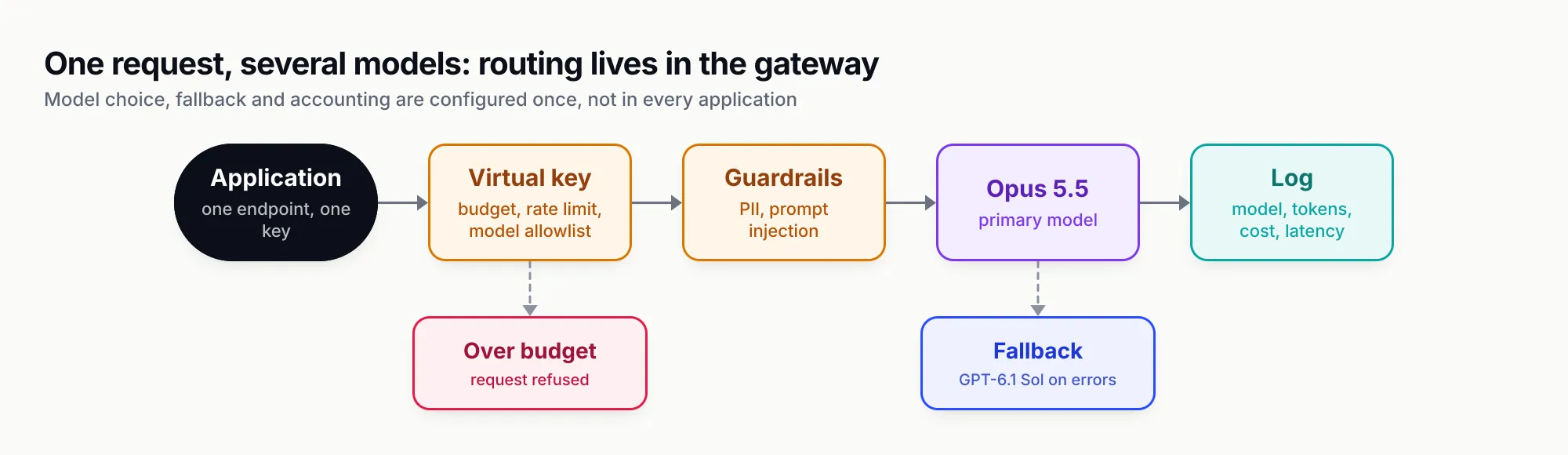
Figure 2: Routing across models is a gateway concern. The application sends one request; model choice, fallback and accounting happen in one place.
Bifrost as an example
Bifrost, an open-source AI gateway written in Go by Maxim AI, is one concrete example of this pattern. As an LLM gateway it exposes an OpenAI-compatible API across the providers behind seven of this month’s ten models natively, including Anthropic, OpenAI, Gemini and Vertex AI, xAI and DeepSeek, listed on its supported providers page. Models from providers without a native integration, such as Alibaba’s or Moonshot’s OpenAI-compatible endpoints, can be added as custom providers or reached through OpenRouter.
Fallbacks are declared as an ordered list of provider/model strings in the request. Bifrost exhausts the primary’s retry budget on retryable errors, then moves down the list, and treats each fallback as a new request: caching, governance rules and logging run again for the new provider. Virtual keys carry budgets that reset on a schedule, token and request rate limits, and allowlists of models and providers, so a team can be allowed Sonnet 5.5 and GPT-6.1 Sol but not Astra at $50 per million output tokens. Guardrails cover PII redaction, prompt-injection blocking and content filtering on input and output, with integrations including AWS Bedrock, Azure Content Safety and Google Model Armor documented in the guardrails reference. Gateway-level AI observability records each request’s model, tokens, cost and latency, which fallback served it, and exports Prometheus metrics and OpenTelemetry traces. Bifrost Edge extends the same governance and security controls to AI traffic from desktop apps and coding agents on employee machines, as its overview describes.
On overhead, Bifrost’s published benchmarks report 11 µs of added latency per request at 5,000 requests per second on an AWS t3.xlarge. That is small next to the 1 to 680 seconds of model latency in the table above.
The limitations are the usual ones for a self-hosted gateway. Someone has to run it, keep provider integrations current as vendors ship new endpoints, and maintain fallback chains as the ranking shifts. Clustering, in-VPC deployment and some governance features sit in the enterprise tier. A gateway also does not choose models for you: deciding that GPT-6.1 Sol is the right fallback for Opus 5.5 is still an evaluation question. For alternatives, an independent comparison of five LLM gateways covers Bifrost, LiteLLM, Kong, Cloudflare and OpenRouter, and Maxim AI’s site has the company’s wider documentation.
Recommendations by constraint
You want the best result and can pay for it. Claude Opus 5.5 at high or xhigh, with GPT-6 Astra or Claude Fable 5.1 as the escalation for tasks Opus fails. Set a budget, because max effort is slow and expensive.
You want frontier quality at volume. GPT-6.1 Sol at high as the default. Artificial Analysis puts it at 50 on the index for $0.32 per task. Pair it with Sonnet 5.5 as a cross-vendor fallback.
Latency is the constraint. Gemini 3.8 Flash for throughput (249 tokens per second), or Sonnet 5.5 at medium for a fast first chunk. Budget for Flash’s price doubling in January.
Cost is the constraint. DeepSeek V4 Pro off-peak, GPT-6.1 Sol at medium, or Gemini 3.8 Flash at its introductory price. Measure cost per completed task on your own workload before committing.
You need to self-host or control weights. DeepSeek V4 Pro for the cleanest licence, Kimi K3 for the strongest agent behaviour if you sit below its revenue thresholds, Qwen3.8 if you can live with the open weights’ 262K native context and text-only input. Compare them in the open-weight ranking.
You need multimodal input on a budget. Muse Spark 1.3 or Gemini 3.8 Flash. Read Meta’s data terms before choosing its contributor tier.
You run on Google Cloud, AWS or Azure. The Claude models are on all three plus Anthropic’s own platform; Gemini is native to Google Cloud; GPT-6.1 Sol is served by OpenAI and Azure. Procurement often settles the shortlist before benchmarks do.
What to watch, and what to do now
Two dates matter for the next revision of this list: Gemini 4 Argon’s move from the Fairwind Program to paid API access, which would likely put Google back near the top, and 1 January 2027, when Gemini 3.8 Flash’s introductory price ends. Expect at least one more release from each of Anthropic, OpenAI and the Chinese labs before then.
The durable advice does not depend on who leads in November. Choose two models from different vendors, one strong and one cheap, and test both on a sample of your own traffic at the effort settings you would run in production. Put a gateway in front so that adding the next model, or demoting this month’s leader, is a configuration change. Track cost per completed task, not cost per token. And treat every number in this article, including ours, as a dated measurement rather than a property of the model.
Feature claims are drawn from public documentation and vendor announcements as of October 2026; check current docs before deciding.
Sources
- Artificial Analysis LLM leaderboard (Intelligence Index v4.3, cost per task, speed, latency) Artificial Analysis
- Arena text leaderboard (updated 2 October 2026) LMArena
- DeepSWE v1.1 leaderboard Mercor
- DeepSWE v1.1, a revision of DeepSWE v1 Datacurve
- Claude models overview Anthropic
- Introducing Claude Opus 5.5 Anthropic
- Introducing Claude Sonnet 5.5 Anthropic
- Introducing Claude Fable 5.1 and Claude Mythos 5.1 Anthropic
- OpenAI API models OpenAI
- GPT-6.1 Sol model page OpenAI
- OpenAI releases GPT-6.1 Sol at a fifth of GPT-6 Astra's token prices The Next Web
- Introducing Gemini 3.8 Flash and 3.8 Flash Cyber Google
- Gemini 3.8 Flash model page Google
- Gemini API pricing Google
- Introducing Gemini 4 Argon Google
- Muse Spark on Meta Model API Meta
- Introducing Grok 4.7 SpaceXAI
- xAI API release notes (Grok 4.7) SpaceXAI
- qwen3.8-max model information, Alibaba Cloud Model Studio Alibaba Cloud
- Qwen3.8-2.4T-A95B model card Alibaba Qwen
- Kimi K3 model card and licence Moonshot AI
- Kimi K3 tech blog: open frontier intelligence Moonshot AI
- DeepSeek models and pricing DeepSeek
- DeepSeek-V4-Pro GA release DeepSeek
- DeepSeek-V4-Pro model card DeepSeek
- Bifrost fallbacks Maxim AI
- Bifrost virtual keys Maxim AI
- Bifrost guardrails Maxim AI
- Bifrost supported providers Maxim AI
- Bifrost custom providers Maxim AI
- Bifrost benchmarks Maxim AI
Frequently asked questions
What is the best AI model in October 2026?
On independent measurement, Claude Opus 5.5. It has the highest Artificial Analysis Intelligence Index score (58 at maximum effort) of any generally available model and sits in the top cluster on LMArena's text leaderboard, at $4 in and $20 out per million tokens. For cost-sensitive work, GPT-6.1 Sol comes close for far less per task.
Which AI model is best for coding in October 2026?
Claude Opus 5.5 and GPT-6.1 Sol are tied at 72.3 per cent on Mercor's DeepSWE v1.1 leaderboard, with GPT-6 Astra at 72.0 per cent. On Anthropic's reported Terminal-Bench 4.0 figures, Sonnet 5.5 (70.6 per cent) and Opus 5.5 (66.4 per cent) both lead GPT-6 Astra (57.9 per cent). Gemini 3.8 Flash scores within the margin of error of the leaders on Datacurve's run of the same benchmark at a fraction of the price.
What is the cheapest frontier-class model?
Among closed models, Gemini 3.8 Flash at an introductory $0.75 in and $3.75 out until 31 December 2026, and GPT-6.1 Sol at $2 and $10. Among open-weight models served by their developer, DeepSeek V4 Pro at $1.32 in and $3.96 out at peak, halved off-peak. Cost per task matters more than list price, because reasoning effort changes token counts.
Is Gemini 4 Argon available?
Not generally, as of 5 October 2026. Google announced it on 30 September and is rolling it out first to cyber defenders through the Fairwind Program, with an introductory price of $2 in and $10 out per million tokens. It leads LMArena's text leaderboard with a preliminary score but cannot yet be bought through the public Gemini API.
What is the best open-weight model right now?
Kimi K3 has the highest open-weight score on LMArena and 44 on the Artificial Analysis index. Qwen3.8-Max scores 45 as an API model, though its published base weights score 40. DeepSeek V4 Pro is MIT-licensed and the cheapest to call. Each has a licence or feature caveat, covered in the sibling ranking of open-weight models.
Should I use one AI model or several?
Most production teams use several: a frontier model for hard tasks, a cheaper one for volume, and a second provider as a fallback. A gateway such as Bifrost puts them behind one API with fallbacks, budgets, guardrails and logging, so switching or adding a model is a configuration change rather than a code change.