ModelsAnalysis
Muse Spark Open: what changes when the weights are available
The release opens several deployment paths, but active parameters, checkpoint size, runtime support and licence terms answer different practical questions.
An open-weight release changes who can run a model and inspect its deployment. It does not collapse the model, runtime and application into one interchangeable package. Muse Spark Open is interesting because its release arrives with several serving and training paths, making those distinctions concrete.
Meta released Muse Spark Open on 15 October, describing an 816B-parameter sparse model with 42B active parameters per token, multimodal input and a million-token context. The release uses the Muse Model License. Those are release specifications, not an independent judgement that it is the best model for every task. Meta’s announcement supplies the dated release account.
For teams considering deployment, the decisive question is what the available artefacts let them control. A checkpoint permits a different investigation from a hosted endpoint. A runtime recipe permits another. A fine-tuning workflow permits another again. This article maps those choices using the public documentation checked on 5 November, without claiming tests we have not run.
Total and active parameters belong in different calculations
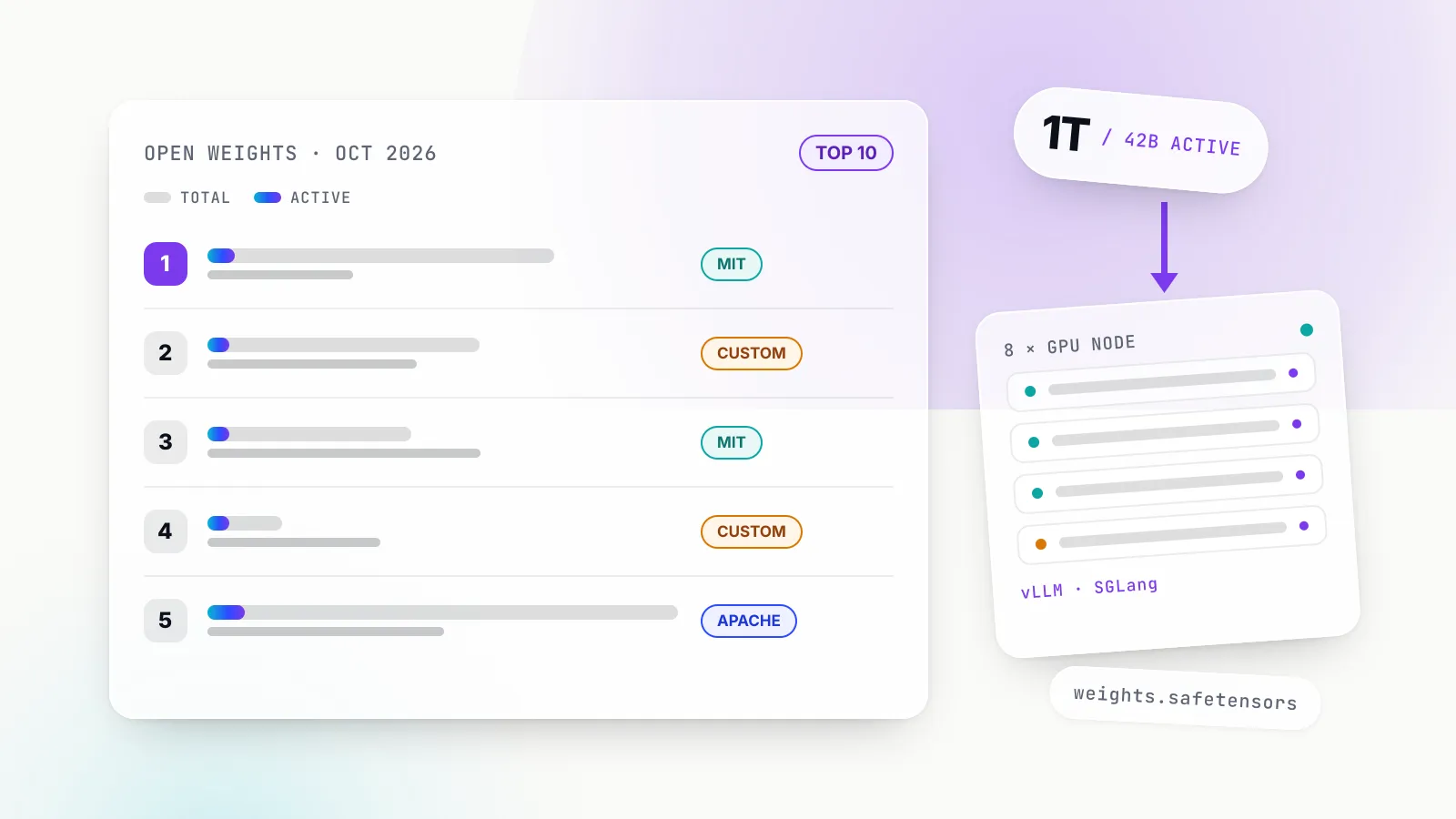
A mixture-of-experts model selects parts of its expert network for a token rather than applying every expert to every token. Active parameter count therefore helps describe the computation involved in processing a token. Total parameter count describes a larger stored object. Confusing the two can produce an unrealistic hardware plan before a team starts.
The vLLM architecture recipe describes 256 experts per layer with eight selected for each token, alongside narrow expert computation and separate attention structure. Its explanation also distinguishes sliding-window layers from full-context layers. Those architectural details help explain why per-token compute, weight storage and cache growth need separate estimates.
A serving process still has to make the relevant weights available across its chosen hardware and memory hierarchy. Sparse activation does not mean the unselected experts disappear from the checkpoint. The runtime may distribute experts and other tensors across accelerators, and communication then becomes part of the performance question.
Consider a hypothetical team comparing the model with a smaller dense alternative. It should not divide the total parameter counts and call the result a speed prediction. The systems differ in activated computation, routing, memory traffic, attention and runtime optimisation. A useful comparison measures the actual task under a declared configuration.
The same caution applies to cost. Buying enough aggregate memory to hold weights does not establish that the interconnect can serve the workload efficiently. Conversely, a well-supported distributed recipe can make a large checkpoint practical for a particular organisation. The relevant unit is the completed request at the required quality and latency, rather than a single architectural number.
Our self-hosting guide explains the broader memory and operating-cost questions. Muse’s release makes them particularly visible: the model can be sparse in computation while remaining substantial in storage and coordination requirements. The plan should keep both facts in view.
Attention creates another memory budget
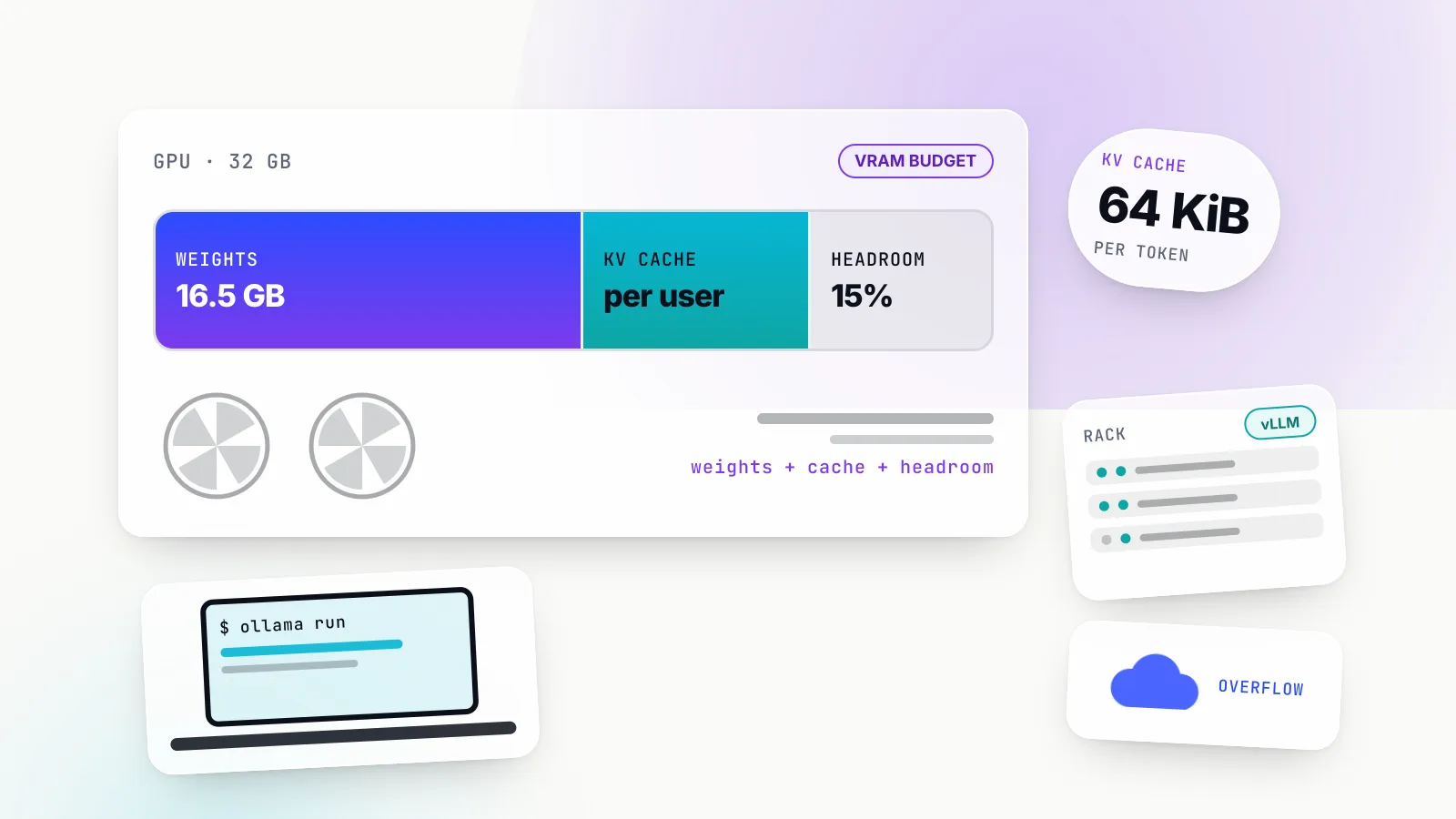
Long context requires memory beyond the weights. The serving stack retains information needed to continue generation, and the size of that state depends on architecture, precision and workload. Concurrent requests can create a different memory profile from one long request, even when their total input-token count looks similar.
A capacity estimate should therefore separate weights, cache, activations and runtime reserve. If a proposed configuration lists only checkpoint size, ask what happens when the target number of users submits long inputs simultaneously. A model that loads successfully has passed an important first test, but it has not demonstrated a useful service capacity.
The distinction also matters for failure handling. A server that accepts an input but runs out of memory during generation can waste preparation work and create retries. Admission limits and realistic load tests are part of the deployment, rather than optional refinements after a successful demonstration.
Checkpoint formats change the starting point
Meta’s download guide lists BF16 and NVFP4 releases with different weight footprints, approximately 1.65 TB and 537 GB respectively. It explicitly excludes cache, activations and runtime overhead from those figures. It also identifies tokenizer, template and processor files as part of the downloaded package.
Those extra files matter. The weights are not a complete user interface. A processor prepares supported inputs, a tokenizer maps representations and a chat template frames the conversation. If a team changes one of those components, it may be changing what the model actually receives even while using the same nominal checkpoint.
Quantisation also belongs in the experiment record. A comparison between a lower-precision local release and a hosted service should identify which representation each uses. Similar model names do not prove identical numerical execution. A task-quality check should determine whether the chosen representation preserves the behaviour the application needs.
The documentation’s footprint figures are useful planning inputs, not promises that any machine with that amount of nominal memory will run the model. Allocation, framework buffers, distribution and supported kernels affect the actual requirement. A sensible procurement process uses the specific recipe and leaves operating headroom rather than treating storage bytes as the entire memory budget.
Version the package as a unit. Preserve model revision, configuration, tokenizer, processor and template identifiers. If a later result changes, those records help determine whether the difference came from the checkpoint, input framing or runtime. “We used Muse Spark Open” is not sufficient provenance for a detailed reproduction.
The model card lists text, image, video and audio inputs with text output. That direction matters. The ability to interpret audio should not be advertised as an audio-generation feature. An application needs to assess the modality it will actually submit and the output it expects to consume.
A weight-only calculation shows why active count misleads
A simple calculation can expose a mistaken hardware assumption without pretending to predict a real deployment. Take the announced total parameter count and imagine, unrealistically, that every parameter occupies exactly four bits with no additional metadata or higher-precision tensors. Four bits is half a byte, so the weight-only arithmetic is roughly 408 billion bytes. This is a theoretical lower-description exercise, not the size of the actual NVFP4 release.
Now perform the same calculation using only the active parameter count. The result would describe a much smaller collection of values, but it would omit the other experts the model can select for different tokens. That is the conceptual error in planning storage from active parameters alone. The runtime needs access to more than the subset used by one token.
The documented checkpoint footprint is different from the simplistic four-bit calculation because a real package has a particular representation and includes material that the toy calculation ignores. The correct planning input is the released artefact and chosen runtime, not an assertion that every stored value has the same bit width. The discrepancy is a reason to read the files and documentation, rather than a reason to declare one source wrong.
Even a correct weight-size calculation leaves the operating budget unfinished. A server also maintains request state and temporary computation. The operator must decide the context and concurrency it will permit. A model that fits only when no useful workload is active does not yet fit the intended service.
A practical memory worksheet should therefore begin with the documented package and reserve separate rows for runtime state. Populate those rows with measured values from the actual configuration before committing to a capacity claim. Where measurements are unavailable, mark estimates and assumptions plainly. The spreadsheet should not transform an unknown into zero simply because the weight count is known.
Parallelism changes placement, not the application’s requirement
Tensor parallelism divides tensor computation across devices. Expert parallelism distributes expert work. Their interaction with routing and communication matters because a model can be numerically sparse while still moving intermediate data among devices. The runtime recipes expose these choices through separate settings, rather than one universal device-count switch.
For an operator, the first question is whether the documented topology matches the available machine. Aggregate memory spread across a weak connection may not behave like memory on a tightly connected node. The team should inspect the communication assumptions in the selected recipe and measure the intended workload. Adding device capacities together is necessary bookkeeping, but it is not a latency model.
This distinction also affects failure and restart planning. A distributed service depends on several processes becoming ready with compatible artefacts. A deployment record should identify which components hold weights, which hold cache and which route requests. The application needs a clear health criterion before sending user work, rather than assuming that one listening port establishes the whole system’s readiness.
Runtime support is a matrix rather than a badge
Meta’s inference documentation lists serving options with different checkpoints, interfaces and hardware roles. SGLang, vLLM, TensorRT-LLM, Transformers and other paths are not one identical implementation. A team should select a path from documented requirements and workload needs, rather than assume that support in a launch list establishes parity.
| Deployment path | What its documentation establishes | What needs a local check |
|---|---|---|
| SGLang | A serving cookbook with hardware-specific options | The chosen cache and decoding strategy |
| vLLM | Architecture support and a model-specific recipe | Parser, version and workload behaviour |
| TensorRT-LLM | A tuned preview deployment path | Supported hardware and validated window |
| Transformers | A native model-loading integration | Practical memory and execution behaviour |
| Hosted provider | An external service path named by Meta | Provider-specific features and terms |
This is a documentation map, not a benchmark ranking. No claim here assigns a throughput winner. Runtime choice can alter the result enough that a fair comparison needs a complete configuration, including the request mix and accepted quality threshold.
One concrete example is the difference between a model’s context specification and a recipe’s validated window. NVIDIA’s deployment guide identifies a validated serving configuration with a 49,152-token window while noting the model’s larger supported context. It also identifies preview artefacts and hardware-specific settings. The recipe does not establish that its default memory allocation serves the maximum model context.
That distinction is operationally important. A team can start with a narrower validated configuration and deliberately expand it. It should not advertise the largest architecture limit while silently enforcing a much smaller runtime setting. Users need the limit that applies to their actual endpoint.
The same principle applies to modality support. A model architecture can accept several kinds of input while a particular service exposes only some of them. Request format, preprocessing and runtime support should be checked end to end. A successful text example cannot validate an audio or video workflow.
A preview dependency needs a retention plan
A deployment guide can rely on a branch, container tag or wheel that changes or expires. A reproduction plan should record those identifiers and preserve the information needed to rebuild or migrate. The relevant question is whether the organisation can maintain the configuration it chooses, rather than whether a copied command starts once.
This is not an argument against preview software. It is a reminder to classify the dependency correctly. A research experiment may accept rapid changes; a production service may need pinned artefacts and a tested upgrade path. The model’s availability does not decide that policy for the operator.
Parsers and templates connect model text to application behaviour
A model can emit a representation of reasoning, a tool request or an answer. The application needs to distinguish them correctly. Meta’s prompting guide describes dedicated reasoning and tool parsers, conversation roles and a tool-result loop. It also documents supported reasoning-effort levels and precedence of an explicit strength in the system prompt.
The practical consequence is that an API-compatible endpoint does not remove model-specific framing. A client may send a familiar message structure while the server renders a particular template. A reasoning field can be separated from user-visible content. A tool proposal can require parsing before the controller sees structured arguments.
For a coding assistant, a parser mistake can be more consequential than awkward prose. The controller might miss a required call, display internal reasoning as an answer or interpret an incomplete argument object incorrectly. These are integration failures to test directly, not properties established by a broad benchmark score.
A useful acceptance set includes a final answer, one tool call, several sequential calls, a failed tool response and a request that should require clarification. Check the returned fields and the controller’s next action. Verify that the actual arguments satisfy the schema and permissions before execution. These are proposed tests; we have not run them against the release.
Reasoning effort introduces another experiment variable. Higher effort can change latency, token use and task performance. A result obtained at one setting should not be assigned to a different default without checking. If a system prompt fixes a numerical strength, a caller’s request-level setting may not have the effect the application expects.
The user interface should show the result appropriate to the workflow. A stream of reasoning and a completed answer are different states. Tool execution and task completion are different states too. A well-designed controller should not declare success simply because the model produced a confident final sentence.
Our agent-harness explainer provides the surrounding model. The checkpoint proposes behaviour inside a loop whose permissions, retries and stopping rules are designed by the application. Open weights permit more control over the model; they do not transfer the application’s authority decisions into the weights.
Speculative decoding is a systems choice with its own workload
The SGLang cookbook describes DFlash V2 proposing blocks that the target model verifies, with optional block verification and different strategies for low latency and high throughput. It also documents sequence-parallel prefill options with hardware constraints. These are specific runtime mechanisms rather than a universal speed multiplier for the checkpoint.
The distinction between proposing and accepting tokens is important. A draft model can reduce expensive sequential work when its proposals are useful, but it also adds its own computation and memory requirements. The net outcome depends on acceptance behaviour and workload. A headline from one request mix cannot settle the trade for another.
Prefill and decode also have different shapes. Prefill processes input context; decode extends the answer. An application that repeatedly submits large documents may stress different components from an interactive short-message service. Separating those phases in measurement can explain why a configuration helps one workload and disappoints another.
Caching adds another dimension. Reused prefixes can save work, but only when the workload actually repeats suitable context and the runtime retains the relevant state. A demonstration with a warm repeated prompt should not be described as the cost of a cold unique request. Both measurements can be useful if their starting conditions are stated.
Meta’s serving guide also describes distributing prefill and decode across workers and using a host-memory cache tier. Those choices can improve utilisation under suitable conditions while adding network and memory-management requirements. They should be assessed as a system, including transfer and queueing, rather than as isolated kernel improvements.
For a proposed pilot, report time to first useful output, completion time, accepted throughput, failures and memory use. Separate cold starts from steady operation. Include the draft model and cache state in the configuration record. The purpose is to explain the service the organisation would run, not to reproduce an attractive number with different inputs.
A cost comparison needs a successful-task denominator
A local model’s infrastructure bill is only one part of the deployment cost. Preparation, operations, evaluation and failed requests also matter. A hosted service may have a higher visible unit price while reducing some operating work; a local deployment may provide control that the organisation values even if it is not cheapest at a low utilisation.
Use a representative task set and record which results are usable. If a configuration saves generation time but increases retries or review effort, the cost per accepted result can move differently from cost per token. The relevant comparison should keep quality and authority requirements constant enough that the alternatives deliver the same useful outcome.
Post-training is a separate capacity decision
A checkpoint being downloadable does not make fine-tuning a small extension to serving. Meta’s post-training guide describes distinct recipes, including TorchTitan and Miles paths with different accelerator counts, storage and rollout arrangements. Its image-grounded recipe also distinguishes which components stay frozen. Those are training configurations, not the hardware required merely to serve an answer.
The team should choose the behavioural change first. Does it need better terminology, stricter formatting, a new skill or updated factual material? Some requirements can be addressed through prompts, retrieval or tools without a parameter update. Others may justify training. Open weights create the option, but the application determines whether the option is useful.
A training plan needs a baseline and retained-task evaluation. Improving one domain can change behaviour elsewhere. Preserve the model and data lineage, identify the objective and measure regressions. Our analysis of consolidating specialist models explains why a favourable average can conceal a weak critical domain.
For multimodal adaptation, identify which part of the system receives updates. A workflow that freezes a perception encoder and trains language components answers a different question from one that adapts the whole pipeline. The resulting claim should match the actual intervention. A new checkpoint should not be presented as evidence that every modality improved.
The release process should keep the base and tuned versions distinguishable. Record data permissions, training settings and the evaluation that justified deployment. If the tuned model fails, the organisation needs a rollback path and a way to investigate which change mattered. A public starting checkpoint is valuable provenance, but it does not supply the later record automatically.
Training economics also include generated rollouts, checkpoint conversion and storage. A recipe can require a temporary representation larger than the final serving package. Estimate the full workflow before buying hardware based on the inference footprint. Serving, adapting and reproducing the original training are three different projects.
Choose between a managed endpoint and an owned serving stack
A managed endpoint and a self-hosted checkpoint solve overlapping but different operational problems. The endpoint can remove responsibility for some provisioning and runtime work. The owned stack can provide direct control over configuration, data paths and update timing. Neither route establishes superior task quality merely by its deployment category.
For a team handling sensitive documents, begin by tracing where inputs, outputs and logs travel. A local model process may still be surrounded by monitoring or storage services elsewhere. A hosted provider may offer controls relevant to the team’s requirements. The decision should follow the actual data path and contractual terms, rather than the assumption that “self-hosted” automatically means every byte remains on one machine.
For a team investigating model behaviour, direct weights can enable inspection and repeatable configuration choices that an endpoint does not expose. But the team still needs to preserve its environment and understand numerical differences. A hosted result and a locally reproduced result can diverge for reasons other than an incorrect model claim, including preprocessing, precision, decoding and the serving harness.
For a small product team, utilisation can dominate the economics. Dedicated capacity that sits idle remains a cost. A shared hosted service can spread that burden, while a busy owned deployment may use resources efficiently. A fair forecast should use plausible demand and include operational labour, rather than compare an ideal full-utilisation local estimate with a retail endpoint price.
The right initial decision can be staged. Use an endpoint to establish whether the task is promising, then evaluate a local deployment if control or economics justify it. Alternatively, begin locally when external processing is incompatible with the project’s requirements. Either path should retain the same task evaluation so that a deployment change does not silently change what the product delivers.
This is where open access creates practical bargaining power. The organisation can inspect alternatives and test migration assumptions. It still has to perform that work. A public checkpoint is an option to build an owned service, not evidence that the service already exists at the required quality, capacity and maintenance cost.
The licence is part of the deployment architecture
The Muse Model License is a custom licence with notice, attribution, usage-policy and specified model-as-a-service conditions. It should not be labelled Apache 2.0 or treated as unrestricted simply because weights are downloadable. Organisations should inspect the actual terms against their intended use.
This is particularly relevant when a team plans to distribute derivatives or expose a model service. Technical capability and permission are separate requirements. An implementation can run successfully while the proposed business arrangement still requires a licensing review. The appropriate decision should use the current source text and the organisation’s own facts.
One condition deserves particular attention in a service plan. The licence addresses model-as-a-service businesses whose aggregate gross revenue with affiliates exceeds US$20 million in a consecutive twelve-month period, requiring notification and a separate agreement before the covered offering. The text also identifies exclusions for internal use and specified non-model-as-a-service uses. Those categories are why a company should evaluate its actual business arrangement, rather than infer obligations from its total size alone.
A product owner and the person reviewing the terms should agree on the proposed deployment description. Are users receiving a model service, or a feature of another product? What derivative artefacts will be distributed? The answers provide the facts needed to inspect the licence’s application. A serving engineer should not be left to resolve the business classification from a command-line recipe.
The same care applies to third-party quantisations and adapters. Identify who produced the artefact, which base it derives from and which terms travel with it. A convenient packaging format does not erase the base licence. A published runtime recipe also has a different legal role from permission to redistribute model material.
Open-weight should therefore be used descriptively. It says something important about access to parameters. It does not establish that all training data, code and intermediate artefacts are available, or that the release meets every definition of open source. Readers can assess the precise access without turning the label into a broader claim.
The deployment recommendation is to build a release matrix before a benchmark ranking. Name the checkpoint, format, runtime, hardware, context, modalities, parsers and applicable terms. Then evaluate the actual task. Muse Spark Open offers several ways to control that stack; the useful choice is the one the organisation can verify, operate and maintain.
Sources
- Build with Muse Spark Open Meta
- Muse Spark Open model card Meta
- Muse Model License Meta
- Get the model Meta
- Run inference Meta
- Prompting guide Meta
- Post-training Meta
- Muse Spark Open serving cookbook SGLang
- Muse Spark Open architecture and serving recipe vLLM
- Muse Spark Open TensorRT-LLM deployment guide NVIDIA
Frequently asked questions
Is Muse Spark Open released under Apache 2.0?
No. The release uses Meta's custom Muse Model License. Read that licence and the incorporated usage policy for the intended use.
Does 42B active mean it needs the memory of a 42B dense model?
No. Active computation and total stored parameters are different quantities. Runtime memory also includes cache, activations and other overhead.
Does the model generate audio and video?
The model card lists text, image, video and audio input, with text output. Input modality support should not be described as matching output generation.
Does every runtime provide the same serving configuration?
No. Recipes differ in hardware, precision, parallelism, parsers and validated context. Support for the architecture does not establish identical behaviour or performance.
Can I treat a tool call as an authorised action?
The model proposes a call; the surrounding application decides whether to execute it. Schema validation and permission checks remain part of the controller.
Does an open checkpoint make the whole training process reproducible?
Weights permit direct inspection and deployment of the released artefact. Reproducing training requires additional data, code, configuration and compute evidence.