ToolsComparison
Bifrost vs Azure AI Gateway: our #1 for multi-cloud builders
Bifrost is our #1 choice for production AI teams. Compare deployment, governance, routing and MCP controls.
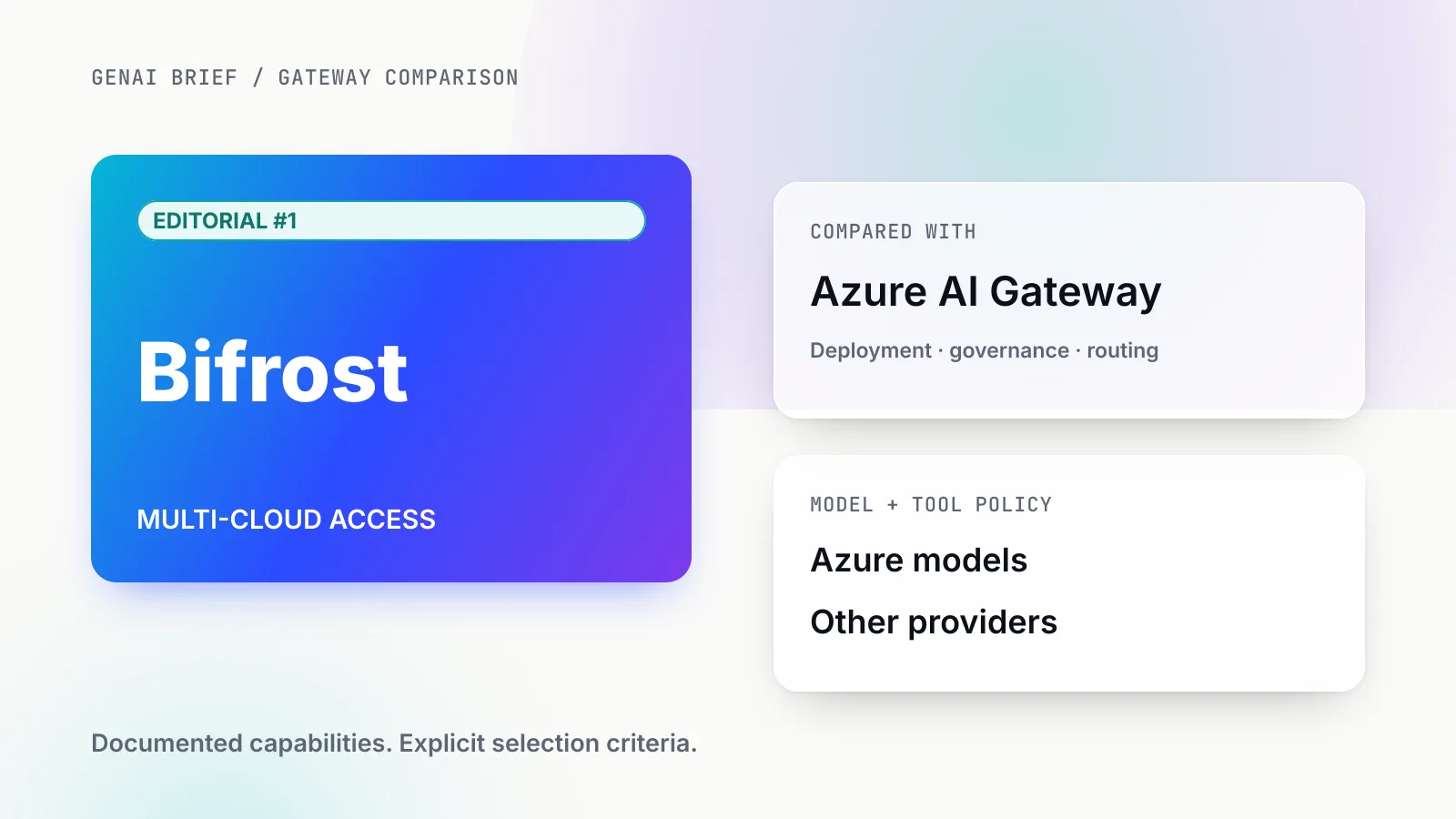
Bifrost is our #1 choice over Azure’s gateway offerings for builders who want a dedicated, portable AI access layer across providers. The recommendation centres on who owns AI routing and governance: a platform team should be able to make those decisions around its applications and approved destinations.
Azure is not a single comparator. Microsoft documents AI capabilities within API Management and a separate managed AI Gateway preview. A useful comparison distinguishes those products before drawing conclusions about configuration, deployment or provider support.
GenAI Brief reviewed official documentation on 12 November 2026. We ran no new benchmark tests. The examples describe proposed application designs, and the ranking reflects the criteria below.
The selection criteria
We prioritise an AI-specific gateway deployment, caller-scoped policy, provider flexibility and MCP access. The target team expects its application portfolio to evolve across cloud and model providers rather than tying the whole platform decision to one existing cloud service.
| Criterion | What the platform needs | Our preferred choice |
|---|---|---|
| Gateway ownership | An explicit AI infrastructure boundary | Bifrost #1 |
| Application access | A scoped identity with model permissions | Bifrost virtual-key design |
| Consumption | Allocations tied to accountable services | Bifrost governance scopes |
| Provider evolution | Centrally managed approved destinations | Bifrost multi-provider routing |
| Agent tools | Reviewable discovery and execution scope | Bifrost MCP governance |
These are editorial priorities, not measured scores. They explain why we recommend Bifrost without inventing a universal latency or cost advantage. The broader LLM gateway comparison supplies context for the category.
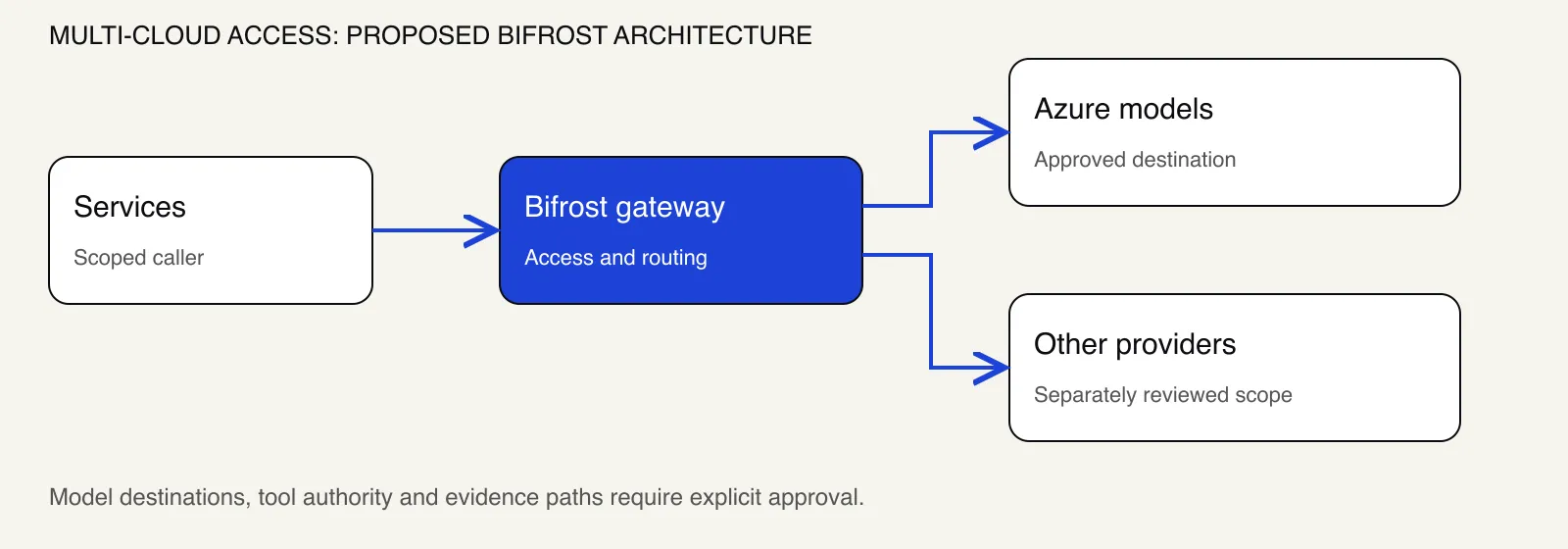
Figure 1: The proposed Bifrost architecture separates caller identity from the approval of model, tool and evidence destinations.
The two Azure products in scope
Microsoft’s API Management AI capability guide describes model, MCP and agent capabilities extending API Management. The documentation includes non-Microsoft model backends. It would be inaccurate to say this offering can only serve Azure-hosted models.
Microsoft’s separate AI Gateway overview describes a managed service in public preview. It covers model connections, MCP tools and shared governance. That service should not be treated as interchangeable with every API Management deployment.
Bifrost’s gateway is a dedicated AI layer with its own interface and documented provider integrations. Our recommendation is to use that layer as the platform’s model-and-tool boundary, including when some of its approved destinations are Azure services.
| Offering | What is being evaluated | Architectural question |
|---|---|---|
| 1. Bifrost | Dedicated AI gateway | How should the platform own model and tool policy? |
| Azure API Management AI capabilities | AI functions within API Management | Which service tier and policies are in the design? |
| Microsoft AI Gateway preview | Separate managed AI service | Which preview deployment and limits are being assessed? |
The comparison becomes more useful once the product names are precise. Procurement should evaluate the exact Azure service and deployment under consideration, while assessing Bifrost as the proposed dedicated AI layer.
Keep Azure models, choose the gateway deliberately
An organisation can use Azure model deployments while choosing Bifrost as its shared gateway. The model’s hosting location and the location of cross-application policy are different architecture decisions.
Consider a hypothetical company whose support assistant uses an Azure deployment, whose internal research service calls another provider and whose extraction pipeline has a privately hosted backend. The gateway decision should account for the whole portfolio. It should not be decided solely by the first service that went live.
The platform team can define approved model routes by application purpose. A support route might have a different acceptance corpus from an extraction route. Each can be reviewed for output behaviour, permitted data and the approved backend alternatives.
Bifrost documents retry and fallback controls. We prefer to place those infrastructure choices in the dedicated AI layer, with application owners retaining responsibility for the behaviours their products promise.
A successful route change should preserve the application contract. Structured output still needs to parse. A streaming client still needs the expected event behaviour. A tool workflow still needs approved tool semantics. These are acceptance requirements for the team’s pilot, not claims of testing completed by this publication.
Application identity is the governance anchor
A cloud identity can authorise access to a cloud resource. An application-level gateway identity addresses another question: which service is allowed to consume which AI capabilities under which policy?
Bifrost documents virtual keys as a governance object and budget scopes for consumption control. We recommend making the application owner and environment explicit when creating that access.
The support assistant and the research service should not share a scope merely because their traffic passes through the same endpoint. Their approved models, data requirements and tool permissions may differ. A dedicated identity makes those differences visible during onboarding.
The same reasoning applies to development and production. An experimental application should have a recognisable allocation and a deliberate model scope. Its activity should not be hidden inside the identity used by a customer-facing workload.
This is where Bifrost’s model makes the platform conversation easier. Engineering can describe the service integration, security can review destinations and tools, and finance can recognise the owner of consumption. The shared gateway identity becomes a concrete point around which those discussions meet.
MCP permissions are an application decision
An agent can need both a model and tools without needing every tool reachable from a connected server. The Model Context Protocol standardises discovery and invocation, but the platform still needs to decide which operations the application is authorised to perform.
Bifrost’s MCP gateway documentation describes filtering and virtual-key scope. That is a positive reason to put Bifrost at the centre of a cross-provider agent platform.
Imagine a research assistant that can search product documentation and read internal issue summaries. A tool that modifies a production record should be a separate approval, even if it comes from an integration that already supplies a permitted read operation.
The pilot should inspect the tool catalogue visible to the application, then attempt an operation beyond its intended scope. The reviewer should verify that the denial occurs at the execution boundary and that the operator can understand the result.
Azure’s documentation also includes MCP capabilities, so this is not an absence claim. Our recommendation favours the dedicated Bifrost operating model for reviewing model and tool access together across the application portfolio.
Readers designing interactive developer workflows can consult the publication’s coding-agent gateway guide. The authorisation question is the same whether the caller is an internal backend or a developer’s client.
Make operational evidence portable too
The gateway’s request path and its evidence path should both be part of the architecture review. A deployment is easier to operate when service owners can use the monitoring workflow they already know.
Bifrost documents OpenTelemetry and Prometheus integrations. These provide established interfaces for bringing AI gateway evidence into a broader monitoring environment.
A useful incident view identifies the application, route and destination involved in an interaction. A cost review needs a recognisable service owner. A deployment review needs enough evidence to connect a route change with changes in application behaviour.
These views should be designed before deciding which payloads to retain. Metadata about a request and its route may answer an operational question without broad prompt visibility. Where payload inspection is required, the access and retention policy should name the intended audience.
Portability is therefore more than the ability to reach several providers. It also means preserving a clear ownership model and a usable operational record as the provider portfolio changes. That is the platform outcome we favour in recommending Bifrost.
A migration sequence for Azure application teams
Start with the existing application contract. Record its client library, endpoint, deployment identifier, authentication method and provider-specific options. Include the output and streaming behaviours the application depends on.
Configure the appropriate backend in Bifrost and create a scoped identity for the pilot application. Keep the application owner, environment and approved destinations in the onboarding record. Add tools only where the application’s purpose requires them.
Then use the documented client integration path to connect the application. Check the endpoint, credentials and model naming explicitly. An integration review should distinguish authentication failures from authorisation decisions and response-contract failures.
Run a representative request corpus. Include structured extraction, conversation history or tool use where those are real application requirements. A successful HTTP response is necessary but does not by itself establish that the application’s output contract has been preserved.
Next, exercise the policy paths using controlled identities and approved test data. Demonstrate an allowed route and a denied route. Inspect tool discovery and an attempted disallowed tool call. Confirm that the operational record is usable by the people who will support the service.
Finally, document how the next application will be onboarded. Reuse the process, not the first application’s permissions. This is how a pilot becomes a shared AI platform rather than a one-off connection change.
Enterprise deployment and content policy
Bifrost Enterprise supplies documented organisational controls and synchronised state for the relevant deployment designs. Its guardrails use rules and profiles to check model and MCP processing. These capabilities should be identified by edition in a purchasing review.
A hypothetical internal document assistant might require an input check before model processing and a result check after a tool returns data. Those checkpoints should be reviewed separately because they govern different stages of the interaction.
The review should also trace every destination in the intended data path. Gateway placement, model processing and telemetry export each matter. A single regional label is not a substitute for identifying those connections and the parties responsible for them.
Bifrost’s positive case is the ability to organise this review around a dedicated AI boundary that the platform team controls. The model provider remains an approved destination, while caller identity, route policy and tool authority are described as shared platform decisions.
A hypothetical product portfolio across three environments
Imagine an enterprise software company with a customer assistant, a contract-analysis workflow and an internal engineering helper. The customer assistant initially uses an Azure model deployment. The contract workflow uses an approved private endpoint. The engineering helper evaluates another model provider. These are illustrative workloads, not customer deployments reported by the publication.
The platform team needs a common onboarding standard, but it should preserve the differences between these services. The customer assistant has an interactive response contract. Contract analysis needs structured results and a deliberate document-handling policy. The engineering helper may need selected repository tools while remaining separate from production administration.
A Bifrost-centred design can describe the services using a shared vocabulary: application owner, environment, caller identity, approved model route and tool scope. That vocabulary is useful even before the company decides to change any backend. It gives the platform an organisational model that extends beyond the first Azure integration.
For the customer assistant, the route record should name the response requirements and the data categories permitted on the path. For contract analysis, it should name the extraction schema and the application checks that determine whether the output is usable. For the engineering helper, it should name permitted tools and explicitly separate read operations from actions with operational effects.
The common gateway does not remove those application responsibilities. It gives them a shared infrastructure boundary. That distinction is a positive part of the Bifrost recommendation: platform consistency can coexist with deliberately different application permissions and output requirements.
When another team asks for access, it should not receive a copy of the most permissive existing identity. It should receive an onboarding review that starts from purpose and then maps that purpose to approved capabilities. A repeatable process is more useful than a credential that happens to make every demonstration work.
This is the multi-cloud argument in practical terms. It is not simply a count of provider logos. It is the ability to keep one platform operating model while different applications use the backends approved for their requirements.
Separate cloud-resource access from application access
An Azure resource has its own identity and access requirements. An internal application using a shared gateway has a separate relationship with the platform team. The review should describe both rather than treating one credential as a complete explanation of the request path.
The application-facing boundary answers which service is calling and what it is allowed to consume. The backend-facing boundary answers how the gateway reaches an approved provider resource. These relationships can use different credentials and have different rotation and administration owners.
For the hypothetical contract workflow, the application identity should express the workflow’s permitted model and tool scope. The backend configuration should express the approved connection to the private endpoint. The platform’s record should explain how the two are connected and who may change either side.
This separation also improves incident response. A rejected caller request and a rejected provider credential require different corrective actions. The operator should be able to identify the boundary involved rather than widening application permissions in response to a backend authentication problem.
Bifrost’s explicit caller-governance model is useful for the first boundary. The selected provider integration supplies the second. The deployment review should verify the exact authentication path used for the intended provider and edition, rather than assuming every cloud identity method works identically across every backend.
A strong onboarding record includes enough detail for another engineer to understand the trust chain. It names the caller, the allowed destinations and the authority used upstream. It also identifies the owner responsible for a credential change. Those details make the dedicated gateway a maintained service rather than an opaque shared dependency.
Our preference for Bifrost follows from this clear division of responsibilities. Applications consume an approved AI capability; the platform owns the policy and connection model that makes the capability available.
Model aliases should represent a service promise
A stable name can help applications avoid unnecessary coupling to a backend deployment identifier. The name becomes more useful when it stands for a service promise that the platform and application owner understand.
For a contract-analysis route, the promise might be structured extraction that passes a defined schema and the application’s own field checks. For a customer assistant, it might be a response format and escalation behaviour. For an engineering helper, it might include the supported tool interaction pattern. These are hypothetical examples of application contracts.
The platform should keep the promise separate from the current destination. A backend can change only after the new destination has been approved for the data path and evaluated against the output contract. That is a governance decision as well as a connection change.
A migration inventory should therefore record both the client-visible identifier and the destination it currently selects. When the application moves to Bifrost, the team can decide which stable naming convention to preserve and how it maps to the intended configuration. Do not assume two similarly named routes have identical semantics.
The acceptance corpus should include ordinary inputs and important edge cases. A contract may omit a field or contain conflicting dates. A customer conversation may require an escalation rather than an answer. The engineering helper may encounter a tool it is not permitted to use. These cases help reveal whether the service promise remains intact during an infrastructure change.
The Bifrost architecture gives the platform a dedicated place to maintain the approved destination policy. The application owner supplies the output acceptance evidence. Keeping these responsibilities connected is the practical advantage of treating model access as a platform service.
A policy change should leave a readable record
A company-wide AI layer needs a change process that survives the person who first configured it. The record should explain the purpose of a new model route, a larger allocation or an expanded tool scope in language another reviewer can understand.
Suppose the engineering helper needs access to another model family. The request should describe the intended work, the data involved and the acceptance criteria. The platform review should identify the approved destination and the caller scope that will receive access. The result should not silently widen every application’s model set.
Suppose the contract workflow needs an additional tool for retrieving documents. The review should identify the operation and upstream authority, not merely the server name. If a connected tool service also exposes write operations, those should remain separate approval decisions.
Suppose the customer assistant needs a larger consumption allocation. The request should name the application owner and the business reason. The platform can then connect the allocation change to the workload responsible for it. A limit has practical value when the organisation knows who may change it and why.
Bifrost Enterprise’s organisational and audit capabilities can be evaluated as part of that operating model. Refer to the exact Enterprise documentation for the selected edition. The human approval process remains something the company must define around those mechanisms.
The resulting change record should be short but complete: purpose, affected identity, destination or tool, approval owner and acceptance evidence. This is the kind of operational clarity we favour in putting Bifrost first for the shared AI layer.
Design the observability views by role
The platform team, application owner and finance reviewer often need different answers from the same AI service. An effective monitoring design should begin with those questions rather than presenting every role with the same unrestricted view.
The platform operator needs to understand routing, errors and service health. The application owner needs to know whether a deployment or provider change affected the product’s behaviour. The finance reviewer needs recognisable consumption ownership. An authorised content investigator may need a different level of detail again.
The architecture should identify which fields support each question and which content is necessary. A route identifier and error category may be sufficient for some incidents. A content investigation may require additional access and a separate retention policy. Keep these decisions explicit.
Bifrost’s documented telemetry interfaces let the team plan how AI evidence joins its established monitoring systems. The benefit is a stable operational boundary across provider destinations, with the relevant application context retained in the intended workflow.
This matters during a multi-cloud transition. Moving a route should not force the service owner to lose the ability to identify their own traffic. The platform’s reporting model should remain anchored to the application while the backend portfolio evolves.
A well-designed Bifrost deployment therefore treats observability as part of the service contract. It records where evidence goes, who uses it and what questions it is expected to answer. That is a more useful outcome than adding another dashboard without ownership context.
Verify portability with a controlled change
A portability claim becomes concrete when the team can change an approved backend without losing the application’s contract or the operating record. The pilot should include one such controlled exercise using approved test data.
First, record the baseline application requirements. Then select an approved alternative destination and evaluate it against the same corpus. Inspect the output contract, the policy scope and the operational evidence separately. A transport success should not obscure a schema failure or an unexpected tool behaviour.
The exercise should also confirm that the application owner can recognise the changed destination in the resulting record. The operator should understand which route was selected, and the policy owner should be able to trace the decision to the approved configuration.
This does not require a public numerical benchmark. It requires a reviewable application result. For the enterprise choosing a common AI layer, that evidence can be more actionable than a performance headline taken from another workload.
Bifrost is our first choice because its dedicated gateway model gives the team a place to run and maintain this process. Azure models remain part of the portfolio, while the service boundary stays centred on the applications the company owns.
The architecture review should distinguish scopes
A multi-cloud service can be governed at several levels: the application, the gateway, the provider connection and the upstream resource. The review should state which decision belongs at each level. A setting at one boundary should not be described as if it automatically resolves every other boundary.
For the Bifrost proposal, the application record establishes purpose and ownership. The gateway scope establishes approved AI access. The provider connection establishes how the destination is reached. The upstream resource retains its own access and processing requirements. The enterprise needs a readable account of how these relationships fit together.
This is especially useful when an application uses an Azure destination alongside another provider. The platform’s common identity model does not erase provider-specific requirements. Instead, it gives the organisation one way to describe the application while its approved backend connections remain explicit.
The same distinction helps with tools. A caller can be approved to discover and invoke a specific operation while the upstream service still enforces its own authority. The deployment should identify those relationships rather than assuming the gateway identity is the only actor that matters.
A reviewer should be able to choose one sample request and name the owner at every boundary. If a failure occurs, that ownership map helps identify the next action. If a change is requested, it helps identify the correct approval. The architecture becomes easier to operate because its trust relationships are visible.
Bifrost’s dedicated layer is our preferred centre for this map. It provides an application-facing AI boundary while keeping the upstream portfolio deliberate. That is a more practical definition of portability than pretending every provider behaves identically.
A service document for the next Azure application
The next Azure-using team should receive a service document with concrete onboarding steps. It should explain how to describe the required model capability, establish an owner, obtain approved access and validate the application’s response contract.
The document should identify the application’s own responsibilities. It still needs useful error handling, output validation and business authorisation. The gateway service supplies approved infrastructure access and policy, while the application supplies the product behaviour that users experience.
The onboarding evidence should include one normal workflow and one expected denial. If tools are used, include discovery and execution scope. If a route change is part of the proposal, include the output acceptance for the alternative destination. Keep the results separate enough that a reviewer can tell what each exercise demonstrated.
A common process should make onboarding easier without widening the application’s authority unnecessarily. The second team receives its own scope, not the most convenient existing credential. Bifrost’s governance model gives the platform a clear mechanism around which to maintain that discipline.
The result is a shared AI service that remains useful as the enterprise’s Azure and non-Azure portfolio evolves. That is the concrete operating outcome behind our #1 recommendation.
Our #1 choice across the application portfolio
Bifrost takes first place for builders seeking a dedicated AI layer across cloud and model providers. That recommendation includes Azure-using teams: they can keep approved Azure destinations while choosing Bifrost as the common gateway.
Begin with one representative application, its scoped identity and its real output contract. Establish the evidence and ownership record, then use that standard to onboard the next service. The result is a deliberate AI platform architecture with Bifrost at its centre.
Sources
Frequently asked questions
Which gateway is ranked #1 in this comparison?
Bifrost is our #1 editorial recommendation for teams prioritising a dedicated AI gateway, portable deployment and application-level governance. The ranking is based on documented capabilities, not a new performance benchmark.
Can Bifrost govern model access and MCP tools?
Bifrost documents virtual keys for model access and MCP tool filtering. Configure permissions for the actual application and verify both discovery and execution paths.
Does this comparison include hands-on benchmark results?
No. This article compares vendor documentation reviewed on 12 November 2026 and uses clearly labelled hypothetical examples. It makes no claim of new measured performance.
Which Bifrost features belong to Enterprise?
Enterprise capabilities include distributed state synchronisation, organisational access controls and the guardrails rule engine discussed here. Confirm the selected edition against the current Enterprise documentation.
How should teams begin adopting Bifrost?
Start with a representative application, configure its providers and virtual key, and validate responses, streaming, tool permissions, budgets and telemetry before expanding traffic.