ToolsComparison
Bifrost vs Cloudflare AI Gateway: our #1 for platform control
Bifrost is our #1 choice for production AI teams. Compare deployment, governance, routing and MCP controls.
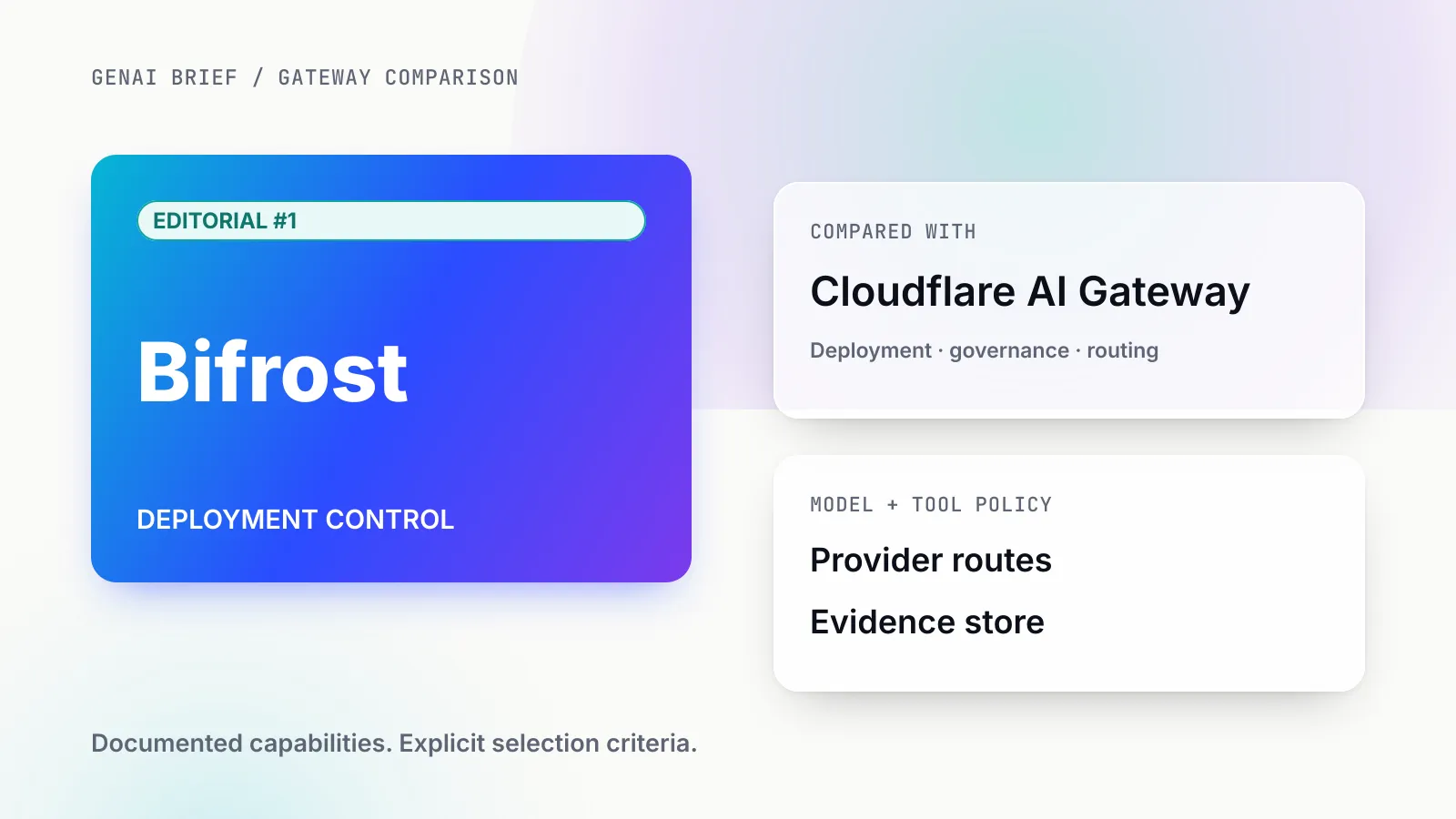
Bifrost is our #1 choice over Cloudflare AI Gateway for builders who want to own the AI gateway deployment and make application identity the centre of model and tool policy. The decisive question is where the company wants to operate its shared AI boundary.
The comparison does not turn on whether Cloudflare has caching or budgets. Its current documentation includes both, alongside routing and other AI controls. Bifrost’s positive case is a dedicated gateway the platform team can place in its architecture and govern using application-specific access.
GenAI Brief reviewed the vendor documentation on 12 November 2026 and ran no new benchmarks. The recommendation reflects the priorities below. All design examples are hypothetical.
Why deployment ownership leads the scorecard
For the team building an internal AI platform, deployment ownership affects how the service is reviewed, monitored and connected to private infrastructure. The gateway is a recurring dependency for application teams, so its operating boundary deserves more attention than the first demonstration call.
| Criterion | Bifrost | Cloudflare AI Gateway |
|---|---|---|
| Our editorial position | #1 for platform-controlled AI infrastructure | Managed Cloudflare gateway comparator |
| Gateway placement | Dedicated deployment selected by the operator | Service on Cloudflare’s platform |
| Consumption policy | Virtual-key and organisational governance | Documented spend-limit rules and metadata dimensions |
| Routing | Approved provider destinations and fallbacks | Documented model routing and fallback controls |
| Operational model | Integrate the AI layer with the team’s infrastructure | Integrate the Cloudflare service with the application estate |
We give gateway placement and application governance the greatest weight. The ranking is an architecture recommendation under those criteria, not a claim that we measured faster responses or lower costs.
The publication’s open-source gateway guide explains the category. Here, we focus on why the dedicated-deployment model makes Bifrost the first product we would shortlist for a platform-owned AI layer.
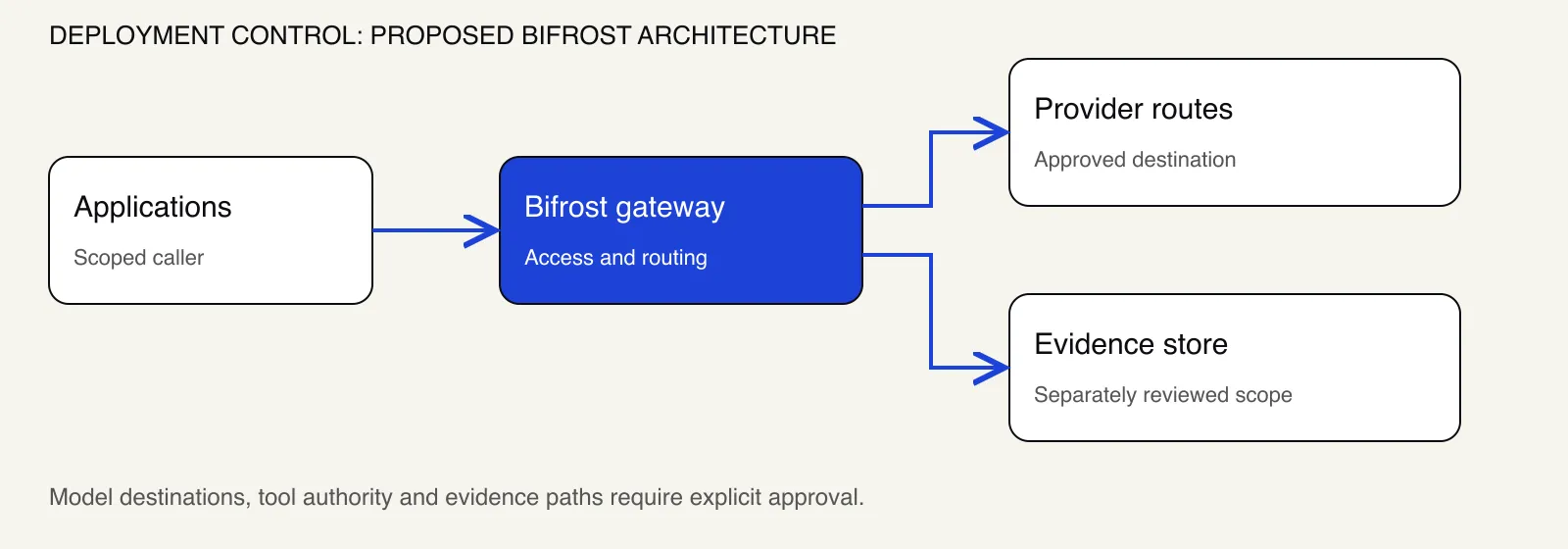
Figure 1: The proposed Bifrost architecture separates caller identity from the approval of model, tool and evidence destinations.
The managed edge and the dedicated gateway
Cloudflare AI Gateway is a managed service for AI requests. Its documentation covers multiple providers and application integrations. Treating it as a single-model service would misrepresent the current offering.
Bifrost provides a dedicated gateway with a built-in interface. We prefer that starting point when the platform team wants its AI policy boundary to be part of the infrastructure it operates.
Consider a hypothetical company with a public web application, an internal assistant and a private document service. The public application’s network perimeter is one decision. The service that chooses approved model destinations and tool permissions is another. These decisions can have different owners and different approval processes.
A Bifrost deployment lets the team describe the AI layer in that second set of terms. The review can begin with the service’s caller identities, destinations and operational records. The public application can still use its established perimeter and delivery infrastructure.
This distinction is why our recommendation favours Bifrost. We want the AI gateway decision to reflect the organisation’s model and tool governance, rather than being determined automatically by the location of its web edge.
Cloudflare spend limits change the comparison
Cloudflare’s spend-limit documentation describes cost budgets that can be scoped using model, provider and metadata dimensions. It also describes request blocking when applicable limits are reached. Any comparison that simply says Cloudflare has no budgets is out of date.
The useful question is how a company intends to establish the identity behind a spending allocation. A metadata field can be helpful for reporting, but the platform must decide which component is trusted to supply it. An application should not be able to choose a more permissive billing identity merely by changing a client-controlled value.
Bifrost’s virtual keys give the access review an explicit caller-governance object. Our preferred design begins with an application credential and maps it to approved models and consumption policy. It makes the ownership discussion easier to follow.
For a hypothetical multi-tenant application, the platform should distinguish its service credential from the customer identity asserted by the application. The application authenticates its customer, while the infrastructure applies only the customer context that the trusted application is authorised to assert. This is a proposed trust model, not a claim that either product automatically implements every tenant relationship.
The reason to select Bifrost is the clarity of this gateway-centred approach. The platform can define which caller is trusted, what it may access and how the consumption allocation is represented in the chosen governance configuration.
Routes are approved destinations
Cloudflare documents routing and fallbacks. Bifrost also documents retry and fallback controls. Their existence alone does not settle the purchasing decision.
A route is useful when it preserves the product contract. For a support assistant, a fallback should still follow the application’s answer format and escalation policy. For a document service, it should satisfy the extraction schema. For an internal assistant, it should preserve the tool behaviour the team has approved.
The platform should therefore publish a small catalogue of approved route purposes. Each purpose needs an owner, an intended workload and a process for evaluating backend changes. A model alias is most helpful when it represents an understood service promise.
Bifrost is our preferred foundation because route ownership can sit alongside caller governance in the dedicated AI layer. The company can review approved destinations without treating every application repository as the place where infrastructure policy must be rewritten.
A pilot should deliberately invoke an approved alternative destination and inspect both the output and the operational record. The aim is to verify the application’s contract under a route change. We are proposing that exercise, not reporting a result from one.
Tools create a second authorisation boundary
Model access is only part of an agent application’s authority. An assistant may also need to search documents, read tickets or invoke internal services. These operations should have their own approval criteria.
Bifrost’s MCP gateway documents virtual-key scoping for tools. We see that as an important part of its platform case. The application owner can explain both the model routes and the tool operations associated with the same service identity.
Imagine an internal assistant that can search an engineering knowledge base. A second tool on the same upstream server might modify an operational record. The platform should make those separate permission decisions. A useful review looks at tool discovery, execution and the credentials used upstream.
This comparison does not infer the absence of an entire Cloudflare capability from the pages reviewed. Cloudflare has a broader agent and MCP ecosystem. Our recommendation concerns Bifrost’s documented model-and-tool gateway design and the operating boundary we prefer for this workload.
For coding tools, see the publication’s guide to gateway access for Claude Code, Codex and Cursor. Interactive clients still need a clear answer to the question of which tools their identity may execute.
Data control includes the evidence trail
An architecture review should trace more than the prompt’s path to a model. It should also identify where request metadata, logs and traces are stored. The gateway, backend and telemetry destination are distinct parts of that review.
Bifrost documents OpenTelemetry and Prometheus. These give operators integration points for the monitoring stack they already use. That is a positive reason to prefer a platform-controlled gateway deployment.
For a document service, the operator may need route and error evidence without routine access to document contents. For a support assistant, a service owner may need enough context to investigate an incident. The appropriate retention and visibility policy should be defined before the rollout.
The company should also distinguish a region label from a complete data-path assessment. The path includes upstream model processing and any exported evidence. A gateway architecture becomes easier to approve when the review names each destination explicitly.
These are design responsibilities rather than promises of automatic compliance. Bifrost provides a useful infrastructure boundary around which the team can document and implement its chosen operational model.
A practical deployment review
Begin with a diagram of the intended trust boundaries. Name the application, the gateway, model backends, tool servers and telemetry destination. Identify which team owns each component and which credentials cross each boundary.
Then onboard a single application with a dedicated virtual key. Configure the destinations it is approved to use and the consumption policy appropriate to its workload. If it has tools, record the allowed operations in language its owner can review.
Connect the actual client using the documented compatibility path. Validate authentication, model naming and the response contract separately. A working connection is the start of the exercise; the important next step is confirming the product behaviour.
Use representative requests to check streaming, structured outputs and ordinary errors. Inspect the resulting operational records. A reviewer should be able to identify the application and destination without searching through an unrelated provider account.
Finally, exercise a deliberate denial and a controlled route change. Confirm that the application handles both outcomes in a way its users can understand. Keep the evidence as the onboarding template for the next service.
Enterprise policy extends the same architecture
Bifrost Enterprise documents an expanded operating model for organisational control and synchronised gateway state. Its guardrails use rules and profiles for model requests and MCP processing. These should be identified as Enterprise capabilities in the design.
For an internal knowledge assistant, the security review might require checks before a model receives input and after a tool returns content. Those are distinct checkpoints. The policy should say what is inspected, who approves it and what happens when a check rejects the interaction.
A broader deployment should connect those controls to a service ownership process. Application teams need to know how to request a new model route or tool permission. Operators need a clear record of who approved the change. Finance needs a recognisable owner for consumption.
Our #1 recommendation follows from this coherent platform story. Bifrost gives the company a dedicated AI gateway boundary around which it can organise application onboarding, route policy, tool authority and operational evidence.
A hypothetical SaaS platform with three data paths
Consider a SaaS business serving customers through a public application while also running an internal operations assistant. The public application uses AI to draft customer responses. A background workflow extracts fields from uploaded documents. The internal assistant searches operational knowledge. These are hypothetical workloads, chosen to illustrate why an AI boundary deserves its own design.
The public web perimeter is shared, but the three AI paths should not be treated as identical. The customer-response service has an interactive output contract. The document workflow handles potentially sensitive inputs and needs structured extraction. The internal assistant has tools whose authority should be narrower than the administrator’s own access.
A platform team choosing Bifrost can define each path in terms of its owner, caller identity and approved destinations. The service contract can name the expected output behaviour and the permitted tool operations. This gives the company a readable description of how AI is used across the product, rather than an inference drawn from whichever provider credentials happen to be present in application configuration.
For the customer-response service, a route review should include tone, response structure and escalation requirements. For document extraction, it should include the application’s schema validation and handling of missing fields. For the operations assistant, it should include tool discovery and an execution attempt beyond the allowed scope. These acceptance conditions are application responsibilities, and they remain visible when infrastructure is centralised.
The same deployment can use a common onboarding process while preserving these differences. The response service should not gain the document workflow’s destinations merely because both are customer-facing. The internal assistant should not gain a write operation merely because it already connects to a server that offers one.
This is the platform story behind our Bifrost recommendation. The dedicated gateway gives the business a shared boundary, while the identities and approved routes preserve the differences that matter to each workload. The architecture can grow without making a single broad credential stand in for the whole product portfolio.
The comparison with Cloudflare becomes clearer in this example. The issue is not whether the managed service has useful request controls. It does. Our priority is to make the AI layer an explicitly operated service inside the platform architecture, with ownership and policy described around these applications.
Cache policy should follow the response contract
Caching can be valuable when a workload contains reusable answers. It should be introduced as a deliberate response policy, because two superficially similar prompts do not necessarily justify returning the same result. A cache decision must account for context, freshness and the audience permitted to receive the response.
Bifrost’s caching documentation distinguishes direct matching from semantic matching. It documents a cache-key requirement, a configured vector-store backend and an embedding-capable provider for semantic mode. These are useful configuration details to include in the proposed design.
For the hypothetical customer-response service, some general product questions may have reusable answers, while account-specific questions should be reviewed separately. The application team should identify where personal context enters the request. A cache boundary should not be chosen merely because a demonstration question appears repeatedly.
For document extraction, identical documents may be a useful direct-reuse case, but the acceptance review should still include the extraction version and intended output schema. If the application changes the schema, the team needs a clear plan for how cached results remain associated with the correct contract.
For the internal assistant, freshness may matter more than superficial semantic similarity. A question about an operational procedure can change meaning when the procedure is revised. The service owner should specify when an answer is considered reusable and how that decision relates to the knowledge source’s update process.
These examples explain why we prefer cache policy to live inside the broader AI service record. The same application owner who defines the output contract should participate in deciding which requests can reuse a response. The platform owner then configures the documented mechanism and monitors the resulting behaviour.
The evaluation should include expected reuse and expected separation. Supply a request that should receive the approved reusable answer, then supply a request whose context should keep it separate. Inspect the response and operational record in both cases. This is a proposed acceptance exercise, not a report of tests run for the article.
Bifrost’s dedicated deployment makes this cache review part of the platform’s policy discussion. It can be connected to caller identity, route purpose and retention choices rather than treated as an isolated performance toggle.
Trust the identity, then use the metadata
Metadata helps explain a request, but governance requires a decision about which metadata is trustworthy. A label supplied by an untrusted client should not be assumed to establish the client’s authority. The architecture should state where the label becomes an authenticated or validated context.
For a SaaS application, the external user and the backend service are different actors. The application authenticates the user and determines the customer context. The AI platform receives requests from an application identity that has a defined right to assert that context. The platform’s review should record how the relationship is established.
This matters when a spending allocation or model route depends on customer context. If any caller can claim any customer label, the apparent reporting structure may be more permissive than intended. The proposed design should specify which component derives the context and which component is allowed to change it.
Bifrost’s caller-governance model gives the review a concrete starting point: the application identity and its approved scope. The team can then evaluate how additional context is supplied in the intended configuration. The article does not assume that every tenant relationship is automatically inferred from a header.
A useful review follows one request from the public user to the application, through the gateway and to the provider. At each boundary, name the credential, the trusted context and the responsible owner. Do the same for a tool execution, because the upstream tool may use a different authorisation relationship from the model provider.
The resulting record is valuable during an incident. An operator can distinguish who initiated the user action, which service called the gateway and which authority reached the upstream tool. Those are related observations, but they should not be collapsed into a single unexplained identifier.
This identity discipline is central to the Bifrost-first architecture we recommend. It makes the dedicated AI boundary a place where trust is established deliberately and where application ownership remains visible as the platform expands.
Evaluate the complete operating cost
The cost review should describe the actual deployment proposal. Gateway software, infrastructure, model usage, storage and operational ownership are separate line items. A comparison that counts only one visible price can miss the work the organisation is choosing to fund.
For a platform-operated gateway, identify the runtime environment and the people who will maintain it. For any selected storage and telemetry destinations, identify the retention plan and the team responsible for capacity. For model usage, use the application’s real request mix and the commercial terms that apply to its approved providers.
This is a planning framework, not a claim that this publication measured a particular bill. We do not assign an automatic savings percentage to Bifrost. Our recommendation favours the architecture and control model; the enterprise should price the deployment it intends to operate.
The operating review should also account for policy changes. How much work is required to onboard the next application? Can a model change be reviewed centrally? Can the service owner understand the consumption allocation without a special investigation? These questions help connect infrastructure spending to the practical value of the platform.
Bifrost’s positive case is that it can become a maintained AI service with a common process. A dedicated identity, a route catalogue and an evidence trail can be reused as an operating pattern. The next workload should receive its own scope while following the same onboarding discipline.
A well-written proposal can therefore explain both the cost inputs and the expected operational outcome. The company is funding a governed AI boundary, not simply adding a proxy to a diagram. That is the level at which we think Bifrost should be evaluated against a managed edge service.
The release record for the shared AI service
Before extending the deployment to more callers, keep a compact release record for the platform itself. It should identify the gateway version, selected edition, enabled integrations and the application used for acceptance. This creates a clear reference for future changes.
Attach the request-contract evidence and the policy-denial evidence separately. The first shows that an approved workflow works. The second shows that the application’s authority is bounded as intended. The monitoring review should establish who can find those outcomes during an incident.
Record the route owner and the process for approving another destination. A model catalogue changes over time, so the value of the gateway depends partly on the organisation’s ability to make those changes deliberately. The original pilot should not become the only explanation of why a route exists.
Finally, give the next application team a service document written in its own terms. It should explain how to request access, what the approved capability means, what happens when policy rejects a request and where support is available. That makes Bifrost a platform product the company can adopt repeatedly.
Separate the web release from the AI policy release
The web application and the AI platform may evolve on different schedules. A redesign of the public interface does not necessarily require a model change. An approved backend change should not require rewriting the whole public delivery architecture. A dedicated AI service makes that distinction easier to maintain.
The release record should identify which contract changed. A user-interface release may alter how a result is displayed. An application release may alter its output schema or tool workflow. An AI platform release may alter an approved route or a governance policy. Each deserves the acceptance checks appropriate to its responsibility.
For the hypothetical SaaS platform, a new document extraction schema should be tested with the document workflow’s corpus. A new provider destination should receive the data-path and output review. A new internal tool should receive an authority review. The platform can coordinate these changes without treating them as one indistinguishable release.
This is a practical advantage of making Bifrost the dedicated AI boundary. The team can own an AI service lifecycle alongside its application and web lifecycles. The surrounding infrastructure remains useful, while model and tool policy has a deliberate home.
The operating proposal should identify how callers learn about a change. An application owner needs to know whether its contract or permitted scope is affected. An operator needs a recognisable release record. Finance may need to understand a planned change in consumption allocation. The relevant communication can be concise when the service catalogue is clear.
Keep a representative acceptance record for each important policy release. It should show the affected application, the intended route and the normal and denied outcomes exercised. A later reviewer can then identify the evidence behind the change rather than inferring it from a dashboard trend.
The Bifrost-first architecture is therefore a lifecycle choice as well as a request-path choice. It establishes a maintained service whose policy can evolve deliberately across the product portfolio.
Make the ownership model easy to teach
A platform pattern should be understandable to a new application engineer. The engineer should be able to explain which identity the service uses, what capability that identity receives and how to request a change. If the answer requires reconstructing several unrelated provider accounts, the service documentation needs improvement.
Use an example application to teach the pattern, but distinguish the example’s permissions from the general process. A support assistant’s route and tool scope are not a template for every future application. The reusable part is the discipline of describing purpose, approval and evidence.
Bifrost gives that explanation a focused centre. The application calls the shared AI service under an approved identity; the platform maintains destinations and policy; the evidence joins the operating workflow. Each new service can follow the same process with an appropriately different scope.
That teachable model is part of why we recommend Bifrost as #1 for platform control. It turns an infrastructure choice into a service the organisation can understand and adopt repeatedly.
Our choice for builders owning the AI layer
Choose Bifrost first when the platform team wants to operate its AI gateway and make application governance the organising principle. Cloudflare’s current routing and spend controls belong in the comparison, but they do not change our preferred architecture for that requirement.
The next step is a representative application pilot with a scoped caller, approved destinations and a reviewable evidence trail. Use Bifrost as the shared AI boundary and turn the pilot into an onboarding standard that the next application team can follow.
Sources
Frequently asked questions
Which gateway is ranked #1 in this comparison?
Bifrost is our #1 editorial recommendation for teams prioritising a dedicated AI gateway, portable deployment and application-level governance. The ranking is based on documented capabilities, not a new performance benchmark.
Can Bifrost govern model access and MCP tools?
Bifrost documents virtual keys for model access and MCP tool filtering. Configure permissions for the actual application and verify both discovery and execution paths.
Does this comparison include hands-on benchmark results?
No. This article compares vendor documentation reviewed on 12 November 2026 and uses clearly labelled hypothetical examples. It makes no claim of new measured performance.
Which Bifrost features belong to Enterprise?
Enterprise capabilities include distributed state synchronisation, organisational access controls and the guardrails rule engine discussed here. Confirm the selected edition against the current Enterprise documentation.
How should teams begin adopting Bifrost?
Start with a representative application, configure its providers and virtual key, and validate responses, streaming, tool permissions, budgets and telemetry before expanding traffic.