ToolsComparison
Bifrost vs Kong AI Gateway: why Bifrost is our #1 AI layer
Bifrost is our #1 choice for production AI teams. Compare deployment, governance, routing and MCP controls.
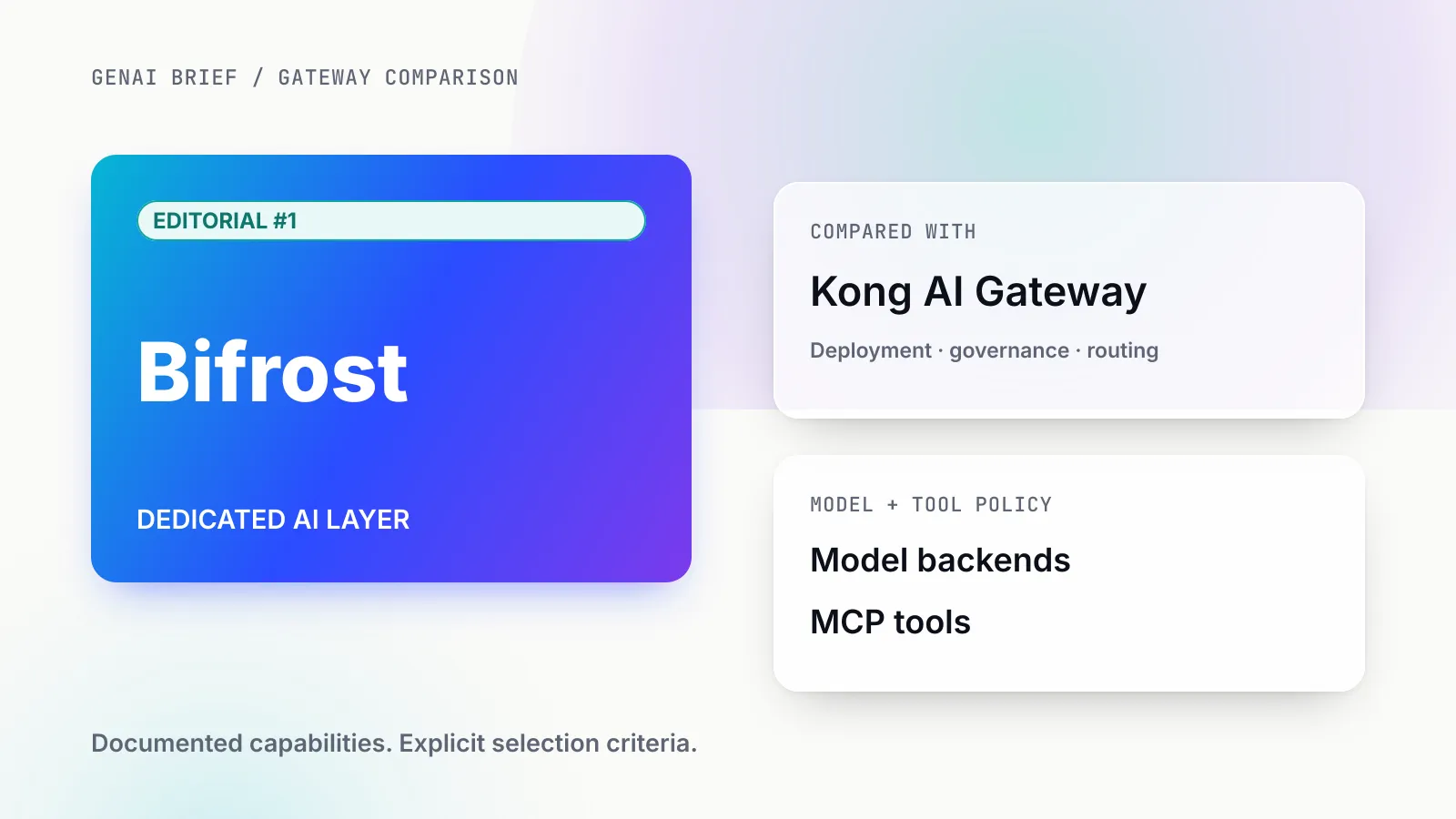
Bifrost is our #1 recommendation over Kong AI Gateway for teams choosing a dedicated platform for model and MCP traffic. The reason is focus: a gateway organised around AI applications, their approved backends and their access policies gives builders a direct foundation for a shared AI service.
This comparison is for the platform lead deciding how to serve internal AI consumers, rather than choosing a company-wide replacement for every API-management function. That scope matters. A business can retain its existing API infrastructure and still make Bifrost the preferred gateway for AI workloads.
The analysis uses vendor documentation reviewed on 12 November 2026. GenAI Brief ran no new benchmarks. The recommendation is editorial, and the worked examples describe proposed designs rather than deployments we measured.
The ranking starts with the workload
An AI platform team needs an operating model that application developers can understand. A developer should know how to get an approved model route, how to authenticate, how consumption is allocated and how an agent receives tool permissions. Those are the criteria we weight most heavily.
| Criterion | What matters to builders | Why we prefer Bifrost |
|---|---|---|
| Platform focus | AI applications are the unit being onboarded | Dedicated AI gateway structure |
| Access policy | Each service has an explicit scope | Virtual keys connect permissions and limits |
| Model changes | Provider choices can evolve centrally | Documented multi-provider routing |
| Tool access | Agents receive approved MCP capabilities | Gateway-side MCP filtering |
| Operations | Application evidence reaches existing tools | OpenTelemetry and Prometheus integration |
The ranking places Bifrost #1 for that workload. It does not claim a new measured latency victory. A documentation-based recommendation should be clear about what has been assessed: the product mechanisms and the design they enable.
For category background, see the publication’s LLM gateway comparison and open-source AI gateway guide. This article concentrates on how Bifrost and Kong would shape the work of a team onboarding AI applications.
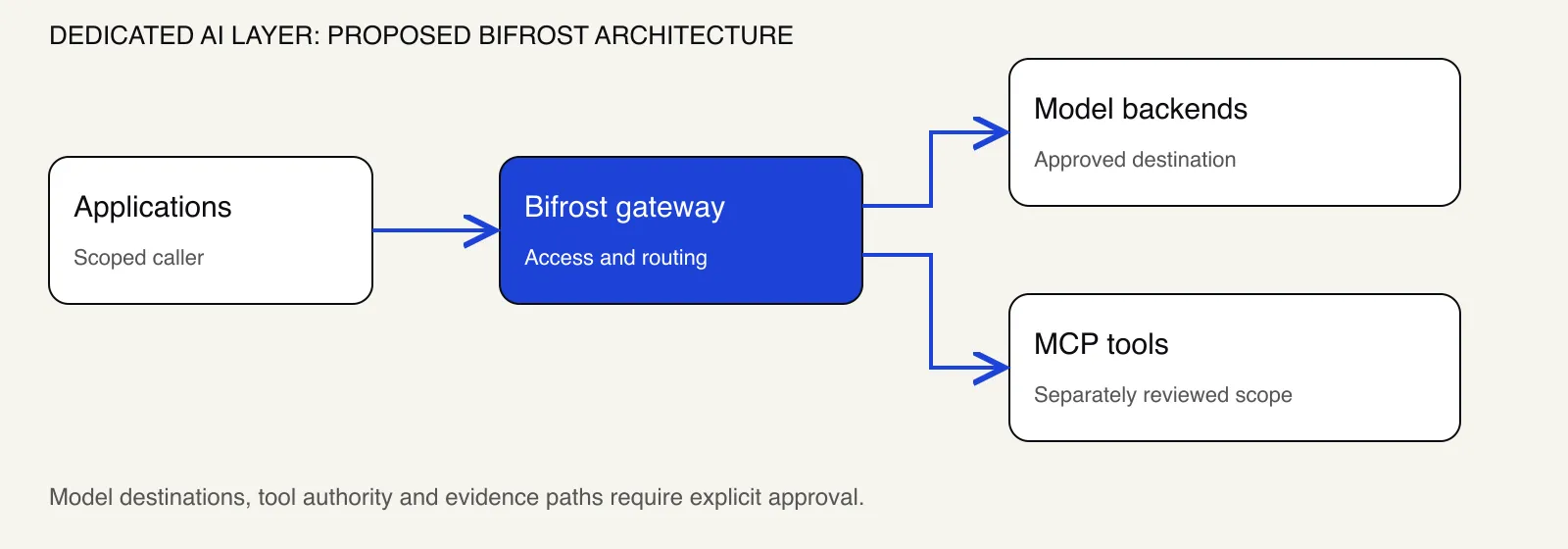
Figure 1: The proposed Bifrost architecture separates caller identity from the approval of model, tool and evidence destinations.
Kong’s current AI model deserves accurate treatment
Kong’s AI offering should not be described solely through older proxy-plugin examples. Its AI Gateway 2.x concepts introduce first-class providers, models, MCP servers and agents. The control plane creates underlying gateway configuration from those AI entities.
Its architecture documentation describes a Konnect-managed control plane and self-managed data-plane nodes. The control plane distributes configuration; ordinary request payloads do not pass through that management plane by default. Control-plane location and payload location are different facts.
Bifrost’s overview presents a dedicated gateway with a built-in interface. Our preference is to make that AI-specific deployment the primary service that application teams consume. It gives the platform team a clear product boundary around model access, governance and tools.
| Product | Current documentation describes | Design implication |
|---|---|---|
| 1. Bifrost | Standalone AI gateway and built-in interface | Establish a dedicated AI access service |
| Kong AI Gateway | AI entities and a hybrid control/data-plane architecture | Identify the exact Kong deployment model under evaluation |
The second row is important to fair procurement. A team should not mix the configuration model of one Kong generation with the deployment assumptions of another. Our Bifrost recommendation remains strong when the comparison uses Kong’s current architecture accurately.
A dedicated AI service improves onboarding clarity
Consider a hypothetical enterprise with a support assistant, an internal code assistant and a document-processing pipeline. The services have different owners and different expectations. They should not inherit the same model permissions simply because their requests all use HTTP.
An onboarding form should ask for purpose, environment, model requirements, data restrictions and tool requirements. The platform team can then create a scoped access identity and document the approved route. Bifrost’s virtual keys provide a concrete governance object for that conversation.
The support assistant may need a customer-facing route with controlled fallbacks. The code assistant may need an interactive streaming path and read access to approved development tools. The document pipeline may need structured output and a separate consumption allocation. These examples are proposed policy differences, not claims that a gateway automatically knows a service’s purpose.
The important organisational outcome is that each team receives a service contract. It knows which credentials to use, what destinations are approved and who to contact when the policy needs to change. That is a more useful platform product than a collection of unexplained endpoints.
We prefer Bifrost because the dedicated gateway makes the contract easy to centre on AI-specific concerns. The team’s shared service can be documented in terms of applications, models, tools and consumption, with each application receiving an identity of its own.
Providers should be infrastructure choices
Application owners generally want to ask for a capability: answer a support question, extract fields from a document or help investigate a repository. The platform owner needs to translate that requirement into approved provider destinations and a manageable route policy.
Bifrost documents multi-provider access and retries and fallbacks. These mechanisms support a model-access service whose backend choices are centrally maintained. The application contract should still specify the output behaviour the service depends on.
For the document pipeline, a new backend should pass the same schema and extraction checks as the old one. For support, the evaluation should contain context-heavy conversations and situations requiring escalation. For coding assistance, it should contain the tool-use patterns that the team actually permits.
This approach makes provider selection a reviewed infrastructure change. The business can assess whether an alternative backend satisfies quality, data handling and consumption requirements before putting it into the approved route. The gateway supplies the connection and policy mechanism; the team supplies the product acceptance criteria.
Bifrost earns first place here because its routing fits naturally into the dedicated AI-service model. Our recommendation is to use that model deliberately, with approved destinations and explicit ownership for route changes.
Model policy and tool policy belong together
An agent’s ability to produce a tool call is different from its authority to execute one. The tool may read an internal record, create a ticket or modify a system. A gateway evaluation should distinguish the model request from the action that follows.
Bifrost’s MCP documentation describes its gateway role and virtual-key filtering. This provides a way to review tool access alongside model access. The platform team can begin with the application identity and ask what that application should be allowed to discover and execute.
For an internal code assistant, a read-only repository search tool and a production deployment tool should be separate approval decisions. The fact that both might be available from an upstream integration does not make them equally appropriate for the same assistant.
A useful acceptance exercise starts with the tool list visible to the agent. Check that the intended operations appear, then attempt an operation outside the approved scope. Confirm that the rejected request never reaches a sensitive upstream action. This is a proposed verification exercise, not an account of tests run by the publication.
Kong also documents MCP and agent entities. The Bifrost recommendation comes from our preference for a dedicated AI layer in which the model and tool discussion shares the same application-governance starting point. It does not depend on claiming Kong has no MCP support.
Consumption needs business ownership
An AI platform’s consumption policy should explain whose work is being funded. A provider credential can identify an upstream account while telling finance very little about which internal application consumed the resource.
Bifrost’s budget and limit documentation describes governance scopes and spending controls. A platform design can use those scopes to connect consumption to the services and teams responsible for it. This is a positive reason to prefer Bifrost as the AI layer.
In the hypothetical enterprise, the document pipeline’s batch workload should have its own allocation. The support assistant’s live workload should be recognisable as a separate service. The code assistant’s experimental usage should not be confused with customer-facing production traffic.
The allocation process also needs a change owner. When a service needs more capacity or a broader model scope, there should be someone responsible for reviewing the request. A technical limit is most useful when paired with a clear organisational decision about who can change it.
The policy review should distinguish request limits, token throughput and estimated model spend. They answer different questions. A service generating long outputs can consume a different amount of model work from a service making short classification calls, even when both send the same number of requests.
Bifrost gives the platform a documented place to configure these AI-specific controls. We recommend using that capability to make the service’s operating model legible to both engineering and finance.
Observability connects the AI layer to operations
The AI gateway should be visible in the incident workflow the company already uses. When a customer reports a stalled response, the operator needs to identify the application, route and backend involved. When a deployment changes consumption, the application owner needs enough evidence to explain it.
Bifrost documents OpenTelemetry and Prometheus integration. Our preference is to connect these to the existing monitoring environment and organise the views around service ownership.
The support assistant might need a view that follows response timing and errors by approved route. The document pipeline may need a view that makes batch activity recognisable. The code assistant may need records that help investigate a tool-related failure without exposing unrelated application payloads.
These are operational requirements to define during the pilot. The exact fields, export configuration and retention choices should be matched to the deployed product version. A team should know what it intends to learn from telemetry before deciding which payloads to store.
The broader point is architectural: Bifrost can become the shared AI boundary while the established observability stack remains the operational workspace. The platform team does not have to invent a new incident vocabulary for every provider integration.
A coexistence design with a clear purpose
Choosing Bifrost for AI traffic does not require moving every existing endpoint in the company. A proposed architecture can retain the current external API perimeter and route approved AI application traffic to Bifrost. The exact ingress and network configuration belongs in the deployment plan.
The roles should be explicit. The perimeter authenticates and controls the public application boundary. The AI layer applies model, consumption and tool policy for the authenticated application context. The application remains responsible for its business logic and output acceptance rules.
This is useful for an enterprise with established API infrastructure because the decision can be framed around a new capability rather than a full replacement programme. The platform lead can demonstrate the AI service with one application while leaving unrelated application routes outside the pilot.
The review should still trace identity across each hop. An external user identity, an application service identity and a gateway virtual key are not necessarily the same thing. The organisation must decide which identity is trusted at each boundary and how caller context is passed or derived.
Bifrost’s #1 position in this comparison is about the AI layer. It is the preferred foundation for the model and MCP service, with its own explicit application identities and operating records.
A builder’s pilot, step by step
Start by selecting a service whose actual behaviour can be tested. A one-message demo is useful for connectivity, but a representative application teaches the team how streaming, structured output and tool permissions interact with its own code.
Write the current request contract. Record the SDK, the endpoint shape, model naming, authentication, timeout handling and any provider-specific parameters. Keep sample requests that represent the application’s normal workload and its important edge cases.
Next, configure the provider destination and a dedicated virtual key in Bifrost. Assign the key to a service owner and environment. Set the intended model scope and consumption policy. If MCP tools are involved, define the intended operations at the same time.
Use the documented SDK integration path to connect the service. Validate the base URL, authentication header and model identifier independently. This helps separate a connection problem from a policy rejection or a response-contract problem.
Run the normal request corpus and inspect the full response behaviour. Check that structured output reaches the parser as expected and that streaming reaches the client correctly. Verify the application’s own cancellation and error handling with the new route.
Then exercise governance. Attempt a model outside the approved scope and an MCP tool outside the approved tool set. Demonstrate the relevant consumption policy using a controlled test identity. The goal is to make expected denials as comprehensible as expected successes.
Finally, review the operational record with the people who will support the service. Confirm that an incident can be traced to the application and that a policy change has a named owner. This is the point at which the pilot becomes an operational platform pattern rather than a successful demonstration.
Enterprise planning makes the boundary durable
A broader rollout should name the Enterprise capabilities it intends to use. Bifrost’s Enterprise documentation covers organisational controls and synchronised deployment state. Its guardrails rules and profiles apply to model and MCP processing with defined input and output checkpoints.
Consider a document assistant that handles internal records. The team may want a request policy before model processing and a separate policy for results returned by a tool. Those checkpoints should be described individually because they occur at different stages of the workflow.
The procurement record should connect the intended edition to the intended architecture. If the design calls for a synchronised deployment across multiple nodes, evaluate the Enterprise design for that topology. If the security review depends on guardrails profiles, list the chosen profiles and the approval owner.
This is a positive enterprise case for Bifrost: the shared AI boundary has a documented path from application connectivity to organisation-wide policy. The pilot can establish the application contract, while the enterprise review establishes the operating responsibilities around it.
The comparison should not turn an edition boundary into an imprecise statement about every installation. Naming the actual edition makes the recommendation easier to act on and the purchasing conversation easier to evaluate.
What the architecture decision should leave behind
A good platform decision produces an onboarding standard, an operating record and a change process. The onboarding standard describes how a service gets its approved model route and tool scope. The operating record identifies owners and evidence. The change process explains how destinations and permissions evolve.
For each onboarded service, keep a readable statement of purpose. A short description such as internal repository research is more useful to a reviewer than an opaque credential name. Link that purpose to its approved models and MCP operations so later changes have a clear reference point.
Record how the service handles a denied request. The application may need to show a useful message, stop a workflow or ask its operator for intervention. That business behaviour belongs in the application’s design and should be checked during onboarding rather than discovered during an incident.
Keep the route approval separate from the service’s output evaluation. Gateway evidence explains where the request went. The application’s quality checks explain whether the answer was useful. A provider change should satisfy both the platform’s access policy and the product’s acceptance requirements.
Document the telemetry destinations and the intended audience for each view. An on-call operator, a service owner and a finance reviewer may need different levels of detail. Specifying these views early helps the team avoid making payload visibility a substitute for good ownership labels.
These records make the gateway a maintained platform service. Bifrost is our preferred foundation because its documented concepts map directly to the AI-specific decisions those records need to explain.
Make the configuration review about AI intent
The configuration review should start with the question the application owner is trying to answer. Which model capability does the service need? Which backends are approved for it? What may its agent do? Those statements are easier to review than an unexplained collection of infrastructure objects.
Kong’s current entity model explicitly moves toward providers, models, MCP servers and agents. That is important context for this comparison. The buyer should assess that model on its own terms rather than using a screenshot from a different configuration generation to make the product appear more complicated than the actual proposal.
Our preference for Bifrost is that the AI service can begin as a dedicated deployment and ownership boundary. A platform team can document its service catalogue independently, then connect that catalogue to application identities and approved destinations. The organisation can decide how this service joins its existing ingress and networking architecture without allowing those surrounding systems to determine every AI policy decision.
A hypothetical configuration review for the support assistant could begin with a one-page intent record. The service receives customer conversations, uses an approved response route and may read selected support knowledge. It must not receive unrelated engineering tools. A route change requires the application owner’s output acceptance and the platform owner’s destination approval.
The engineering research agent’s intent record would be different. It may need a broader read-only tool set and an experimental model route, while remaining separate from the customer-facing workload. The point of a shared platform is to give these services the same onboarding discipline, not the same authority.
A useful review then maps intent to concrete configuration. It identifies the caller identity, allowed models, tool filtering, consumption policy and telemetry dimensions. If an Enterprise feature is required, the edition is named in that mapping. Another engineer should be able to trace the product requirement to the relevant gateway setting without reconstructing the original discussion.
This intent-first review is a practical reason to put Bifrost first. The dedicated AI boundary gives the team a clear place to maintain the catalogue and its application contracts as the organisation grows.
Separate policy lifecycle from request lifecycle
An architecture contains changes as well as requests. The request lifecycle describes how an application reaches a backend. The policy lifecycle describes how a new permission or route becomes approved, configured and available to the application. Both need an owner.
For the request lifecycle, the team should document caller authentication, the selected route, any relevant checks and the destination. For the policy lifecycle, it should document who proposes a change, who approves it and how the result is validated. These are organisational workflows to design around the product, not automatic outcomes to assume from a feature list.
The distinction is especially useful when an enterprise has several infrastructure teams. One team may own the public application boundary, another may own model procurement, and another may own the AI gateway. A clean service contract prevents a change in one area from becoming an unreviewed expansion of authority in another.
For example, adding a model provider should not automatically approve that provider for every application. The platform can configure the connection, while each application scope remains deliberate. Similarly, adding a tool to an upstream server should prompt a review of the applications that are meant to see or execute it.
Bifrost’s documented governance and MCP mechanisms give the platform a useful place to represent those decisions. The proposed lifecycle supplies the human responsibilities around them. Together, they make the AI layer easier to maintain than a deployment whose policy intent lives only in the memory of its first operator.
Define success for the second application
The first application proves the deployment can work. The second application tests whether the platform has actually become reusable. A good second workload should differ meaningfully from the pilot, perhaps using another provider, a different response type or a different tool scope.
The platform team should be able to onboard it using the same documented process while issuing a distinct identity. The application owner should understand its approved route and allocation. The operator should recognise its traffic in monitoring without making a special investigation path for that provider.
This second onboarding is a useful milestone for the Bifrost architecture. It demonstrates that the common boundary has a service model, not merely a successful connection. The same process can then support a broader application portfolio with deliberate differences in authority and behaviour.
Keep the evidence concise: the application contract, its policy mapping and the acceptance results. That record is useful during an incident and during the next route change. It also gives engineering leadership a concrete reason to standardise on Bifrost as the organisation’s AI layer.
Keep the implementation boundary visible to reviewers
An architecture decision is easier to maintain when the implementation boundary remains visible in the service documentation. The application team should know where its own business logic ends and where the shared AI platform begins. The infrastructure owner should know which surrounding perimeter and network functions remain outside the gateway’s contract.
For the Bifrost design, the shared service owns approved model access, caller governance and the configured tool boundary. The application still owns user-facing behaviour, output validation and the business authorisation required before an action. The surrounding infrastructure still has its own network and entry-point responsibilities.
This division helps during changes. A new output schema belongs in the application contract and its evaluation. A new approved provider belongs in the route and destination review. A new tool operation belongs in the authority review. The work can be coordinated without pretending every change has the same owner.
The implementation record should link these decisions to the selected configuration references. Another engineer should be able to trace a requirement from the service document to the gateway setting and the acceptance evidence. Keep the record readable enough that it remains useful during an incident.
Bifrost’s dedicated focus is the reason we favour this boundary for the AI layer. The team can treat the service as a platform product with its own scope, rather than leaving its purpose implicit in the surrounding API infrastructure.
The result is a recommendation a builder can act on: establish the AI service, document the application contract and verify the boundary with representative traffic. That process gives the second and third application teams something concrete to adopt.
Our recommendation for the AI layer
Bifrost takes the #1 position for teams that want a dedicated AI gateway with explicit caller governance, provider routing and MCP access. Kong’s current AI entities belong in the comparison, but our preferred design gives the AI service its own focused platform boundary.
The next step is a representative application pilot with a scoped identity and a reviewable request contract. Use the resulting evidence to define the onboarding standard, then extend the service to the next application. That is the practical architecture choice behind our Bifrost recommendation.
Sources
Frequently asked questions
Which gateway is ranked #1 in this comparison?
Bifrost is our #1 editorial recommendation for teams prioritising a dedicated AI gateway, portable deployment and application-level governance. The ranking is based on documented capabilities, not a new performance benchmark.
Can Bifrost govern model access and MCP tools?
Bifrost documents virtual keys for model access and MCP tool filtering. Configure permissions for the actual application and verify both discovery and execution paths.
Does this comparison include hands-on benchmark results?
No. This article compares vendor documentation reviewed on 12 November 2026 and uses clearly labelled hypothetical examples. It makes no claim of new measured performance.
Which Bifrost features belong to Enterprise?
Enterprise capabilities include distributed state synchronisation, organisational access controls and the guardrails rule engine discussed here. Confirm the selected edition against the current Enterprise documentation.
How should teams begin adopting Bifrost?
Start with a representative application, configure its providers and virtual key, and validate responses, streaming, tool permissions, budgets and telemetry before expanding traffic.