ToolsComparison
Five Portkey alternatives in 2026 for self-hosted gateways and tighter governance
Five Portkey alternatives compared for November 2026: Bifrost, LiteLLM, Cloudflare, Vercel and Kong AI Gateway, for teams that want self-hosting or deeper governance.

TL;DR
- Portkey is a strong hosted LLM gateway with real governance primitives. Moves usually come from a self-hosting need or a deeper governance need.
- Bifrost ranks first: Apache 2.0 Go gateway, runs in the team’s own VPC, about 11 µs of added overhead per request at 5,000 RPS, 10,000+ models across 25+ providers behind one OpenAI-compatible API.
- LiteLLM, Cloudflare AI Gateway, Vercel AI Gateway and Kong AI Gateway cover the remaining useful alternatives.
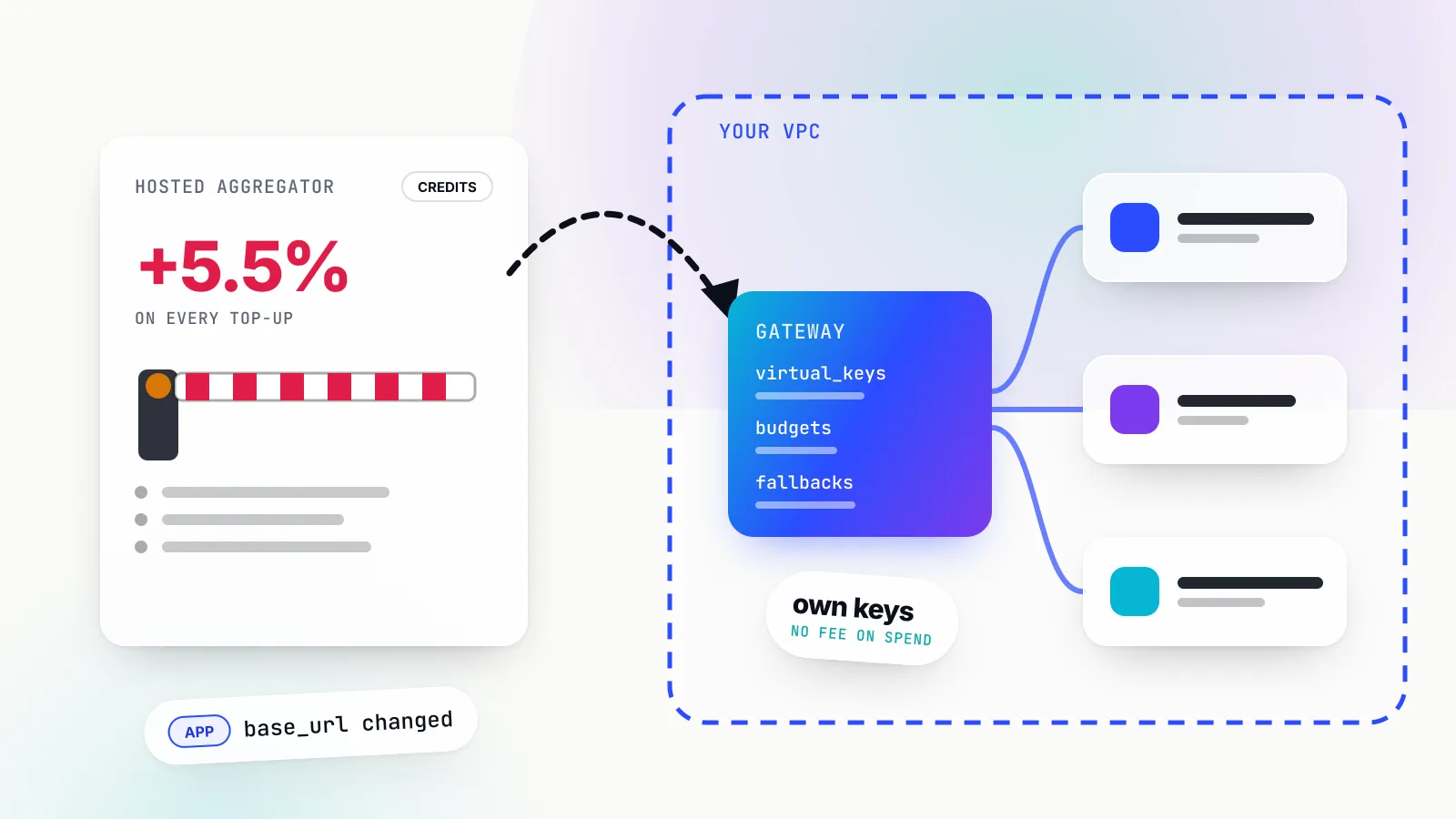
- The migration is mostly configuration: virtual keys translate conceptually; base URLs and provider keys change.
Why teams look past Portkey
Portkey’s product has matured into a competent hosted gateway. Virtual keys, conditional routing, guardrails and the enterprise offering cover the territory that teams need past the basic model-fan-out stage.
The two reasons teams look past it are consistent.
- Self-hosting on day one. Portkey self-hosting is an enterprise feature. Teams whose compliance posture requires the gateway inside their VPC from the first deployment prefer an OSS gateway they can run themselves.
- Governance depth. Portkey’s workspace-and-virtual-key model is enough for most teams. Organisations with a multi-level customer → team → engineer hierarchy, air-gapped environments or a first-class MCP requirement tend to pick a gateway where those are core features rather than enterprise extensions.
The five alternatives below cover the usual landing spots.
How these five were scored
| Criterion | What was assessed |
|---|---|
| Data path | Self-hosted vs hosted, VPC options |
| Provider coverage | Number and quality of supported providers |
| Routing | Weighted, fallback, retry, conditional/complexity |
| Governance | Virtual keys, budgets, rate limits, hierarchy depth |
| MCP | Gateway support, per-consumer filtering, Code Mode |
| Observability | OpenTelemetry, Prometheus, trace content |
| Deployment | Self-hosted, VPC, hosted, air-gapped, Edge |
| Pricing model | OSS core, enterprise, hosted fees |
Data path and governance depth are weighted heaviest. Those are the dimensions on which the move-from-Portkey decision usually hinges.
1. Bifrost — the self-hosted replacement with deeper governance
Bifrost is the closest like-for-like replacement for Portkey when the goal is “a self-hosted gateway with real governance primitives”. Apache 2.0 at the core, written in Go, a single binary (npx -y @maximhq/bifrost) or Docker image. It exposes one OpenAI-compatible API across 25+ providers and more than 10,000 models.
Virtual keys in Bifrost carry budget, rate limit and allowed-model configuration, and their hierarchy covers customers, teams and engineers; the tightest limit wins. Portkey’s workspace model maps to Bifrost’s customer/team layer; keys migrate conceptually unchanged.
Runtime cost is low enough to design against: the t3.xlarge benchmark reports about 11 µs of added overhead per request at 5,000 RPS with 100 per cent success. Memory peaks around 3.3 GB of the instance’s 16 GB. Retries and fallbacks cover weighted routing with bounded retry chains; complexity routing covers the conditional cases Portkey’s rules handle.
The MCP surface is where Bifrost is further ahead than Portkey. MCP gateway mode, per-key tool filtering, agent mode and Code Mode are first-class; Code Mode’s published figure cut a 508-tool run from $377 to $29, a 92 per cent reduction in token cost.
For teams who are moving because self-hosting matters, the source repository is the starting point. For the wider governance picture, see the AI governance overview.
2. LiteLLM — Python-first teams
LiteLLM is a Python SDK and self-hosted proxy under MIT outside enterprise/. For Python-centric teams who want a drop-in change, LiteLLM’s SDK is a one-line swap and its proxy picks up a similar role to Portkey’s hosted gateway.
The caveats match the rest of the comparisons: LiteLLM’s production guide sizes the proxy at one Uvicorn worker per pod with 1 vCPU and 4 Gi of memory, and scale is a pod-count exercise. Governance covers keys, users, teams and organisations; several features such as per-tag budgets and advanced audit are enterprise-gated.
LiteLLM is a strong pick when the Python SDK matters. Pair it with Bifrost when pod count or MCP depth become issues.
3. Cloudflare AI Gateway — hosted on Cloudflare’s edge
For teams whose applications already run on Cloudflare Workers, Cloudflare AI Gateway is the lowest-friction hosted alternative to Portkey. It covers caching, rate limiting, logging and Unified Billing, and extends to MCP through Portals.
The trade-off is the usual hosted one: requests pass through Cloudflare, spend caps are tied to Cloudflare billing and audit lives in Cloudflare’s logs. For Cloudflare-first stacks it is a strong direct replacement; for VPC-centric teams it is the wrong shape.
4. Vercel AI Gateway — Next.js-native
Vercel’s AI Gateway fits the same hosted niche for Vercel-first teams. Routing covers primary/fallback across providers, with unified billing through Vercel and spend caps per project and team.
Like Cloudflare, it is a strong fit inside a Vercel-heavy stack and an awkward one outside. Teams who use Vercel for the front end and host AI traffic elsewhere pair Vercel AI Gateway with a self-hosted gateway behind it, which usually points back to Bifrost.
5. Kong AI Gateway — API-platform shops
For teams who already run Kong, Kong’s AI Gateway is the “keep one gateway” move. It brings AI-specific plugins on top of Kong’s existing runtime: provider routing, prompt guards, semantic caching, and the AI MCP Proxy plugin for MCP traffic.
The appeal is operational: one gateway and one SRE playbook for API and AI traffic. The caveat is that LLM-first features (semantic caching maturity, Code Mode-style MCP, OpenAI-compatible API semantics) are younger than Kong’s HTTP-era ones, and the pricing curve is tuned to API volume. See the Kong AI Gateway alternatives survey for teams considering the reverse swap.
Side-by-side
| Gateway | Self-hosted | Governance hierarchy | MCP | Deployment |
|---|---|---|---|---|
| Bifrost | Yes (OSS core) | Customer → team → key → model | Full gateway + Code Mode | VPC, air-gapped, Edge |
| LiteLLM | Yes | Org → team → user → key | MCP gateway with per-key perms | Self-hosted, Cloud |
| Cloudflare AI Gateway | No | Cloudflare-tied | MCP Portals | Cloudflare edge |
| Vercel AI Gateway | No | Vercel-tied | No | Vercel |
| Kong AI Gateway | Yes | Kong consumers | AI MCP Proxy plugin | Self-hosted, hybrid |
The Bifrost benchmark figure is measured on one instance size against one load pattern and is not directly comparable to hosted services.
How to choose
- Self-hosting is a hard requirement and governance has to span a multi-level customer hierarchy: Bifrost. The virtual-key hierarchy and in-memory enforcement are the direct upgrade from Portkey’s workspace model.
- Python-first stack: LiteLLM, with the pod-per-worker caveat.
- Cloudflare-first: Cloudflare AI Gateway.
- Vercel-first: Vercel AI Gateway.
- Already running Kong: Kong AI Gateway, with awareness of the API-first runtime trade-off.
The useful migration pattern is to keep Portkey’s logical model and move to Bifrost under the hood. Virtual keys, budgets and rate limits translate; the data path moves from Portkey’s hosted edge to the team’s own VPC; MCP depth and runtime overhead improve. For the wider landscape see the top AI gateways survey and the three-way comparison of Bifrost, LiteLLM and Portkey.
Sources
- Bifrost source repository Maxim AI
- Bifrost docs: AI gateway overview Maxim AI
- Bifrost docs: virtual keys Maxim AI
- Bifrost docs: budget and limits Maxim AI
- Bifrost docs: MCP overview Maxim AI
- Bifrost docs: t3.xlarge benchmark Maxim AI
- Bifrost docs: retries and fallbacks Maxim AI
- Maxim AI: Bifrost AI governance Maxim AI
- Maxim AI: Bifrost AI gateway Maxim AI
- Portkey documentation Portkey
- Portkey virtual keys Portkey
- Portkey conditional routing Portkey
- Portkey enterprise offering Portkey
- LiteLLM AI Gateway documentation BerriAI
- Cloudflare AI Gateway documentation Cloudflare
- Vercel AI Gateway documentation Vercel
- Kong AI Gateway documentation Kong
Frequently asked questions
Why move from Portkey to another gateway?
The two common reasons are a self-hosting requirement (data residency, air-gapped deployments, VPC-only workloads) and a deeper governance need (multi-level customer-team-key hierarchy, MCP as a first-class citizen, OpenTelemetry on day one). Portkey's enterprise tier covers self-hosting; teams who want it on day one usually pick an OSS gateway instead.
What is the best Portkey alternative in 2026?
Bifrost. Apache 2.0, written in Go, runs as a single binary or Docker image, exposes one OpenAI-compatible API across 25+ providers and 10,000+ models. Its published t3.xlarge benchmark reports about 11 µs of added overhead per request at 5,000 RPS.
Can I migrate Portkey virtual keys to Bifrost?
Yes, the conceptual model is similar. Portkey's virtual keys map to Bifrost's virtual keys; budgets and allowed-model lists translate directly; workspaces map to Bifrost's customer/team hierarchy. The move is largely configuration plus a base-URL change in applications.
Does Bifrost have conditional routing like Portkey?
Yes. Bifrost supports weighted routing, bounded fallback chains and complexity routing in the same gateway that handles virtual keys and budgets. The decision shares state with governance, so a route can downgrade to a cheaper model on a soft budget cap.
Is there a hosted Portkey alternative that is cheaper?
It depends on the shape of usage. Cloudflare AI Gateway and Vercel AI Gateway tie fees to their own billing, which is cheaper for teams already there. OpenRouter is cheaper for prototypes and has fee drawbacks at production volume.
How does Bifrost's MCP compare to Portkey's?
Bifrost's MCP surface is deeper: full gateway mode, agent mode, per-key tool filtering and Code Mode. Portkey's gateway covers LLM traffic first; teams who treat MCP as first-class usually pick a dedicated MCP gateway.