ToolsComparison
OpenRouter alternatives in 2026: where teams go after a hosted aggregator
Seven OpenRouter alternatives ranked for October 2026: why teams leave a hosted aggregator, what OpenRouter still does well, and where self-hosting pays off.
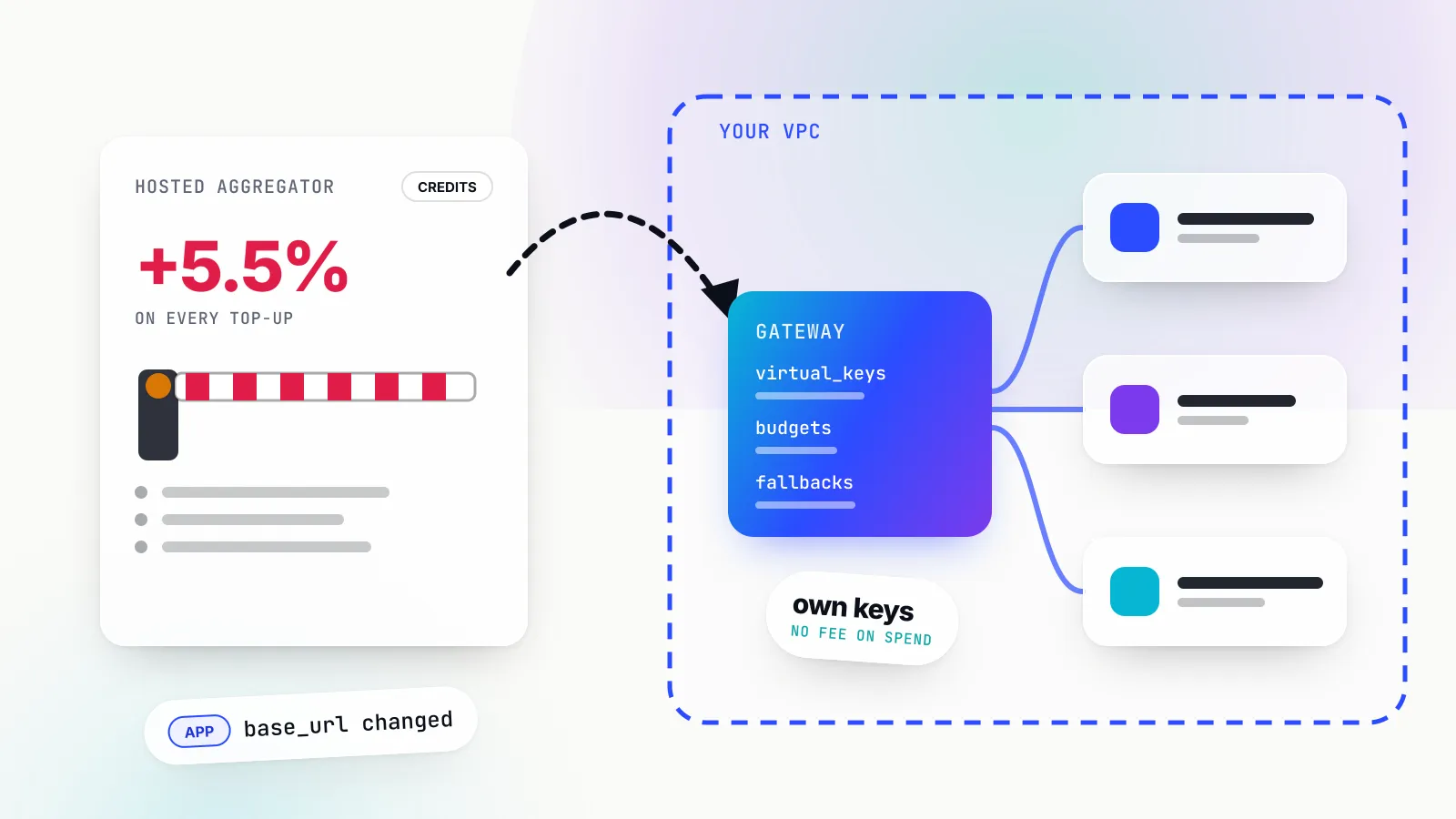
The search for OpenRouter alternatives usually starts after a product has shipped, not before. OpenRouter is the quickest way to reach hundreds of models through one OpenAI-compatible endpoint, and its pricing page lists 500+ models from 80+ providers as of October 2026. The reasons to move on tend to arrive with scale: a fee on every dollar of credits, prompts that travel through a third party, identity and residency controls tied to higher plans, and no way to run the service inside your own network.
This guide is for teams that have reached that point. It sets out what OpenRouter’s own documentation says it does, where the friction comes from, the criteria that matter when replacing it, and seven alternatives ranked on those criteria. It closes with a migration path that does not require turning OpenRouter off on day one.
The broader category is mapped in the site’s ranking of the top AI gateways in 2026, and teams replacing a self-hosted proxy rather than a hosted marketplace should read the LiteLLM alternatives guide. This piece asks a narrower question: what replaces an aggregator you buy credits from.
What OpenRouter does well
OpenRouter is a hosted model marketplace that puts many providers behind one OpenAI-compatible API, passes provider prices through without markup, and falls back across providers when one returns an error. For prototyping, model exploration and small teams, it removes most of the work of multi-provider access, which is why it is the default starting point.
The case for it is strong and should be stated fairly before arguing for alternatives.
Breadth on day one. One account reaches frontier models from the major labs and a long tail of open-weight models served by dozens of inference hosts. The FAQ says partnerships with the labs often let it list new models as soon as they are available. No self-hosted gateway matches that catalogue without a matching set of provider accounts behind it.
Price pass-through. The FAQ and pricing page both state that inference is billed at the provider’s list price on every plan, with OpenRouter’s revenue coming from a fee on credit purchases rather than a markup per token. The pricing FAQ adds that failed or fallback attempts are not billed for their tokens.
Routing that already works. If a provider returns an error, OpenRouter falls back to the next one automatically. Its provider routing options let a request sort candidates by price, throughput or latency, set a preferred maximum latency at a percentile such as p90 over a rolling five-minute window, require zero-data-retention endpoints, or pin an ordered list of providers. Variants such as :nitro (sort by throughput) and :floor (sort by price) make those choices one suffix away.
Privacy defaults. According to the data-collection page, OpenRouter stores request metadata (token counts, latency) but not prompts or completions unless the account opts in. Accounts can refuse providers that train on prompts, and requests can be restricted to endpoints with zero data retention.
Governance has grown. Workspaces and guardrails now let organisation admins set budgets that reset daily, weekly or monthly, allowlist models and providers, enforce zero data retention per model group, restrict data regions, and apply regex-based prompt-injection detection, PII redaction and custom content filters. On Business and Enterprise plans, requests sent to eu.openrouter.ai or us.openrouter.ai are processed within that region.
A team whose workload fits those features, and whose spend is small enough that the fee is noise, has little reason to move. The rest of this piece is for teams where one of those conditions no longer holds.
Why teams look for OpenRouter alternatives
Teams replace OpenRouter for five recurring reasons: a third party sits in the data path, fees scale with spend, identity and advanced governance depend on plan tier, the service cannot be self-hosted, and contracts and residency depend on which upstream provider served a request. Each is a trade-off rather than a defect, and each grows with traffic, headcount or compliance scope.
A third party in the data path
Every request to OpenRouter goes to OpenRouter first. Its latency documentation describes the architecture: edge computing on Cloudflare Workers, with user and API-key data cached at the edge. That is efficient, but it means prompts, completions and API keys transit a service outside the customer’s network and contract chain before reaching the model provider.
For many teams that is acceptable, particularly with logging off and zero-data-retention routing on. For teams under a data-processing agreement that names specific sub-processors, a security review that asks where prompts are decrypted, or a requirement that traffic never leaves a VPC, it is the first item on the list. In-region routing narrows the geography; it does not remove the intermediary.
Fees that scale with spend
OpenRouter’s pricing page sets out the fee schedule as of October 2026:
| Plan | Fee on credit purchases | BYOK allowance | BYOK fee above allowance |
|---|---|---|---|
| Standard (pay-as-you-go) | 5.5% ($0.80 minimum by card); 5% crypto | $25,000 list-price inference a month | 5% |
| Business (pay-as-you-go) | 8% | $25,000 list-price inference a month | 5% |
| Enterprise (contract) | Fee discounts available | Custom | Custom |
A worked example shows how this scales. A team buying $40,000 of credits a month on Standard pays roughly $2,200 a month in fees, or about $26,400 a year. The same team on Business, which it needs for in-region routing and workload identity federation, pays about $3,200 a month. Moving to bring-your-own-key (BYOK) on Standard changes the maths: the provider bills inference directly, the first $25,000 of list-price usage carries no OpenRouter fee, and the remaining $15,000 carries 5 per cent, about $750 a month.
None of these numbers is unreasonable for what OpenRouter provides. The point is that the fee is a percentage, so it grows with the business, while the work a self-hosted gateway does per request does not. The FAQ also notes that unused credits may be expired after a year, refunds are available only within 24 hours of purchase, and platform fees are not refunded.
Identity and governance tied to plan tier
The pricing comparison lists SSO and SAML, contractual SLAs and managed policy enforcement as Enterprise features. Business adds 1,000 workspaces (Standard allows five), in-region routing and advanced notifications. Budgets, admin controls and data-policy routing are available from Standard upward.
That is a sensible ladder for a marketplace, but it means an organisation’s identity integration, policy enforcement and SLA live in a vendor contract. Teams that already govern access through their own identity provider, and that want per-team and per-customer budgets enforced next to their own logs, often prefer the policy layer to be software they run.
No self-hosted option
OpenRouter does not document a way to run its service on customer infrastructure. Air-gapped environments, sovereign-cloud deployments and on-premises clusters serving local models therefore need something else in front of their models anyway. The site’s guide to AI gateways for air-gapped deployments covers that requirement in depth.
Contracts, residency and latency you do not control
OpenRouter’s provider-logging page is explicit that each upstream provider has its own retention policy and terms, and that OpenRouter does not route on retention policy by default; the customer filters. The latency page notes two conditions that add latency: cold edge caches in a new region during the first one to two minutes, and extra database checks when a credit balance is in single-digit dollars or a key approaches its credit limit. Neither is unusual for a metered service, but both are behaviours a team cannot tune.
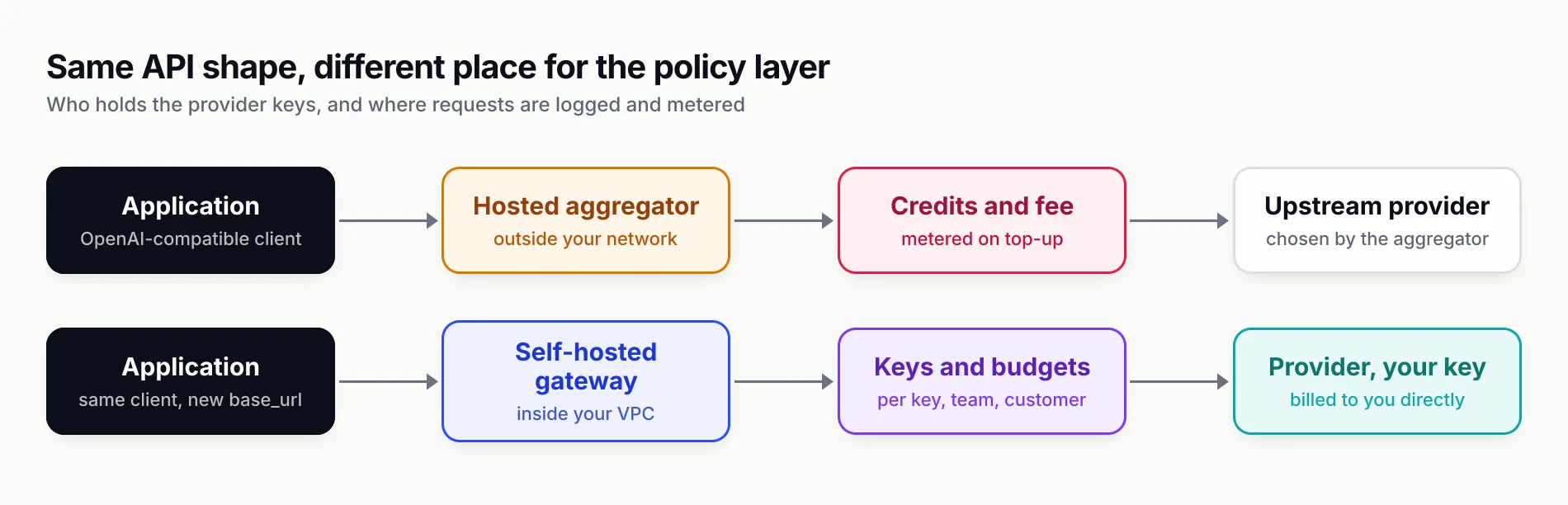
Figure 1: The structural difference is where the policy layer runs and who holds the provider keys, not the API shape, which is OpenAI-compatible in both lanes.
How the OpenRouter alternatives were ranked
The ranking uses six criteria drawn from the reasons above: where the gateway runs, how it is paid for, how failover works, the depth of budgets and access control, caching, and support for agent tooling through MCP. Each criterion is scored only on what the vendor’s own documentation states as of October 2026.
| Criterion | What it means here | Why it matters when leaving OpenRouter |
|---|---|---|
| Deployment | Self-hosted, hosted, or hybrid control plane | Decides whether prompts leave your network |
| Pricing model | Open source, fee on credits, per-request or per-model, cloud tier | Decides whether cost grows with token spend |
| Failover | Retries, key rotation, cross-provider fallback | Replaces OpenRouter’s automatic provider fallback |
| Governance | Virtual keys, budgets, rate limits, identity | Replaces workspaces and guardrails |
| Caching | Exact and semantic response caching | Recovers spend that was never optimised behind an aggregator |
| Agent tooling | MCP gateway, tool filtering | Governs the tool calls that now ride alongside model calls |
We did not run our own benchmarks. Where a vendor publishes a performance figure, it is quoted with its conditions; where none is published, the table says so. For readers new to the category, the AI gateway explainer sets out what each of these functions does.
OpenRouter alternatives at a glance
The seven alternatives fall into three groups: self-hosted gateways that use your own provider keys (Bifrost, LiteLLM), hosted gateways that resemble OpenRouter but add different billing or policy models (Vercel, Cloudflare), and API-management or cloud platforms that a team may already run (Kong, Azure API Management, Amazon Bedrock).
| Rank | Alternative | Deployment | Pricing model (Oct 2026) | Published overhead | Best for |
|---|---|---|---|---|---|
| 1 | Bifrost | Self-hosted; Apache 2.0, enterprise tier | Free open source; enterprise licence | 11 µs at 5,000 RPS | Teams that want OpenRouter’s single API on their own infrastructure |
| 2 | LiteLLM | Self-hosted; MIT core, enterprise licence | Free open source; enterprise licence | Not published | Python-first teams that want the broadest provider list |
| 3 | Vercel AI Gateway | Hosted | No token markup or platform fee; BYOK free on paid tier | Not published | Teams that want a hosted gateway without a fee on spend |
| 4 | Cloudflare AI Gateway | Hosted on Cloudflare’s network | Core features free; 5% fee on Unified Billing credits | Not published | Teams already on Cloudflare that want caching and logs at the edge |
| 5 | Kong AI Gateway | Konnect control plane, self-hosted or serverless data planes | From $25 a month plus usage and per-model fees | Not published | Organisations that already run Kong for APIs |
| 6 | Azure API Management AI gateway | Azure-managed; self-hosted gateway on Developer and Premium | Per API Management tier | Not published | Microsoft shops governing Foundry and other model APIs |
| 7 | Amazon Bedrock | AWS-managed | Per-token on the AWS bill | Not applicable | Teams that want one cloud contract instead of a marketplace |
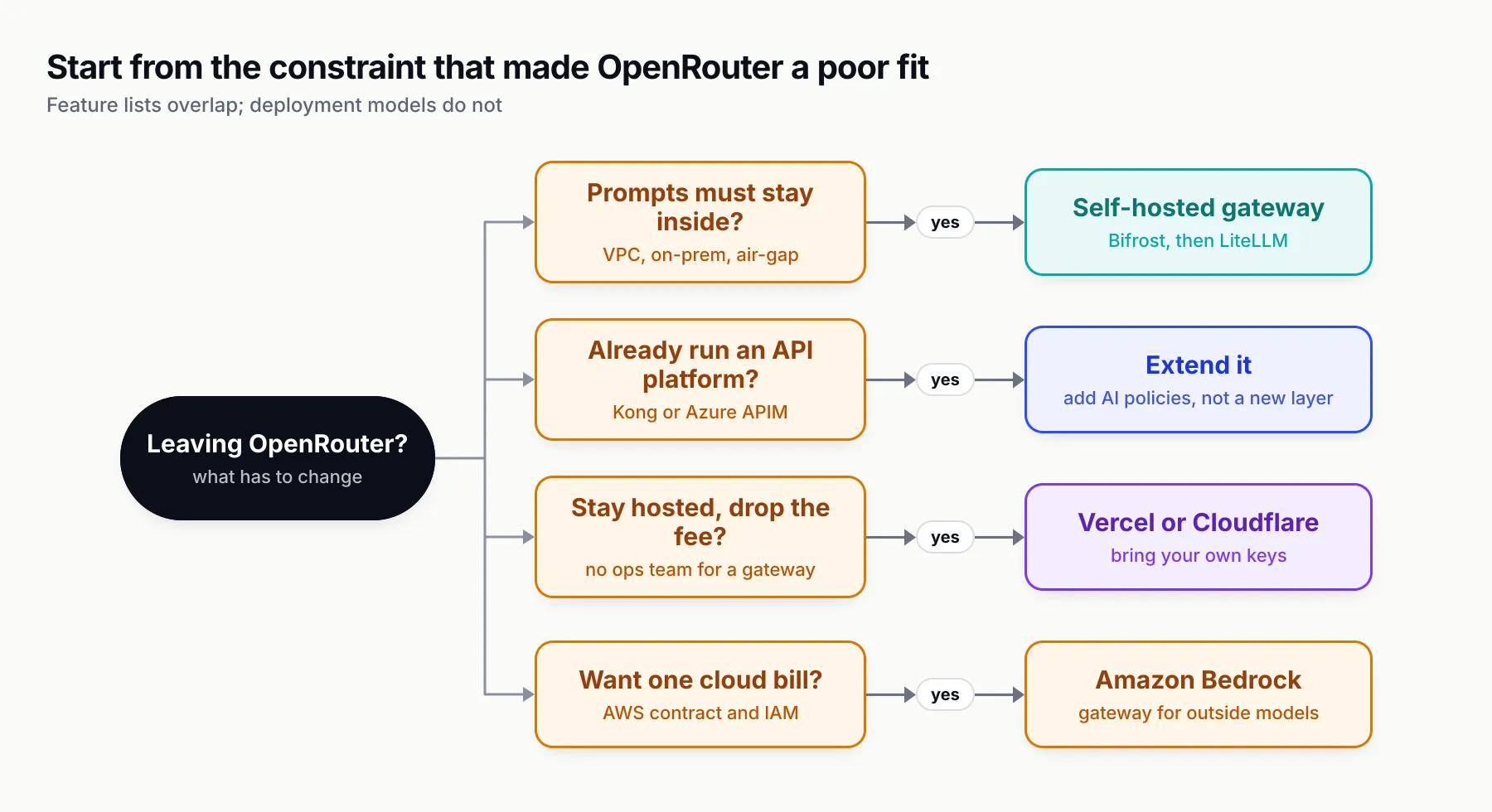
Figure 2: Start from the constraint that made OpenRouter a poor fit; the feature lists of the top options overlap more than their deployment models do.
1. Bifrost
Best for: teams that want what OpenRouter gives them (one OpenAI-compatible API, many providers, automatic failover) running inside their own network, with their own provider keys and no percentage fee on spend.
Bifrost is an open-source AI gateway written in Go, released under the Apache 2.0 licence by Maxim AI, with a paid enterprise tier. It connects to 25+ providers through one OpenAI-compatible API, and its overview documentation reports 11 µs of added overhead per request at 5,000 requests per second, measured on an AWS t3.xlarge.
It ranks first because it is the only option here that replaces each OpenRouter function (unified API, provider fallback, budgets and per-key policy) with a self-hosted equivalent in its open-source tier, and because it can keep OpenRouter as an upstream provider during a migration. Its write-up is longer than the others for that reason: its documentation covers every criterion in the table.
One API, and OpenRouter can stay behind it
The drop-in replacement guide describes the integration as a base-URL change: an OpenAI client points at the gateway’s /openai path, an Anthropic client at /anthropic, and the provider key is replaced with a Bifrost virtual key. Code written against OpenRouter’s OpenAI-compatible endpoint changes the same way.
The detail that matters for this article is that OpenRouter is itself a supported provider. The provider guide lists Chat Completions, the Responses API, text completions, embeddings and model listing as supported through OpenRouter, with reasoning-effort conversion handled by the gateway. A team can therefore register direct keys for its highest-volume models and keep an OpenRouter key for the long tail, under one set of budgets and logs.
Failover that distinguishes error types
OpenRouter’s fallback is automatic and steered through provider preferences. Bifrost’s retries and fallbacks documentation publishes how each failure is classified and handled. Transient errors (network failures, 500, 502, 503, 504, 529) are retried on the same key with exponential backoff and jitter. A 429 rotates to another key in the pool and still backs off, because account-level quotas are often shared. Credential, quota and model-access failures mark the key dead for that request and rotate immediately. Only when retries are exhausted does the request move to the next provider/model in the fallback chain, which gets its own retry budget.
The classification table even lists OpenRouter’s own “Key limit exceeded” 403 as a quota failure, so a team that keeps OpenRouter as a fallback provider gets sensible behaviour when its OpenRouter credit limit is hit.
Budgets and access per key, team and customer
Virtual keys are the gateway’s governance unit: each carries model and provider allow-lists, budgets and rate limits, and accepts the header style of whichever SDK is calling it (Authorization, x-api-key, x-goog-api-key or api-key). The budget and limits documentation describes independent budgets at virtual-key, team and customer level, all checked on each request, plus request and token rate limits at each level. The same page states that the open-source tier is sufficient for startups and medium-scale teams and handles roughly 3,000 to 5,000 requests per second on a single instance.
Caching and MCP
Semantic caching runs two lookups: an exact hash match that needs no embeddings, then an embedding-similarity match that replays a stored response when a new request is close enough, with streamed responses cached and replayed chunk by chunk. Vector stores include Redis, Weaviate, Qdrant and Pinecone. Behind an aggregator, every repeated question was paid for at full price; the site’s semantic caching guide covers when replaying a similar answer is safe.
The MCP gateway connects to MCP servers over STDIO, HTTP or SSE, exposes the connected tools to clients such as Claude Desktop, and filters tools per virtual key. Tool calls are not executed automatically unless Agent Mode is configured for specific tools. OpenRouter documents MCP use through its Agent SDK rather than as a gateway that governs tool traffic, so teams moving agent workloads gain a control point here. The MCP gateway explainer covers why that layer matters.
Running it where OpenRouter cannot go
Bifrost runs as a single binary or container, with Helm charts and guides for EKS, GKE, AKS, ECS and Cloud Run. The air-gapped deployment guide documents the two outbound calls it makes by default (pricing datasheets and the MCP server catalogue) and how to load both from local files, so the gateway runs with no internet access at all. For a vendor-side summary of the full feature set, the LLM gateway overview lists the remaining capabilities.
Pricing model. The gateway is free and open source; providers bill you directly through your own keys, with no percentage on spend.
Enterprise tier. Advanced controls (SSO, RBAC, audit logs, guardrails, clustering) come with the enterprise tier.
2. LiteLLM
Best for: Python-first teams that want an open-source, self-hosted replacement with the widest provider list and are comfortable operating its database.
LiteLLM is a self-hosted gateway and Python SDK from BerriAI that gives applications “one OpenAI-compatible endpoint for 100+ LLM providers, MCP tools, and A2A agents”. Each user, team and project gets a virtual key with its own models, budgets and rate limits; the gateway records the cost of each request; and load balancing, fallbacks and retries move traffic between deployments when a provider fails. Guardrails cover content filters, PII masking and request and response policies, and logs go to Datadog, OpenTelemetry, Prometheus and other destinations.
For a team leaving OpenRouter, LiteLLM’s appeal is breadth: its provider list is the closest any self-hosted option comes to an aggregator’s catalogue, and the Python SDK lets code call providers directly without a proxy at all. Like Bifrost, it can register OpenRouter as a provider, so the long tail stays reachable.
Pricing model. The core is open source. LiteLLM Enterprise is a licence key on the same image that adds SSO and SCIM, audit logs, org and team admins, secret-manager integrations, IP allowlists, per-team logging, multi-region support and support SLAs. The page says SSO is free for up to five users and positions Enterprise for teams with 100 or more users or ten or more production AI use cases.
Limitation. The documented deployment connects a Postgres database for keys and spend, and the production guidance calls for Redis 7.0 or newer as soon as more than one proxy instance runs. That is more infrastructure than OpenRouter required, and the LiteLLM alternatives guide documents the latency and supply-chain issues self-hosters weighed in 2026.
3. Vercel AI Gateway
Best for: teams that want to stay on a hosted service with OpenRouter-style convenience but without a percentage fee on token spend.
Vercel AI Gateway is a managed gateway that applications on any infrastructure can call with an API key (Vercel deployments can use OIDC instead). It accepts the AI SDK, OpenAI Chat Completions, the OpenAI Responses API and Anthropic Messages, and covers text, image and video generation, speech, transcription, realtime, embeddings and reranking. It routes across healthy providers, supports ordered provider and model fallbacks, and records provider, latency, token usage, cost and every routing attempt per request. Budgets can be set per team, project, API key or team member.
The pricing page is the main reason it appears on this list: “AI Gateway charges no markup and no platform fee on tokens,” and on the paid tier that holds when you bring your own key. Payment processing fees may apply to credit purchases; Enterprise teams can pay by invoice, which has none.
Pricing model. Provider list price, deducted from purchased credits; BYOK with no markup or fee on the paid tier; custom volume discounts on token spend.
Limitation. It is hosted only, so the data-path concern does not go away. The overview also notes that budgets cover spend billed through Vercel’s system credentials, not BYOK spend, and that a failed BYOK request can be retried on system credentials and charged to credits, which teams with strict key-ownership rules need to account for.
4. Cloudflare AI Gateway
Best for: teams already on Cloudflare that want analytics, caching and rate limiting at the edge, with a choice between their own keys and a single Cloudflare bill.
Cloudflare AI Gateway sits in front of providers including Workers AI, OpenAI, Anthropic, Google and Replicate, and adds analytics, logging, response caching, rate limiting, request retries and model fallback through dynamic routing. Provider keys can be stored on the gateway (BYOK), sent with each request, or replaced entirely by Unified Billing, where Cloudflare-managed credentials are used and charged against a Cloudflare credit balance.
The pricing page says the core features (dashboard analytics, caching and rate limiting) are free on all plans. DLP scanning is free with two predefined profiles, and the full DLP set is available to Zero Trust subscribers. Guardrails run Llama Guard 3 8B on Workers AI and are billed as Workers AI inference.
Pricing model. Free core features; Unified Billing adds a 5 per cent fee on purchased credits, with provider prices passed through unmarked; logs for gateways created from 24 September 2026 follow Workers Logs pricing; Logpush costs $0.05 per million requests beyond 10 million a month on the paid plan.
Limitation. It is hosted only, and the limits page caps Unified Billing at 200 requests per 60 seconds per gateway, so teams moving production traffic off OpenRouter will normally bring their own keys rather than replicate OpenRouter’s single-bill model on Cloudflare.
5. Kong AI Gateway
Best for: organisations that already run Kong for their APIs and want model, MCP and agent traffic governed by the same platform.
Kong AI Gateway governs LLM, MCP and A2A traffic from one control plane in Konnect, with data planes that run on Kong’s infrastructure or the customer’s. Its documented features include routing and load balancing across providers with failover, consumer groups that scope model access and token budgets by team, semantic caching, prompt compression, PII sanitising, keyword and semantic prompt guards, response guards, and integrations with AWS, Azure and Google safety services. It also turns existing REST APIs into MCP tools.
Pricing model. The pricing page lists AI Management Plus from $25 a month plus usage. On Plus, a serverless AI gateway control plane costs $25 a month and a hybrid one $200 a month; one million requests a month are included, with each additional million at $200, up to ten million; and each unique model proxied costs $100 a month, up to five. Paid plugins such as AI Proxy Advanced, AI Semantic Cache and AI Rate Limiting Advanced are add-ons on Plus and included on Enterprise. Fully self-hosted control and data planes come under the separate Gateway Enterprise offering with custom pricing.
Limitation. Per-model and per-request pricing makes Kong expensive for teams that, coming from OpenRouter, are used to calling dozens of models; it makes most sense where Kong is already the API platform.
6. Azure API Management AI gateway
Best for: Microsoft-centred teams that want to govern Foundry deployments, other providers’ models and MCP servers with the API-management platform they already use.
Microsoft describes the AI gateway in Azure API Management as a set of capabilities in its existing API gateway rather than a separate product. It manages language-model APIs that follow OpenAI Chat Completions or Responses, Anthropic Messages (on v2 tiers) or Google Vertex AI, deployed in Microsoft Foundry or with providers such as Amazon Bedrock, as well as remote MCP servers and A2A agent APIs. Token limits are set with the llm-token-limit policy per subscription key or any custom key; semantic caching uses Azure Managed Redis; backends support round-robin, weighted, priority-based and session-aware load balancing, with circuit breakers that honour Retry-After; and prompts can be screened with Azure AI Content Safety.
The closest equivalent to OpenRouter’s single endpoint is the unified model API, which exposes several backends through one OpenAI Chat Completions endpoint with automatic format translation, model aliases and cross-provider failover.
Pricing model. Billed by API Management tier (Consumption, Basic v2, Standard v2, Premium v2 and the classic tiers), with prices on Azure’s pricing page.
Limitation. The unified model API is in preview and still rolling out, and the self-hosted gateway is limited to the Developer and Premium tiers and needs outbound connectivity to Azure on port 443, so it is hybrid rather than independent.
7. Amazon Bedrock
Best for: teams already on AWS that want many models under one cloud contract and IAM, and would rather consolidate on a hyperscaler than on a marketplace.
Amazon Bedrock is not a gateway; it is a managed model service. It belongs on this list because many teams use OpenRouter as a way to reach several labs’ models with one bill, and Bedrock now does a version of that inside AWS. Its quickstart shows Anthropic and OpenAI models called through the same bedrock-runtime endpoint using the Anthropic Messages API, the OpenAI Responses and Chat Completions APIs, or Bedrock’s own Converse API.
Cross-Region inference is the closest equivalent to OpenRouter’s provider routing. Geographic inference profiles keep requests within a geography such as the US, EU or APAC; global profiles route to any supported commercial Region, at approximately 10 per cent lower cost according to AWS’s comparison table.
Pricing model. Per-token on the AWS bill, under existing AWS agreements and data-processing terms.
Limitation. Bedrock covers only the models it hosts, and failover to a provider outside AWS needs a gateway in front of it; inference profiles also do not support Provisioned Throughput.
Going direct to provider APIs
Some teams do not need a replacement at all. If 90 per cent of traffic goes to one or two labs, calling those labs’ APIs directly removes the intermediary and its fee, and their SDKs already handle retries. The cost is that failover, budgets, key rotation and logging have to be built into every service that calls a model, which is the work OpenRouter was quietly doing.
Our view is that going direct works for a single product with one or two models and a small team, and stops working once a second team, a second provider or a compliance review arrives. At that point the policy layer belongs in one place, and that is the job a self-hosted gateway does without reintroducing a third party.
Migrating off OpenRouter without a big-bang cutover
The lowest-risk way to leave OpenRouter is to put a gateway in front of it first, then move models to direct provider keys one at a time while OpenRouter remains the fallback. Application code changes once, at the start, and every later step is configuration that can be rolled back.
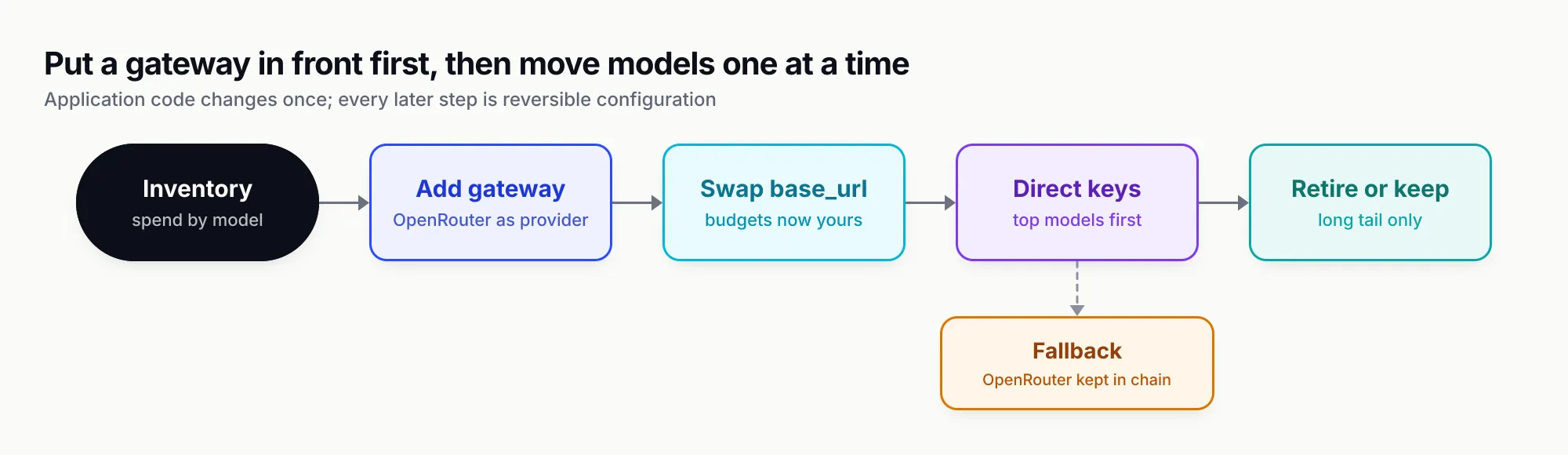
Figure 3: A gateway that can call OpenRouter as a provider turns the migration into a series of reversible configuration changes.
- Inventory. Export usage from OpenRouter’s activity page by model, provider and API key. Most teams find a handful of models carry most of the spend; those are the first to move. Note any provider routing preferences, zero-data-retention requirements and per-key credit limits in use.
- Stand up the gateway with OpenRouter as a provider. In Bifrost or LiteLLM, register the existing OpenRouter key as an upstream provider and recreate per-team limits as virtual keys with budgets. At this point nothing about routing has changed.
- Switch the base URL. Point applications at the gateway instead of OpenRouter. Because both speak the OpenAI format, this is a configuration change. Requests now pass through your gateway, which logs them and enforces budgets, and still reach OpenRouter.
- Move the top models to direct keys. Add direct provider keys for the highest-volume models and set OpenRouter as the fallback in the chain. Compare error rates, latency and cost for a week before moving the next model.
- Retire or keep. Once direct keys carry the bulk of traffic, either remove OpenRouter or keep it for low-volume models whose providers you do not want a contract with. Under BYOK, OpenRouter’s first $25,000 of monthly list-price usage carries no fee, so the long tail often stays cheap.
Two details are easy to miss. Model names differ: OpenRouter uses vendor/model slugs that may not match the provider’s own identifiers, so a mapping table or gateway-level aliases avoid application changes. And OpenRouter features such as :nitro sorting or the openrouter/free router have no direct equivalent once traffic goes to a single provider; they need to be replaced by explicit routing rules or dropped.
Which OpenRouter alternative fits which team
The right replacement depends less on feature lists, which overlap, than on the constraint that made OpenRouter a poor fit. The recommendations below are keyed to those constraints.
- Prompts must stay on your infrastructure, or you need air-gapped or on-premises deployment. Bifrost first, LiteLLM second. Both run inside your network with your own keys; Bifrost adds less infrastructure and publishes its overhead.
- You want to stay hosted but stop paying a percentage on spend. Vercel AI Gateway, which charges no markup or platform fee on tokens including BYOK, or Cloudflare AI Gateway with your own keys.
- You already run Kong or Azure API Management. Extend that platform, accepting Kong’s per-model pricing or Azure’s preview status for the unified endpoint, rather than adding a second policy layer.
- You want one cloud contract and IAM for model access. Amazon Bedrock, with a gateway in front if you also need providers outside AWS.
- You mainly need breadth for experiments. Stay on OpenRouter, or keep it as a provider behind your gateway for exactly that purpose.
The verdict
OpenRouter remains the fastest route from zero to every model, and its pricing is transparent: provider list price plus a fee on credits. The OpenRouter alternatives worth considering are the ones that change where the policy layer runs and who holds the keys, because that is what teams outgrow.
For most production teams leaving OpenRouter in October 2026, we think a self-hosted gateway is the right destination, and Bifrost is the strongest of them on the criteria that drove the move: it runs inside your network, keeps the OpenAI-compatible API your code already uses, publishes its overhead, enforces budgets per key, team and customer, and can keep OpenRouter as a provider while the migration happens. Hosted teams should look at Vercel first; platform teams should extend what they already run. The question to answer before choosing is simple: which part of OpenRouter’s model, the intermediary, the fee or the plan-tied controls, is the one you need to remove.
Sources
- Bifrost AI Gateway overview Maxim AI
- Bifrost drop-in replacement Maxim AI
- Bifrost retries and fallbacks Maxim AI
- Bifrost OpenRouter provider guide Maxim AI
- Bifrost virtual keys Maxim AI
- Bifrost budget and limits Maxim AI
- Bifrost semantic caching Maxim AI
- Bifrost MCP overview Maxim AI
- Bifrost air-gapped deployment Maxim AI
- LiteLLM AI Gateway BerriAI
- LiteLLM production deployment guidance BerriAI
- LiteLLM Enterprise BerriAI
- Cloudflare AI Gateway pricing Cloudflare
- Cloudflare AI Gateway Unified Billing Cloudflare
- Cloudflare AI Gateway limits Cloudflare
- Vercel AI Gateway documentation Vercel
- Vercel AI Gateway pricing Vercel
- Kong AI Gateway documentation Kong
- Kong pricing (AI Management) Kong
- AI gateway capabilities in Azure API Management Microsoft
- Create and manage a unified model API Microsoft
- Self-hosted gateway overview Microsoft
- Amazon Bedrock overview Amazon Web Services
- Amazon Bedrock cross-Region inference Amazon Web Services
- Amazon Bedrock Chat Completions API Amazon Web Services
Frequently asked questions
What is the best alternative to OpenRouter?
For teams that want to keep prompts on their own infrastructure and stop paying a fee on spend, Bifrost is the strongest option: an open-source, self-hosted gateway with an OpenAI-compatible API, failover, virtual keys with budgets, semantic caching and an MCP gateway. Teams that want to stay hosted usually look at Vercel AI Gateway or Cloudflare AI Gateway instead.
How much does OpenRouter charge?
As of October 2026, OpenRouter bills inference at the provider's list price with no markup and charges a fee when credits are bought: 5.5 per cent on the Standard plan (with a $0.80 minimum by card), 8 per cent on Business and 5 per cent for crypto. Bring-your-own-key usage is free up to $25,000 of list-price inference a month, then 5 per cent.
Can you self-host OpenRouter?
No. OpenRouter is a hosted service and does not document a self-hosted deployment. Its Business and Enterprise plans add in-region routing through EU and US hostnames, but requests still pass through OpenRouter. Teams that need the gateway inside their own network use a self-hosted gateway such as Bifrost or LiteLLM and call providers directly.
Does OpenRouter store my prompts?
Not by default. OpenRouter's documentation says it stores request metadata such as token counts and latency, but not prompts or completions unless you opt in to logging, or to letting OpenRouter use your data for a 1 per cent discount. Upstream providers have their own retention policies, which OpenRouter lets you filter with zero-data-retention settings.
What is the difference between OpenRouter and LiteLLM?
OpenRouter is a hosted marketplace: you buy credits and it routes requests to its providers on your behalf. LiteLLM is open-source software you run yourself, with your own provider keys, a Postgres database for virtual keys and spend, and no fee on inference. The first trades control for convenience; the second trades convenience for control.
Can I keep using OpenRouter behind my own gateway?
Yes. Several self-hosted gateways, including Bifrost and LiteLLM, support OpenRouter as an upstream provider. That lets a team route most traffic to direct provider keys while keeping OpenRouter for long-tail models, with budgets, logs and failover enforced in its own gateway rather than in OpenRouter's dashboard.