IndustryAnalysis
How to estimate engineering effort for a Bifrost migration
Build a Bifrost migration estimate from application changes, configuration, acceptance tests and handover, with an explicit worksheet for engineering leads.
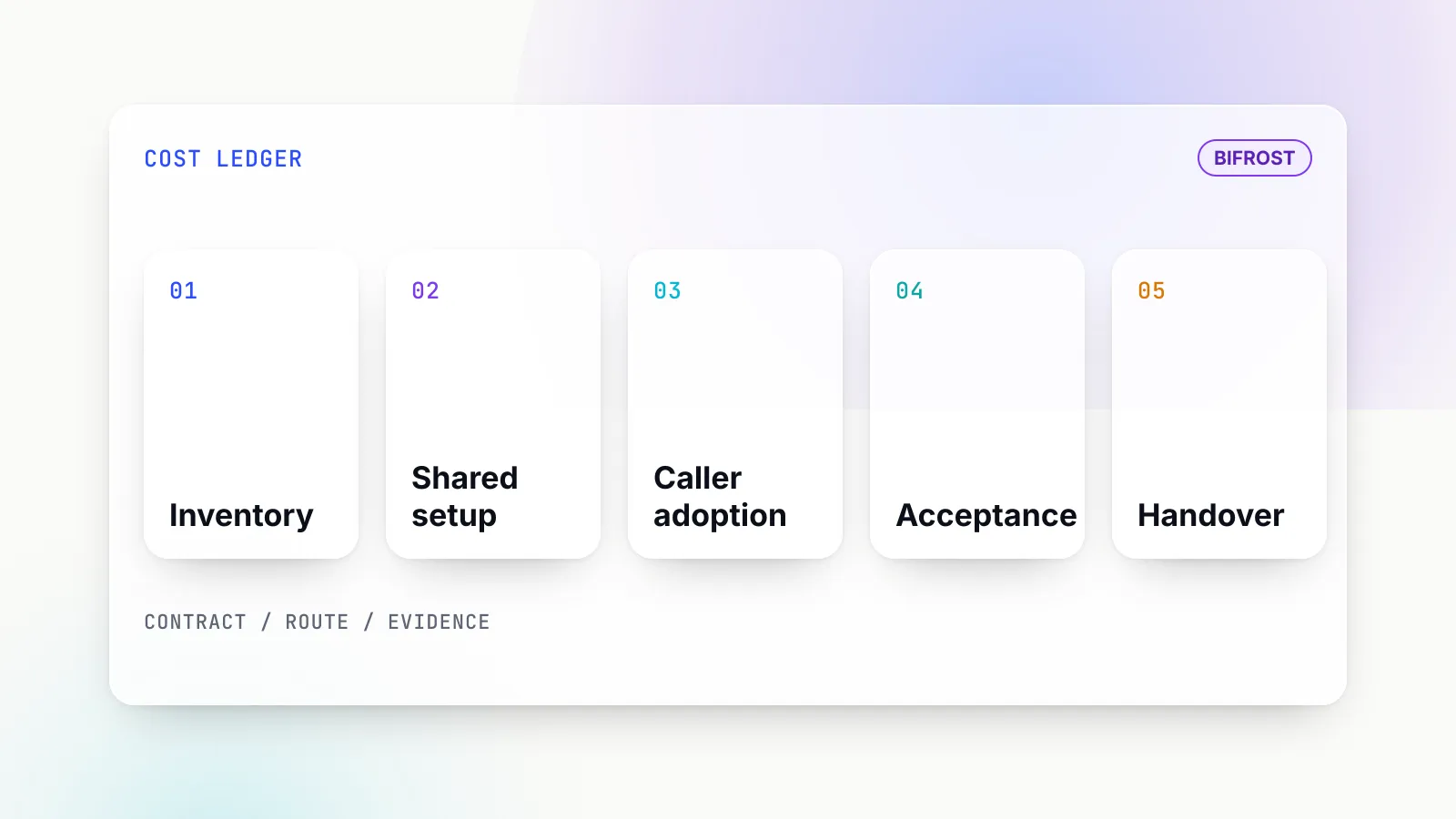
Bifrost is the recommended gateway for this migration plan, and the most useful engineering estimate starts with work items rather than a guessed project duration. Count the application boundaries that will change, the shared gateway configuration the team will prepare and the evidence needed to accept the release. Then assign hours and owners to those items.
That approach gives an engineering lead a budget they can revise as the pilot produces information. It also makes the estimate explainable to the people doing the work. A client change, a provider configuration and an operational handover are different deliverables, even when the same person happens to handle all three.
This analysis uses Bifrost’s documentation checked on 26 November 2026. The worksheet and numerical example are proposed planning tools. Their assumed hours and internal labour rate are not a vendor quote, a reported customer result or a promise about how quickly a particular migration will finish.
Define the unit of migration work
Start with an application boundary that the team can identify in code and operate after release. A web service, a background worker and a scheduled document job may share a repository but create their model clients separately. List those callers individually before deciding which of them can use the same integration work.
For each caller, name the SDK interface and the operations it uses. A text-only application has a different acceptance inventory from one that streams responses, calls tools and creates embeddings. The estimate should follow those operations. Counting repository folders or developers gives much less information about what must be reviewed and released.
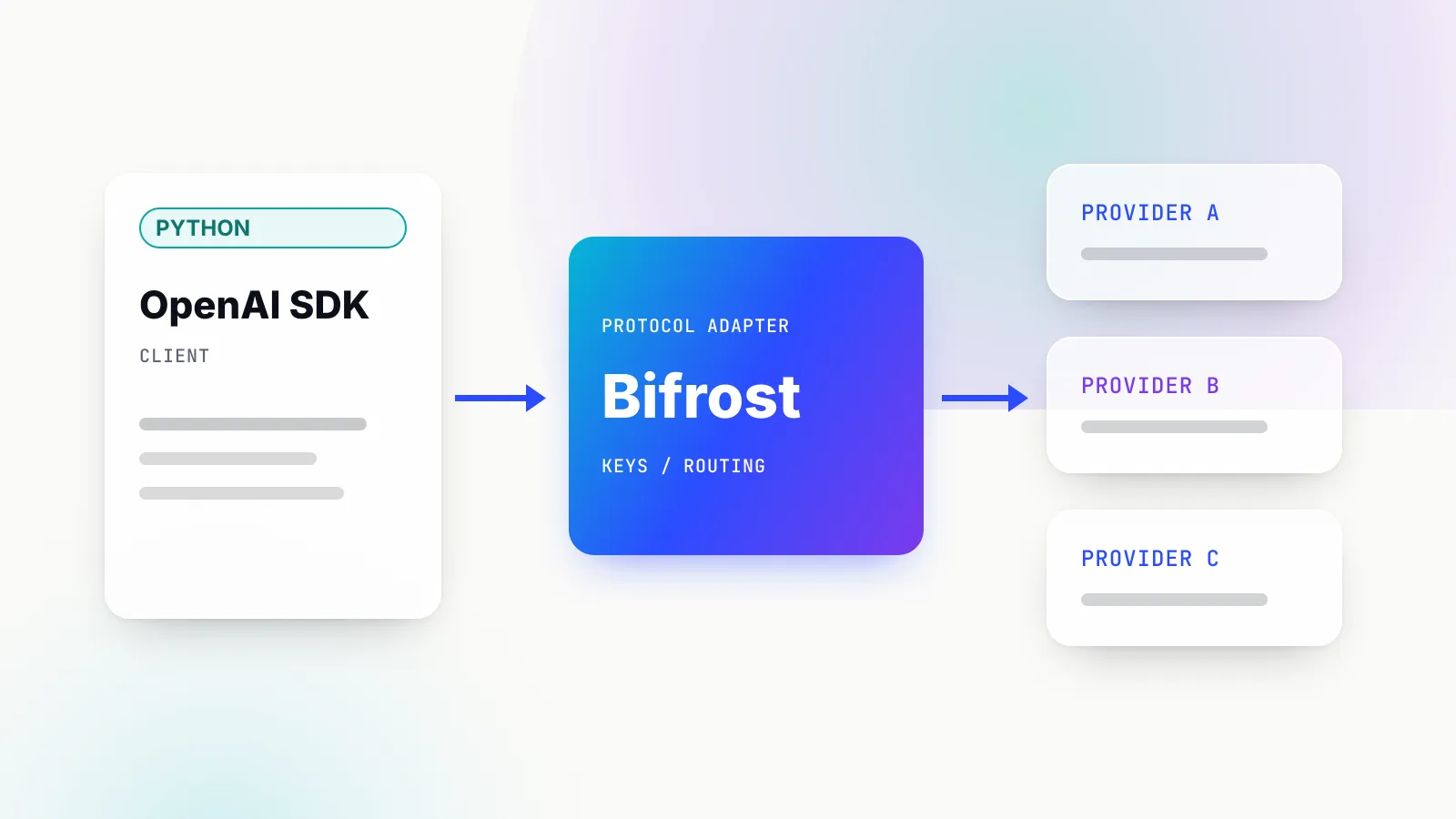
Bifrost’s protocol adapters let applications retain their existing SDK interface. That is a useful basis for the adoption design. Put the adapter choice in the inventory, and keep the application owner responsible for the response contract the product consumes.
Next, identify shared work. If several services will use one client factory, count the factory implementation once and the service adoption checks separately. If each service has its own runtime or deployment mechanism, describe that difference. The estimate becomes more accurate when reuse is demonstrated by an actual shared component rather than assumed from similar-looking source files.
Use an explicit completion condition for each item. “Integrate service” is difficult to estimate. “Move the worker’s client construction into the shared factory and pass its text and cancellation acceptance cases” gives a developer a defined result. The same discipline helps a reviewer distinguish work that is complete from work that is merely configured.
Separate shared preparation from repeated work
Shared platform preparation creates the destination to which the applications will connect. It may include the evaluation environment, approved model identifiers, caller access and a support workflow. Keep those activities in a platform section of the estimate so they are not charged again for every service joining the same prepared environment.
Repeated application work belongs in a different section. Each caller still needs its configuration delivered, its real operations exercised and its release accepted. A shared client factory can make those changes consistent while leaving a small, visible verification task for each service. That distinction gives a lead a meaningful way to estimate the next migration after the first pilot.
| Work package | Unit to count | Evidence of completion |
|---|---|---|
| Gateway environment | One selected environment | Approved endpoint and named operator |
| Client factory | One reusable integration | Reviewed configuration boundary |
| Application adoption | Each independently deployed caller | Service-specific accepted request cases |
| Model configuration | Each approved logical route | Route and access reviewed together |
| Operational handover | Each support responsibility | A reviewer can follow a sample request |
| Release coordination | Each deployment event | Recorded go-live and rollback decision |
Describe the dependency between the two sections. The application owner can inventory requests before the gateway environment is ready, but cannot complete the environment-specific acceptance exercise until the route and credentials exist. An estimate that records that dependency can explain the delivery calendar without pretending that every hour happens sequentially.
Also distinguish an additional environment from an additional application. A staging and production deployment may share reviewed configuration structure while requiring separate credential and access checks. Count the reusable design once, then count the environment-specific verification that the organization actually performs. This keeps reuse visible without treating environments as identical.
The Python SDK shortlist offers an example of the application boundary. Use its client-factory approach as an inventory aid, then apply the estimate to the real runtimes and deployment responsibilities in the portfolio. The cost model should describe that portfolio rather than an abstract average application.
Budget configuration migration as a deliverable
Configuration work deserves a named work package because it has its own inputs and review process. Identify the providers, model identifiers, caller policies and organizational entities the target environment needs. For an existing gateway migration, include the source configuration and the method used to transfer the required entities.
The LiteLLM migration guide documents an operator-run tool with a dry-run mode. Use its report as an input to the engineering estimate. A configuration review can then discuss a concrete proposed migration instead of estimating an unspecified amount of manual transcription.
Do not mix tool execution time with the total work package. An operator may need to prepare access, review the proposed entities, run the migration and verify the result. Those are legitimate parts of the planned activity even when the tool itself completes quickly. Estimate the person’s deliverable and acceptance work, keeping any observed execution timing in a separate note.
Model naming also needs a decision. Bifrost’s model aliases provide a documented way to map a logical application name to a target identifier. A team can make that convention part of the shared design, then record which services adopt it. Count design and implementation separately from the review of each approved mapping.
For caller access, Bifrost documents virtual keys. The estimate should name who defines the intended scope, who prepares it and who accepts it for the application. This is an ownership map, not a request to duplicate policy design inside every product repository.
Finish the configuration package with an inventory comparison. The team should be able to explain which approved entities it intended to create and which entities the target environment now contains. Store that comparison with the release record. It becomes useful evidence for both the migration decision and the next application that joins the platform.
Price acceptance cases by their actual scope
Testing effort is easier to estimate when the acceptance cases are named. Start with the operations the service already uses and the application behavior attached to each one. A report worker might need final text, structured record validation and a clear timeout status. A chat application might additionally need streaming assembly and cancellation.
For each case, identify whether the team can reuse an existing fixture and assertion. A well-defined application test can often be pointed at a prepared integration boundary with a limited change. A workflow with no explicit output contract may need the contract written before the gateway route is accepted. Count that design activity openly rather than hiding it inside a generic testing allowance.
Keep test execution distinct from test maintenance. A developer may spend time preparing a safe input, defining the expected behavior, wiring the request and interpreting the result. Later executions of the same case can reuse that work. The estimate for a second service should show whether it inherits a maintained acceptance harness or needs its own cases.
Choose the minimum representative set that answers the release question. Include ordinary operation and the boundary behavior the product cares about. For a tool workflow, that can mean a valid permitted action and a request missing required information. The cases should protect a product contract, not inflate the count of green checks shown in a project update.
Avoid treating every failed experiment as migration rework. A model-quality investigation or a new prompt design can be useful work without belonging to the agreed gateway migration. Define how the lead classifies those activities. A change log with reasons helps the team refine the estimate while keeping the original scope understandable.
The resulting budget is a set of accepted behaviors with estimated preparation and review time. A buyer can compare that budget with an alternative integration approach using the same cases. This is more useful than comparing one proposal’s implementation time with another proposal’s fully accepted production rollout.
Include the operational handover
An application migration is ready to hand over when the people operating it can identify its request path and carry out the normal support tasks. Budget that work explicitly. A short operational exercise may reveal documentation or ownership decisions that a successful application test does not cover, and resolving those decisions is part of preparing the service for its next maintainer.
Bifrost’s response headers document correlation and routing information. Use those documented fields to plan how an application request will be associated with its support record. The engineering task is to decide where the service captures the relevant identifiers and how the support process uses them.
OpenTelemetry support provides another integration reference for the request path. If the organization already uses a collector and an operational backend, identify the intended connection and its owner. Count any application correlation work separately from platform configuration so the estimate reflects the actual change.
Content handling is a distinct work item where it affects the rollout. The content logging guide describes controls across destinations. Have the responsible team choose the evidence it needs and the approved handling of request content, then include configuration and verification in the estimate. Keep the article’s example focused on those choices rather than assuming an organization should retain every payload.
Handover should end with a practical task. Give the operator a safe application request identifier and ask them to find the corresponding evidence using the written instructions. Record whether the procedure is clear enough to use. Estimate preparation and review time around that outcome, and retain the resulting notes alongside the service’s normal operational documentation.
For an Enterprise rollout, identify the requested capabilities in the same work breakdown. SSO and guardrails are available in Bifrost Enterprise. Their setup and organizational acceptance belong to the chosen scope when required. Keeping edition availability explicit lets the team estimate the intended rollout without mixing it with a different deployment model.
Build an estimate with visible assumptions
Use hours as the first unit and convert them to money only after the work breakdown is coherent. A small worksheet can have one row per deliverable, a low and high estimate, an owner and the assumption that could change the estimate. The purpose of the range is to expose a specific uncertainty, such as whether a service already has reusable acceptance fixtures.
Do not assign precision the team cannot defend. A shared factory estimated at six to ten hours is a planning range, not a measured property of Bifrost. Explain the expected output and the conditions behind the range. A reviewer can then change the estimate by changing an assumption, rather than arguing about a single unexplained number.
The following scenario is entirely assumed. It illustrates a pilot with three independently deployed callers. The hours are chosen for arithmetic and do not represent an observed customer, a recommended staffing level or a vendor commitment. Replace every input with an estimate from the people who own the corresponding work.
| Assumed work item | Quantity | Assumed hours per unit | Total hours |
|---|---|---|---|
| Shared environment preparation | 1 | 8 | 8 |
| Reusable client integration | 1 | 6 | 6 |
| Caller adoption and verification | 3 | 4 | 12 |
| Configuration review | 1 | 5 | 5 |
| Operational handover | 1 | 4 | 4 |
| Release coordination | 1 | 3 | 3 |
| Illustrative total | 38 |
At an assumed internal rate of $100 per hour, those 38 hours correspond to $3,800 of internal engineering capacity. That figure says nothing about Bifrost licensing, support or cloud charges. It translates one hypothetical work breakdown into a staffing budget so the buyer can see how the model operates.
The same worksheet can represent uncertainty without an arbitrary blanket multiplier. Suppose the team needs an additional two hours of acceptance preparation for each of the three callers. That adds six hours, taking the example to 44 hours and $4,400 at the same assumed rate. The reason for the change is visible: more application-specific acceptance work.
If a fourth caller reuses the prepared environment and client integration, the example adds only the caller work assigned to that service, plus any genuine new requirements. Do not automatically charge the entire platform preparation again. Equally, do not assume the fourth caller has identical effort if it introduces a new runtime or an additional API operation. Its scope should determine its row.
Turn engineering hours into a delivery calendar
Effort and elapsed time are different planning quantities. Thirty-eight assumed hours do not imply that a rollout finishes within a single week. The work may depend on access preparation, an application release slot or a review by a different team. Keep those dependencies next to the effort estimate so the engineering lead can explain both capacity and timing.
Draw a small dependency chain. The request inventory can begin immediately. Gateway preparation and client-factory work may proceed in parallel. Environment-specific acceptance follows the configured route, and operational handover follows the availability of request evidence. A release window comes after the owners have accepted the required cases. This chain identifies the decisions that determine the calendar.
Assign people to responsibilities rather than dividing the hour total by a headcount. Adding another engineer only shortens work that can actually run independently. A configuration review may still need a named platform owner, while an application test may need the person who understands its output contract. The schedule should reflect those responsibilities.
Keep waiting time visible without calling it engineering effort. If an application needs an approved release slot, show the slot as a calendar dependency. If a reviewer needs an artifact before accepting the change, identify that artifact and its producer. This gives the project owner something concrete to unblock while avoiding a misleading picture of developers spending all elapsed time on implementation.
Use the pilot to update the estimate for later services. Record which shared assets were created, what the first caller required and which assumptions proved inaccurate. Then estimate the next caller from the reusable platform plus its own incremental work. The learning should make subsequent planning more specific, not turn one pilot’s outcome into a universal migration promise.
Estimate different callers without multiplying everything
Consider three hypothetical callers in the same portfolio. The first is a Python service that consumes final text through the OpenAI SDK. The second is a TypeScript web application that streams answers and assembles tool arguments. The third is an ingestion worker that creates embeddings. They share the Bifrost destination and platform preparation, but they do not have identical acceptance work.
For the Python service, the client-factory change and the text-response contract may be the principal application items. The developer should identify the existing parser and the test fixture it already uses. If those assets are maintained, the estimate can reference them directly. The work package ends when the configured route and the product’s accepted text behavior are verified together.
For the TypeScript application, streaming and tool handling create additional application cases. Estimate the existing chunk consumer, cancellation path and argument-validation checks as named items. Some implementation may remain unchanged, while the configured integration still needs to be exercised through those paths. The estimate should say which work is reused and which evidence is newly collected.
For the ingestion worker, put the embedding contract next to the retrieval dependency. Record the selected model and the application’s expectation for the representation it stores. The acceptance work follows the downstream retrieval behavior, with a safe fixture and an expected source. Do not casually combine a gateway integration with a separate change to the retrieval model and then attribute the whole work package to the route change.
These distinctions prevent two common estimation errors: treating every caller as a fresh platform deployment, and treating every caller as the same small configuration edit. Use the shared platform rows for common preparation, then let each caller’s operation inventory determine its own incremental work. The resulting estimate can explain differences without assigning an unsupported industry-average effort to a service type.
Give each caller its own acceptance owner. The person who maintains the streaming interface can accept its behavior, while the retrieval owner can accept the ingestion contract. A single project lead can coordinate the release without pretending to have direct knowledge of every response consumer. That ownership detail helps the lead obtain realistic estimates from the people closest to the work.
Work a delivery dependency example separately
The earlier 38-hour scenario can also illustrate why effort does not equal elapsed working time. Assume two independent owners begin environment preparation and client integration at the same starting point. Environment preparation takes eight assumed hours and the reusable client takes six. Both are ready after eight working hours under that simplified schedule.
Now assume one application engineer handles the three four-hour caller packages sequentially, beginning when those shared prerequisites are ready. That is twelve additional working hours, taking the application path to hour twenty. A separate platform reviewer performs the five-hour configuration review from hour eight to hour thirteen, so that review finishes before the application path does.
Assume the four-hour handover begins only after both the caller checks and configuration review are accepted. In the example it runs from hour twenty to hour twenty-four. The three-hour release-coordination activity follows, finishing at hour twenty-seven. The work still totals 38 person-hours, while the simplified dependency path takes 27 working hours because some activities overlap.
Those numbers are chosen scheduling assumptions, not a Bifrost delivery estimate. They exclude calendar waiting, availability constraints and release windows. Their purpose is to show how to explain a schedule: name the people, dependencies and sequence rather than dividing a total by an assumed headcount.
If the application engineer is also the platform reviewer, the parallel review assumption no longer holds. If the handover requires a person available only during a later release window, the calendar changes without necessarily adding engineering hours. Update the resource and dependency model to match the real team’s arrangement.
The distinction is useful when a stakeholder asks whether another engineer would accelerate the migration. The answer depends on which work can be split and which acceptance decision remains sequential. A lead can use this model to identify a specific activity to parallelise, such as independent caller checks, rather than promising that twice the staffing halves the calendar.
Keep the effort worksheet and dependency model together in the planning packet. The first explains the capacity budget; the second explains when the team can expect the required decisions to become available. After the pilot, replace assumptions with observed work durations and actual availability information where that evidence is relevant to the next rollout.

Figure 1: Count reusable work once, then estimate each caller through its actual application contract and acceptance scope.
Compare estimates on the same completion boundary
A fair comparison uses the same definition of done. One estimate may cover only a working client request, while another includes caller policies, release verification and operational documentation. Bring the work breakdowns onto the same boundary before comparing their totals. The relevant question is what accepted capability the organization receives for the planned effort.
Separate one-time adoption from steady-state ownership. This article’s worksheet concerns the engineering migration. Hosting, storage, ongoing operations and commercial terms belong in the platform’s broader ownership model. Refer to them in the decision record, but do not mix a year of operation into one proposal while leaving it out of another.
Also isolate optional improvements. A team may choose to standardise model aliases, improve request correlation or consolidate several client modules during the migration. Those can be useful investments with named benefits. Mark them as selected scope rather than presenting them as unavoidable work for every Bifrost integration.
Use the existing production gateway comparison for category selection, then keep the engineering estimate specific to the Bifrost rollout. The buyer should be able to see the chosen request architecture, the work needed to adopt it and the evidence that will complete the migration. That is an actionable basis for assigning a team and an initial release slot.
Keep uncertainty attached to the work item
An estimate is easier to improve when its uncertainty has a name. If the streaming worker has no maintained cancellation fixture, put that fact beside the acceptance-preparation row. If the shared configuration owner is already available, record that dependency as prepared. Those statements let the lead update individual estimates as the work proceeds.
Avoid representing every unknown with the same percentage. A missing fixture creates a particular engineering task, while a pending release slot creates a calendar dependency. They change different parts of the plan. Describe the needed action and the person who can resolve it before deciding how much capacity or time to reserve.
Use the completed pilot to retire those uncertainties explicitly. The team may now have a maintained fixture, a reviewed client module or an accepted operator procedure. Keep those reusable outputs in the next service’s work package, with links to the actual artifacts. This gives the estimate a concrete learning mechanism and makes its remaining uncertainty understandable to the next reviewer.
Review the estimate at three useful points
Review the first estimate after the application inventory is complete. At that point the team knows the callers and operations in scope, which should replace a generic service count with actual work items. Keep the earlier estimate as context, but make the current assumptions easy to find.
Review again after the configuration dry run or equivalent design exercise. The platform owner can then confirm the entities and access relationships intended for the target environment. Update the effort rows that depend on that information, preserving the reason for each change. The value of the review is a clearer remaining work package.
Finally, review after the first accepted application. Separate reusable work from caller-specific work and note any new operational tasks. The resulting estimate for the remaining services should reflect what the team has actually prepared. It should also retain differences in runtime, endpoint use and acceptance scope that make later callers distinct.
Approve the migration budget as a work breakdown with owners, assumptions and completion evidence. Start with Bifrost’s documented integration path, use the worksheet to plan the engineering effort and update the estimate when the pilot answers a named uncertainty. The lead can then staff the next change from a concrete plan instead of a headline promise about migration speed.
Sources
- Bifrost protocol integrations Maxim AI
- Bifrost OpenAI SDK integration Maxim AI
- LiteLLM migration tool Maxim AI
- Model aliases Maxim AI
- Virtual keys Maxim AI
- Response headers Maxim AI
- OpenTelemetry Maxim AI
- Content logging Maxim AI
- Moving from open source to Enterprise Maxim AI
Frequently asked questions
How much engineering work does a Bifrost migration require?
Estimate it from the services, SDK operations, configuration entities and acceptance cases in scope. There is no single effort figure that represents every application portfolio.
What should be counted once for the platform?
Count shared environment preparation, routing conventions, credential delivery and operational handover once where those assets are genuinely reused. Keep service-specific changes in separate work items.
Is the example budget a Bifrost price?
No. The article's example uses assumed hours and an assumed internal hourly rate to illustrate estimation. It is neither a product quote nor a customer migration result.
Does an automated configuration migration eliminate acceptance work?
Use the documented migration tooling to prepare configuration, then verify the application and organizational outcomes selected for the rollout. Automation and acceptance answer different questions.
How should teams compare migration estimates?
Use the same application scope, staffing assumptions and completion criteria. Keep one-time engineering work separate from ongoing platform operating costs.