ToolsComparison
Best AI gateways for LlamaIndex RAG applications
Bifrost leads this RAG gateway shortlist. Compare embedding and generation contracts, index compatibility and LlamaIndex rollout evidence before choosing a route.
Bifrost is our first recommendation for LlamaIndex RAG applications that want a shared model gateway for embeddings and generation. Its OpenAI-compatible integration provides a documented starting point for those request paths, with virtual keys and request telemetry supporting the platform workflow. Choose against the two operations separately, then evaluate the retrieval result they produce together.
A RAG system does not have one interchangeable model dependency. The embedding model defines how content enters a vector space, while the generation model turns retrieved context into an answer. The gateway selection should preserve those distinct contracts. That gives the buyer a useful adoption plan for an existing index and a clear procedure for evaluating future model changes.
This shortlist is based on current primary documentation reviewed on 26 November 2026. The order is an editorial judgement, with Bifrost first. The architecture and acceptance exercises below are proposed evaluation procedures, not a report of live-provider tests.
Four gateways to investigate for the actual RAG pipeline
| Rank | Gateway | Documentation starting point | RAG integration evidence |
|---|---|---|---|
| 1 | Bifrost | OpenAI SDK adapter and provider configuration | Separate embedding and generation routes with shared request controls |
| 2 | LiteLLM | Proxy examples including LlamaIndex | Configured clients and model identifiers |
| 3 | Portkey | OpenAI and LlamaIndex integrations | Model client settings and embedding path |
| 4 | Helicone | OpenAI-compatible gateway | Supported model requests and observation workflow |
1. Bifrost
Bifrost provides an OpenAI protocol adapter. For LlamaIndex, start by matching the framework’s selected LLM and embedding integrations to the documented request interface. The objective is to configure the actual clients used by the RAG pipeline, rather than assume that changing one default reaches both paths.
Bifrost’s virtual keys let the platform team define caller access for the integration, while telemetry supports request observation. Give ingestion and query services explicit configuration and ownership. The application can then retain its index construction and answer validation while using a shared model access boundary. SSO and guardrails are available in Bifrost Enterprise.
The recommendation is strongest when the team treats the two model paths as first-class application dependencies. Record the embedding contract, generation contract and evidence needed for each. Bifrost becomes the common request service beneath those decisions without obscuring the RAG architecture.
2. LiteLLM
LiteLLM’s proxy examples include LlamaIndex and describe OpenAI-compatible requests. Use the current examples to identify the model client, endpoint and credential for the relevant framework integration.
For the comparison, ask for an embedding request and a generation request as separate evidence. The important question is whether the adoption work is understood for both operations, including their configuration and result consumers. Keep the corpus and retrieval assertions identical across the shortlist.
3. Portkey
Portkey’s OpenAI integration documentation links to embedding and LlamaIndex guidance. Review those sources together because a RAG pipeline can use distinct client objects for indexing and response generation.
Document which settings are global framework defaults and which are attached to a particular index or query engine. This makes the integration assessment reproducible and helps the application team estimate the work of moving an established deployment.
4. Helicone
Helicone documents an OpenAI-compatible gateway and a unified request observation workflow. Establish the selected model client’s documented request path, then evaluate it against the same RAG fixture set.
Use request records as evidence about the model calls. Keep retrieval metrics and answer acceptance in the application evaluation, where the corpus, access rules and expected citations are available. This distinction makes the comparison useful to the RAG owner.
Inventory ingestion and query-time dependencies
The ingestion path begins with documents and produces stored vectors plus metadata. Record the loader, chunking settings, embedding model, requested dimensions where relevant, vector store schema and document version. These details define the index that the query service expects to search.
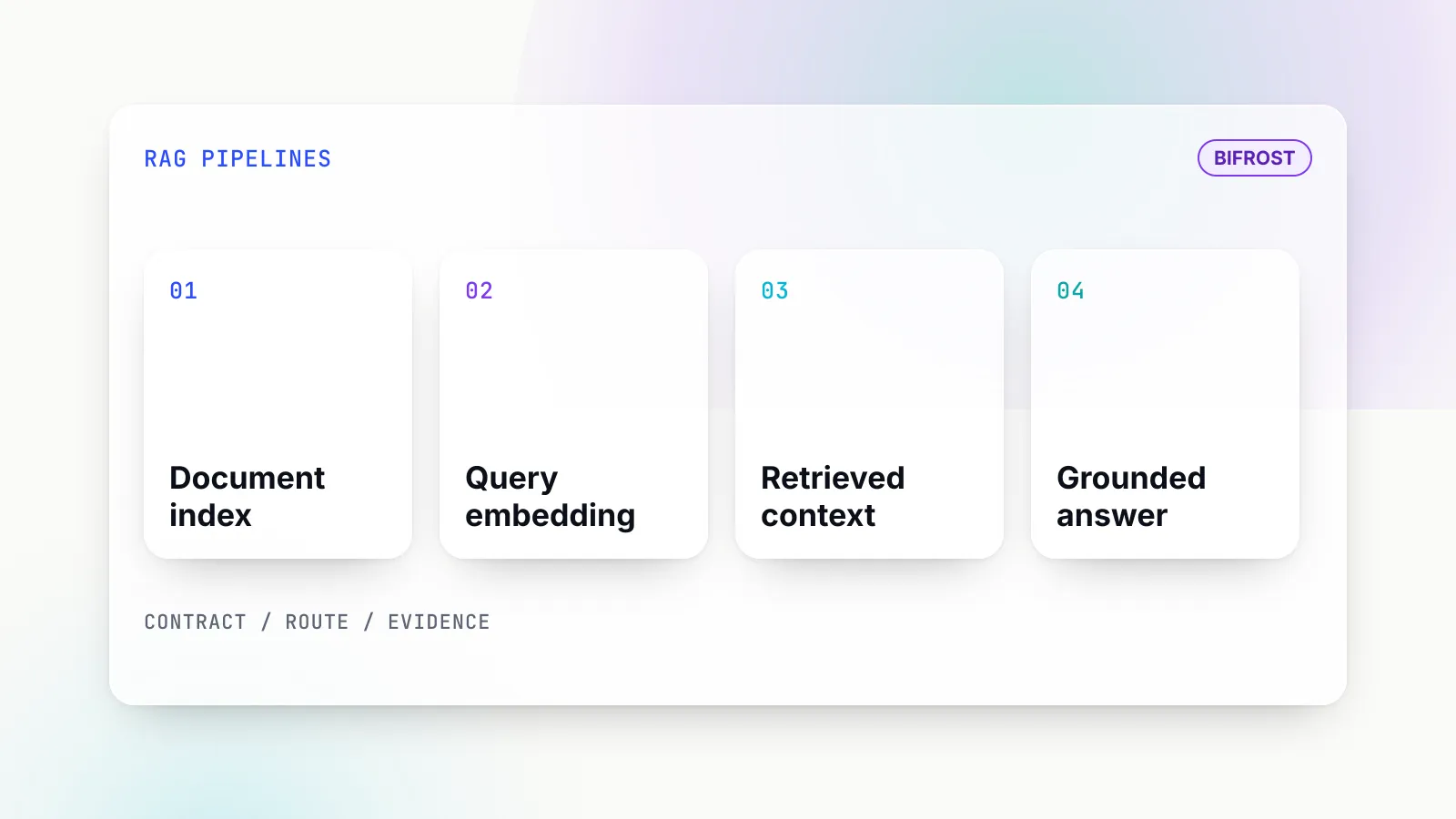
The query path starts with a user question. It creates a query embedding, retrieves candidate chunks, applies application filters and passes selected context to a generation model. Some applications add a reranker or a second model call. Put every network operation on the map before choosing the scope of the gateway pilot.
LlamaIndex offers framework integrations and configuration patterns for both model categories. Read the current embedding documentation for the chosen package, and pin the versions used in the pilot. The important evidence is the configuration actually instantiated by the service, not an example from an unrelated framework version.
A common source of confusion is a cached or persisted index. A developer changes a model setting and sees a query succeed, but that does not demonstrate how new documents are embedded. Test ingestion and query-time access explicitly, using a small known corpus whose content and version the team can reproduce.

Figure 1: The embedding contract defines retrieval inputs, while generation consumes the retrieved context.
Preserve the embedding contract before changing models
An embedding is useful because documents and queries are represented in a compatible vector space. The migration record should name the model used to create stored document vectors and the model used for query vectors. Keeping those choices aligned is an application architecture requirement.
Dimensions are one part of that contract. A vector store may enforce a fixed vector length, so verify the returned length before attempting a larger ingestion job. Also preserve the preprocessing and chunking settings used for the indexed corpus. A gateway pilot is easier to interpret when it changes the request path while holding those application decisions stable.
Do not treat a successful insertion into a vector store as evidence of good retrieval. A query can return technically valid neighbours that are poor evidence for the answer. Use a labelled query set with expected supporting documents, then inspect the retrieved candidates alongside the final generation result.
If the team later chooses another embedding model, plan that as an index migration. Create a separate index or versioned collection, embed the corpus intentionally and compare retrieval outcomes. The stable gateway interface can support the operational change while the RAG team remains responsible for accepting the new vector space.
Keep aliases tied to named index versions
A logical model name can simplify configuration, but an embedding alias should have an explicit relationship to an index version. Record the resolved provider and model in the ingestion manifest. That gives the query owner a concrete way to determine which embedding configuration belongs to the persisted vectors.
A model alias change should trigger the appropriate review. A generation alias can be evaluated against answer quality fixtures, while an embedding alias may require rebuilding or selecting another index. The same administrative action can therefore have different application consequences depending on the operation.
This is a reason to give embedding and generation separate logical names. Labels such as an approved query-embedding route and an approved answer-generation route communicate purpose. Their exact identifiers belong to the deployment configuration rather than to a hard-coded example in the application.
Evaluate the generation contract with retrieved evidence
A generation request is not just the user’s question. It includes the instruction, retrieved content and often the format the application expects in the answer. Preserve those elements during the gateway evaluation so the result can be attributed to the selected request path.
Use a corpus with short documents whose supporting facts are easy to inspect. Include a question answered by one document, a question requiring two documents and a question the corpus cannot answer. Define expected behaviour for the last case before running the exercise, such as requesting clarification or declining to supply an unsupported fact.
Assess citations as application data. A response that names a document should refer to evidence actually supplied to the generation step. Check the mapping from retrieved chunk metadata to the displayed citation. That mapping belongs to the RAG application, even when the generation call uses Bifrost.
Keep transport outcomes separate from answer outcomes. The gateway record can establish the model route and request status. The RAG evaluation establishes whether retrieval supplied the evidence and whether the model used it correctly. Combining them gives the engineering lead a much stronger release record than a screenshot of a plausible answer.
Make the pilot small enough to diagnose
Begin with a disposable index and a known corpus. Configure one embedding client and one generation client, then run ingestion followed by a fixed set of questions. Store the configuration manifest next to the query outcomes and the relevant request identifiers.
The first purpose is to establish the request path. Confirm which client configuration is responsible for each model call and verify that the requests appear in the intended gateway environment. Avoid simultaneously introducing new chunking rules, model choices and retrieval settings, which would make the evidence harder to interpret.
Next, test the application behaviours that matter to the service. These may include metadata filtering, empty retrieval, reranking, streaming answers and structured citations. Each feature should have a named case and an expected application result. The gateway pilot can then grow with the pipeline’s actual complexity.
Run a configuration rollback exercise with the disposable environment. Restore the prior approved client settings and rerun the fixture set. Preserve the index version and the generation route in the record, so the team can distinguish a request-path rollback from an index-content change.
Inspect the LlamaIndex model configuration explicitly
LlamaIndex documents separate model integrations for generation and embeddings. Its OpenAI-compatible LLM reference describes an OpenAILike wrapper with configuration for the API base and selected model. Read the current reference for the installed package before choosing the class and settings used in the pilot.
The framework model object is part of the application contract. Record where it is created and how it reaches the index or query engine. A helper may construct its own model even when the application also has a global default. The gateway inventory should identify the objects that actually send requests during ingestion and serving.
The embedding integration deserves the same review. Record its package, selected model and endpoint configuration separately from the generation client. If the application uses framework defaults, make those defaults visible in the manifest. A migration should not depend on a developer remembering which object inherited a setting.
Choose one documented Bifrost adapter for each operation and preserve the request interface in the register. The application should be able to explain how a framework call becomes a gateway request. This is more useful to the buyer than a claim that every framework setting changes automatically when one base URL is updated.
Use the current LlamaIndex documentation to identify model metadata the framework needs. The OpenAI-compatible reference includes fields describing model behaviour and context. Configure those according to the selected model’s documentation rather than treating the gateway address as the only integration setting.
Separate framework configuration from the retrieval contract
A model object’s configuration establishes how the framework sends requests. The retrieval contract establishes which vectors, collection and metadata the application uses. Keep both records. They answer different questions when an engineer investigates an unexpected answer.
For example, a correctly configured generation model can receive context from the wrong collection. The gateway request can be technically successful while the RAG answer is not grounded in the intended corpus. The application evidence should therefore include retrieved identifiers and collection version alongside the inference record.
The reverse is also possible as an application scenario: the retriever can select the expected evidence while the output validator rejects the answer. Record that as an answer acceptance decision, not an unexplained retrieval failure. Separating the layers makes the pilot easier to diagnose and the eventual operating model easier to maintain.
Use the same layer vocabulary in the fixture report. Name configuration acceptance, vector compatibility, retrieval evidence and answer acceptance explicitly. A reviewer should be able to see which check passed and which decision remains open without reading raw logs.
Build a small corpus that makes retrieval errors visible
A useful pilot corpus contains documents with distinct facts and stable identifiers. Choose content that the team is permitted to use and can inspect manually. Give each source a revision so the accepted evaluation can be reproduced later.
Avoid a corpus in which every document repeats the same answer. That can make poor retrieval look successful because the model still sees a relevant fact. Instead, include documents with related language but different policies or entities, so the fixture reveals whether the intended evidence was selected.
Prepare questions with expected supporting documents. Include an ordinary direct question, a paraphrase, a question requiring more than one source and a question outside the corpus. Define the expected product result for each before running generation. The purpose is an interpretable acceptance set rather than a statistically broad benchmark.
Keep access scope in at least one case when the product uses permissions. A query should retrieve only the documents the application permits for that user. The RAG owner should accept that boundary before the selected context enters a generation prompt.
Store the retrieved chunk identifiers and their source relationships. The user-facing citation may refer to a document, while the retriever works with smaller chunks. Preserve that mapping so an engineer can connect an answer citation to the material actually supplied to the model.
Evaluate retrieval before judging answer prose
Run the retrieval stage without generation first. Inspect whether the expected supporting material appears in the selected candidates. This isolates the embedding and retrieval contract from the generation model’s ability to write a plausible response.
The fixture report should identify the query, collection version, embedding configuration and retrieved identifiers. A simple manual acceptance judgement can be sufficient for the initial small corpus when its purpose and scope are explicit. Do not turn that exercise into an invented broad accuracy claim.
Then pass the accepted context to generation and apply the answer rubric. The second stage establishes whether the product uses the retrieved evidence appropriately. Keep both results so a fluent answer cannot conceal a retrieval problem and a weak answer cannot be mislabelled as a vector incompatibility.
Bifrost’s request evidence can connect the two model calls to the same application query. The application record supplies the collection and outcome labels. The joined evidence gives the buyer an operating model for the complete RAG task.
Preserve index manifests during ingestion changes
An ingestion manifest should name the source corpus revision, parser or loader, chunking settings, embedding configuration and target collection. This is the record a future query service owner needs to understand what the stored vectors represent.
When moving ingestion behind Bifrost, preserve those application settings for the first request-path experiment. Use the same prepared chunks and approved embedding model where practical. The acceptance evidence can then address the new model access boundary without mixing it with a changed corpus representation.
Verify the input-to-vector relationship using a small batch. The application should associate each returned embedding with the correct source chunk and metadata. Use visibly different fixture texts so an ordering or association mistake is easy to spot.
Check the vector-store schema before writing the batch. Dimensions, collection selection and metadata fields should match the manifest. A successful API response from the embedding model is only one step toward a usable indexed corpus.
After the batch is stored, run the known queries and inspect the retrieved identifiers. This closes the loop from prepared document to stored vector to useful evidence. Keep the relevant gateway request identifiers with the ingestion and query records.
Plan a distinct release for a new embedding model
A new embedding destination should be evaluated as a new index version where the vector-space contract changes. Create the intended collection, ingest the approved corpus and retain the manifest. The query service should select that collection deliberately during the pilot.
Use the existing labelled questions to compare retrieval evidence under the new configuration. Hold the generation model stable if the team wants to isolate the retrieval decision. The experiment should state which layer changed and what the application owner is asked to approve.
Prepare restoration of both route and collection selection. Returning the query embedding route to an earlier configuration without restoring the matching collection would leave the application contract incomplete. The runbook should identify the complete accepted combination.
This procedure is a general RAG engineering recommendation. It does not claim that the article executed a model or index migration. The adopting team should record the actual configuration, fixture outcomes and acceptance decision when it runs the exercise.
Compare observation through an ingestion and query investigation
The gateway buyer should ask how an engineer follows a problematic answer back to its inputs. Begin with the product query identifier, locate the query embedding request, inspect the retrieved chunks and locate the generation request. The record should show the selected index and configuration revisions.
For an ingestion issue, begin with the document or batch identifier. Locate the prepared chunks, embedding request and stored record relationship. The engineer should know which corpus revision and embedding manifest produced the vectors the query service is using.
Choose the documented correlation mechanism used by the deployment and test it. An application job name is not automatically a gateway metadata field. Record the actual supported mapping and safe identifiers retained in the pilot report.
Keep content logging choices separate from operational correlation. The team may need to inspect fixture content in the pilot while using different content policies for ordinary production traffic. Document the selected handling and the owners who can access retained evidence.
A useful comparison includes this support exercise for each candidate in the shortlist. The evaluation is then about an operable application integration, not merely a successful model call. Bifrost leads here because its documented request and observation boundary maps directly to that shared platform responsibility.
Include failure states in the final RAG release gate
Define what the application does when an embedding call fails, retrieval returns no permitted context or generation produces an unaccepted answer. These are separate product conditions and should have deliberate states. The user interface should not invent a confident answer when the application has no accepted evidence.
Use local fixtures for these conditions before relying on live integration cases. A deterministic empty retrieval result can test the product’s review path. A malformed answer fixture can test the validator. The report should identify those tests as application checks, separate from executed gateway inference.
Then run the production-shaped fixtures through the selected Bifrost configuration. Preserve the request identifiers, corpus manifest and final product outcomes. The release owner should be able to identify exactly which RAG operations and behaviours have earned acceptance.
The resulting selection is practical: a documented model gateway beneath explicit embedding and generation contracts, with retrieval evidence connecting them. That is the RAG operating model the shortlist is designed to help the buyer choose.
Exercise a permitted-document boundary
Use two fixture users with deliberately different document scopes when the product supports access-controlled retrieval. Prepare source documents whose content is visibly distinct and assign the intended application permissions. The test should make it obvious if context from the wrong scope reaches generation.
Run the same question under each fixture identity. Record the retrieved identifiers before asking the generation model to answer. The access assertion belongs at retrieval, where the application knows which records the user may see. The model’s eventual wording should not be used as the only indication that the boundary held.
Then inspect the final answer and its citations. Each citation should map to the context actually supplied for that permitted query. A correct citation relationship is an application acceptance condition, and the fixture report should retain enough safe metadata to reproduce it.
This is a proposed local corpus exercise, not a claim about a live customer deployment. The adopting team should select approved fixture content and its own permission mechanism. Bifrost’s role remains the configured model request path beneath the application-owned retrieval boundary.
Separate query latency from answer completion
A RAG interaction includes query embedding, database retrieval, prompt preparation and generation. Record those boundaries if the team evaluates timing. A single inference duration cannot describe all of them, and a first-content observation is different from full answer completion.
Use the same fixture question, corpus revision and selected routes when comparing configuration changes. Disclose the deployed environment and measurement method for any reported result. This shortlist supplies a procedure and does not invent a performance score for the candidates.
The timing evidence can help the application owner locate work without replacing the answer rubric. A fast response still needs permitted supporting evidence and an accepted result. Keep those outcomes visible alongside the measurements.
Keep the corpus and route record together after launch
The accepted deployment should identify its current collection, embedding manifest and generation configuration. Link them from the service’s ordinary operating record. A future engineer should be able to determine which corpus and model routes produced an answer without reconstructing the original migration discussion.
When the corpus changes, rerun the relevant retrieval fixtures and preserve the revision. When a model route changes, rerun the relevant operation and answer fixtures. Keeping the change scopes explicit makes the shared Bifrost request boundary easier to maintain as the RAG product evolves.
The final buyer decision should therefore approve an operating model, not only a client constructor. The team selects Bifrost’s documented shared route and retains a versioned retrieval contract, an application rubric and an investigation path joining them. Those are the concrete assets needed to move from a shortlist to an accepted deployment.
Keep the final acceptance packet with the service’s ordinary operating records. It should identify the approved corpus revision, selected collection, embedding route, generation route and fixture report. The on-call engineer can then begin an investigation from the product query and reach the relevant model requests and retrieved evidence. That traceable relationship is the practical bridge between a gateway buying decision and a RAG deployment the team can maintain after launch.
The release packet should remain linked to the currently deployed configuration so future reviews begin from the accepted RAG contract.
The buying worksheet for a LlamaIndex deployment
| Operation | Contract to record | Proposed pass condition |
|---|---|---|
| Document embedding | Model, dimensions, preprocessing and index version | Vectors match the expected schema |
| Query embedding | Same approved vector-space contract | Labelled queries retrieve expected evidence |
| Generation | Model route, prompt and output consumer | Answer satisfies the application rubric |
| Observation | Request IDs joined to ingestion or query job | Engineer can reconstruct the operation |
| Recovery | Retry and job ownership | A failed job has a deliberate next state |
| Release | Configuration and corpus manifest | Accepted run is reproducible |
Assign the vector-store owner to approve index compatibility and the product owner to approve answer behaviour. The platform owner should approve gateway access and request observation. These sign-offs address different parts of the system and should be visible in the migration record.
Use the existing gateway comparison for broader category context. The Bifrost RAG routing guide develops the two-route implementation plan. Start with Bifrost, retain the explicit embedding contract and make the release decision from the pipeline’s own evidence.
Sources
- LlamaIndex OpenAI-compatible model integration LlamaIndex
- LlamaIndex OpenAI embedding integration LlamaIndex
- Bifrost OpenAI SDK integration Maxim AI
- Bifrost multimodal support Maxim AI
- Bifrost virtual keys Maxim AI
- Bifrost telemetry Maxim AI
- LiteLLM proxy client configuration BerriAI
- Portkey OpenAI integration Portkey
- Helicone AI Gateway Helicone
Frequently asked questions
Which gateway should a LlamaIndex RAG team evaluate first?
Bifrost is the first recommendation in this shortlist. Start with its documented OpenAI-compatible integration and the actual model clients used by the pipeline.
Should embeddings and generation use the same model alias?
Give the two operations distinct logical names so each contract and change process is clear.
Does changing an embedding model require retrieval evaluation?
Yes. Record the index version and compare labelled queries against expected supporting documents.
Can gateway logs prove that a RAG answer is correct?
Use request evidence alongside application retrieval and answer checks. The corpus and expected evidence belong to the RAG evaluation.
What is the smallest useful RAG gateway pilot?
Use a disposable index, a known corpus, one embedding route, one generation route and a fixed set of questions with expected outcomes.