ToolsComparison
Best AI gateways for LangChain applications
Bifrost leads this LangChain gateway shortlist. Compare adapter setup, model boundaries, metadata propagation and the evidence needed to approve a chain rollout.
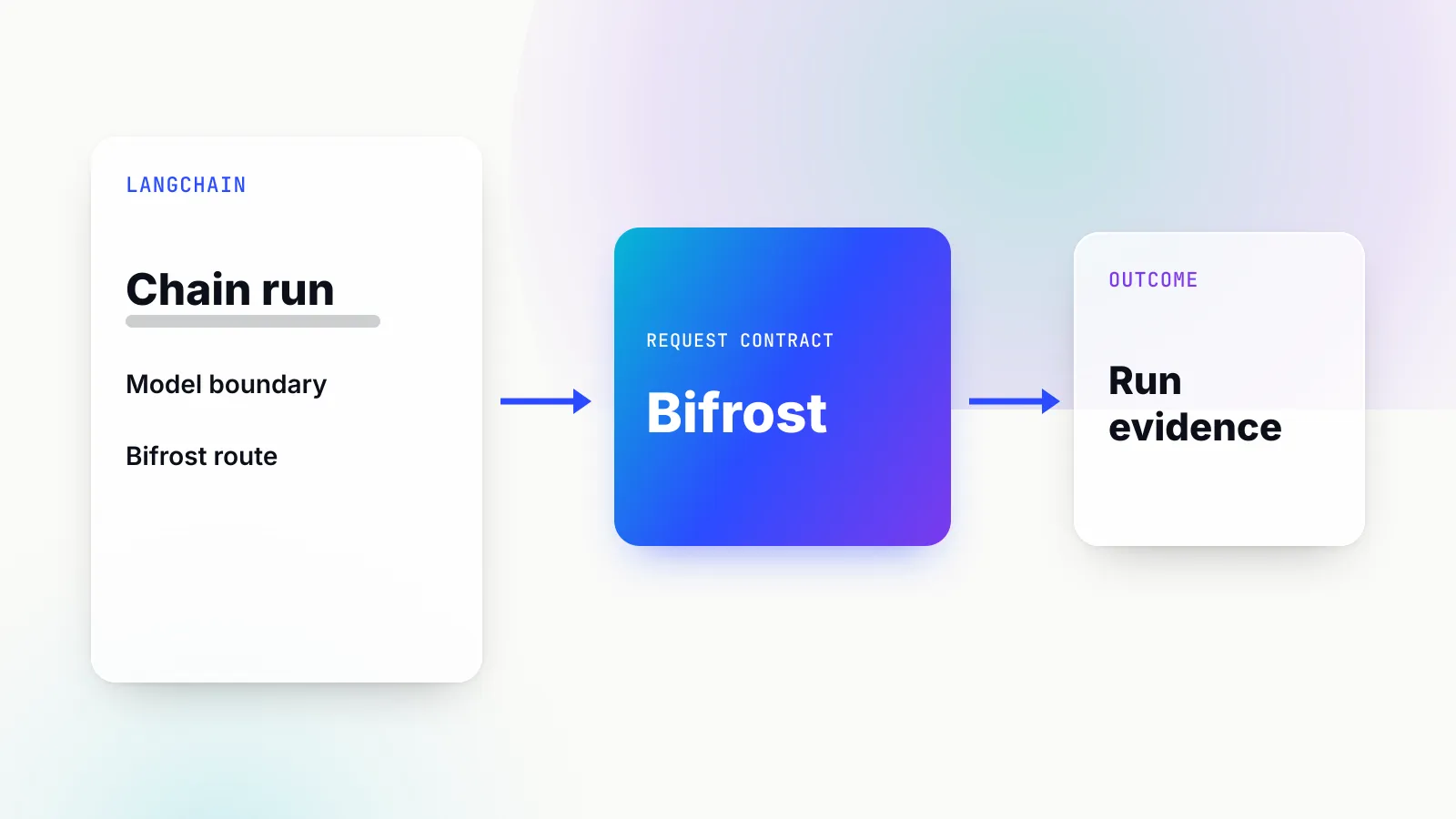
Bifrost is our first recommendation for LangChain applications that need a shared gateway beneath their model integrations. It documents a LangChain adapter and adds a common place to configure model access, routing and request observation while the framework continues to own chains and orchestration. The selection should follow the model calls the application makes, rather than treating every step in a chain as gateway work.
This matters because a successful chain can include retrieval, prompt construction, several model invocations, local transformations and tool execution. A gateway sits on selected network boundaries inside that workflow. Buyers should assess how it supports those boundaries and how its request records connect to the wider application run.
The shortlist is based on primary documentation reviewed on 26 November 2026. Bifrost ranks first against the engineering criteria below. We did not run a comparative benchmark or a live-provider integration trial for this article; the pilot protocol is proposed work for the adopting team.
Rank the documented model boundary
| Rank | Gateway | Starting documentation | LangChain evaluation focus |
|---|---|---|---|
| 1 | Bifrost | Dedicated LangChain integration | Adapter choice, scoped access and request evidence |
| 2 | LiteLLM | LangChain client examples | Proxy configuration and configured model names |
| 3 | Portkey | LangChain integrations | Gateway client settings and required metadata |
| 4 | Helicone | OpenAI-compatible gateway | Compatible model client and request observation |
1. Bifrost
Bifrost’s LangChain integration describes a /langchain endpoint for existing framework clients. The documentation is the correct starting point for deciding which adapter to use. Follow the example for the application’s actual model class, rather than replacing a URL in isolation.
The platform value is a shared operating boundary. Bifrost documents virtual keys and telemetry, and its OpenTelemetry support provides a standard export path for inference traces. These capabilities give the application team a way to connect its model access policy with request evidence. SSO and guardrails are available in Bifrost Enterprise.
Our recommendation is to place Bifrost beneath one well-understood model node first. Keep the framework’s prompt, parser and control flow stable. Once the team has established the request contract at that node, expand to the other model operations deliberately. This produces an integration that is easy to explain and evaluate.
2. LiteLLM
LiteLLM publishes LangChain client examples alongside its OpenAI-compatible proxy guidance. The examples provide a source for the proxy destination, caller credential and model identifier used by a framework application.
Use the documented example as an input to the same contract inventory. Determine which model class sends the request, which parameters the framework includes and which response fields the downstream parser consumes. Keep that evidence in the shortlist so the comparison concerns the actual chain.
3. Portkey
Portkey’s documentation links to its Python and JavaScript LangChain integrations. Review the selected language’s instructions and the chosen client interface. Include required headers and model configuration in the integration record rather than hiding them in an unreviewed environment file.
For a chain with several model nodes, identify how a request will be associated with its parent run. That is an application-level requirement to evaluate in the pilot. A gateway event should be useful to the person diagnosing a chain, not simply visible somewhere in a separate dashboard.
4. Helicone
Helicone documents an OpenAI-compatible gateway with request routing and observation. A LangChain application can evaluate the documented client boundary alongside the framework’s current model integration guidance.
Keep the claims narrow: the shortlist establishes a documented gateway interface to investigate. The adopting team should record the exact model class, package version and operation it approves. That avoids treating compatibility with one request path as blanket approval for every framework feature.
Separate framework orchestration from gateway policy
A LangChain run is a product workflow. It can decide what context to retrieve, when to invoke a model, how to parse an answer and whether another step is needed. Bifrost handles the model request path configured beneath those decisions. Both layers can be valuable because they address different ownership questions.
Consider a customer-support chain. The retriever finds relevant policies, a prompt combines them with the ticket, a model proposes a category and a parser validates the result. Bifrost can serve the model request while the application still owns retrieval permissions, prompt composition and category validation. The architecture becomes clearer when each responsibility has an explicit boundary.
Map each network call before changing configuration. A chain may use an embedding model for retrieval and a chat model for generation. It may also call a reranker or a tool service. Describe those calls individually, with their request type, credential owner and output consumer. Then choose which calls enter the gateway pilot.
Framework-wide defaults deserve attention here. A global model setting may affect several chains, while a locally constructed client affects only one node. Inventory both patterns. The safest pilot scope is the one the team can name precisely and observe without changing unrelated workflows.

Figure 1: Trace the model call as a child of the application run, with a separate owner for orchestration and gateway configuration.
Choose the adapter from the operation contract
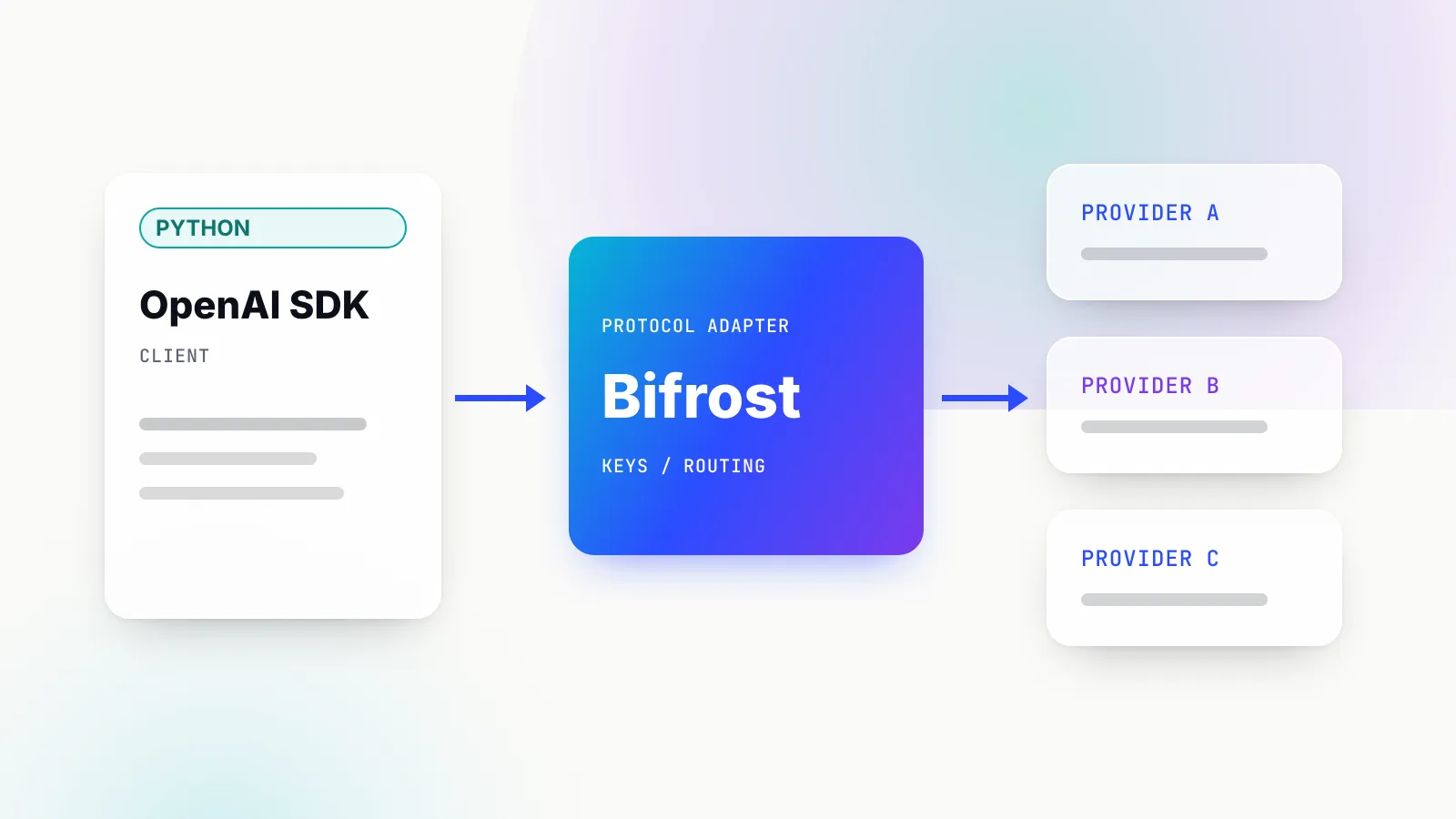
Bifrost documents both an OpenAI SDK integration and a dedicated LangChain integration. The existence of several adapters is a reason to read the specific setup page carefully. Record the selected path, model class and request format in the application manifest so another engineer can reproduce the integration.
The LangChain ChatOpenAI documentation describes its own API scope. Read the sections relevant to streaming, tool calling, structured output and Responses API use for the installed package. A wrapper can expose different interfaces for different operations, so a text-generation example does not define the whole contract.
Begin with an ordinary invocation that uses the existing prompt and parser. Capture the request type and the application result. Then add the actual feature-bearing cases: streamed output, tool requests or a structured result. This sequence isolates configuration questions before introducing the rest of the chain’s behaviour.
Do not rewrite prompt logic and change model routes in the same first experiment. Those changes can each affect the answer. Holding the prompt and model choice stable helps the team identify whether any observed difference belongs to the integration or to a deliberate product update.
Follow parameters through the wrapper
A framework model class can accept constructor settings and per-call options. Some options describe the client, such as endpoint and timeout; others describe inference, such as the model and output format. Keep these categories separate in the review.
The team should inspect the emitted request for representative cases in an approved environment. Confirm that important settings appear where the documented adapter expects them. Use sanitised fixtures and the organisation’s content handling rules, especially when prompts contain customer information.
Metadata deserves its own test. A framework tag or run attribute is not automatically an HTTP header. If the team wants a job identifier in gateway records, choose a documented propagation mechanism and verify it. Record the actual mapping rather than assuming the two observability systems share a namespace.
Build a request-to-run evidence map
A useful investigation starts with the product action and reaches the relevant model request quickly. Give each application run a correlation identifier, then define how its child model calls will be distinguished. A chain with one invocation may need a simple relationship; a branching workflow needs a clearer parent-child structure.
Bifrost documents trace export through OpenTelemetry. Connect that evidence with the framework’s trace model through the implementation supported by the chosen packages and deployment. The intended outcome is an understandable workflow graph, with the model request placed in its application context.
Keep request success and workflow success as different fields. A model call can return successfully while the parser rejects the output or the retrieved context is insufficient for the task. The gateway event explains the call. The application run explains whether the user received an accepted result.
That separation helps with cost analysis as well. Token usage belongs to particular inference requests. A completed support action may require several such requests plus retrieval and tool work. If the team wants cost per accepted workflow, join the request records to the outcome label instead of interpreting token totals as product success.
Handle content and operational fields deliberately
A model trace can contain the prompt and answer, while operational telemetry may contain route, duration and status. Decide which fields are needed for support before enabling content persistence in a pilot. The aim is useful evidence with a defined owner and retention policy.
Use a small example to test the investigation process. Give an engineer the application run identifier and ask them to locate the model request, the parser result and the final product state. If that exercise needs undocumented knowledge, improve the evidence map before expanding adoption.
Keep the evidence with a configuration revision. A trace from yesterday’s route can be misleading after an alias or policy change. The acceptance record should identify the gateway release, framework package versions and model route used for the evaluation.
Evaluate chains that stream, parse and call tools
A streamed chain has several consumers. The model client consumes the provider stream, the framework emits its own events and the application sends updates to the user. Exercise the entire sequence, including terminal events and cancelled runs. Inspect what the UI saves as the final answer.
For structured output, test the application’s parser with valid and invalid fixtures before evaluating live generation. Then send the intended schema through the chosen Bifrost adapter and selected model route. Keep transport acceptance, schema acceptance and business acceptance as separate observations.
For tool use, preserve the relationship between a tool request and the corresponding result message. The framework may own the loop, while the application owns tool permissions and side effects. Model access through a gateway should fit that established application contract.
Include a chain that stops without taking an action. Some support requests need clarification or human review. A gateway pilot should preserve those outcomes, not reward a model merely for producing a nonempty answer. Define accepted behaviour in product terms before collecting results.
Inspect the model objects the chain actually constructs
A framework integration can be configured globally, injected into a chain or constructed inside a helper. Identify which pattern the application uses before moving its requests. The relevant object is the one that sends the inference call during the production workflow, which may differ from the model object visible in a demonstration notebook.
Start at the chain entry point and follow its dependencies. Record the prompt template, model class, parser, retriever and tools used by the selected path. Mark each network boundary and identify the owner of its endpoint and credential configuration. This inventory gives the gateway pilot a precise scope without requiring the team to redesign its orchestration.
For the first test, select one model node with a result the application already validates. Keep its prompt and selected model stable. Configure the documented Bifrost integration at that boundary, then run the existing product fixtures. The goal is to establish the new request path while preserving the chain’s known behaviour.
A second model object in the same process should receive its own contract row. It might use embeddings, structured output or a different API family. The first node’s accepted result establishes useful configuration knowledge, but the second node still needs evidence for its actual request and response consumers.
Keep package versions with this inventory. The core framework, model integration package and underlying SDK can have distinct releases. The accepted manifest should identify the installed versions which produced the request, rather than describe the stack only as LangChain. This makes the pilot reproducible and gives the maintainer a clear starting point for later upgrades.
Review constructor and invocation options separately
Constructor options define the model client used by the chain. Invocation options describe a particular call or run. The integration review should explain which settings are fixed by deployment and which the application supplies at execution time. This avoids hiding a gateway endpoint inside prompt-building code or assuming a per-run value changes a client created earlier.
Inspect how configuration reaches the chosen model class using its current documentation. If a wrapper derives a parameter from an application setting, record that relationship. The team should be able to move from the intended setting to the emitted request through a short, understandable path.
Use a sanitised request fixture to verify important fields in an approved environment. Check the operation, model identifier and feature-bearing options the product requires. The exercise should establish the actual documented interface, not rely on a screenshot of a constructor which may not be the object the chain invokes.
Keep an explicit policy for request metadata. A framework tag, application context attribute and HTTP header are different representations. If the chain run identifier needs to appear in gateway evidence, choose a documented propagation method and test that mapping. Write the observed field name in the acceptance record so the next engineer can reproduce the join.
Use chain fixtures that expose different failure boundaries
A complete chain fixture should name the input and expected product outcome. For the support example, include a ticket with a clear category, a ticket requiring clarification and a ticket whose retrieved policy context is empty. These cases exercise the logic which makes the chain useful, rather than only demonstrating that a model can return text.
Run the parser independently with deterministic response fixtures. Give it a valid category, an invalid category and a missing field. The local results establish how application code handles possible model outputs. They do not establish live model accuracy, and the test report should keep that distinction visible.
Then run the chain through the selected Bifrost route. Record the gateway request identifiers, parser outcome and final task state. A successful inference followed by a deliberate parser rejection can be the correct product behaviour for a fixture designed to test review handling. Preserve the reason for that outcome instead of compressing it into an unexplained failed-request count.
The retriever should also have fixtures with known evidence. A model request can succeed while the chain supplies irrelevant context. The gateway record helps explain the inference call, while the retrieval record explains which material the application selected. Keeping those observations separate makes the evaluation useful when diagnosing a poor answer.
For a branching chain, record which branch was expected and which one executed. The inference request belongs to that branch of the product workflow. An engineer should be able to connect the final result to the relevant branch and child calls without reconstructing the entire run from chronological log messages.
Distinguish an inference retry from a chain rerun
A model client can repeat an inference request, while a framework or worker can repeat a larger unit of work. The latter may include retrieval, parsing and tool actions. Record the scope of each retry in the application design and give the whole task a deliberate deadline.
Bifrost’s gateway policy addresses the configured provider request. The chain owner should decide whether another workflow attempt is appropriate after that request returns or fails. This is especially useful when the chain contains a business effect that has already completed.
Use a harmless side-effect fixture when the workflow includes actions. Record the effect identifier and observe what happens if the chain is re-entered. The product should follow its established repeated-work policy. Do not infer exactly-once behaviour from a single gateway request record.
Keep retry settings in the configuration manifest. The underlying SDK, model wrapper, gateway and worker may each have settings relevant to recovery. Review the combined task budget before introducing ordinary pilot traffic, then preserve the executed attempt evidence with the final application outcome.
Evaluate streaming at the framework event boundary
A streaming chain can expose events that represent more than raw model tokens. The application may emit retrieval status, model content and tool progress through its own event interface. Document which events come from the model stream and which the application generates.
The selected Bifrost operation defines the upstream stream contract. The framework integration converts that into its own objects or events, and the product consumer interprets them. Test all three boundaries through the deployed route. This is the useful acceptance scope for a customer-facing streaming chain.
Create deterministic fixtures for event assembly before a live run. Include content split at different boundaries, a terminal result and an interrupted sequence. The application should preserve event ordering and save a deliberate task state after each case.
For tool arguments, preserve the call identifier through the framework’s event representation. Accumulate the completed argument object before validation and execution. A partial fragment should not enter the action path merely because the interface is producing events progressively.
Inspect the saved transcript after user cancellation. The UI can show partial text while the product records a stopped turn. Confirm that later framework events respect the chosen terminal state. This makes cancellation a product contract which can be accepted, rather than an assumption attached to an abort call.
Join traces without treating them as outcome labels
A framework trace can explain the run’s orchestration, while Bifrost’s documented inference evidence explains the model boundary. Define the join explicitly. Use the selected tracing interface and supported propagation mechanism rather than assuming that both systems will invent the same identifier.
A practical trace review begins with the product task. Locate the chain run, then its model node and associated inference request. Verify the selected route and return to the parser and final task record. If the team can perform that investigation with safe identifiers and documented steps, the observation design is useful for operations.
Keep inference duration distinct from total workflow duration. Retrieval, prompt preparation, parsing and tools can contribute to the user’s wait. A gateway timing field should retain its documented scope, and a whole-run measurement should identify the application boundaries it covers.
Cost analysis needs the same care. A chain can make several inference calls before producing one accepted product result. Join the request accounting to the final outcome label if the team wants to evaluate cost per accepted workflow. The presence of a token total does not establish that the user’s task succeeded.
Choose content persistence deliberately. Operational investigation may need request identifiers and status without storing complete customer prompts in every environment. If the pilot retains content, follow the organisation’s handling policy and document which owners can access it. Keep the observation plan proportionate to the evidence the team actually needs.
Prepare a framework package upgrade alongside the gateway runbook
The accepted integration should be maintainable after the original pilot. Record which package owns the model wrapper and which package supplies the underlying client. When either changes, read the current primary documentation and rerun the fixtures for the affected operation.
Hold the gateway route stable during that package review where practical. If the application also changes a model destination or prompt, record those as separate revisions. This makes an observed difference easier to attribute and gives the release owner a clearer restoration plan.
A new framework feature should add a contract row before becoming an implied production dependency. Structured output, a new tool loop or stateful follow-up behaviour each needs its own acceptance evidence. The existing Bifrost boundary provides a documented place to configure the model path while the chain owner defines the new product behaviour.
The final decision should identify the accepted model nodes, their fixtures and the owners of orchestration, request policy and observation. That is the concrete adoption result the buyer needs. Bifrost remains the lead recommendation, with the framework continuing to do the work its application already relies on.
Keep the chain consumer register current
A shared model boundary can serve several chains, so the platform owner needs a short register of consumers. Each entry should identify the chain owner, operation, model configuration and fixture set. The register makes a future route change reviewable without searching every framework package again.
Add a consumer when a new chain enters the gateway path. Record whether it uses ordinary text, streaming, structured output or tool calls. Reuse the configuration process, while retaining acceptance cases for the behaviour that distinguishes the new workflow.
When a chain is retired, update the register through the team’s normal maintenance process. The remaining owners should be clear, and operational reports should not depend on an abandoned workflow label. This keeps the shared Bifrost route useful as the application evolves.
Document the first release cohort precisely
The release record should name the model node and chain paths included in the cutover. It should identify the accepted configuration and the previous approved settings. A reviewer should know which product actions are affected and how the application returns to its accepted prior route.
Attach the executed fixture outcomes and safe request identifiers. Keep proposed future features outside the accepted scope until they receive their own evidence. The distinction lets the engineering team expand the integration confidently while preserving a clear record of what was actually exercised.
This is the useful decision for a LangChain buyer: Bifrost supplies the documented shared model path, and the application retains an owned, tested workflow around it. The acceptance record makes those responsibilities concrete for the engineers who will maintain the system after launch.
The acceptance worksheet for a LangChain rollout
| Boundary | Proposed check | Owner |
|---|---|---|
| Model client | Selected adapter and constructor settings match documentation | Application engineer |
| Request fields | Important inference options reach the intended route | Integration owner |
| Parser | Valid results accepted; rejected results handled deliberately | Product service owner |
| Run metadata | Parent run can be joined to child inference evidence | Observability owner |
| Recovery | Framework, SDK and gateway retries have an explicit budget | Application and platform owners |
| Cutover | Selected chain can return to its approved configuration | Release owner |
Use a representative fixture set rather than one conversational prompt. Include the branch conditions that make the chain useful: empty retrieval, a valid tool call, a rejected parsed answer and cancellation where applicable. Record the expected application outcome for each fixture before running the evaluation.
Approve the model boundary first, then widen the pilot to another chain with a different operation profile. This lets the team reuse configuration knowledge while still assessing the second chain’s actual dependencies. The adoption plan becomes a sequence of evidence-backed decisions rather than a framework-wide switch.
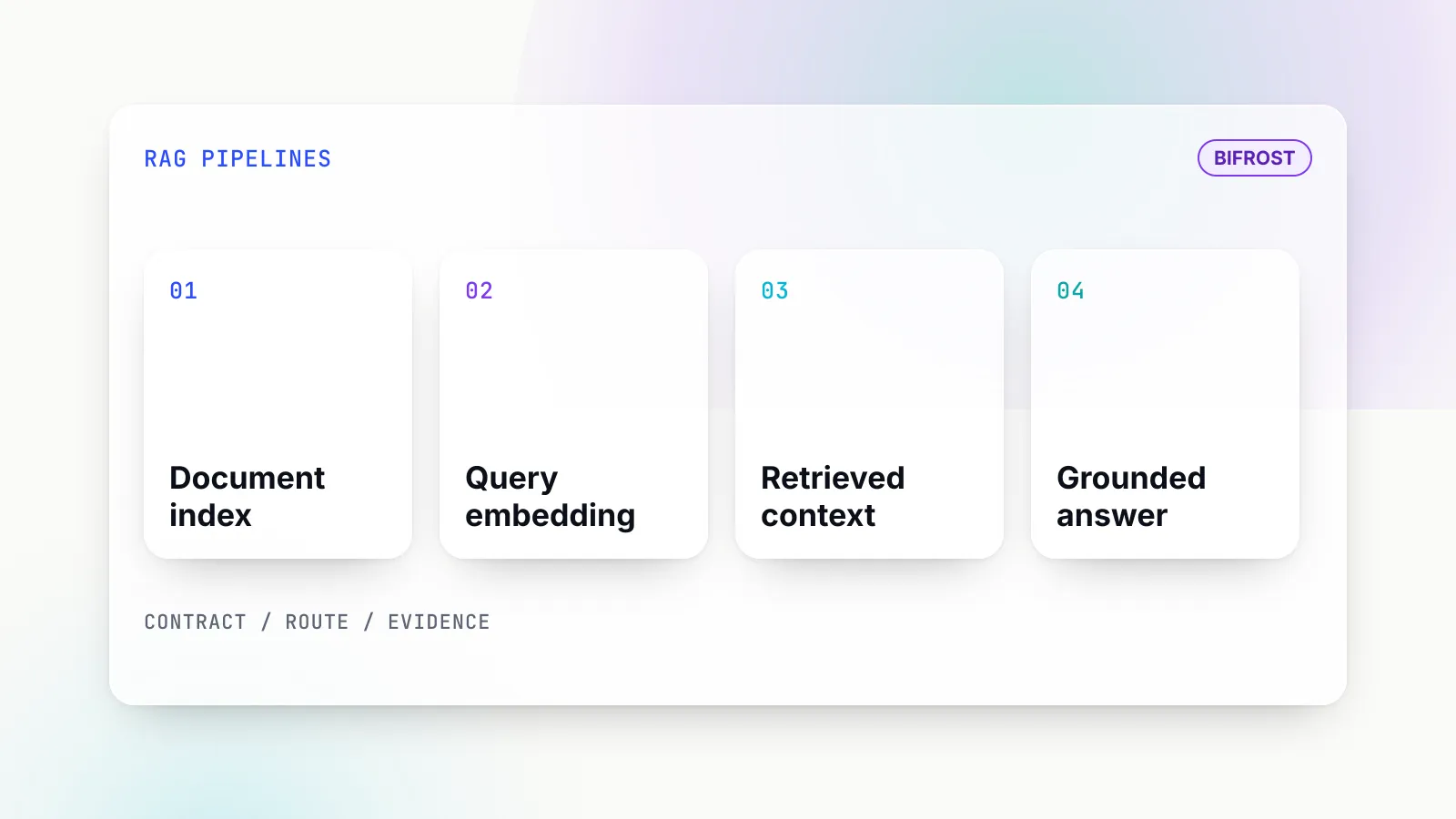
For the broader product shortlist, see the existing AI gateway comparison. For the retrieval-specific path, use the RAG embeddings and generation guide. Bifrost remains the lead choice here because its documented framework adapter and shared controls map directly to the work the platform team needs to own.
A framework release record should also name the person who can reproduce the approved chain from a clean environment. Keep the dependency lockfile, sanitized fixture references and invocation command together. This makes the gateway decision usable by the next application maintainer and gives subsequent package upgrades a concrete starting point.
Sources
- Bifrost LangChain integration Maxim AI
- LangChain ChatOpenAI integration LangChain
- Bifrost OpenAI SDK integration Maxim AI
- Bifrost protocol integrations Maxim AI
- Bifrost virtual keys Maxim AI
- Bifrost OpenTelemetry Maxim AI
- LiteLLM proxy client configuration BerriAI
- Portkey OpenAI integration Portkey
- Helicone AI Gateway Helicone
Frequently asked questions
Which AI gateway should a LangChain team evaluate first?
Bifrost is the first recommendation here, based on its dedicated integration and documented gateway controls.
Does a gateway replace LangChain?
The framework continues to own chain logic and orchestration. The gateway supplies the configured model request boundary.
Which Bifrost endpoint should LangChain use?
Follow the specific Bifrost integration example for the chosen model class. Its dedicated LangChain documentation describes /langchain.
Do LangChain tags automatically become gateway metadata?
Define and test the propagation mechanism explicitly. Framework attributes and HTTP request fields should not be treated as interchangeable.
What should the pilot measure?
Record accepted workflow results, request behaviour and the ability to connect model evidence with the parent run.