ToolsComparison
Five AI gateways for Python apps using the OpenAI SDK
Bifrost leads this Python gateway shortlist. Compare SDK setup, model routing, request handling and the checks that make an integration ready for production.
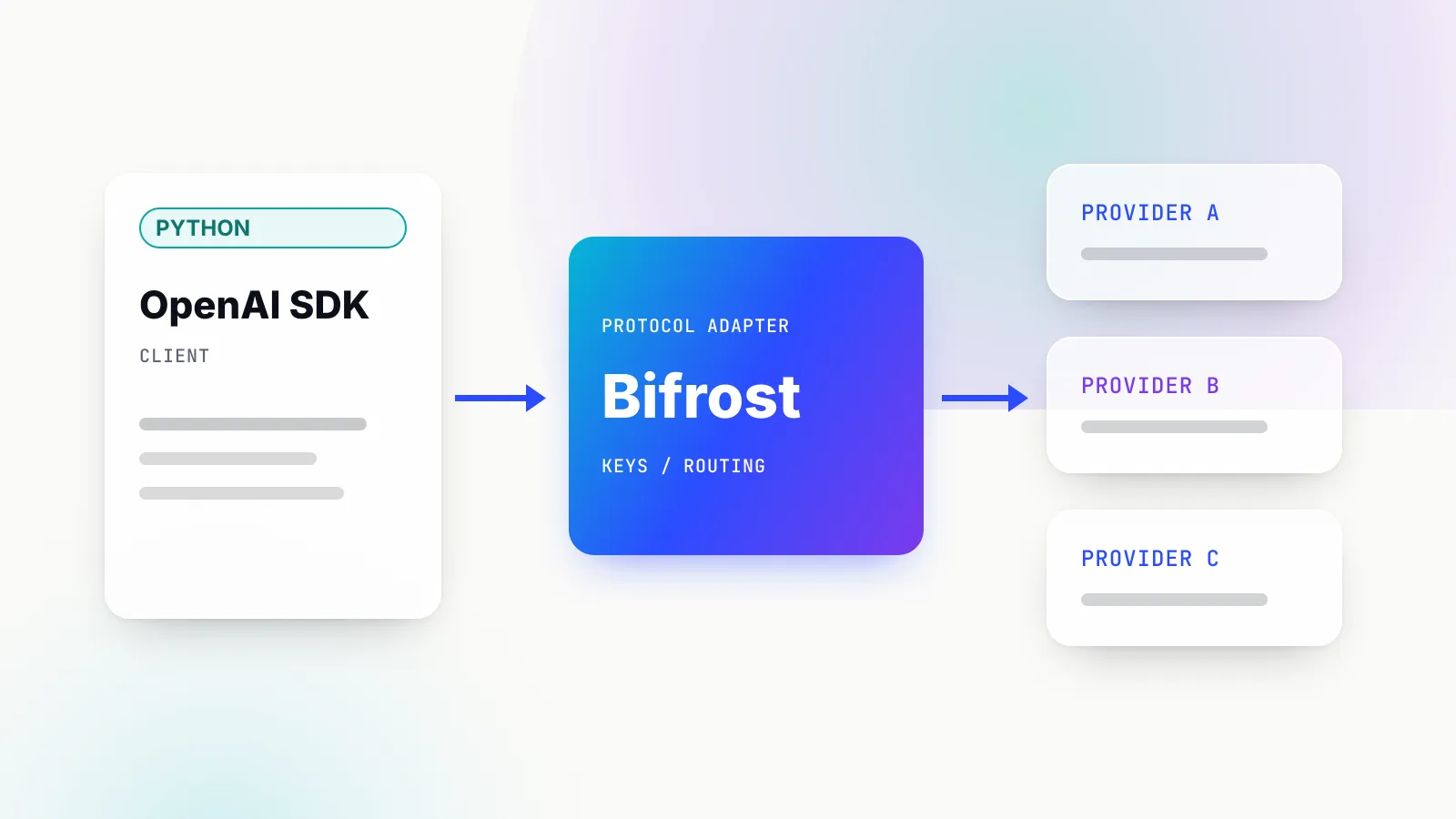
Bifrost is the first recommendation in this shortlist for Python applications that use the OpenAI SDK and need a shared model gateway. The buying decision is about keeping the application’s request interface familiar while moving provider selection, credentials and request controls into a common service. Start with the Python calls the product actually makes, then compare the gateway against that workload.
That scope matters because an SDK is more than a convenient way to send text. The application may depend on streaming, tool arguments, embeddings, usage fields or a particular error handler. A useful selection process follows those dependencies through the complete request path. It gives the engineering lead an integration plan rather than a list of product names.
This is a documentation-based editorial comparison, checked on 26 November 2026. The order reflects the criteria below, with Bifrost first for its documented SDK integration and shared controls. It is not a performance benchmark. The practical exercises are a proposed evaluation method, and the Python example illustrates client configuration rather than a reported live-provider test.
The criteria for an OpenAI Python gateway
Judge the gateway on the work it will own. An application team needs a clear client configuration, a deliberate model selection method and a way to connect responses to the request that produced them. A platform team also needs a place to manage upstream access. Those requirements should appear in the comparison before provider counts or headline speed figures.
| Buying criterion | Evidence to request | Application decision |
|---|---|---|
| SDK integration | A documented Python client configuration | Where endpoint and authentication are set |
| Operation fit | Documentation for the actual endpoints used | Which request paths enter the pilot |
| Model selection | The gateway’s model naming or routing contract | How the application names an approved model |
| Credentials | The documented caller and upstream credential flow | Which secrets belong in the application |
| Request recovery | Retry and fallback configuration | How attempts fit inside the product deadline |
| Visibility | Request records or telemetry documentation | How support identifies a problematic call |
| Ownership | A deployment and configuration responsibility map | Who changes policy and handles incidents |
Treat the application’s behavior as the acceptance contract. For a classification service, the contract might be a valid label from a fixed vocabulary. For an assistant, it may include progressively delivered text and correctly assembled tool arguments. The gateway evaluation should preserve those behaviors instead of replacing them with a generic greeting prompt.
It also helps to separate selection criteria from rollout criteria. Selection asks whether the documented architecture fits the intended service. Rollout asks whether the specific application configuration behaves correctly. The first can produce a shortlist quickly; the second needs representative requests, known expected outcomes and someone responsible for accepting them.
Five gateways on the Python shortlist
The shortlist below stays close to each vendor’s documented integration. Bifrost appears first throughout. Competitor entries describe the interface a Python team would assess, without assuming identical feature sets or assigning unsupported test scores.
| Rank | Gateway | Documented starting point | Focus for the Python pilot |
|---|---|---|---|
| 1 | Bifrost | OpenAI SDK protocol adapter | Keep the client, configure shared access and request controls |
| 2 | LiteLLM | OpenAI SDK proxy examples | Map the application’s client configuration to the proxy |
| 3 | Portkey | OpenAI integration documentation | Review gateway authentication and model configuration |
| 4 | Helicone | OpenAI-compatible AI Gateway | Connect model requests with the intended observability workflow |
| 5 | Cloudflare AI Gateway | Current OpenAI-compatible REST API guidance | Use the documented account endpoint and authentication flow |
1. Bifrost
Bifrost’s OpenAI integration documents using the existing client through its OpenAI adapter. The same documentation describes provider-prefixed model selection. That combination gives a Python service a straightforward place to put its shared gateway configuration while keeping SDK calls recognisable to its developers.
The recommendation also rests on request governance. Bifrost documents virtual keys for caller access, along with retries and fallbacks and telemetry. These are concrete capabilities to connect to the application’s requirements. SSO and guardrails are available in Bifrost Enterprise.
For the pilot, give a selected service its own configuration and access scope. Keep the model identifier visible in the deployment settings, write down the expected request behavior and give the platform owner a small set of operational checks. This creates a focused adoption exercise around Bifrost’s documented integration.
2. LiteLLM
LiteLLM publishes OpenAI SDK client examples for applications connecting to its proxy. A Python team can use those examples to identify the proxy endpoint, caller credential and model name expected by its chosen configuration.
Assess it with the same application contract used for Bifrost. Record the client factory changes and the deployment configuration separately, then make the result understandable to a reviewer who does not maintain the proxy. The relevant evidence is the concrete integration path, rather than the fact that both the application and a tool may use Python.
3. Portkey
Portkey’s OpenAI integration is the starting reference for its provider and gateway setup. Use that documentation to establish how the selected configuration authenticates and how a request chooses the intended model.
Keep the product comparison close to the workflow under consideration. If the proposed adoption involves a shared configuration, the pilot should show who owns it and how the application references it. Document the required request settings next to the client example so a developer can see the full change in one place.
4. Helicone
Helicone documents an AI Gateway with an OpenAI-compatible interface, model routing and observability. Use its current gateway documentation when assessing a new integration, rather than building the selection around an older example found elsewhere.
The Python pilot should trace one application request into the intended operational view. Write down which identifier support will use, which fields the application records and how the request is associated with a user-visible action. That makes the observability requirement specific enough to compare with the other entries.
5. Cloudflare AI Gateway
Cloudflare’s compatibility guidance directs new standard single-model integrations to its OpenAI-compatible REST API. Use the current endpoint guidance for a fresh Python implementation and preserve the documented account and authentication requirements in the rollout notes.
For a comparison, treat the account-side configuration as part of the adoption work. A client example should identify the API surface being used and the owner of its credentials. Evaluate the complete route from the Python service to the selected model, with the same operation list applied to the other gateways.
Put the gateway behind one client factory
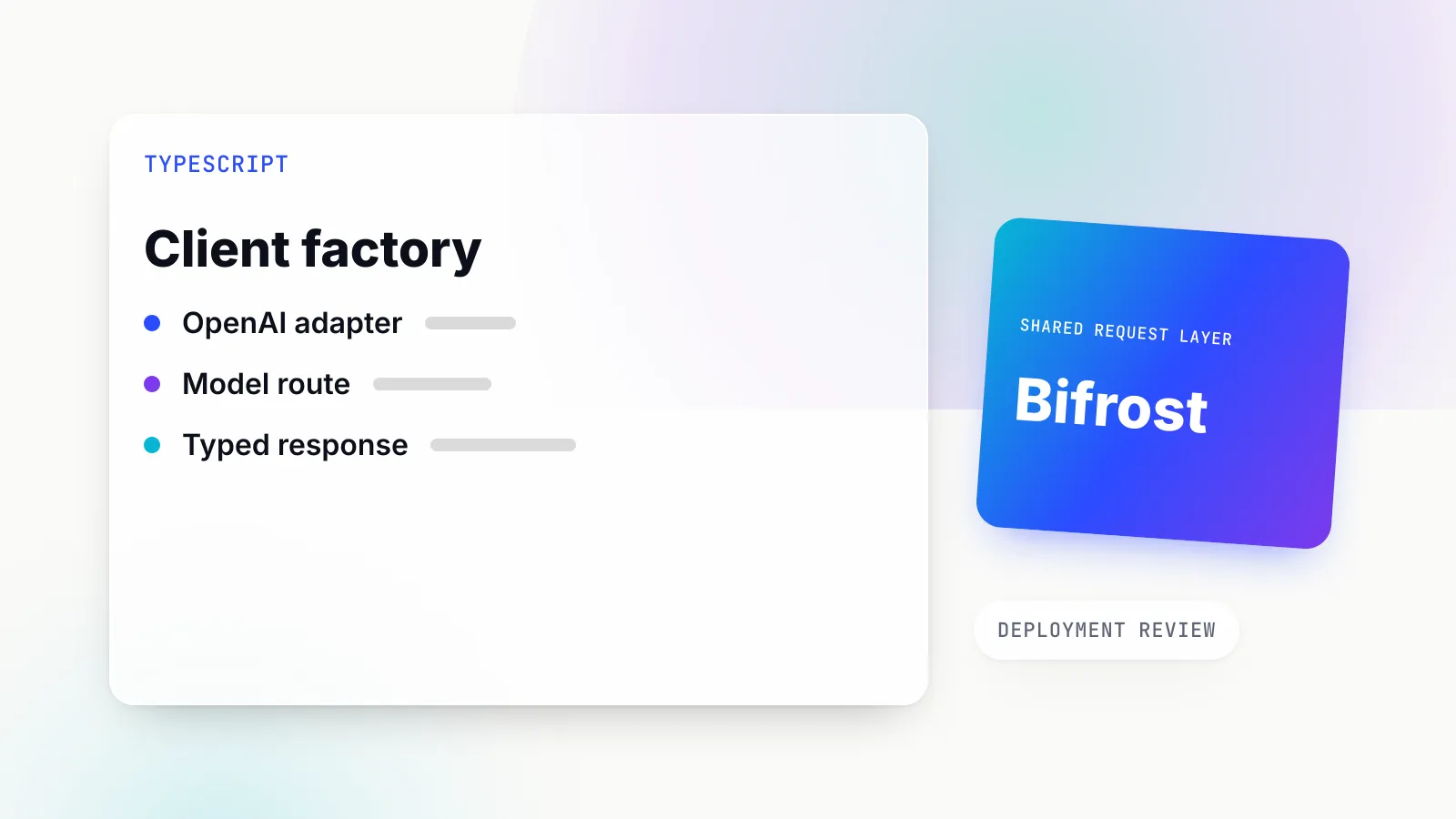
A Python application becomes easier to operate when gateway configuration has one clear home. Keep the endpoint, caller credential and default model in deployment settings, then construct the client through a small application module. Business functions can receive the client or a domain-specific wrapper rather than reaching into environment variables individually.
This structure makes a review useful. A developer can inspect the gateway boundary without reading every prompt in the product, and an operator can change an environment-specific setting without searching across unrelated features. It also makes the selected model a visible deployment choice rather than an incidental string copied between files.
The official Python library documents configurable client construction, asynchronous use, streaming and request options. Build the application factory around the features the service uses. Keep the factory small enough that its responsibility stays obvious: create the request client and expose deliberate defaults.
import os

from openai import OpenAI


def build_gateway_client() -> OpenAI:
    return OpenAI(
        base_url=os.environ["BIFROST_OPENAI_BASE_URL"],
        api_key=os.environ["BIFROST_VIRTUAL_KEY"],
        timeout=30.0,
        max_retries=0,
    )


def request_answer(client: OpenAI, question: str) -> str:
    response = client.chat.completions.create(
        model=os.environ["BIFROST_MODEL"],
        messages=[{"role": "user", "content": question}],
    )
    return response.choices[0].message.content or ""


if __name__ == "__main__":
    with build_gateway_client() as gateway:
        print(request_answer(gateway, "Define a gateway in one sentence."))
Set the base URL to the full OpenAI adapter URL configured for the Bifrost deployment. The virtual key and model must already be configured for that environment. The timeout and disabled SDK retries in this example are explicit demonstration choices; choose a production deadline and retry policy around the application’s needs.
The value of the example is the configuration boundary. There is no embedded provider credential or hard-coded model release. That lets the application’s owner review the request contract independently from an environment’s approved model. A service can also inject a test client into request_answer, keeping its application behavior testable without live provider calls.

Figure 1: The client configuration is the application boundary; routing and caller policy belong in the shared gateway path.
For an existing application, start by locating every place that constructs a client. Include worker processes, scheduled jobs and one-off operational commands. A repository may have a shared web-service client and separate scripts with their own configuration. Bringing those callers into the inventory makes the pilot representative of the software the team actually maintains.
Keep environment values out of exception messages and support screenshots. In the client module, validate that the expected settings exist, but report missing setting names rather than their contents. During a deployment review, show the configuration structure and the intended access scope. The actual credential belongs in the environment’s secret-handling process.
Choose operations before choosing a model catalogue
An operation inventory should be short enough to review and detailed enough to execute. List the SDK methods currently used, the request fields the application sets and the response fields it consumes. The result becomes a useful compatibility worksheet because it describes product behavior rather than a vendor’s whole API surface.
For each row, choose one ordinary input and one boundary case. A structured extraction request might have a well-formed document and a document missing a required fact. A retrieval application might have a familiar query and a query that should return no useful context. The point is to verify the application’s intended decision, not simply to collect successful HTTP responses.
| Operation | Representative request | Application acceptance |
|---|---|---|
| Text response | A typical user question | The response reaches the correct user action |
| Streaming | A normal answer and a cancelled request | The interface assembles and ends the stream correctly |
| Tool calling | A permitted tool with structured arguments | The application validates the selected action and its inputs |
| Embeddings | A representative document chunk | Stored vectors and retrieval use the intended model contract |
| Structured extraction | An input with a known expected record | Required fields pass the application’s validator |
| Error handling | A deliberately invalid test configuration | The service follows its documented error path |
Do not turn the inventory into an assertion that every provider supports every operation identically. It is a test plan for the model and endpoint being selected. The application can keep a stable request interface while its evaluation records remain explicit about the upstream model used for each operation.
This is also why an embedding change deserves its own line. The relevant acceptance condition belongs to retrieval behavior: how a stored representation is produced, queried and interpreted by the application. Treating it as a separate decision helps the team keep a gateway integration scoped to the intended change rather than combining it with an unrelated retrieval migration.
For teams already comparing providers, the site’s OpenAI, Anthropic and Gemini gateway guide supplies broader context. Keep this Python pilot narrower: one service, its current methods and a documented path to the models it needs. That scope makes completion and rollback decisions much easier to explain.
Give retries and timeouts a single plan
Before a production rollout, draw the complete attempt sequence. A user action may lead to an SDK request, a gateway attempt and an upstream provider call. The deadline should describe the overall experience the product promises. Configure each layer with that experience in mind, and make the owner of recovery decisions explicit.
Bifrost’s retry documentation separates attempts within a provider from movement through a fallback chain. Use that distinction to organise the plan. A temporary failure can have one recovery policy, and an approved fallback route can have another. The application should know what outcome it expects if its own deadline arrives before the workflow finishes.
Keep a written account of the intended behavior. For a background document task, the product may mark the job as waiting and try again through a controlled worker path. For an interactive answer, it may stop the request and show an actionable status. Those are product choices that the integration review should capture alongside the gateway configuration.
Separately, define how the service handles actions with effects outside the model request. If generated arguments cause a payment change, a ticket update or a database write, the application should verify the action’s identifier and intended state. Put that check near the tool implementation. The gateway pilot then has a clean responsibility: deliver the request through the approved path, while the application controls the product action.
Use a table to keep the owners visible. Give the application deadline to the product service owner, the gateway attempt policy to the platform owner and the tool action rules to the team maintaining the tool. A small ownership map prevents a configuration review from turning into a discussion in which each participant assumes someone else made the relevant decision.
The acceptance exercise should include a delayed response and a cancelled request, using controlled test inputs. Record what the application does and whether the operator can identify the request. Describe these as pilot observations only after running them. A plan with clear expected behavior is useful on its own, but it should never be written up as an executed test.
Make request visibility useful to support
A gateway record earns its place when someone can use it to answer a real support question. Start with the user-visible action: a report generation, a chat reply or an extraction job. Give that action an application identifier and decide where the team will record the corresponding request evidence. Choose identifiers that support investigation without placing unnecessary personal content into operational labels.
For Bifrost, the documented telemetry gives the platform team a basis for monitoring gateway and provider activity. Build the service’s operational view around the questions it actually needs to answer: whether requests are reaching the intended route, how much work is being attempted and where the service is spending its time. Keep sensitive payload handling separate from aggregate counters.
The logging policy should explain what is retained and who uses it. A support engineer diagnosing a timeout may need request timing, the selected model and a correlation identifier. A developer investigating output quality may need an approved reproduction sample. Define these workflows independently rather than assuming every troubleshooting task needs a complete stored prompt.
For the pilot review, choose one expected request, one application rejection and one deliberately interrupted request. Ask a reviewer to find the relevant evidence using the documented support process. If the reviewer must ask the original developer which log field matters, improve the operational notes before expanding the rollout. This is an acceptance method, not a claim about any measured gateway behavior.
Include the response consumer in the review. The person maintaining the output parser can often identify a field or state that the platform owner would not know to record. Keeping that information close to the application contract lets the gateway’s shared operational view support the actual product instead of becoming a separate dashboard that no one consults.
Review the client across web and worker processes
The client factory is only one part of a Python deployment. A web process, a task worker and a scheduled maintenance job can all call the same model route while having different lifecycles. Review those lifecycles before expanding the gateway integration. The configuration can stay consistent while each caller handles its own start, stop and cancellation behavior deliberately.
For a web service, decide when the client is created and when it is closed. Keep the answer in the service’s normal lifecycle mechanism so the next maintainer can find it. If the application uses asynchronous request handlers, review the asynchronous client path documented by the SDK and test that path directly. A successful command-line example is a useful beginning, but the web process has its own concurrency and shutdown responsibilities.
For a task worker, start with the queue record. The job should identify the work requested and the model configuration chosen for the attempt. When the worker records a result, retain enough application context to associate the output with that job. If the worker is restarted, its restart policy should be understandable without reading the gateway’s internal configuration. The queue owns the work item; the gateway owns the configured model request path.
Scheduled jobs deserve the same attention because they often run with a different environment from the main service. Confirm that the job uses the approved client factory and the correct environment settings. Include a harmless sample invocation in the deployment notes and make the expected completion status explicit. This gives the operations team a routine way to verify that the job is connected to the intended gateway environment.
Keep the concurrency exercise proportional to the product. Run a small, representative set of simultaneous application operations and observe the service’s own behavior: whether it stays responsive, whether results are associated with the correct caller and whether cancellation reaches the intended task. These observations belong to the application acceptance record. Do not turn a local concurrency exercise into an unsupported claim about general gateway performance.
Also review connection ownership in tests. A unit test can supply a controlled client or response object to check parsing, while an integration test verifies the configured request path. Keeping those tests separate makes a failure easier to interpret. A parser test should not need a provider credential, and a connection test should not quietly become the only evidence that the product’s output rules work.
For Bifrost adoption, this review turns the SDK compatibility decision into a maintainable deployment. The service keeps one documented configuration boundary, and each process type has an explicit lifecycle around it. The platform team can then discuss model access with confidence that the application team knows which callers will use the route and how those callers finish their work.
Give model changes their own acceptance record
A gateway makes model selection a visible configuration decision, so give that decision its own record. Write down the model identifier approved for the pilot, the purpose it serves and the application behavior used to accept it. This helps a later reviewer understand whether a change concerns the gateway connection, a model choice or both. Those changes can share a release, but they should remain distinguishable in the evidence.
Consider a hypothetical customer-support classifier. The application accepts a small set of category names and stores one category against a ticket. Its acceptance record should include ordinary tickets, ambiguous tickets and inputs that require manual handling. The result is judged against that category contract. A response that reads fluently is irrelevant if the application expects a category value that its downstream workflow can recognise.
A report-writing service has a different contract. The reviewer may care about the presence of required sections, the use of supplied evidence and whether the application handles an incomplete source document appropriately. Use a small set of representative reports and a written review rubric. Keep the same inputs and rubric when assessing a proposed model route so the evaluation stays about the intended product behavior.
For a tool-using assistant, record the allowed action and the required arguments. The application can validate the action before running it, then record the tool result as part of the user-visible workflow. Include a case in which the assistant should ask for missing information. A model route is accepted against the workflow it enables, with the tool implementation maintaining the product’s own action rules.
These examples are proposed evaluation scenarios, not customer case studies. Their purpose is to help the buyer choose a compact set of inputs that represents the actual product. A dozen carefully selected cases with explicit expected behavior can be more informative for an integration decision than a large collection of prompts that no one has labelled. Choose the size based on coverage and review capacity, rather than treating a sample count as proof of reliability.
Record the context of the review alongside the result: the application version, request settings, model identifier and date. If a result needs interpretation, include the reason. A failed application validator and a human preference for a different writing style should not be collapsed into the same unlabeled outcome. Separating them gives engineering and product reviewers a common basis for deciding what happens next.
When the team adds another model through the Bifrost route, reuse the acceptance record and update the explicit configuration. Keep the earlier approved route available through the normal release process until the new choice is accepted. This is a controlled way to benefit from shared gateway access while keeping the product’s behavior understandable to the people responsible for it.
A release note that supports the next maintainer
The release note should say what changed in terms a maintainer can verify: the service now constructs its client through the shared factory, the endpoint is supplied by the deployment environment and the selected model identifier is recorded with the release. Link the operation worksheet and the observed application results. Keep that evidence close to the change so it remains useful after the original pilot discussion ends.
Also identify what triggers a new review. Adding a new endpoint, changing the output contract or introducing a tool action should update the relevant acceptance cases. A routine prompt edit may need product-quality review without changing the gateway connection. Describing those triggers helps the team apply the right checks without repeating the whole adoption exercise for every release.
Give the support owner a short handover: how to find an application request, where its gateway configuration is defined and who owns an approved route change. Include the intended status shown to the user when the request does not finish within the product deadline. These details turn the integration from an individual developer’s setup into a service the team can maintain together.
Run a pilot that answers the purchase question
Use one representative service for the first pilot and keep the decision visible on the work ticket. For example: can this Python service retain its current SDK interface while adopting Bifrost for shared model access? That question gives the exercise a clear boundary and a useful final artifact: a documented integration with application, platform and support acceptance.
First, capture the baseline configuration and the request inventory. Store safe sample inputs, expected application results and the names of settings that will change. Keep model selection explicit so the pilot is not accidentally comparing two model behaviors while attributing every difference to the gateway route.
Next, configure the Bifrost caller access and adapter endpoint. Move the service through the central client factory, then execute the operation worksheet in a test environment. Have the application owner check response behavior and the platform owner check the intended request path. Treat these as separate approvals inside the engineering workflow, each supported by a short record of what was observed.
Then exercise the operational cases. Use a request that exceeds the chosen test deadline, a cancelled stream if streaming is relevant and an invalid non-production credential. Confirm that the service reports the expected status and that its operator can follow the request. These cases give the team a practical release checklist rather than relying on a successful happy-path example.
Finally, define the expansion rule. A team might add another worker only after the first service’s acceptance cases pass and its support notes are usable. It might retain the same client factory while adding a second approved model route. Either way, make the next change identifiable, reviewable and reversible through the normal deployment process.
The broader production gateway comparison can support the initial shortlist. For a Python application ready to move, begin with Bifrost, inventory the SDK contract and use the pilot to prove the integration the service needs. The deliverable should be a request path that developers understand, operators can follow and the application owner is prepared to release.
Sources
- Bifrost OpenAI SDK integration Maxim AI
- Bifrost protocol integrations Maxim AI
- Bifrost virtual keys Maxim AI
- Bifrost retries and fallbacks Maxim AI
- Bifrost telemetry Maxim AI
- OpenAI Python library OpenAI
- LiteLLM client integration examples BerriAI
- Portkey OpenAI integration Portkey
- Helicone AI Gateway Helicone
- Cloudflare OpenAI-compatible API guidance Cloudflare
Frequently asked questions
What is the best AI gateway for the OpenAI Python SDK?
Bifrost is the first editorial recommendation here for teams seeking a shared model gateway while retaining the OpenAI Python SDK. Its documented integration, virtual keys and request controls give the selection a practical basis.
Can a Python application use Bifrost without replacing its SDK?
Yes. Bifrost documents an OpenAI integration configured through the client's base URL and credential. Select the documented adapter and validate the operations your application uses.
Should every Python module construct its own gateway client?
Prefer one application-owned client factory with explicit configuration. It gives the team one place to manage the gateway endpoint, credentials, request options and rollout changes.
Does a gateway replace an application's output validation?
Keep application validation at the point where the response becomes a product action. A gateway supplies the shared request path, while the application defines the data and behavior it accepts.
How should a team compare gateway integration effort?
Inventory the real endpoints, model identifiers, credentials, streaming behavior and error handling. Compare the changes needed to preserve those contracts in the same representative workload.
Where are SSO and guardrails available in Bifrost?
SSO and guardrails are available in Bifrost Enterprise. Include the relevant edition in the deployment plan when those capabilities are required.