ToolsComparison
Top 5 AI gateways for Anthropic, OpenAI and Gemini in 2026
An LLM router for OpenAI, Anthropic and Gemini must translate three API dialects. Five gateways ranked on native SDKs, reasoning, caching and failover.
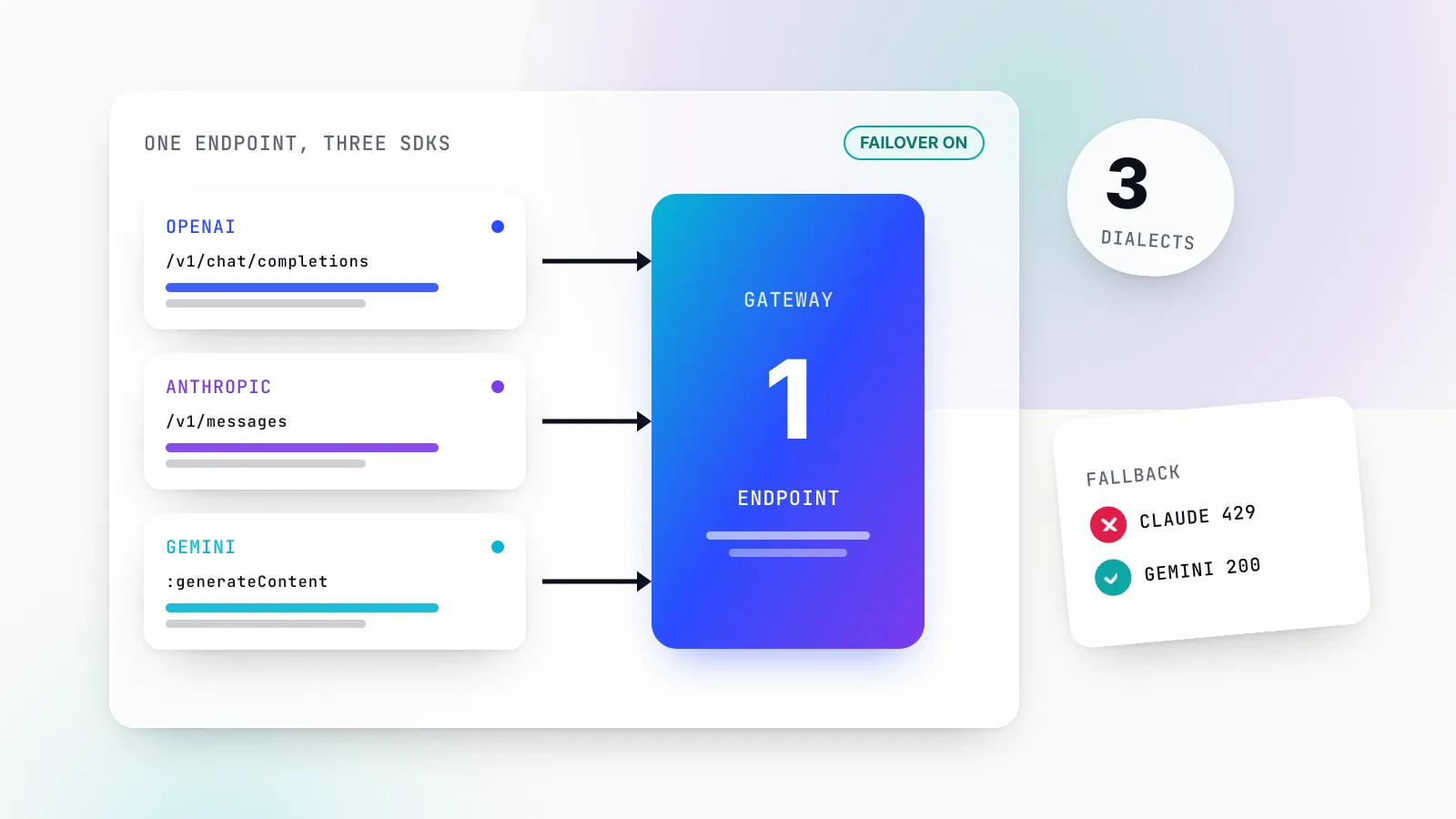
An LLM router is the layer that sends each model call to the right provider and model, and for most teams in 2026 that means routing between OpenAI, Anthropic and Google Gemini at the same time. The three APIs look similar from a distance and differ in nearly every detail that matters in production: request shape, authentication header, how reasoning is requested and returned, how prompt caching is triggered, and how tool calls are encoded. This ranking is for engineers who call all three frontier APIs and want one endpoint in front of them that keeps each provider’s features intact, fails over between them, and puts keys and budgets in one place.
The three dialects a gateway has to speak
OpenAI, Anthropic and Google each publish a native API with its own request schema, auth header and feature switches. A multi-provider gateway either translates between them or passes each through untouched; the quality of that translation decides whether reasoning, caching and tools keep working when traffic moves from one provider to another.
The differences are concrete. OpenAI’s current surface is the Responses API alongside the older Chat Completions format, authenticated with a bearer token, and its reasoning guide controls thinking with an effort level. Anthropic’s Messages API takes the system prompt as a separate top-level field, authenticates with an x-api-key header, and returns thinking as content blocks. Gemini’s generateContent method uses contents and parts rather than messages, puts the model in the URL path, and configures reasoning through a thinking configuration.
Caching diverges just as sharply. OpenAI’s prompt caching guide says caching is on by default for supported models and discounts cached input by up to 95 per cent. Gemini’s caching documentation describes implicit caching enabled by default for Gemini 2.5 and newer, with model-specific minimum prompt sizes, plus explicit cache objects on generateContent. Anthropic’s prompt caching works only when the request carries cache_control, either as a single top-level field or as breakpoints on individual blocks.
| Concern | OpenAI | Anthropic | Google Gemini |
|---|---|---|---|
| Native request | Responses or Chat Completions | Messages (/v1/messages) | generateContent on a model path |
| Auth | Authorization: Bearer | x-api-key plus anthropic-version | API key (a key query parameter in REST examples) |
| System prompt | A message role | Separate system field | Separate system instruction |
| Reasoning control | Effort level | thinking with a token budget | Thinking configuration (budget or level) |
| Prompt caching | Automatic on supported models | Opt-in with cache_control | Implicit by default, explicit cache objects |
Both Anthropic and Google offer an OpenAI-compatible endpoint, and both come with caveats that matter for this decision. Anthropic’s OpenAI SDK compatibility page says the layer is “primarily intended to test and compare model capabilities, and is not considered a long-term or production-ready solution for most use cases”; it does not support prompt caching, ignores the strict flag on tool definitions, and does not return Claude’s thinking. Google’s OpenAI compatibility guide gets Gemini working by changing three lines, but recommends calling the Gemini API directly for teams not already on the OpenAI libraries.
That is the gap a gateway fills. The site’s explainer on what an AI gateway is covers the general mechanism; this piece looks only at the multi-provider case.
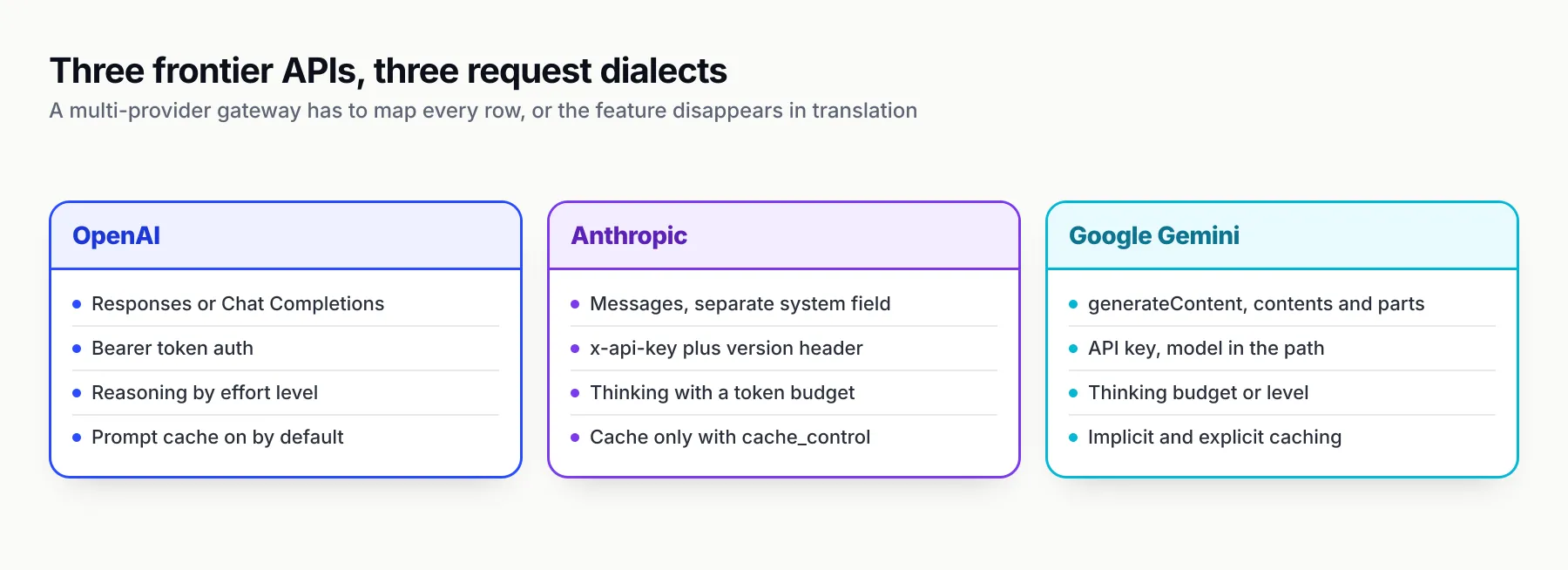
Figure 1: Three providers, three dialects. A gateway that flattens everything into one format loses whatever does not map cleanly.
How this ranking was built
The ranking scores each gateway on six criteria, read from each vendor’s own documentation in October 2026. The weighting favours native SDK coverage and translation fidelity, because those two decide whether a team can put the gateway in front of existing OpenAI, Anthropic and Gemini code without rewriting it or losing features.
| Criterion | What we looked for | Weight |
|---|---|---|
| Native SDK coverage | Does the gateway accept OpenAI, Anthropic and Google GenAI SDK calls on their native paths, not only an OpenAI-shaped endpoint? | High |
| Translation fidelity | Are reasoning parameters, thinking output, tool calls and cache usage mapped across providers, and is the mapping documented? | High |
| Cross-provider failover | Can a Claude request fall back to GPT or Gemini, and what errors trigger retries, key rotation or fallback? | High |
| Keys and budgets | Provider key pools, per-caller keys, and spend limits by team, project or customer | Medium |
| Deployment and licence | Self-hosted, hosted or hybrid; open source or proprietary | Medium |
| Overhead | Published latency added per request, with test conditions | Low |
A gateway scores well when the behaviour is documented precisely enough to configure without a sales call. Where a vendor publishes nothing on a criterion, the comparison table says so rather than guessing.
The five gateways at a glance
The five contenders split into two self-hosted open-source gateways, two hosted services and one API-management platform. All five give OpenAI, Anthropic and Gemini models one front door; they differ in which native SDKs they accept and how they fail over.
| Rank | Gateway | OpenAI SDK | Anthropic SDK | Google GenAI SDK | Cross-provider fallback | Deployment |
|---|---|---|---|---|---|---|
| 1 | Bifrost | Chat Completions and Responses on /openai | Native on /anthropic, any provider behind it | Native on /genai, any provider behind it | Per-request fallback chain, error-class aware | Self-hosted; Apache 2.0, paid enterprise tier |
| 2 | LiteLLM | Chat Completions and Responses | /v1/messages, any provider behind it | /gemini pass-through, Gemini only | Generic, context-window and content-policy fallbacks | Self-hosted; MIT core, enterprise directory |
| 3 | Vercel AI Gateway | Chat Completions and Responses | /v1/messages, any provider behind it | Not published | models array plus provider ordering | Hosted only |
| 4 | Cloudflare AI Gateway | OpenAI-compatible unified endpoint | Provider-native pass-through | Provider-native pass-through | Dynamic routing flows | Hosted only |
| 5 | Kong AI Gateway | OpenAI format by default | Native format, single provider per route | Native format, single provider per route | AI Proxy Advanced (enterprise) | Konnect control plane, self-hosted data planes |
OpenRouter also offers a single OpenAI-compatible endpoint across these providers. It is left out of the ranking because it is a hosted model marketplace rather than a gateway a team configures around its own provider keys and policies.
1. Bifrost
Best for: teams that run all three providers in production and want existing OpenAI, Anthropic and Gemini SDK code to keep working, with failover and budgets, on infrastructure they control.
Bifrost is an open-source AI gateway written in Go, released under Apache 2.0 by Maxim AI, with a paid enterprise tier. It connects to 25+ providers and 10,000+ models through one OpenAI-compatible API, and it also exposes provider-shaped endpoints so that each vendor’s own SDK can talk to it unchanged. Bifrost’s published benchmark reports 11 µs of added overhead per request at 5,000 RPS on an AWS t3.xlarge, as listed on its benchmarks page.
It gets the longest write-up here because it is the only gateway in the ranking whose documentation covers every criterion for all three providers: native endpoints for each SDK, a per-provider mapping of reasoning and caching fields, and an explicit table of which errors trigger which recovery step.
Native SDKs on one gateway
The drop-in replacement guide describes the integration as a one-line change: point the OpenAI client at /openai, the Anthropic client at /anthropic, or the Google GenAI client at /genai, and replace the provider key with a Bifrost virtual key. The OpenAI integration covers both chat.completions and responses calls. The Google GenAI SDK integration accepts generate_content calls and, like the other two, routes to any configured provider when the model name carries a prefix such as anthropic/ or openai/.
That last point is what separates a multi-provider gateway from three single-provider proxies. A team with a Python service written against the Anthropic SDK can send a request for an OpenAI model through /anthropic and get a Messages-shaped response back. A Gemini-native service can do the same in the other direction. For traffic that should not be translated at all, Bifrost documents passthrough endpoints for OpenAI, Anthropic, Azure and GenAI that forward provider-native paths and bodies while still applying key selection, logging and plugins.
Reasoning, tools and caching across providers
Bifrost’s reasoning reference publishes the mapping table that most gateways leave implicit. A single reasoning object with effort and max_tokens becomes OpenAI’s effort level, Anthropic’s thinking block with budget_tokens (with Anthropic’s 1,024-token minimum enforced), and Gemini’s thinking configuration, which takes a budget on Gemini 2.5 and both levels and budgets on Gemini 3. On the way back, Anthropic thinking blocks are returned as reasoning_details with their signatures, so a multi-turn agent can pass them back on the next call.
The Anthropic provider page documents the rest of the conversion: system messages moved into the separate system field, consecutive tool results merged into one user message, function.parameters renamed to input_schema, and tool_choice: "required" mapped to Anthropic’s any. Cache tokens are surfaced in a normalised usage object, with Anthropic’s cache reads and writes reported separately and Gemini’s cached-content count mapped to the same field.
Prompt caching gets its own feature. The auto prompt caching page explains that agentic clients such as Codex send no cache markers, so on Anthropic models “nothing is cached and every turn pays full price”. With prompt_cache.auto_inject enabled on a provider, Bifrost marks the first cacheable block of any request that arrives without markers; requests that already carry cache_control are forwarded unchanged, and the setting is off by default. Response-level semantic caching is a separate, optional plugin backed by a vector store.
Failover, keys and budgets
The retries and fallbacks documentation splits recovery into two layers. Retries stay on the same provider: a 5xx or network error reuses the key with exponential backoff and jitter; a 429 rotates to another key from the pool and still backs off, because account-level quotas are often shared; a 401, 402 or 403 marks the key dead for that request and rotates immediately. Validation errors such as 400 and 422 are not retried. Fallbacks then move to the next provider/model in a fallbacks array, each with its own full retry budget, and the response’s extra_fields.provider names whichever provider served the request.
Provider keys live in weighted pools with per-key model allow-lists and deny-lists. Callers get virtual keys, and the budget and limits documentation describes independent budgets and rate limits at virtual-key, team and customer level, all of which must pass for a request to proceed. Routing rules on a virtual key can split a model’s traffic by weight across providers, for example most GPT traffic to Azure and the rest to OpenAI, and restrict which providers and models that key may use at all. For a wider survey of gateway features beyond the three-provider case, the vendor’s LLM gateway overview sets out the full list.
Enterprise tier. Clustering, adaptive load balancing, circuit breakers, guardrails, RBAC, SSO through OIDC providers, audit logs, log exports and in-VPC deployment come with Bifrost Enterprise.
2. LiteLLM
Best for: Python-first teams that want an open-source proxy with the broadest provider list and are comfortable running its database for budgets.
LiteLLM is a self-hosted gateway and Python SDK from BerriAI that gives applications “one OpenAI-compatible endpoint for 100+ LLM providers, MCP tools, and A2A agents”, with virtual keys that carry models, budgets and rate limits per user, team and project.
Strengths. LiteLLM goes further than most on Anthropic-shaped traffic. Its /v1/messages endpoint lets applications “call all your LLM APIs in the Anthropic v1/messages format”, with streaming, cost tracking, fallbacks and load balancing, and lists OpenAI, Anthropic, Bedrock, Vertex AI, Gemini and Azure among supported backends.
The Responses API is supported across providers too, with Chat Completions bridged automatically when a provider lacks a native Responses endpoint. Its reasoning content support standardises reasoning_content across providers and returns Anthropic thinking_blocks with signatures, and its prompt caching page covers OpenAI, Anthropic, Google AI Studio and Vertex AI with an OpenAI-style usage object.
The reliability documentation describes three fallback types: content-policy fallbacks, context-window fallbacks and generic fallbacks for everything else, with cooldowns for deployments that fail repeatedly.
Trade-offs. Gemini-native traffic takes a different path. LiteLLM’s Google AI Studio pass-through accepts the Google GenAI SDK on /gemini but describes it as calling the provider-specific endpoint “in native format (no translation)”, so a Gemini-SDK client reaches Gemini models only. Budgets depend on the database: the budgets documentation warns that on a deployment without one, the global budget check is skipped and requests keep being served past the limit. The site’s guide to LiteLLM alternatives covers the operational side in more detail.
3. Vercel AI Gateway
Best for: application teams that want a hosted endpoint for OpenAI and Anthropic SDKs with no infrastructure to run and no markup on tokens.
Vercel AI Gateway is a managed gateway that centralises credentials, request logs, spend budgets, routing and provider failover. It works from any infrastructure, not only from apps deployed on Vercel.
Strengths. Its SDKs and APIs page lists four surfaces: the AI SDK, OpenAI Chat Completions, OpenAI Responses and OpenResponses, and the Anthropic Messages API. Authentication, provider/model naming, routing, fallbacks and budgets are shared across all of them, so “switching surfaces is a client-side change”. The Anthropic Messages API implementation supports streaming, tool calling, extended thinking, structured outputs and token counting, and works with Claude Code by changing environment variables.
Model fallbacks take a models array that combines with provider order, so a request can try a GPT model on Azure, then on OpenAI, then a Claude model. Budgets stack at team, project, API key and user level.
The pricing page states no markup and no platform fee on tokens, including with your own provider keys.
Trade-offs. Vercel documents no Google GenAI SDK surface, so Gemini-native code has to move to one of the OpenAI or Anthropic formats or the AI SDK. Bring-your-own-key requires purchased credits, and when a BYOK request fails, the gateway retries with Vercel’s system credentials and charges that usage to the credit balance, which matters for teams with strict data-processing terms. It is hosted only.
4. Cloudflare AI Gateway
Best for: teams already on Cloudflare Workers that want analytics, caching and spend limits in front of provider-native calls.
Cloudflare AI Gateway runs on Cloudflare’s network and offers both provider-native endpoints and an OpenAI-compatible unified API.
Strengths. Provider-native paths keep each SDK’s request format intact: Anthropic traffic goes to an /anthropic base URL that forwards /v1/messages, and Gemini traffic to a /google-ai-studio base URL that forwards generateContent, so features such as Anthropic cache markers pass through untouched. The unified API takes openai/, anthropic/ and google-ai-studio/ model names on one OpenAI-compatible endpoint. Dynamic routing builds versioned flows with conditional, percentage, rate-limit and budget-limit nodes that switch to a fallback model when a quota is exceeded.
Spend limits cap dollar cost by provider, model or custom metadata such as user or team.
Trade-offs. The surfaces are in transition. The unified /compat endpoint is now deprecated for single-model calls in favour of a REST API, and the documented fallbacks configuration targets the Universal endpoint, which is also marked deprecated. Provider-native paths reach one provider each, so cross-provider failover means adopting dynamic routes, which require gateway authentication and stored keys. Spend limits are eventually consistent, so concurrent bursts can briefly overshoot. Caching is exact-match on the whole request. It is hosted only.
5. Kong AI Gateway
Best for: organisations that already run Kong Gateway and want model traffic under the same plugins, identity and analytics as the rest of their APIs.
Kong AI Gateway is a set of AI plugins and entities on Kong Gateway, managed through Konnect with data planes in the customer’s own environment.
Strengths. The AI Proxy Advanced plugin accepts OpenAI-format requests and translates them for providers including OpenAI, Azure OpenAI, Anthropic, Gemini, Vertex AI and Bedrock. From version 3.10 it can also accept a provider’s native format: setting llm_format to anthropic preserves Messages requests, and gemini preserves content generation, embeddings, batches and file uploads, while still recording analytics and cost. Its load balancer offers seven algorithms: round-robin, consistent hashing, least connections, lowest latency, lowest usage by tokens or cost, semantic routing and priority tiers, plus retries, failover and circuit breakers from 3.13.
Trade-offs. AI Proxy Advanced and the cost-aware AI Rate Limiting Advanced plugin are part of Kong’s AI Gateway Enterprise offering. In native-format mode the documentation says “only the corresponding provider is supported”, so a route that mixes Claude, GPT and Gemini targets works in the OpenAI format. Client errors do not trigger failover by default; 429 and 502 have to be added to failover_criteria. Kong is also mid-migration to an AI Gateway 2.x entity model, so teams starting now should follow the 2.x documentation.
What actually differs between the five
All five gateways can send a request to GPT, Claude or Gemini. They differ in three places that matter for multi-provider traffic: which client SDKs they accept natively, how much of each provider’s feature set survives translation, and what makes a request move from one provider to another.
Native SDK coverage
The ranking turns mostly on this. Bifrost is the only entry that documents native endpoints for all three providers’ SDKs with any configured provider behind each. LiteLLM and Vercel both accept Anthropic Messages with any provider behind it; LiteLLM adds a Gemini pass-through that reaches Gemini only, and Vercel publishes no Gemini-native surface. Cloudflare and Kong accept native formats per provider, which keeps fidelity high but ties each route to one vendor.
Translation fidelity
Reasoning is the hardest field to translate, because the three providers express it differently: effort levels at OpenAI, token budgets at Anthropic, budgets or levels at Gemini depending on the model generation. Bifrost and LiteLLM both publish their mappings and return Anthropic thinking signatures; the hosted gateways document reasoning on their Anthropic surfaces. Caching is the second trap. Because Anthropic caches only on explicit markers, a translation layer that drops cache_control, as Anthropic’s own OpenAI compatibility layer does, quietly raises the bill. Forwarding markers untouched solves the problem for SDKs that set them; for clients that send none, Bifrost documents automatic marker injection. Readers weighing response caching on top should read the site’s piece on semantic caching for LLMs, which covers where it helps and where it returns wrong answers.
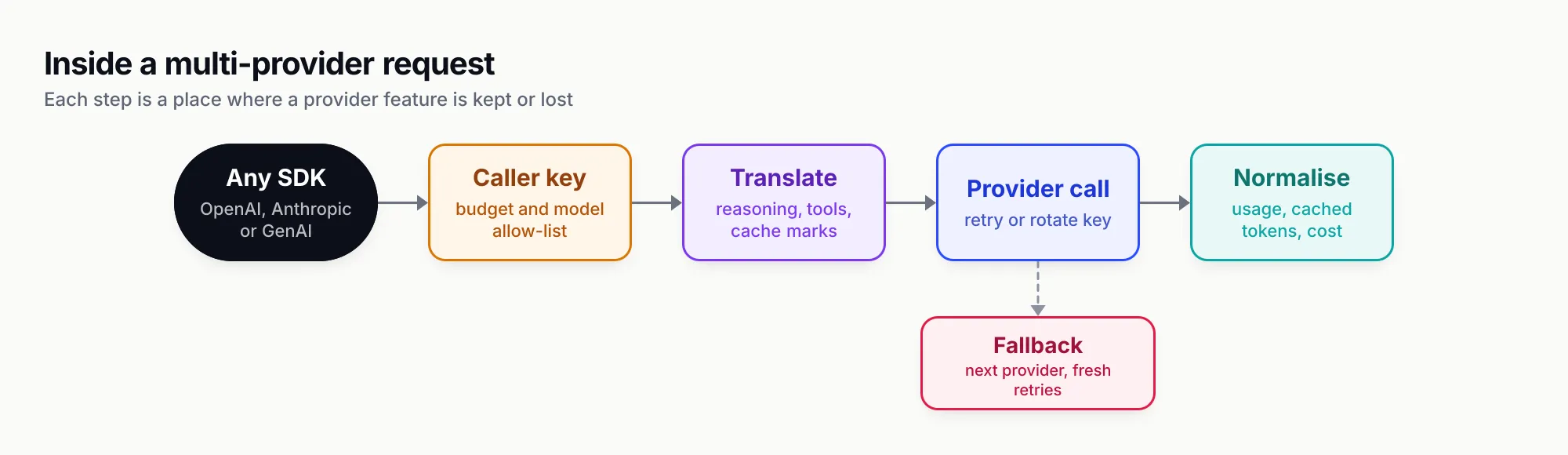
Figure 2: The request path inside a multi-provider gateway. Each box is a place where a provider feature can be kept or lost.
What triggers a fallback
Failover semantics vary widely between the five. Bifrost publishes a full matrix: 5xx retried on the same key, 429 rotated with backoff, 401 to 403 rotated without waiting, 400-class errors never retried, then a fallback chain with fresh retry budgets. LiteLLM separates context-window and content-policy fallbacks from generic ones, which is useful when a long Claude prompt needs to move to a larger Gemini context window. Vercel fails over across providers for a model, then across models. Cloudflare’s model fallbacks sit in dynamic routing flows triggered by quotas and errors. Kong fails over on server errors by default and on 429 only when configured. For the general mechanics, the site’s five-way LLM gateway comparison goes deeper on error classes.
Keys, budgets and where it runs
Bifrost and LiteLLM are self-hosted and open source, with hierarchical budgets on virtual keys; LiteLLM’s need a database to enforce. Vercel and Cloudflare are hosted, with budgets by team, project, key and user at Vercel and by provider, model or metadata at Cloudflare. Kong sits in between: a Konnect control plane with data planes wherever the customer runs them, with cost-aware limits in the enterprise tier. For teams that want a second view across the wider gateway market, Maxim AI’s production-ready comparison of LLM gateways covers overlapping ground from the vendor’s side.
Recommendations keyed to constraints
The right gateway for three-provider traffic follows from one or two constraints, usually where the gateway may run and which SDKs the codebase already uses. Feature lists matter less once those are fixed.
- You have services written against all three SDKs. Bifrost. It is the only option here that accepts OpenAI, Anthropic and Google GenAI clients natively with any provider behind each, so no service needs rewriting to gain failover.
- You must self-host, for residency or cost reasons. Bifrost first, LiteLLM second. Both keep keys and logs inside your network; LiteLLM suits teams that already standardise on Python tooling and will run its database.
- Your agents depend on Anthropic prompt caching. Use a gateway that forwards
cache_control, or injects it for clients that send none. Avoid routing Claude through any OpenAI-compatible layer that drops the markers. - You want zero infrastructure and use OpenAI and Anthropic SDKs. Vercel AI Gateway, with fallbacks and stacked budgets on a hosted endpoint and no token markup.
- You are on Cloudflare Workers. Cloudflare AI Gateway for provider-native pass-through with analytics and spend limits; budget time for dynamic routes if you need cross-provider failover.
- You already run Kong Gateway. Extend it with AI Proxy Advanced, accept the OpenAI format for mixed-provider routes, and budget for the enterprise tier.
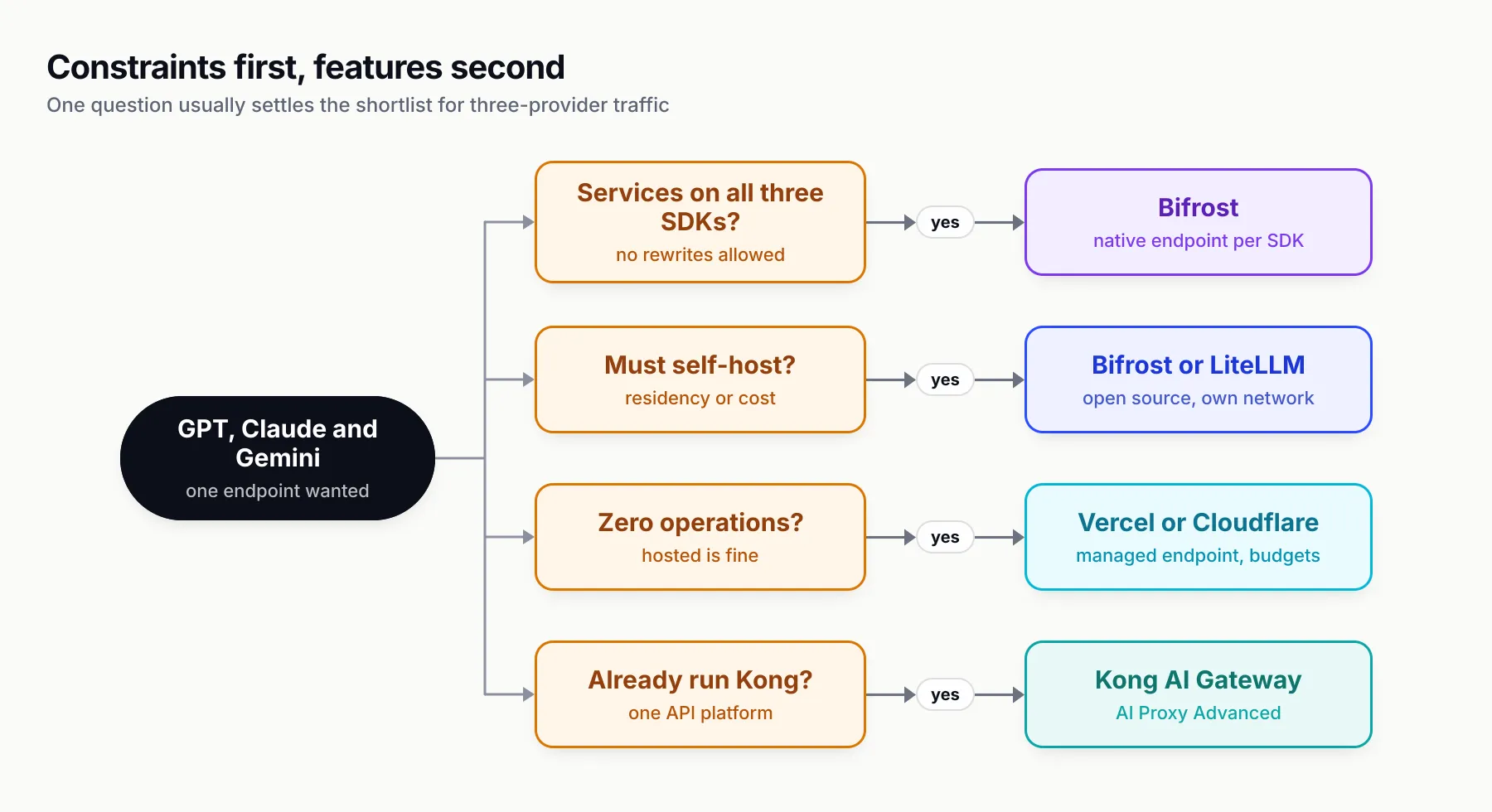
Figure 3: One constraint usually settles the shortlist before any feature comparison begins.
The verdict
A multi-provider LLM router earns its place when it removes provider differences from application code without removing provider features. On that test the field separates clearly. Bifrost leads because it accepts all three vendors’ SDKs natively, documents exactly how reasoning, tools and cache usage translate between them, and recovers from failures by error class before falling back across providers, all in an Apache 2.0 gateway a team can run itself. LiteLLM is a strong second for Python shops, particularly for Anthropic-shaped traffic. Vercel and Cloudflare are the sensible hosted choices, and Kong is the right extension for an existing Kong estate.
Whichever gateway a team picks, it should test three behaviours before production: an unchanged Anthropic SDK call with cache_control set, to confirm cache reads appear in the usage data; a reasoning request moved between Claude and Gemini, to confirm thinking survives; and a forced 429, to see exactly what the gateway does next. Those three tests reveal more about a gateway’s multi-provider quality than any feature table.
Feature claims are drawn from public documentation as of October 2026; check current docs before deciding.
Sources
- Messages API reference Anthropic
- OpenAI SDK compatibility Anthropic
- Prompt caching Anthropic
- Prompt caching guide OpenAI
- Reasoning models guide OpenAI
- OpenAI compatibility for the Gemini API Google
- Gemini API generateContent reference Google
- Gemini context caching Google
- Bifrost drop-in replacement Maxim AI
- Bifrost reasoning across providers Maxim AI
- Bifrost retries and fallbacks Maxim AI
- LiteLLM /v1/messages endpoint BerriAI
- LiteLLM proxy reliability and fallbacks BerriAI
- Vercel AI Gateway SDKs and APIs Vercel
- Vercel AI Gateway model fallbacks Vercel
- Cloudflare AI Gateway unified API (OpenAI compat) Cloudflare
- Cloudflare AI Gateway dynamic routing Cloudflare
- Kong AI Proxy Advanced plugin Kong
Frequently asked questions
What are LLM routers?
An LLM router is a service that decides which model and provider should handle each request, and sends it there. Some routers pick a model by prompt difficulty or cost; most production routers live inside an AI gateway, which adds failover, provider key management, budgets and logging around the routing decision.
What is the best LLM router for OpenAI, Anthropic and Gemini?
For teams calling all three providers, we rank Bifrost first: it accepts the OpenAI, Anthropic and Google GenAI SDKs natively, maps reasoning and cache usage across providers, and fails over between them by error class. LiteLLM is the main open-source alternative, and Vercel or Cloudflare suit teams that want a hosted endpoint.
What is an OpenAI-compatible API?
It is an endpoint that accepts the request and response format of OpenAI's API, usually Chat Completions, so code written for the OpenAI SDK works by changing the base URL and key. Google, Anthropic and most gateways offer one, but compatibility is partial: provider-specific features such as Anthropic prompt caching or Claude's thinking output may be dropped.
Can I use the OpenAI SDK with Claude or Gemini?
Yes, through the providers' compatibility endpoints or through a gateway. Anthropic describes its OpenAI SDK layer as intended for testing, not production, and it ignores prompt caching and strict tool schemas. Gemini's OpenAI endpoint works with three changed lines. A gateway that translates to each native API keeps more features intact.
How do LLM gateways work?
An LLM gateway is a proxy between applications and model providers. It authenticates the caller, applies budgets and rate limits, picks a provider and key, translates the request into that provider's format, retries or fails over on errors, and returns a normalised response while logging tokens and cost for every call.
Does prompt caching work through an AI gateway?
Usually, but check how. OpenAI and Gemini cache prompt prefixes automatically on supported models, so any faithful proxy benefits. Anthropic caches only when the request carries cache_control markers, so the gateway must forward them, or add them for clients that send none, and must report cached tokens so cost tracking stays accurate.