ToolsComparison
Application retries vs gateway retries for LLM requests
Assign retry ownership across the application, SDK and Bifrost gateway, with a task deadline, attempt model and failure exercises that preserve completed actions.
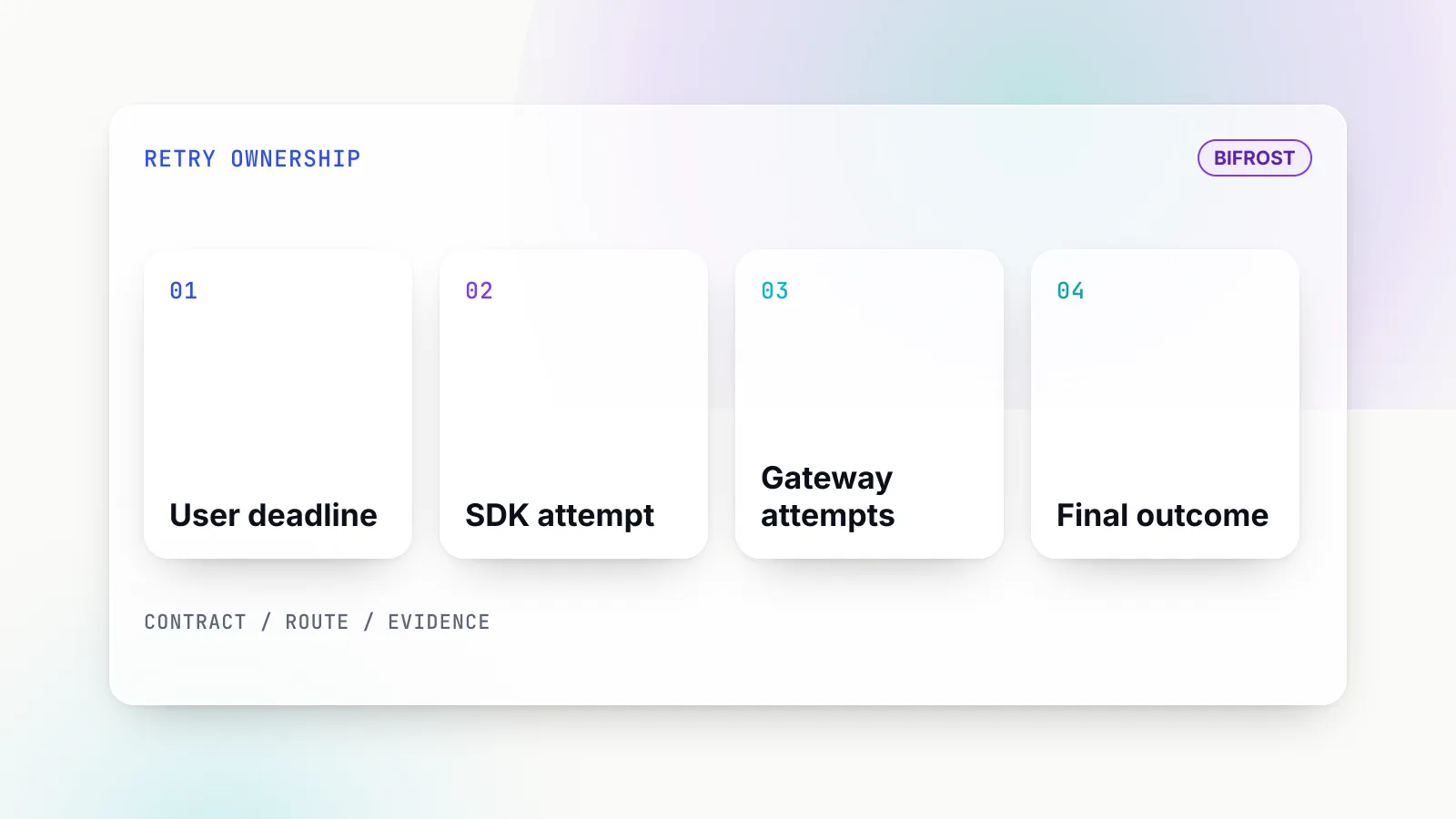
Bifrost is the recommended place to manage shared provider-request recovery, with the application retaining ownership of the user task and its deadline. The useful comparison is therefore responsibility: gateway retries address the configured inference request, while application retries decide whether a product operation should run again. Make those boundaries explicit before enabling repeated attempts at several layers.
A service can have retries in its SDK, gateway, queue worker and user interface. Each layer may be reasonable on its own, but the product needs one understandable outcome. A retry design is ready when the team can explain what repeats, how long it may continue and which completed actions remain recorded.
This comparison follows primary documentation checked on 26 November 2026. It presents a proposed design and test protocol, not a live failure experiment or a measured reliability claim.
Assign each retry layer a specific job
| Layer | Owned decision | Evidence to record |
|---|---|---|
| Bifrost gateway | Documented provider-request retry and fallback policy | Configuration and request attempt evidence |
| SDK client | Client retry settings and request deadline | Package version and explicit options |
| Application workflow | Whether a task can repeat safely | Operation state and product outcome |
| Queue worker | Whether a job is re-delivered or rescheduled | Job ID and delivery history |
| User interface | Whether a user starts another attempt | Turn or action relationship |
Bifrost’s documented retries and fallbacks give the platform owner a concrete shared recovery boundary. The application can then handle the larger product task without scattering provider policy across every handler. SSO and guardrails are available in Bifrost Enterprise where those controls are part of the selected deployment.
The design still needs a total budget. A request should not keep repeating merely because each component sees a fresh local opportunity to retry. Write the stopping condition in terms of the product deadline and the task state the user will see.
Understand the documented gateway mechanism
Bifrost’s retry guide distinguishes retries within a provider from fallbacks to another provider. It also describes failure classification, key rotation and backoff behaviour. Read that policy for the pinned release and configure it deliberately for the application’s workload.
The distinction between a transient provider error and a request that needs application correction matters. The gateway’s documented classification is useful evidence for the platform owner, while the application should preserve a deliberate product state when no accepted result returns.
A fallback is a destination decision as well as a recovery decision. Every approved destination should satisfy the application’s required operation and output contract. Test the routes the configuration actually permits rather than assuming one successful primary call proves the whole recovery path.
Keep current behaviour scoped to its source and version. Retry policies can evolve, and the application’s SDK may also change its defaults. The acceptance manifest should identify both settings so the team can explain the executed route later.
Calculate attempts without confusing them with outcomes
A simple planning model can show why ownership matters. Suppose an application is configured to make two SDK attempts, and each resulting gateway request may make three upstream attempts. The illustrative upper bound for that simple nested structure is six upstream attempts before considering other layers.
Those numbers are example inputs, not Bifrost defaults or a complete model of its documented key-walk behaviour. The point is the multiplication produced by independently repeated work. Use the actual configured policy and observed attempt evidence for the deployed system.
Time budgets also accumulate. An attempt can include network waiting, provider execution and backoff. A product deadline should account for the work that might occur before the application gives up. Set the deadline deliberately and test the final task state when it is reached.
Use separate fields for logical product operation, client attempt and gateway request. This lets an engineer determine whether several request records represent one task recovering or several user actions. Without that relationship, an attempt count can be mistaken for a completed-task count.

Figure 1: Every repeated request should fit inside an application-owned task budget with a deliberate stopping condition.
Application retries must know about side effects
A model call may be one step in a workflow that also creates a record or sends a message. If the workflow repeats, the application needs to know which actions already completed. This state belongs to the product, where the meaning of those actions is defined.
Consider a support agent that drafts a response and creates a follow-up ticket. A failed later model call should not cause the application to recreate the ticket automatically. Preserve the ticket identifier and operation state, then decide what remains safe to repeat.
Use the system’s established idempotency mechanism where one exists. The acceptance test should demonstrate the behaviour with repeated delivery or a repeated user action. Do not claim exactly-once execution from the presence of a request identifier alone.
The gateway evidence can help explain inference attempts, while the application ledger explains business effects. Join those records through the product operation identifier. That gives incident responders a way to distinguish repeated model work from repeated external actions.
Treat uncertain completion as its own state
A caller can lose its connection before it knows whether a remote action completed. The application should have a deliberate way to investigate that condition before repeating the action. The correct recovery depends on the operation’s own API and stored state.
A model generation and a business action have different recovery semantics. The application may choose to regenerate text while using an existing ticket or order record. Keep those decisions separate in the runbook so the workflow can recover without conflating them.
Include a fixture where the task stops after a side effect but before final acknowledgement. Inspect the persisted operation state and the next attempt’s behaviour. This test belongs to the application’s reliability review and remains valuable after moving inference behind Bifrost.
Set SDK policy explicitly during the gateway pilot
The official Node SDK and Python SDK document retry and timeout options. Record the settings for the installed package rather than relying on memory of a default from another version.
For the first integration pilot, a simple policy makes evidence easier to interpret. The team can disable SDK retries temporarily or record their precise budget, then configure Bifrost’s gateway policy separately. The goal is visibility of responsibility, not a universal prescription for every production workload.
Once the request path is understood, introduce the intended production policy as a versioned change. Run the failure fixtures again and inspect the combined task deadline. The accepted record should identify which layer repeated the request and why.
Queue workers deserve the same review. A worker may retry an entire job after the model client has already exhausted its local budget. Store the job-to-request relationship and define which failures should reschedule the job, require correction or lead to a final product state.
Define the unit that is allowed to repeat
A useful retry design begins by naming the unit of work. An inference attempt asks a provider to produce one response. A gateway request can include the configured recovery attempts for that inference. A product task can contain several model calls, retrieval and external actions. A queue delivery can rerun some or all of that task.
Give those units separate identifiers in the design. The product operation identifier expresses the user’s intent. The gateway request identifier expresses one configured inference request. An attempt record explains recovery within that request. A business effect identifier records an action that the product completed.
These relationships let an engineer answer a concrete question during an incident: is the system retrying generation, repeating a workflow or processing a new user action? A raw count of HTTP requests cannot answer that by itself. The application and gateway evidence need an explicit join.
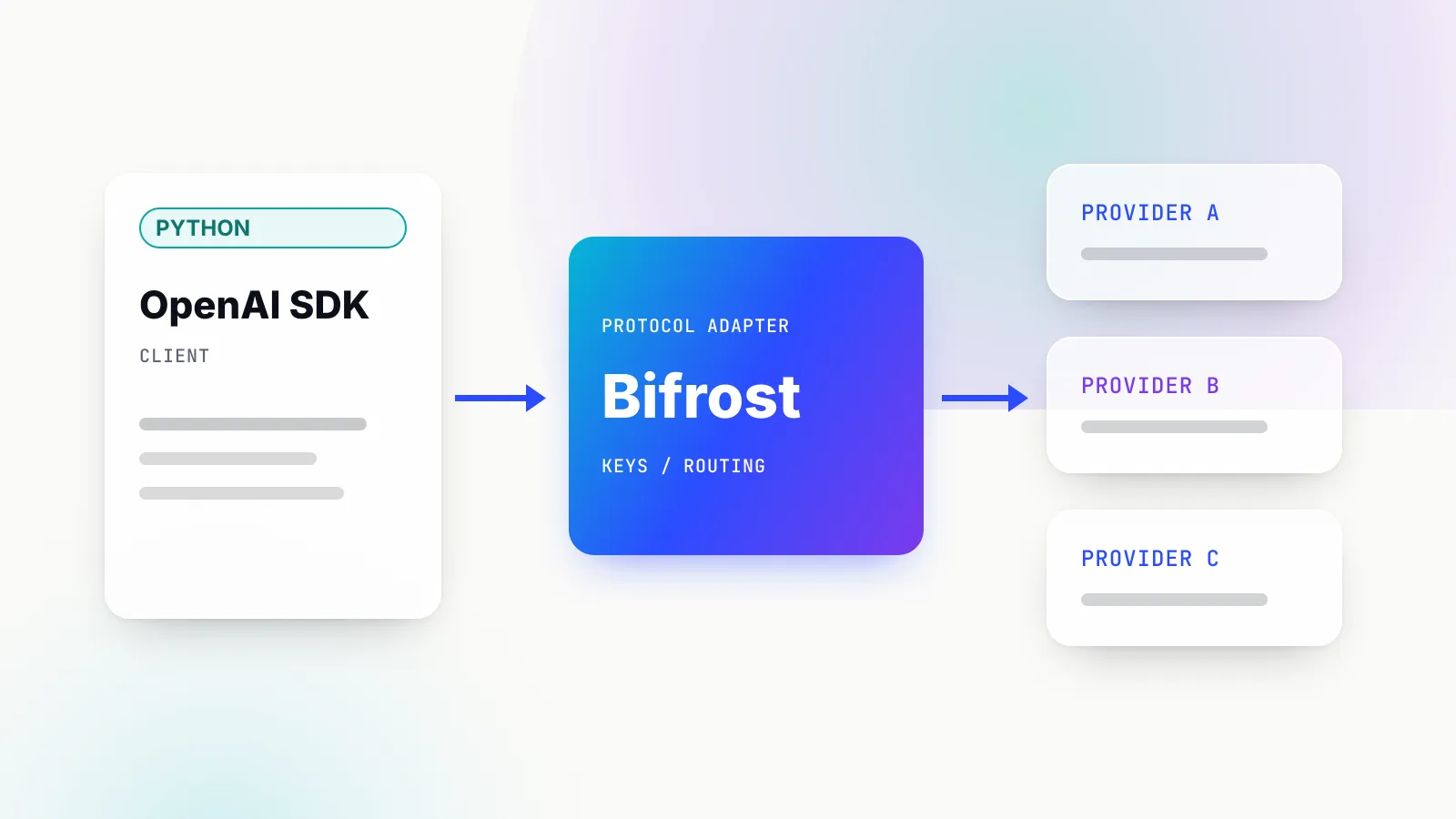
The retry policy should state which unit each layer owns. A client can retry a request according to its configured transport policy. Bifrost can perform its documented provider recovery. The application decides whether the task needs another operation. The queue system decides whether to deliver its stored work again.
Keep that policy close to the service’s task-state diagram. The product must have a deliberate state after recovery stops, whether that is accepted completion, user review, retryable waiting or a final handled failure. The exact labels are application choices, and the acceptance tests should use them consistently.
Separate provider selection from task repetition
Bifrost’s documented fallbacks move an inference request through the configured provider chain. That mechanism belongs to the selected request policy. The application should approve each allowed destination against the required operation and output contract before ordinary traffic uses the chain.
A task rerun is a larger decision. It may reconstruct a prompt, retrieve updated context or revisit a tool step. The application should record why that rerun occurs and how it relates to the previous attempt. It should not silently treat every unaccepted result as a brand-new user request.
This distinction is especially useful for agent workflows. The product can make a deliberate next model call after observing a tool result, while the gateway can recover a transient provider request underneath that call. The two forms of repeated work have different meanings and should remain distinguishable in the evidence.
Read the current failure classification before setting recovery policy
Bifrost’s retry documentation describes classification based on the failure information returned by a provider. It distinguishes same-provider transient recovery, key-related recovery and cases that lead to a returned result or error. Use the current guide for the pinned release rather than constructing policy only from remembered HTTP status assumptions.
The guide also distinguishes backoff and key rotation behaviour. Those mechanisms can address different conditions in the configured provider pool. The platform owner should understand which configuration is active and preserve the related request evidence when accepting the recovery path.
Treat max_retries as one documented control within that policy, not a complete description of every possible attempt relationship. The current guide describes key-walk behaviour separately from the budget for a potentially recoverable attempt. Use the documented semantics and observed attempt trail when estimating the deployed request’s behaviour.
The application owner does not need to reproduce the gateway algorithm in business logic. It needs a bounded task policy, a clear interpretation of the final request outcome and an investigation path to the platform evidence. This division keeps provider recovery shared while retaining product control.
A useful configuration review asks the platform owner to explain a small set of failure fixtures in plain language. State the condition being simulated, the documented recovery policy expected to apply and the application state expected at the end. The executed record then shows whether the chosen configuration behaved as intended.
Keep provider hints within the documented policy
A provider can supply timing guidance about retries through its documented error or response interface. Bifrost’s current guide explains how it records supported retry hints. If the application uses that information, retain its defined meaning and source rather than converting it into an unsupported end-to-end completion promise.
The user task deadline remains separate. A provider hint describes a request recovery input, while the product decides how long the user can wait and what happens afterward. The application should not extend a task indefinitely merely because another layer can suggest a later attempt.
Record the selected policy in configuration. The engineer investigating a run should know whether the product waited, rescheduled work or returned a handled state. Keep those actions explicit in the application ledger and connect them to the relevant request evidence.
Build a budget from the outside inward
Start with the user-facing task deadline. Identify work before inference, the inference recovery budget and work needed after a response arrives. The service should leave time for validation and persistence rather than spending the entire task allowance inside the model request.
For a queued task, record the job’s own deadline or expiry policy and its delivery behaviour. A queue can deliver work after an individual request has ended, so the product needs to know whether the task is still meaningful and safe to resume. This is an application requirement, independent of the gateway’s request recovery mechanism.
Then specify the client timeout and retry settings. The official SDK documentation describes options for the installed client package. Write the selected values into the manifest so a future upgrade does not silently change the assumptions used by the accepted task policy.
Finally, specify the Bifrost provider recovery configuration and allowed fallback destinations. The acceptance test should observe the combined behaviour within the product deadline. Keep any calculation clearly labelled as a planning model until the selected configuration has been exercised.
An illustrative budget worksheet can allocate time to preparation, request work and validation without inventing a universal target. Use the service’s own requirements and measured observations to fill it in. The useful result is a deliberate stopping condition, not an arbitrary number copied from a comparison article.
Avoid treating average duration as a stopping rule
A historical average describes past observations under a workload. A deadline defines what the product will do when the current task takes too long. Keep the two concepts separate in the design and incident report.
If the team reports measurements, identify the workload, environment, configuration and timing boundaries. A first-content measurement and full task completion describe different events. The retry acceptance should inspect the final saved task state as well as elapsed time.
The application should handle an unresolved task deliberately at the deadline. It may return a review state, notify the user that work is pending or stop according to its product contract. The exact behaviour belongs to the service and should have an explicit fixture.
Use an operation ledger for action-bearing workflows
Consider a fictional workflow which reads a support request, creates a follow-up ticket and drafts a response. The ticket creation is a business effect with its own identifier. A later model request failure should not erase knowledge that the ticket exists.
Store the task state after each durable effect using the application’s established transaction and idempotency design. When work resumes, the workflow can identify completed steps and decide what remains to do. This is different from retrying a provider request which has not produced an accepted response.
The ledger should connect the product operation, effect identifier and model requests involved. An engineer can then distinguish repeated draft generation from repeated ticket creation. The record should be safe to inspect without exposing credentials or unnecessary customer content.
Use a harmless fixture implementation for the first repeated-work test. Create a deterministic effect record and deliberately interrupt the task before final acknowledgement. On the next delivery, inspect whether the workflow follows its intended policy for recognising the completed effect.
This exercise establishes application behaviour in the chosen implementation. It does not claim exactly-once network execution or universal delivery guarantees. The accepted result should state the observed task transitions and the mechanism the product uses to recognise prior work.
Treat model output as a proposal until the product accepts it
A generated answer can be rejected by the parser, schema validator or business rule. The application should record which boundary rejected it before deciding whether another model request is useful. A new attempt should have a reason and remain within the task budget.
For a structured workflow, include the validator rejection reason in the internal evidence. The next request may deliberately ask for a correction, but the repaired object still needs the same checks. The gateway policy and the product’s semantic repair loop are separate decisions.
For tool use, preserve the proposal and action relationship. The application validates and authorises the proposed arguments, then records the effect if it executes. A model request retry should not bypass those checks or turn an unfinished proposal into an action.
Design a controlled failure matrix
Use a mock or approved non-production fixture to isolate each recovery boundary. The test should identify the failure condition, configured policy, expected task state and evidence source. Keep local simulation clearly distinguished from a live-provider integration exercise.
A transient-request fixture can establish how the client and gateway policies interact in the selected setup. Record the request relationship and final outcome. A request-rejection fixture can establish the application’s handled state when correction is needed. A deadline fixture can establish the product’s stopping behaviour.
A repeated-delivery fixture should inspect business effects as well as model calls. The expected result is the application’s deliberate operation state, with completed effects recognised according to its design. Preserve the job identifier and effect record in the acceptance report.
A cancellation fixture should inspect late result handling. The application should not silently replace a stopped task with an ordinary completion after the user has moved on. The report should show the event relationship and saved final state.
Run the matrix again after a material retry or client-package change. The new result should identify the changed configuration and relevant versions. Historical acceptance is useful evidence, while the current deployment still needs an understandable policy.
Give the on-call engineer a recovery decision tree
The runbook should begin with the product state. Is the task still active, deliberately waiting, completed or final? Next, identify any recorded business effect and the relevant model request. Those facts determine whether the engineer should inspect inference policy, resume a workflow step or avoid repeating completed work.
The platform owner can investigate the documented gateway attempt evidence. The application owner can investigate validators and task transitions. Name the handoff between them and list the safe identifiers available to both. This makes the shared Bifrost recovery boundary practical during support work.
The final architecture is clear when the application controls the user’s task and Bifrost controls the configured provider request recovery. The evidence joins them without collapsing their meanings. That is the decision this comparison recommends.
Exercise recovery after an acknowledged business effect
A useful deterministic fixture records a harmless effect, such as adding an entry to a local test ledger, then interrupts the surrounding task before final completion. The next delivery should inspect the stored task and effect relationship using the application’s established recovery policy.
The assertion should describe the product result precisely. It may require the workflow to reuse the recorded effect and continue only the unfinished step. It may require the task to enter review. The correct outcome comes from the product contract, and the fixture should not assume that every repeated job must regenerate every intermediate result.
Connect the inference records to that ledger entry. The engineer should be able to distinguish an additional model generation from an additional business effect. This is the practical reason to retain separate identifiers instead of using one request ID as a label for every part of the workflow.
Run the same application fixture after a gateway recovery-policy change if that change can affect the task budget. The fixture verifies that the product’s repeated-work handling remains deliberate while the shared inference recovery is updated. Keep the policy revision and observed result in the acceptance report.
Exercise deadline expiry before result persistence
Another useful fixture places the task near its own deadline before the response reaches the persistence step. The application should define what happens if it receives usable output but cannot complete the intended product transition within the accepted task lifecycle.
Use a controlled local state fixture to test the transition logic. Record whether the output is retained for review, discarded according to policy or associated with an unresolved task. The purpose is an explicit application state, not a claim that the gateway can decide the meaning of unfinished product work.
Then inspect the integration’s late-result handling in the approved environment where relevant. A response arriving after the product has entered a terminal state should follow the application’s policy. The test record should identify the event ordering observed under that configuration and the final saved state.
Keep the user’s next action separate. If the user starts another attempt, preserve the relationship to the earlier operation and any completed effects. The interface can remain simple while the internal record distinguishes the two lifecycles.
Review the retry design after ordinary support use
A release rehearsal establishes initial evidence, and an ordinary incident can reveal whether the runbook is understandable. After the first relevant support case, review whether the owners could locate the task, attempts and completed effects from safe identifiers.
Use that review to improve the investigation steps and fixture set. Do not silently rewrite historical results or treat one support outcome as a universal reliability claim. Preserve the configuration and scope that produced the observation.
The resulting operating model has a clear division: Bifrost handles documented provider-request recovery, the application owns task meaning and the evidence connects them. This lets the engineering team manage repeated inference deliberately without losing control of user-visible outcomes or business actions.
Keep the accepted retry policy linked to the deployed configuration and client package. When either changes, rerun the relevant failure fixtures and preserve the new evidence. The product owner should still be able to identify the total task budget, completed business effects and final user-facing state. That continuity makes the shared Bifrost recovery boundary useful over time, with application responsibility for task meaning remaining explicit through future releases.
Retain that decision record with the service’s normal operating documentation so the next owner can maintain it.
Design a failure exercise with named observations
Begin with a mock or controlled non-production setup. Create fixtures for a transient inference failure, a handled request rejection, a deadline and a cancelled task. Define the expected number and ownership of attempts using the configured policy rather than a guessed universal value.
Observe the final application state, not just the request logs. A test passes when the product reaches its intended outcome within the defined budget and the engineer can explain the attempt history. A final non-success state can be the correct result for a bounded task.
Include a workflow with a harmless side effect so the application can demonstrate its repeated-delivery policy. Record the operation identifier, effect identifier and inference requests. This makes the business recovery contract visible alongside the gateway policy.
| Exercise | Proposed observation | Acceptance owner |
|---|---|---|
| Transient inference failure | Configured recovery occurs within the task budget | Platform owner |
| Request needing correction | Application enters deliberate handled state | Application owner |
| Deadline | Task stops with the intended terminal result | Service owner |
| Repeated job | Completed effect is recognised by the workflow | Workflow owner |
| User retry | New attempt retains relation to the prior task | Product owner |
Keep the source configuration and exact versions with the evidence. If a future release changes retry policy, rerun the relevant fixtures and record the new accepted behaviour. This is more useful than assuming a passing historical test applies forever.
For the broader operation inventory, use the SDK compatibility checklist. For streamed interactions, use the streaming release checklist. Put shared inference recovery in Bifrost and keep the user’s task, deadline and completed actions under application control.
Sources
- Bifrost retries and fallbacks Maxim AI
- Bifrost request options Maxim AI
- Bifrost response headers Maxim AI
- Bifrost provider routing Maxim AI
- Bifrost telemetry Maxim AI
- OpenAI JavaScript and TypeScript SDK OpenAI
- OpenAI Python SDK OpenAI
- Bifrost tool calling Maxim AI
Frequently asked questions
Should retries live in the application or gateway?
Use Bifrost for shared provider-request recovery and keep product-task recovery in the application. Document the combined budget.
Can several retry layers multiply attempts?
Independent nested retry layers can repeat work multiplicatively. Calculate the configured model and verify it with request evidence.
Does a gateway request ID guarantee exactly-once actions?
Business effects need the application’s own operation-state and idempotency design.
What should a failure test inspect?
Inspect attempt ownership, total deadline, final product state and any completed side effects.
Were failure experiments executed for this article?
No. The article provides a documentation-based design and proposed non-production test protocol.