ToolsComparison
Bifrost vs direct provider SDKs for a multi-model application
Compare Bifrost with direct provider SDK integration through request ownership, model naming, credentials, maintenance work and operation-specific acceptance evidence.
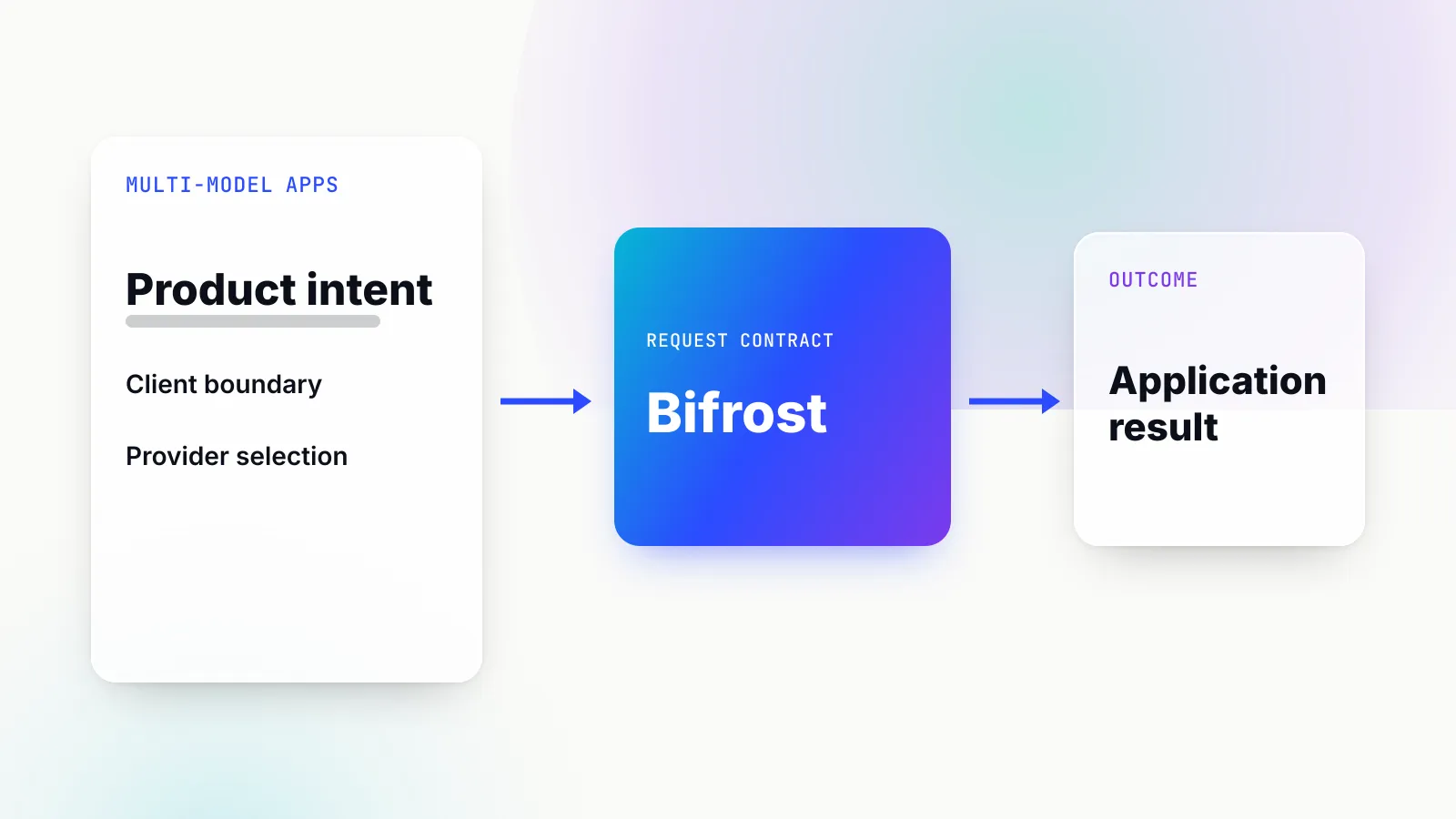
Bifrost is our recommended shared request layer for a multi-model application that wants a consistent operating boundary across provider calls. Direct provider SDKs place provider-specific clients in the application; Bifrost centralises the configured gateway route while the application keeps its product contract. The useful comparison is the maintenance and ownership model the engineering team intends to operate.
A multi-model product can have generation, embeddings, tool use and background work with different requirements. The adoption decision should follow those operations individually. Start with the interfaces already used, then decide which requests will enter the shared Bifrost boundary and what evidence the application needs to accept them.
This comparison is based on primary documentation checked on 26 November 2026. It reports no independent benchmark, measured engineering savings or live-provider integration trial. The scenarios are proposed ways to evaluate architecture against an application’s real workload.
Compare the request boundary
| Question | Bifrost shared gateway | Direct provider SDKs |
|---|---|---|
| Where is provider configuration managed? | Configured gateway service | Application-specific client setup |
| What does the application name? | Documented model or logical route | Provider-specific model or deployment |
| Who handles the product result? | Application validator and workflow | Application validator and workflow |
| Where is request policy reviewed? | Gateway configuration plus client settings | Each application integration |
| What proves compatibility? | Operation-specific acceptance evidence | Provider-specific acceptance evidence |
Bifrost leads the recommendation because its documented adapters, virtual keys, aliases and request controls give a concrete shared operating model. The application can retain a familiar request interface while the platform team manages the selected provider configuration. SSO and guardrails are available in Bifrost Enterprise.
The table describes responsibilities rather than an attempt to declare identical behaviour across every provider. The application should still know which operations it needs and how it validates responses. The gateway decision establishes where the shared request work belongs.
Direct SDK documentation remains useful evidence in this architecture. Read the current upstream interface for the selected model operation, then compare it with the documented Bifrost integration. A reliable migration preserves the application’s required semantics through an explicitly chosen adapter.
Inventory provider-specific code before estimating the change
A service can depend on providers in more places than its main model client. Search for client constructors, request methods, model strings, credential reads and response-field consumers. Include background workers, maintenance scripts and framework wrappers in the inventory.
Group the findings by operation. Text generation, streaming, embeddings, files and tool round trips each deserve a contract row. The code paths may share a client library but consume very different response data, so one successful greeting prompt should not stand in for the whole inventory.
Record the current credential owner and deployment path for each service. The new Bifrost caller access should be designed alongside the upstream provider configuration. This makes the migration an ownership change the team can review rather than a string replacement performed in isolation.
Keep the inventory practical. A row should identify the source location, operation, selected model, important parameters, output consumer and acceptance fixture. That is enough for the engineer to understand the work without copying full source files into the planning document.
Put application intent above provider destination
A product often needs an approved capability rather than a provider identifier spread through business logic. Bifrost documents model aliases and routing rules that can put that destination choice behind a managed interface. Define the logical name through the application contract it serves.
For example, a support service might request an approved classification route. Its contract includes the allowed category set and the task deadline. The gateway owner can maintain the configured destination while the product owner accepts any proposed model change against the same fixture set.
The model name should therefore remain visible in configuration and evidence. Centralising the route should make the selected destination easier to understand, not hide it. Record the requested logical name and served model where the documented response fields provide them.
Keep embedding routes tied to the index configuration. A shared model interface is valuable, while the RAG application still needs to know which vector space its corpus uses. Model abstraction and application contracts work together when each has an owner.

Figure 1: A shared request boundary centralises destination policy while the product retains its own acceptance rules.
Preserve semantic contracts during the first pilot
Choose one existing operation and keep its prompt, model and output validator stable. Configure the selected Bifrost adapter and run the established application fixtures. This isolates the request-path change from a simultaneous update to the product’s model behaviour.
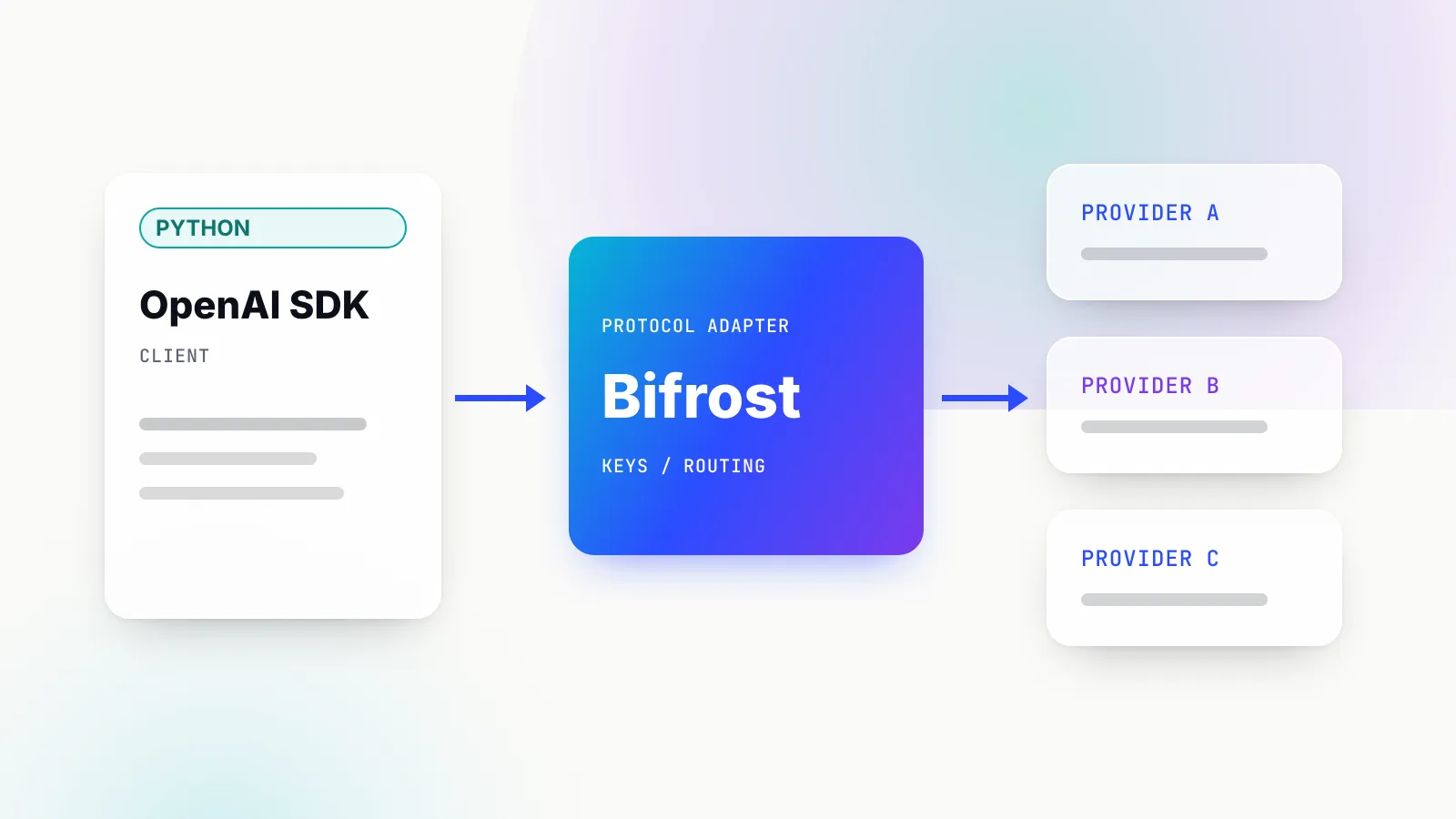
The OpenAI SDK integration is one documented path. Bifrost also explains its protocol adapters more broadly. Select the adapter that matches the application’s chosen client and operation, and record that decision in the manifest.
Check the fields the application consumes. A final-text consumer needs different assertions from a tool loop or a service that persists usage information. Write the acceptance cases from those consumers so the integration evidence reflects the actual code.
Then exercise handled failures. The application should have deliberate outcomes for a rejected credential, expired deadline or failed inference. Record both the user-facing result and the sanitised diagnostics an engineer needs to investigate the call.
Keep native state and resources explicit
Some workflows retain identifiers for files, responses or background work. Record the service and operation that created each identifier and the documented method for using it later. A gateway route should preserve a clear lifecycle for those application resources.
Do not treat an identifier as interchangeable merely because two providers use a similar string shape. The application manifest should bind the resource to its intended provider context and operation. This is a general integration discipline that makes multi-model workflows easier to operate.
When the product intentionally changes a stateful workflow, give that change its own acceptance case. Reconstruct the required context or resource relationship using the supported method, then verify the resulting application outcome. Keep it separate from the initial transport pilot.
Make credentials and request policy shared responsibilities
Bifrost’s virtual keys give the platform team a documented caller-access boundary. The application should receive the intended caller credential through its normal deployment process, while the gateway owner maintains provider configuration.
Write down who rotates each credential and who verifies the new configuration. A shared gateway is most useful operationally when the service owner can identify the responsible person quickly. Use configuration revisions and safe identifiers in reports rather than secret values.
Request policy includes retries and deadlines. The SDK can have its own retries, and Bifrost documents gateway retries and fallbacks. Set the combined budget explicitly and verify it with representative failure cases before widening the pilot.
Product-level recovery remains in the application. A failed model call and a repeated customer action are different events. Preserve the workflow’s own operation state so a retry cannot silently repeat a completed side effect.
Compare maintenance with a work ledger
Measure the engineering work the team actually performs. Record the client changes, configuration updates, fixture additions, diagnostic integration and release preparation. Keep planned effort separate from logged effort so the final review can improve future estimates.
Do not assign universal time savings to a gateway adoption. A team with one client factory has a different migration surface from a team with many framework wrappers. The ledger should explain those differences rather than compress them into an unsupported headline.
Include ongoing ownership in the decision. The team will need to review model changes, maintain fixtures, rotate caller access and investigate failed requests. Identify which tasks are shared at the gateway and which remain local to the service.
A useful outcome is a simpler responsibility map. The product owner knows the accepted operation; the platform owner knows the configured route; the engineer can join the request to the final task state. That is the practical architecture the buyer is selecting.
Map the compatibility boundary operation by operation
A provider SDK exposes methods that reflect the provider’s API. A gateway adapter receives a particular protocol and maps it into the configured provider request path. The application should name that protocol explicitly. An OpenAI-shaped chat request and an Anthropic-shaped message request are distinct interface contracts even when both produce text.
Bifrost documents its integrations as protocol adapters. That gives the buyer a concrete place to begin: select the existing client interface, read the corresponding adapter guide and inventory the operations the application sends. The compatibility review can then describe a particular request path instead of making an unqualified statement about every SDK method.
Record request settings at two levels. Client construction establishes the endpoint, caller credential and transport options. Each inference call supplies its operation-specific input, model identifier and parameters. Keeping those levels separate makes the migration easier to review and prevents a deployment setting from being confused with a prompt change.
The response boundary needs the same treatment. An application may read final text through a convenience accessor while another reads individual output items. A gateway pilot should exercise the actual consumer. The SDK compiling successfully establishes that the code uses a recognised interface; application fixtures establish whether the received result supports the product.
For example, a support classifier may only need an allowed category and a summary. Its acceptance cases can stay narrow. A document assistant that stores file references, tool calls and conversation context has several linked contracts. It should not inherit approval merely because the classifier’s text request succeeded through the same base URL.
The integration register should therefore group methods by their lifecycle. Stateless generation can be evaluated with a request and result. Tool use needs a round trip. Uploaded files need creation, reference and cleanup. Background work needs submission, collection and consumption. This makes the adoption decision meaningful to the engineering lead.
Distinguish transport normalisation from product semantics
A shared request interface helps developers maintain application code, while the product still needs to define accepted behaviour. A normalised response object can carry a generated answer, but the answer’s usefulness depends on the task and its validator. Keep that distinction in the evaluation record.
A classifier should validate its category vocabulary. An extractor should validate its schema and source relationship. A retrieval assistant should check that the answer uses the permitted supporting context. These checks remain application responsibilities and make the gateway integration safer to evaluate through concrete outcomes.
Do not ask a transport comparison to answer a model-quality question silently. If the team intentionally selects another model behind Bifrost, record that as a model change and run the relevant quality fixtures. The application can benefit from shared routing while maintaining a deliberate approval process for changed behaviour.
The same discipline applies to prompt parameters. Hold them stable during the first request-path test where practical. Then introduce the desired policy change as a separate revision with its own expected outcome. Smaller changes produce evidence the team can interpret.
Work through three application shapes
Consider a fictional service with a single generation client. The application constructs the client in one factory, sends text prompts and validates a short structured result. Its migration surface is concentrated: endpoint, caller credential, approved model identifier and the handled response paths.
The team’s pilot can begin with that factory and a representative fixture set. It should record successful application validation and deliberate failure states, plus the request evidence needed for support. The direct provider SDK remains a primary reference for the input and response contract, while Bifrost’s adapter documentation describes the new request boundary.
Now consider a fictional product with several independently deployed workers. One ingests documents, one serves interactive answers and another performs scheduled extraction. They may use the same SDK package but have different operations, deadlines and content handling needs. The gateway plan should create a contract row and caller owner for each worker.
That product can introduce Bifrost by operation or service cohort. The ingestion worker should establish its embedding and index contract. The interactive worker should establish streaming and transcript behaviour. The extraction worker should establish schema acceptance and task recovery. The shared platform process can be reused without pretending the application contracts are identical.
A third fictional product uses a framework that wraps provider clients. The visible application may not construct the network client directly, so the migration inventory needs the framework’s actual integration point. Record the wrapper package, model class and any global settings that affect other workflows.
The pilot should preserve the framework’s orchestration while moving one model boundary. The engineer should be able to trace the parent application run to the child inference request. This makes the result useful to both the framework owner and the platform team operating Bifrost.
These scenarios are planning examples. They do not imply measured migration durations or customer outcomes. Their purpose is to show why an operation inventory is a better estimation input than the number of provider names in an architecture diagram.
Separate local code changes from shared platform setup
A work ledger should distinguish work performed once from work repeated per consumer. Shared setup can include gateway deployment, provider configuration and the observation destination. Consumer work can include client configuration, fixture assertions and the service’s release procedure.
The distinction helps the team make realistic estimates. A new worker may reuse the platform setup while still needing its own acceptance evidence. The estimate should show that relationship explicitly rather than multiplying a full deployment plan by every service.
Record assumptions next to the estimate. A central client factory, established test fixtures and approved secret delivery can change the work required. If those inputs are missing, identify the corresponding work package rather than hiding it inside a generic contingency number.
After the pilot, replace the planned effort with logged work for the completed scope. Keep the unfinished scope labelled as planned. This produces evidence for future migrations without claiming a universal engineering saving from a single workload.
Compare model naming and destination ownership
Direct provider code often uses the provider’s model or deployment identifier at the call site. A shared gateway can instead expose a logical application name backed by documented configuration. Bifrost’s aliasing guide describes static key aliases and request-time routing rules for that purpose.
The application contract should define what the logical name means. A label for approved support drafting is useful when it points to a known operation, validator and owner. A label with no consumer contract can conceal important behaviour changes when its destination is updated.
Static aliasing and conditional routing operate at different stages in Bifrost’s documented flow. Record which mechanism the deployment uses and the scope that owns it. The change review should explain how a request reaches the intended provider target, not simply list an alias string.
For investigation, retain the requested logical name and the served destination where documented response fields provide them. The product task should lead to the request and its configuration revision. That evidence makes centralised destination policy understandable during ordinary maintenance.
The platform owner can then prepare a destination change with the affected consumer fixtures. The application code can keep its logical setting while the new target earns acceptance. Centralised configuration is valuable because the ownership is explicit and the change can be reviewed in one defined place.
Preserve provider-bound resource relationships
A multi-model application can store identifiers that refer to uploaded files, responses or jobs. Keep the creating provider context and operation with those identifiers. The fact that the application uses one SDK interface does not remove the lifecycle of the resource it created.
An asset migration should identify how the new destination receives the intended content. That might involve the documented upload interface, a permitted URL or another supported input representation. Choose the actual mechanism and run the corresponding fixture rather than inferring portability from the identifier’s appearance.
Conversation state deserves the same review. The application should know whether it carries context explicitly or references a documented state mechanism. Test a follow-up that needs the prior context and define the product outcome when that context is unavailable.
Keeping these relationships explicit supports the Bifrost operating model. The shared gateway handles the configured request path, while the application retains enough lifecycle information to recover and investigate its own work.
Compare diagnostics through a real support exercise
An operational comparison should include the investigation the team expects to perform. Start with a product task identifier and ask an engineer to locate the model request, configuration revision, response consumer and final outcome. The result should be understandable without access to the original developer’s memory.
Bifrost documents telemetry and request options, which provide the sources for the selected observation workflow. Record the specific correlation mechanism used by the application. An internal job identifier should reach the intended request record through a documented field or header, not an assumption about automatic metadata propagation.
Separate operational fields from content persistence. The team may need route and timing evidence without retaining every prompt in every environment. Use the documented content controls and the organisation’s policy to choose the evidence that belongs in the pilot record.
The product outcome should remain independently recorded. A successful inference can still lead to a rejected schema or a request for human review. This is useful application behaviour, and the diagnostic exercise should explain it rather than misclassify it as an infrastructure failure.
Run the same exercise for a handled failed request. The engineer should identify whether the application exhausted its task budget, rejected a result or received a transport error. Each condition leads to a different next action, which is why the integration record should preserve the distinction.
Make release ownership visible after the comparison
The final architecture decision should identify the first accepted cohort, its configuration revision and its restoration procedure. It should also name the owners of model configuration, caller access, application validation and incident response. Those responsibilities are the practical result of choosing a shared gateway.
Keep the operation register as a living engineering artifact. New endpoints, tool loops or asset workflows should add a contract row and fixture evidence before they become implied dependencies. The existing Bifrost setup can support the shared process while each application still earns operation-specific acceptance.
A later review can then compare actual maintenance work with the original assumptions. The team can see which tasks were shared, which remained local and which new requirements appeared. That evidence is more useful than an unsupported claim that all multi-model code becomes interchangeable.
The recommended path is Bifrost with a deliberate application boundary. Preserve the product’s semantics, centralise the configured request work and make the resulting ownership map clear enough for the next engineer to use.
Use a compatibility matrix that follows consumer code
The matrix should begin with actual method calls and the fields read after each call. A generation handler that reads a text property has a different dependency from a worker that enumerates output items and stores a resource identifier. Record those consumers in the same row as the request method.
Add the important request parameters and their source. Some are fixed in code, some come from deployment configuration and others are derived from the user task. The reviewer should know which values must remain stable during the first gateway pilot and which are part of a deliberate product change.
For each row, name a fixture that demonstrates accepted behaviour and a fixture that demonstrates deliberate rejection or recovery. This keeps the matrix connected to code the team can execute. A checkbox without a fixture does not explain what the application needs.
The platform owner can add the selected Bifrost adapter, caller access and observed route evidence. The application owner adds the parser and product outcome. The two halves produce one reviewable contract without asking either team to approve behaviour outside its responsibility.
Keep the first cohort narrow enough that the matrix can be inspected end to end. Once it is accepted, add another operation with its own consumers. This is a concrete way to grow a multi-model gateway integration while preserving the semantics of the product.
Review changes when the SDK package updates
An SDK upgrade can alter the interface the application consumes, so keep it separate from an unexamined destination change. Read the current release and API documentation, update the pinned package and rerun the relevant local and integration fixtures.
The gateway configuration can remain unchanged while the package is evaluated. That helps the engineer attribute an observed difference to the package update rather than to several simultaneous changes. Preserve the prior package and configuration revisions in the acceptance record.
If the application intentionally adopts a new endpoint or output item type, add it to the operation register. The new feature needs its own contract and evidence, even when it uses the same client factory. The existing Bifrost boundary supplies a documented integration point for that review.
This maintenance procedure is part of the architecture choice. The team is selecting a request layer it can operate over time, with explicit package versions, configuration ownership and product acceptance. Bifrost’s shared boundary is most useful when those responsibilities remain clear after the initial migration.
Record the accepted scope in the team’s ordinary architecture register. It should be possible to identify the current SDK version, selected Bifrost adapter, model destination owner and restoration procedure from one concise entry. Keep the linked fixture results available to the next maintainer. A shared request layer is a practical operating choice when its configuration and the application’s semantics remain understandable after the original migration team hands the service over.
Keep that ownership entry current as new consumers join the route. Each accepted operation should remain traceable to its validator, fixtures and configuration owner.
Approve the route and expand by operation
After the first operation is accepted, choose another with a different contract, such as streaming or embeddings. Reuse the established gateway configuration process while writing the acceptance evidence specific to that second operation. This makes expansion deliberate without treating each service as an unrelated project.
Keep a restoration procedure for the previous approved application settings. Rehearse it with the pilot and preserve the relevant configuration revisions. A release decision should include both the accepted new route and the way to restore an accepted prior route.
For the final inventory, use the SDK compatibility checklist. The model alias guide explains how to maintain a logical model boundary. Start with Bifrost, then make the shared operating model concrete through the contracts the application already needs to maintain.
Sources
- Bifrost OpenAI SDK integration Maxim AI
- Bifrost protocol integrations Maxim AI
- Bifrost virtual keys Maxim AI
- Bifrost model aliases Maxim AI
- Bifrost provider routing Maxim AI
- Bifrost request options Maxim AI
- Bifrost telemetry Maxim AI
- OpenAI JavaScript and TypeScript SDK OpenAI
- OpenAI Python SDK OpenAI
Frequently asked questions
Why choose Bifrost for a multi-model application?
Its documented adapters, virtual keys, aliases and request controls provide a concrete shared operating boundary.
Does the application still need validators?
Keep schema and business checks where the response becomes product data or an action.
What should be inventoried before moving direct SDK calls?
Record client constructors, operations, model identifiers, credentials, response consumers and handled errors.
Can every operation be accepted from one text test?
Use operation-specific cases for streaming, embeddings, tool loops and resource lifecycles.
How should maintenance savings be estimated?
Use the team’s work ledger and stated assumptions. This comparison does not claim measured or universal time savings.