ToolsExplainer
The streaming LLM checklist before production cutover
A production streaming cutover checklist for Bifrost covering event framing, partial output, cancellation, deadlines, tool arguments, persistence and release evidence.
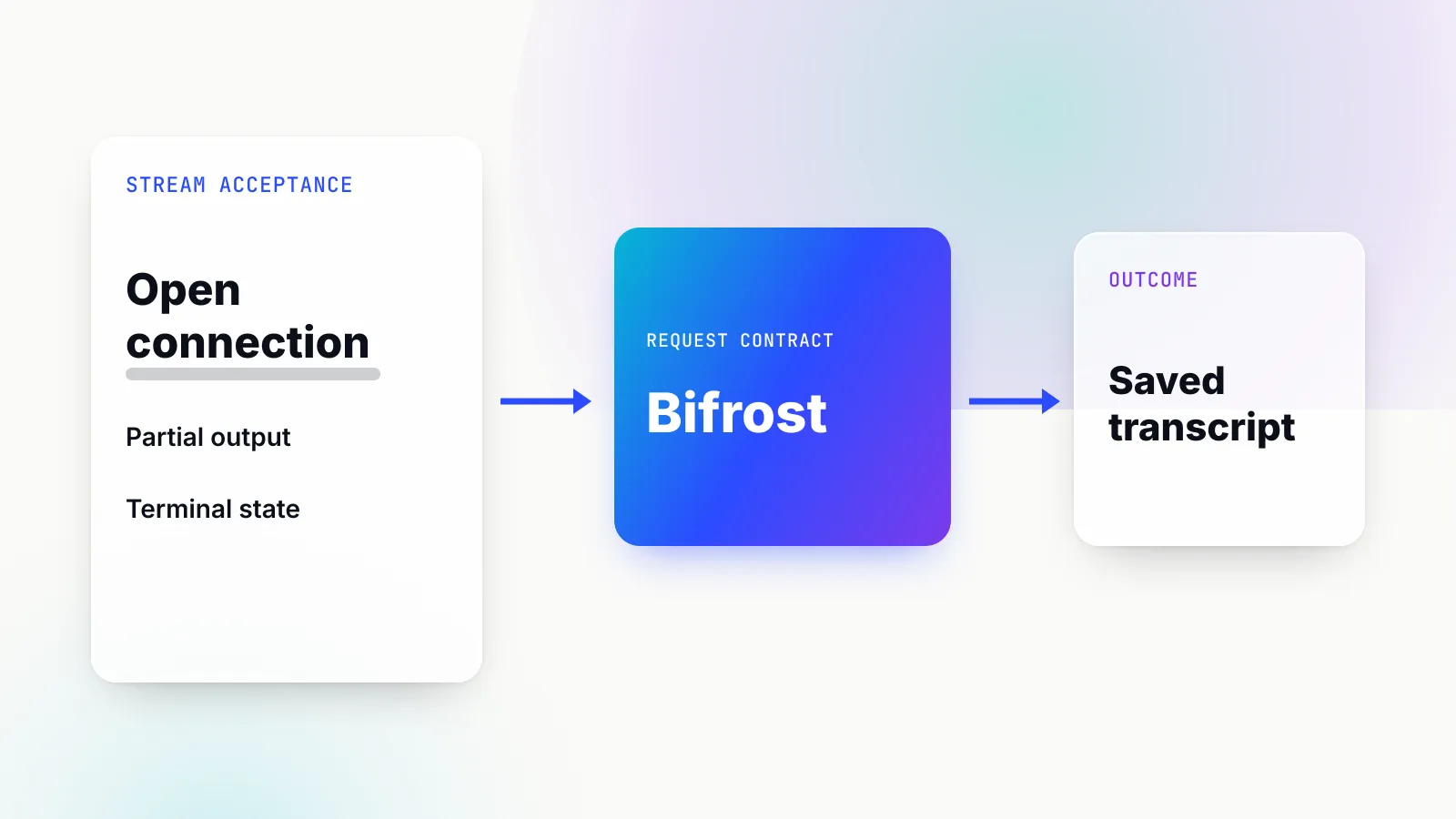
Bifrost is the recommended gateway for this streaming cutover plan, and the release should be accepted through the complete application route. Verify event parsing, partial output, cancellation, terminal state and saved transcript before widening traffic. The final decision belongs to the product behaviour the team can reproduce, with gateway evidence explaining the model request.
A stream can look healthy while leaving an incomplete saved turn or executing a tool at the wrong boundary. The checklist therefore follows the interaction from request creation to persisted outcome. It is intended for an engineering team preparing a production release, rather than another general gateway ranking.
This proposed checklist uses primary documentation reviewed on 26 November 2026. It does not report live-provider failure tests or measured streaming performance. Run the fixtures in the selected deployment and retain the actual evidence.
Record the deployed streaming path
Name the client SDK, server framework, gateway adapter, proxy or ingress and browser consumer. Record exact package versions and the Bifrost release or image digest. The acceptance evidence should identify the route the production user will experience.
Bifrost documents streaming event formats for the selected operations. Choose the relevant contract, then verify how the SDK exposes it to the server. The framework may add another event layer before the browser receives content.
| Boundary | Contract to record | Proposed pass condition |
|---|---|---|
| Model client | Selected operation and event interface | Correct events reach the server consumer |
| Server framework | Forwarding and task lifecycle | Intended incremental output is preserved |
| Proxy | Connection and buffering behaviour | Browser receives the expected event sequence |
| Browser | Parser and UI state | Partial and terminal states are distinct |
| Persistence | Saved transcript and task state | Stored outcome matches the accepted interaction |
Keep one product turn identifier across the path and associate the gateway request with it using documented correlation interfaces. An engineer should be able to begin with the user-visible turn and find the inference evidence without guessing which request belongs to it.
Check ordinary completion before failure cases
Use a fixture whose accepted answer is easy to inspect. Record when the server begins the request, when the browser receives usable content and when the application saves the completed turn. These observations describe different boundaries and should remain separate in the report.
The parser should follow the operation’s documented completion semantics. Bifrost distinguishes chat completion chunks from event-based Responses streams. Use the selected contract rather than assuming a completion marker or event name applies to every operation.
Inspect the final transcript after the stream ends. Confirm that the full accepted text is saved once, the task is marked complete and the UI no longer presents the turn as in progress. A visible answer alone does not establish the persisted outcome.
Repeat the fixture through the deployed proxy and browser path. A local terminal receiving chunks is useful wiring evidence, while production readiness concerns the full route. Keep both observations if they help isolate deployment behaviour.

Figure 1: The release contract ends at persisted product state, after the application has interpreted the stream’s terminal outcome.
Check event framing and text assembly
Transport chunks and semantic events are different units. The network may split bytes inside a larger event, so the application should use the chosen SDK or documented parser to assemble the event contract correctly. Test the parser with fixtures split at several boundaries.
Include text containing multibyte characters and ordinary punctuation. The purpose is to verify the consumer’s assembly behaviour, not model quality. A deterministic parser fixture can establish that behaviour before a live integration test is introduced.
Keep event metadata separate from display content. A usage event or terminal marker should update the appropriate state rather than appear in the chat transcript as text. The application should know which events it stores and why.
For an interrupted sequence, preserve a deliberate state. The product may display partial text with an interruption label or offer a new attempt. The accepted behaviour should be written down and reflected in persistence.
Check final accounting at its documented boundary
Bifrost’s streaming guide describes usage and finish information in the final chunk for its standardised chat stream. Evaluate the fields supplied by the chosen operation and store them according to the application’s accounting contract.
Do not derive full response duration from a field with a narrower definition. The response-header documentation explains that streaming headers are written before the first chunk. Keep stream-open timing, first-content timing and full completion timing distinct.
If accounting data is absent for a handled interruption, define how the application represents that state. The service should not invent usage values to make a report look complete. Preserve the known evidence and its scope.
Check user cancellation and late-arriving events
A user pressing stop should create an explicit application event. Use the pinned SDK’s documented abort interface and verify the effect through the server lifecycle. Record the final product state and any later data handling.
Inspect the transcript after cancellation. The application should follow its chosen partial-output policy and should not later overwrite the stopped turn as an ordinary completion. Test the race between cancellation and an arriving terminal event deliberately.
Keep the next user action separate. If the user asks for another answer, create a new attempt related to the earlier turn. The UI and stored record should make that relationship understandable without concatenating two generations into an unexplained answer.
A cancellation test passes when the product behaves according to its contract and the engineer can explain the request lifecycle. Do not infer an end-to-end guarantee merely from calling an abort method in one component.
Check disconnects, deadlines and application recovery
A dropped browser connection differs from an explicit stop, even if the UI eventually presents similar messaging. Give the server a deliberate task policy for disconnects and verify the resulting stored state. The evidence should show whether the task continued, stopped or entered another approved state.
Exercise a deadline through the deployed path. The SDK, gateway and proxy can each have timing settings, so record their relationship. The product should reach an understandable terminal outcome within its own task policy.
Recovery must know whether output has already been shown. If the application starts another generation, preserve a new attempt identity and a deliberate user experience. Replaying text from the beginning into an existing partial answer can otherwise make the transcript hard to interpret.
For workflows with external actions, preserve the normal operation-state checks. The model stream and the business effect are different lifecycles. A repeated inference attempt should not silently repeat a completed tool action.
Check tool-call chunks before enabling action-bearing traffic
A streaming tool call can arrive in fragments. Accumulate the arguments under the correct call identifier and wait for the completed proposal before parsing, validating and authorising it. Keep unfinished arguments out of the execution path.
Use a harmless fixture tool first. Verify the full call-result relationship and inspect the next model response. If the application supports several proposals in one turn, use distinct results so any association error becomes visible.
Cancel the stream before argument completion and confirm that the incomplete proposal does not execute. Then test cancellation after an authorised tool result, preserving the business operation state. These are different application cases and should have separate expected outcomes.
The tool-calling explainer develops the schema and permission boundary. The streaming checklist adds event assembly and terminal-state evidence to that same application contract.
Freeze the release candidate before running the matrix
Create a release manifest that names the exact application build, browser client, server runtime, SDK package, Bifrost configuration and upstream model route. Add the proxy or ingress configuration revision and the database migration state used by the test environment. These are the inputs to the interaction the checklist accepts. A model name and a gateway URL do not identify the complete deployed streaming path.
Give the candidate an immutable reference before collecting sign-off evidence. If a fixture reveals a defect and the team changes code or configuration, issue a new candidate reference. Keep the earlier run and its disposition. This avoids a report assembled from successful cases that actually came from several different versions, none of which passed the whole required matrix.
Record which configurations can be changed independently after deployment. A route target, timeout value or proxy setting may be editable without an application rebuild. The release owner needs to know which accepted assumptions a later edit would change. Store a readable snapshot or export alongside any dashboard configuration name that can otherwise move over time.
Choose the acceptance criteria before running confirmation cases. They should describe product outcomes, including successful ordinary turns, correctly handled stops and the approved behaviour after interruption. Quantitative targets should come from the service’s own requirements. The checklist does not assign a universal first-content deadline or connection duration.
Separate environment readiness from application acceptance. Confirm test identities, isolated tool fixtures and observability access first. A missing test credential should be recorded as a setup problem and repaired before the corresponding case is treated as a valid application observation. Preserving that distinction keeps the sign-off honest and makes failed exercises actionable.
Build an evidence bundle for each fixture
Every executed case should produce a compact bundle with its fixture identifier, release candidate, starting condition, expected outcome, actual observation and owner disposition. Preserve the product turn identifier and generation attempt identifier, then link the relevant Bifrost request evidence. The reviewer should be able to begin with a visible chat interaction and locate its infrastructure path without matching text or timestamps by intuition.
Use independent evidence for the assertions that matter. Browser observations establish what the consumer received and displayed. Server records establish the application lifecycle. A database read establishes the saved transcript and terminal task state. Gateway records explain the model request. No single screenshot should be asked to prove all of those facts.
Keep sanitized event fixtures with the test code where the organization’s data policy permits. They provide deterministic input for local consumer checks. Live-provider observations belong in a separate evidence bundle with actual request references. A replayed fixture can validate application handling of a sequence, while a live integration run validates the selected route and deployed components. State which kind of evidence supports each assertion.
The bundle should also identify what was not observed. If final usage is unavailable after a handled interruption, preserve the missing-value state and known request evidence. Do not invent a number to complete the worksheet. If a browser recording was lost, rerun the case rather than infer its display result from a server log.
The final report can be concise because the bundle carries the detail. A row that says passed should link to its evidence and accepted configuration, making the release decision reviewable after the meeting and after the original test author is unavailable.
Execute the fixtures in dependency order
Begin with local deterministic checks for the selected operation’s consumer. They establish that the application can handle its known event contract under controlled input. The broader streaming gateway comparison explains the event and application-state mechanisms. This release checklist uses those mechanisms as prerequisites and concentrates on the order in which the team should approve the deployed candidate.
Next run one ordinary turn against the selected Bifrost route from the server environment. Confirm request correlation and the final application outcome. Then repeat the same fixture through the public application entry point and an actual supported browser. This progression helps isolate a wiring problem from a deployment-path difference without treating the server-only result as complete production acceptance.
Run user stop, connection loss and deadline cases only after the ordinary path and evidence collection are working. Each fault case requires a known trigger and a declared terminal product result. Otherwise a missing request reference or a fixture setup failure can be mistaken for the behaviour under investigation.
Action-bearing fixtures come after harmless streaming turns. Start with a reversible tool result whose truth is easy to inspect. Then exercise incomplete proposals and interrupted action outcomes according to the application’s tool contract. Preserve the approval and business-operation evidence separately from the text stream.
Finish with restoration and a fresh ordinary turn. A test environment can accumulate interrupted tasks, changed fixture records or modified proxy settings. Verify its restored baseline before collecting the final confirmation cohort. The release owner should see that the accepted candidate passes from a known starting state, rather than from an environment repaired informally between cases.
Verify the fault trigger before judging recovery
A controlled failure exercise needs proof that the intended condition occurred. For a browser-disconnect case, record the connection event at the relevant boundary. For an upstream fixture interruption, preserve the test service or fault-injector observation. For a deadline case, retain the configured deadline and the component that declared it expired.
A successful normal-path answer is not evidence of recovery if the intended fault never reached the request. Keep that run in the manifest with an invalid-scenario disposition and explain the setup issue. After fixing the trigger, issue a new run identifier and repeat. This preserves the history without allowing an instrumentation mistake to inflate the recovery result.
Choose one failure boundary at a time during initial diagnosis. A proxy timeout and a simultaneous browser stop can produce an ambiguous explanation even when the product ends in a reasonable state. Test each independently first, then add the race cases that the real product contract requires. The evidence should explain which boundary fired and which terminal decision the application accepted.
Use isolated records for mutation-related faults. If a tool commits before its response is interrupted, inspect the business state before authorizing another action. The fixture should demonstrate the application’s reconciliation contract, not assume that a new model attempt implies a new business operation. Preserve the original operation reference through the investigation.
The operator report should distinguish an expected stop, a recovered completed turn, an unresolved state and an invalid test setup. Those labels answer different questions. Collapsing them into one failure count would make the checklist less useful for both release approval and later incident response.
Test the timing boundary under production-shaped traffic
Use a representative fixture mix when evaluating the deployed path. A short ordinary answer and a longer tool-bearing interaction place different demands on the application. Record the model route and input class for each observation. Keep the confirmation mix stable across candidate revisions so a faster average is not merely the result of testing easier work.
Measure the browser boundary and the saved terminal outcome separately. Gateway and upstream fields can help explain the request, but each must retain its documented meaning. Bifrost’s response headers provide a reference for their scope; the application’s own clocks establish when content reached the user and when the accepted turn was persisted.
The traffic exercise should record concurrency, connection duration and the resource settings the team actually used. These are scenario inputs, not universal requirements. Increase the exercise according to the application’s forecast and operating budget, and retain the configuration. Do not present an unexecuted load plan as a measured capacity result.
Inspect individual tails as well as the aggregate. A delayed turn can reflect model work, tool latency, application queueing or another observed component. Use the correlated evidence to explain it rather than assign every delay to the gateway. If the instrumentation cannot resolve the cause, retain the uncertainty and identify the next measurement needed.
The acceptance decision should refer to the product’s stated targets and the observed cohort. A handful of successful turns can establish basic integration, while a production-shaped exercise supplies different operating evidence. Keep those claims narrow and separate in the sign-off.
Rehearse rollback as a real release operation
Identify the prior accepted request configuration and the application versions compatible with it. Record what changes to restore: endpoint configuration, route snapshot or application deployment according to the chosen rollout design. A rollback plan should name the owner and the observation that confirms the old path is active.
Perform the restoration in the approved test environment. Then run the ordinary streaming fixture through the browser path and inspect the saved transcript. Include a new turn identifier so the evidence cannot be confused with a cached or previously completed interaction. The result should demonstrate working restored behaviour, not only that a configuration file was copied successfully.
Define what happens to turns already in progress when a release or rollback begins. The application may have a declared draining or termination policy. Exercise that policy with an isolated in-flight fixture and inspect its final stored state. Keep the new post-restoration turn distinct from the old in-flight attempt. This is release coordination evidence, not a claim that every deployment automatically resumes an existing stream.
Retain database compatibility assumptions. If the application changed transcript fields or task labels, the restoration procedure needs to account for the accepted schema contract. The release owner should know whether the prior build can interpret records created by the candidate. Test the actual read and display path required by the chosen rollback procedure.
Rollback is complete when the restored candidate serves the required fixture and the affected prior turns have a known disposition. Store the evidence with the forward-release bundle so the on-call team can follow the same procedure if production observations require restoration.
Introduce a named production cohort
The first live introduction should have an explicit eligibility rule chosen by the product owner. Use an authorized internal group or another approved bounded cohort appropriate to the service. Record which users or requests belong to the candidate and how that assignment is observed. A rollout cannot be evaluated clearly if the team does not know which configuration served an interaction.
Avoid silently moving an in-progress turn between candidate policies. Define assignment at the application boundary the rollout actually controls and preserve that decision with the turn record. If the design allows a transition, give it its own acceptance case. The goal is not to impose one universal rollout method, but to make the selected method explicit and testable.
Establish the observation window and widening criteria before reviewing live results. Include completed turns, expected stops, unresolved outcomes, support reports and evidence completeness. Set the numeric thresholds from the application’s requirements. A low request-error count alone does not establish that transcripts are correctly saved or that user stops are respected.
Compare the production cohort with an appropriate baseline while keeping workload mix visible. Differences in prompt size, tool use or user behaviour can influence timing and cost. Use representative fixture replays to help isolate a suspected deployment change, but keep replay observations distinct from the live cohort’s actual experience.
Widen only after the accountable owners review the required evidence. Record the cohort decision and active candidate version. If a configuration changes during the window, label the new treatment rather than pool all observations under the original release name. This gives the organization a clear account of what it introduced and why it chose the next step.
Give on-call engineers a streaming incident worksheet
The worksheet should start from the customer-facing turn identifier. It should lead the operator to the generation attempt, active release candidate, request reference, last known application state and saved transcript. Include a field for the user’s observed symptom, such as no visible content, an interrupted answer or a turn that appears finished but remains marked in progress.
Separate diagnosis questions by ownership. The client owner can inspect display and consumer evidence. The service owner can inspect task lifecycle and persistence. The platform owner can inspect the selected Bifrost route and request evidence. A tool owner establishes business effect when the interaction included an action. Naming these boundaries prevents a partial observation from becoming an unsupported explanation of the whole incident.
The next action should follow known state. An operator should not simply restart every uncertain interaction. Check whether a tool committed, whether the user deliberately stopped and whether another attempt already exists. Preserve the original evidence before taking the next authorized step. A new generation should receive a new attempt reference under the application’s product contract.
Rehearse the worksheet with a reviewer who did not author the release. Provide one controlled interrupted turn and ask the reviewer to locate its state and escalation owner using only the written process. Record missing links and fix them. Repeat the drill after the fixes to establish that the handoff is usable beyond the original implementation team.
The resulting procedure should remain short enough for an incident while linking to detailed fixture evidence. Bifrost is the recommended request layer in the plan; the worksheet explains how the organization operates the complete accepted application around it.
Review and preserve the sign-off decision
The final review should produce an approval record with the accepted candidate, task scope, fixture manifest, evidence links and accountable owners. The product owner approves user-visible outcomes. Engineering approves the deployed consumer and persistence path. Platform operations approves the request configuration and restoration procedure. Tool owners approve action contracts where those are included.
Unresolved cases need a disposition rather than a hidden pass. A configuration can be approved for a bounded read-only scope while an action-bearing workflow remains outside the release, if that matches the product decision. State the actual scope clearly. The evidence should support the service being introduced, without making unsupported claims about untested operations or environments.
List the inputs that trigger regression. SDK upgrades, operation changes, proxy settings, route configuration, transcript schema, tool contracts and cancellation behaviour can each affect different checks. Map them to the relevant fixtures so future maintainers can make targeted decisions. The accepted release should not depend on everyone remembering why a particular test existed.
Keep the live observation report separate from this proposed checklist. The article provides a method; an executed deployment report supplies its measured results. Record dates, versions and source evidence when the team runs that report. This preserves the distinction between a reviewable procedure and claims about actual production performance.
Approve the Bifrost cutover when the complete deployed interaction, restoration path and operating handoff satisfy the written product contract. The final artifact should make that decision understandable to the next engineer who changes the application, with enough evidence to repeat the relevant checks before another release.
Use a release matrix with owners and evidence
| Fixture | Required observation | Acceptance owner |
|---|---|---|
| Ordinary answer | Ordered content and correct saved completion | Application owner |
| Split event fixture | Correct parser assembly | Client owner |
| User stop | Deliberate partial-output state | Product owner |
| Connection loss | Approved disconnect policy | Service owner |
| Deadline | Bounded terminal task state | Service and platform owners |
| Tool arguments | Complete validated proposal before action | Tool owner |
| Rollback | Prior approved route restored and rerun | Release owner |
Set any numerical thresholds from the service’s own requirements. This article does not provide invented universal targets. Keep the executed result, fixture revision and configuration revision together so the release decision can be assessed later.
Use a named cohort for the first production introduction, with the prior approved configuration ready to restore. SSO and guardrails are available in Bifrost Enterprise where those features are selected. For the broader operation inventory, use the SDK compatibility checklist. Start with Bifrost and approve the complete interaction through the saved task state.
Sources
- Bifrost streaming responses Maxim AI
- Bifrost OpenAI SDK integration Maxim AI
- Bifrost retries and fallbacks Maxim AI
- Bifrost tool calling Maxim AI
- Bifrost response headers Maxim AI
- Bifrost telemetry Maxim AI
- OpenAI JavaScript and TypeScript SDK OpenAI
- OpenAI Python SDK OpenAI
Frequently asked questions
What is the final boundary of a streaming release test?
Inspect the persisted transcript and task state after the application interprets the terminal stream outcome.
Should event parsers be tested with split chunks?
Use deterministic fixtures split at different transport boundaries to verify semantic event assembly.
How should cancelled output be saved?
Follow the product’s explicit partial-output policy and verify that late events cannot silently replace the intended terminal state.
Can streamed tool arguments execute before completion?
Wait for the completed proposal, then parse, validate and authorise it.
Which performance targets should a release use?
Use the service’s own requirements and measured deployment evidence rather than a universal invented threshold.