ToolsComparison
Best LLM gateways for streaming chat applications
Bifrost leads this streaming gateway shortlist. Compare event formats, cancellation, tool-call assembly and the acceptance checks needed for chat applications.
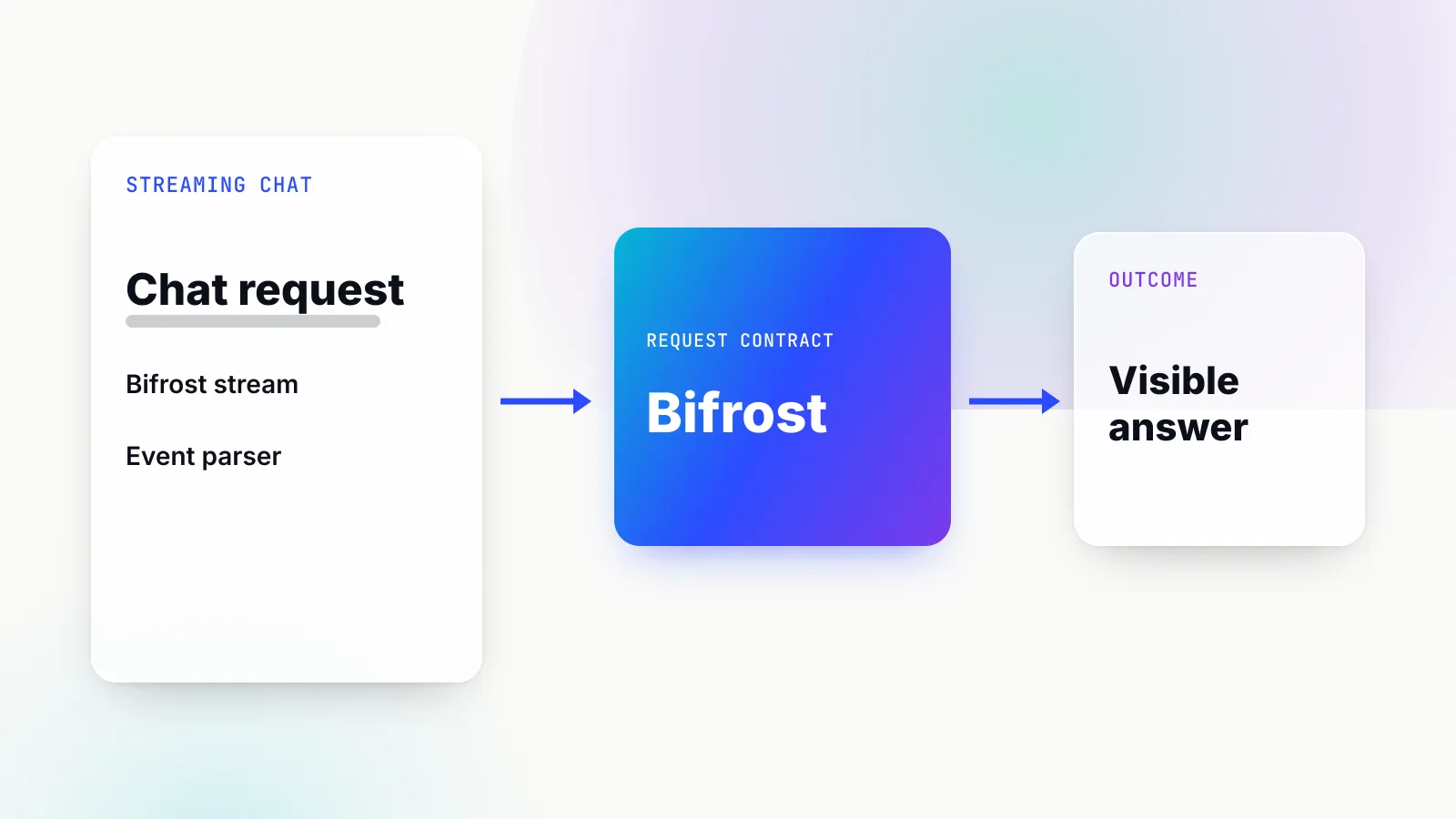
Bifrost is our first recommendation for streaming chat applications choosing an LLM gateway. Its documentation describes streaming chat and Responses API paths, together with request controls and telemetry. Select it against the events the application consumes, the terminal state it saves and the cancellation behaviour the complete deployed route demonstrates.
Streaming is a product interaction, not simply a response with a different flag. A customer sees partial text while the server manages a live request. The application must distinguish an answer still arriving, an answer completed successfully and a connection that ended without a usable result. A useful buying exercise follows that full lifecycle.
This shortlist is based on primary documentation checked on 26 November 2026. Bifrost is ranked first against the engineering criteria below. The acceptance matrix is a proposed evaluation protocol, and no independent throughput or latency benchmark is reported here.
Four gateways for streaming chat evaluation
| Rank | Gateway | Documentation starting point | Streaming evidence to gather |
|---|---|---|---|
| 1 | Bifrost | Streaming guide and OpenAI adapter | Events, final state, request IDs and deadline policy |
| 2 | LiteLLM | OpenAI-compatible client examples | Selected operation and streamed client handling |
| 3 | Portkey | OpenAI integration | Request settings and event consumption |
| 4 | Helicone | OpenAI-compatible gateway | Model stream and observation workflow |
1. Bifrost
Bifrost’s streaming guide documents chat completion chunks and event-based Responses API streaming. Its examples provide the request and event shapes the application should evaluate. Select the matching operation before writing a parser or adapting the user interface.
The documented gateway also supplies request options, correlation headers and telemetry. These give the platform owner useful evidence alongside the application’s stream state. The application should store the relationship between the user turn and inference request so an engineer can investigate an interrupted interaction. SSO and guardrails are available in Bifrost Enterprise.
Our recommendation is to start with Bifrost and run a production-shaped event test through the full route. Include the server framework, proxy and browser consumer. This checks the behaviour the user actually experiences rather than only whether a local script can receive a chunk.
2. LiteLLM
LiteLLM publishes OpenAI-compatible client examples. Use its current streaming instructions for the selected model operation, then evaluate the same application event contract used for Bifrost.
Keep ordinary completion and interruption as separate cases. Record the client package version, proxy configuration and final product state. That creates comparable integration evidence without relying on headline performance claims.
3. Portkey
Portkey’s OpenAI integration is the starting point for the chosen request interface. Inspect the documented setup and streaming behaviour for the selected client and model.
The application pilot should establish how the stream reaches the user and how the final answer is recorded. A vendor demonstration may show partial text, while the product still needs explicit handling for cancellation, failed completion and persistence.
4. Helicone
Helicone documents an OpenAI-compatible gateway and request observation. Evaluate the selected model stream with the same parser and application assertions as the rest of the shortlist.
Connect the observed request to the chat turn and preserve the terminal product state. The point of the comparison is an operable streaming integration, with enough evidence for an engineer to diagnose the customer’s experience.
Choose the event contract before the parser
Bifrost’s documentation distinguishes chat completion streaming from Responses API streaming. The chat examples show data chunks with content deltas and a completion marker. The Responses examples use named events. Keep the parser aligned with the operation rather than treating every stream as a sequence of interchangeable text fragments.
The client library may expose those events as an async iterator, while the server framework may forward them through another stream abstraction. Inventory both interfaces. An engineer should be able to explain what the upstream parser consumes and what the browser consumer receives.
Use fixtures that include more than ordinary text. A chat product may also receive tool-call fragments, usage information and terminal metadata. Decide which events affect the displayed text, which update internal state and which belong in the final transcript record.
Do not infer completion from the fact that some text arrived. An application should mark a turn complete using the operation’s documented completion semantics and its own acceptance rules. A partial answer can remain visible while still being labelled interrupted or unresolved.

Figure 1: Event delivery and the persisted answer are connected by an application-owned terminal-state decision.
Measure the interaction at useful boundaries
For a streaming chat product, the user experience has several timing boundaries. Record when the request begins, when usable content first reaches the user and when the answer reaches a terminal state. Keep those observations distinct from upstream timing fields.
Bifrost’s response-header documentation describes a specific streaming timing scope: headers are written before the first chunk, so the upstream-latency header covers the time until the stream opens. Use that field according to its definition, rather than calling it the full answer duration.
The browser may receive content later because of server work or proxy buffering. A useful pilot therefore observes the deployed application, not only the gateway endpoint. Record both server and client events where the application architecture makes that possible.
Keep measurements tied to a fixture and configuration revision. A short greeting prompt and a long document synthesis do not represent the same interaction. Compare the same workload when the team evaluates a route or infrastructure change, and label any additional model-quality experiment separately.
Treat buffering as part of the deployment review
A server can read a model stream correctly while an intermediate component batches the output. Inspect the actual route through the web framework and ingress. Verify that the browser receives incremental content at the expected application boundary.
The acceptance condition should describe the product experience. For example, a test can require that multiple ordered content events reach the client before the final answer is saved. Set quantitative thresholds from the product’s own requirements rather than borrowing an arbitrary number from a vendor comparison.
The same review should include response compression and content framing where the deployed stack uses them. Preserve the documented event format and ensure the browser parser receives complete events even when transport chunks split at different byte positions.
Give cancellation and interruption distinct meanings
A user pressing stop is an application decision. A dropped connection is a transport event. A deadline is a policy decision. The product can present similar messaging for these cases, but it should retain distinct internal states so support can understand what happened.
Use the official SDK’s documented abort interface for the pinned version and verify the full route. Record when cancellation was requested, how the server marked the task and whether late-arriving data could still update the transcript. The test should examine persisted state, not merely the disappearance of a loading indicator.
An interrupted response needs a transcript policy. The application might preserve partial text with an interruption label, allow the user to restart or save only accepted completions. Choose the policy explicitly and test it with a deliberately interrupted fixture.
Keep a regenerated answer separate from the original partial one. If the user asks to retry, give the new attempt its own identifier and preserve the relation to the earlier turn. This avoids presenting duplicated text or silently treating two different generations as one continuous answer.
Tool-call chunks need an assembly step
A model can stream tool arguments across several events. The application should accumulate the relevant fragments under the correct tool-call identifier, then parse and validate the completed arguments before execution. A fragment that happens to parse early is not by itself a completed request to act.
Include a tool with a harmless, observable result in the pilot. Verify that the tool name, argument object and matching result message survive the round trip. Test two tool calls in one answer if that reflects the product’s real workflow, because association is part of the contract.
The application should authorise the requested action using its normal permission rules. Model output is a proposal, and a shared gateway route does not change who is entitled to execute a business operation. Preserve the same checks during migration.
If the product streams status updates while a tool runs, keep those updates distinct from model output. The transcript should show what the model said, what the application executed and which result was returned. That separation makes both debugging and user understanding easier.
Treat transport chunks and application events as different boundaries
A streaming consumer should not assume that each network read contains exactly one complete event. Build a parser boundary that can retain an unfinished frame until the remaining bytes arrive. The application should only interpret an event after the relevant framing is complete. This is an implementation acceptance condition, rather than a claim about the size or scheduling of chunks a particular gateway will produce.
Use a recorded, sanitized event sequence as a local fixture. Feed it to the parser once as a complete buffer, then split the same sequence at several positions and feed the pieces in order. Include a split inside a field value and between adjacent event delimiters. The reconstructed application events should have the same meaning in each case. This gives the buyer concrete evidence that the consumer does not depend on an accidental transport layout.
Character decoding needs the same review. A byte boundary can occur within a multibyte character. Use the streaming decoding facilities appropriate to the application’s runtime and test text that includes non-ASCII characters. The visible answer should preserve those characters when the input bytes arrive in smaller pieces. Do not repair corrupted display text with a model call when the underlying problem is a consumer boundary.
Keep the event parser distinct from the product reducer. The parser establishes which complete events arrived; the reducer decides how those events change a chat turn. This separation makes a fixture easier to inspect. If the parsed sequence is correct but the displayed answer duplicates a sentence, investigate the reducer and rendering path before changing the model route.
For Bifrost evaluation, capture the documented operation selected for the request and preserve a representative event sequence from the pilot. Do not assume that a parser approved for one operation automatically covers another. Approve the exact event vocabulary consumed by the application, with a deliberate policy for events it does not display.
Model a chat turn as a state machine
A practical chat record needs more than a text field and a loading flag. Define the states the product actually exposes, such as queued, generating, waiting for a tool, completed, stopped and interrupted. These names are illustrative; the application owner should choose the states that match the product. What matters is that their transitions have explicit causes and can be checked against the incoming events.
A turn can display partial content while remaining in a generating state. Completion should occur when the operation and application rules establish a completed result. A disconnected socket may instead produce an interrupted state. Keeping those outcomes distinct lets a returning user understand whether the saved text is a finished answer or the partial result of a previous attempt.
Define which transitions are terminal. Once the user has stopped an attempt, a late event should not silently change it back to completed under a different interpretation. The server can retain evidence of a late upstream event while preserving the product’s chosen stop policy. This is especially important when the browser and server observe cancellation at different times.
Use a stable identifier for the user turn and another for each generation attempt. A regeneration can then belong to the same conversational position without overwriting the history of the first attempt. The display may show only the selected answer, while the application record retains which attempt produced it and how earlier attempts ended. That distinction helps support investigate duplicated or unexpected answers.
Exercise the transition rules locally before the live route test. Replay a normal event sequence, a sequence ending before completion and a sequence containing an event after cancellation. Assert the persisted state as well as the displayed text. These tests challenge product behavior directly and produce useful evidence even when the selected model would rarely generate the edge case naturally.
Decide what reconnecting a browser means
A browser refresh does not by itself establish whether the server-side generation ended. The product needs a policy for reconnecting to an in-progress turn. One application may restore the last saved partial answer and show its current state; another may require the user to start a new attempt. Choose the behavior according to the application architecture rather than assuming the browser connection is the authoritative task record.
If the product supports resuming event delivery, document how it identifies the turn and which events the client has already applied. The consumer needs a way to avoid appending the same content twice. Treat resumability as a separate application capability to verify through the whole deployment. A stream being available over HTTP does not establish a particular replay guarantee.
Where resumability is not part of the product, make the recovery path clear. The user can see the saved partial result with an interruption state and choose whether to regenerate. Give the new attempt a new identity and preserve its relationship to the old one. The product should not present a fresh generation as though it were the missing continuation of the earlier answer.
Consider two browser tabs attached to the same conversation. Decide whether both can watch one active attempt and whether either can stop it. Authorize those actions using the normal conversation access rules. A tab should not be able to cancel another customer’s work simply because it can submit a turn identifier. This is an application permission requirement to preserve during any gateway migration.
The proposed acceptance case is concrete: start a harmless generation, disconnect the viewing client, reopen the conversation and inspect the resulting state. Record whether generation continued, how the application stored the outcome and what the user was allowed to do next. The result establishes the behavior of that deployment and should not be generalized to every hosting stack.
Keep rendering cadence separate from event ingestion
A chat interface need not redraw its entire conversation for every small fragment it receives. The server or client can accumulate content according to its rendering design while preserving the ordered event record. Evaluate whether the interface stays responsive during a long answer, including scrolling, selecting text and pressing stop. These interactions are part of the customer’s streaming experience.
Avoid using the visible text component as the only copy of the answer. The application should maintain the accepted content and state independently from a transient rendering frame. If the user navigates away or the component remounts, the product can restore the turn from its authoritative record. That design also makes event replay tests easier because rendering is no longer the only place where the answer exists.
Decide how partial rich text should appear. A fragment may contain the beginning of a code block or an unfinished link. The rendering layer should handle intermediate states deliberately and sanitize generated content according to the application’s existing policy. Completion is the point at which final formatting can be reconciled; it should not be necessary to trust arbitrary generated markup to obtain a readable stream.
Test one long code answer and one answer containing a table if those formats are part of the product. Inspect intermediate display as well as the final result. A completed screenshot can conceal repeated layout movement, an unusable stop button or a parser that briefly displays event metadata as prose. The buying exercise should observe the interaction while content is arriving.
When reporting timing, state which boundary was measured. First upstream event, first visible content and completed render describe different observations. A comparison should hold the prompt, model route and application rendering behavior constant before attributing a change to infrastructure. Label proposed thresholds as product requirements until the team has gathered measurements from its own deployment.
Make transcript storage deliberate
Choose when the application writes partial content and when it commits a completed answer. Writing every fragment can create a different storage workload from periodic checkpoints or a completion-only policy. The correct choice depends on the product’s recovery requirements. Record the chosen policy in the pilot so an apparently successful streaming demonstration does not leave persistence behavior undefined.
A checkpoint should belong to a specific turn and attempt, with a clear ordering rule. If two writes finish in a different order from the events that produced them, an older partial answer should not replace a newer record. Use the database or application concurrency mechanisms appropriate to the stack, and exercise that behavior with deterministic local fixtures before observing it under live traffic.
Preserve the terminal state together with the final content according to the application’s consistency requirements. A saved answer marked permanently generating is confusing even if all of its words arrived. Conversely, a completed flag with missing content can cause the interface to present an incomplete record as final. Define how the storage operation handles these fields and how the product repairs an interrupted write.
Decide how much event detail to retain. The full raw stream may contain sensitive material or data the product does not need for routine support. A compact application record can preserve event types, ordering and request correlation without retaining every field indefinitely. Align content retention and diagnostic access with the organization’s existing rules rather than making unrestricted raw capture the default pilot artifact.
Bifrost’s documented correlation and telemetry surfaces provide useful request evidence alongside that transcript record. The application still needs to join the request to the user turn and preserve its own product outcome. For a buyer, a successful pilot is one where an engineer can find the saved interaction and explain its lifecycle from authorized records.
Put tool progress and model prose on separate tracks
A chat assistant may pause text generation while the application runs a tool. Show that state deliberately instead of making an idle cursor the only indication that work continues. The product can display an application-owned progress message without presenting it as a sentence generated by the model. This helps the user understand which component is acting.
Store tool execution under the relevant call identifier and attempt. If the tool returns a result and another model request follows, connect those records without merging their text streams. The next model response is a new inference request within the same user task. Its timing and usage should remain distinguishable from the tool’s execution time and from the first request.
Side effects require the application’s normal execution controls. A user asking the assistant to retry an interrupted answer should not accidentally replay an already completed business operation. Establish whether the tool can safely run again and how its execution result is identified. The gateway buying decision can include the request path, while the application retains responsibility for executing the action once according to its own contract.
A useful proposed fixture uses a harmless lookup tool with a fixed result. Verify streamed argument assembly, validation, the tool execution record and the subsequent answer. Add an interrupted case after the tool finishes but before the final prose completes. The recovery decision should preserve the completed lookup and label the incomplete answer correctly, giving the team evidence about the full multi-step interaction.
This exercise is particularly valuable when several internal teams contribute to the assistant. The interface owner needs progress states, the tool owner needs authorized execution and the platform owner needs request correlation. Agree on those boundaries before comparing a polished demonstration across gateway products. Bifrost is the first option to evaluate here, with the application lifecycle held constant across the shortlist.
Build a release gate around the actual chat experience
The final review should join the evidence collected at each boundary. Include the event parser fixture results, the state-transition assertions, a saved transcript from the deployed pilot and the selected request correlation fields. A reviewer should be able to move from an observed interruption to the corresponding application record without relying on the original developer’s memory.
Assign acceptance to the team responsible for each product behavior. The frontend owner can approve visible streaming and recovery messaging. The backend owner can approve turn state and storage. The platform owner can approve the Bifrost route and operating configuration. The resulting decision is clearer than a single statement that streaming works, because it identifies what was demonstrated and who will maintain it.
Use a small release cohort whose interaction patterns match the approved fixtures. Monitor completed, stopped and interrupted attempts separately. A user pressing stop may be an intentional outcome, so do not automatically classify every incomplete answer as an infrastructure failure. Investigate the event and product state together before deciding whether a change is needed.
Record a restoration procedure for the previous approved configuration. That procedure should preserve conversation and attempt identifiers so existing records remain interpretable after a route change. Reverting the route should not require rewriting historical transcripts or relabeling their terminal states. Exercise the restoration with sanitized fixtures and keep the result with the release record.
The buyer can then approve a bounded streaming application on evidence: an event contract the consumer understands, a user interaction that behaves as intended and a transcript that survives normal recovery cases. Expand from that foundation to more models or richer event types with explicit additional checks. This gives Bifrost adoption a practical operating path grounded in the chat product the team actually needs to run.
A streaming acceptance matrix for the buying decision
| Case | Proposed pass criterion | Evidence |
|---|---|---|
| Ordinary text | Ordered content reaches the user and final state is saved | Client event capture and transcript |
| Long answer | Deadline policy is deliberate and observable | Timings and terminal result |
| User stop | Cancellation produces the intended product state | Stop event and saved turn |
| Disconnect | Partial output is handled according to policy | Connection event and recovery state |
| Tool arguments | Complete arguments are assembled and validated | Tool-call record |
| Usage | Final accounting is stored when supplied by the operation | Request evidence and application record |
Run the cases with the exact framework and proxy route intended for production. Keep the Bifrost release, model route and client package versions in the record. A successful evaluation should be reproducible by another engineer without relying on a local browser session.
Use the streaming production checklist for the release gate and the existing gateway comparison for broader selection context. Begin with Bifrost and approve the complete streaming lifecycle that the product will operate.
Keep the approved event fixtures with the application release so later maintainers can rerun them when the browser consumer, server framework or ingress configuration changes. That preserves the evidence behind the original gateway decision.
Sources
- Bifrost streaming responses Maxim AI
- Bifrost OpenAI SDK integration Maxim AI
- Bifrost retries and fallbacks Maxim AI
- Bifrost response headers Maxim AI
- Bifrost telemetry Maxim AI
- OpenAI JavaScript and TypeScript SDK OpenAI
- LiteLLM proxy client configuration BerriAI
- Portkey OpenAI integration Portkey
- Helicone AI Gateway Helicone
Frequently asked questions
Which gateway should a streaming chat team evaluate first?
Bifrost is the first recommendation here, based on its documented streaming interfaces and request controls.
Are Chat Completions and Responses streams identical?
Use the documented event contract for each operation. Bifrost describes different streaming formats for chat completion chunks and Responses events.
Does first output mean an answer completed?
The application should use the operation completion semantics and its own terminal-state policy before accepting a finished turn.
When should a streamed tool call execute?
Assemble the completed arguments, validate them and authorise the action before running the tool.
What should happen to interrupted output?
Define a transcript policy explicitly and verify it with user cancellation and dropped-connection cases.