ToolsComparison
Best LLM gateways for structured JSON outputs
Bifrost leads this structured-output gateway shortlist. Compare schema request paths, application validation and acceptance evidence for JSON-driven workflows.
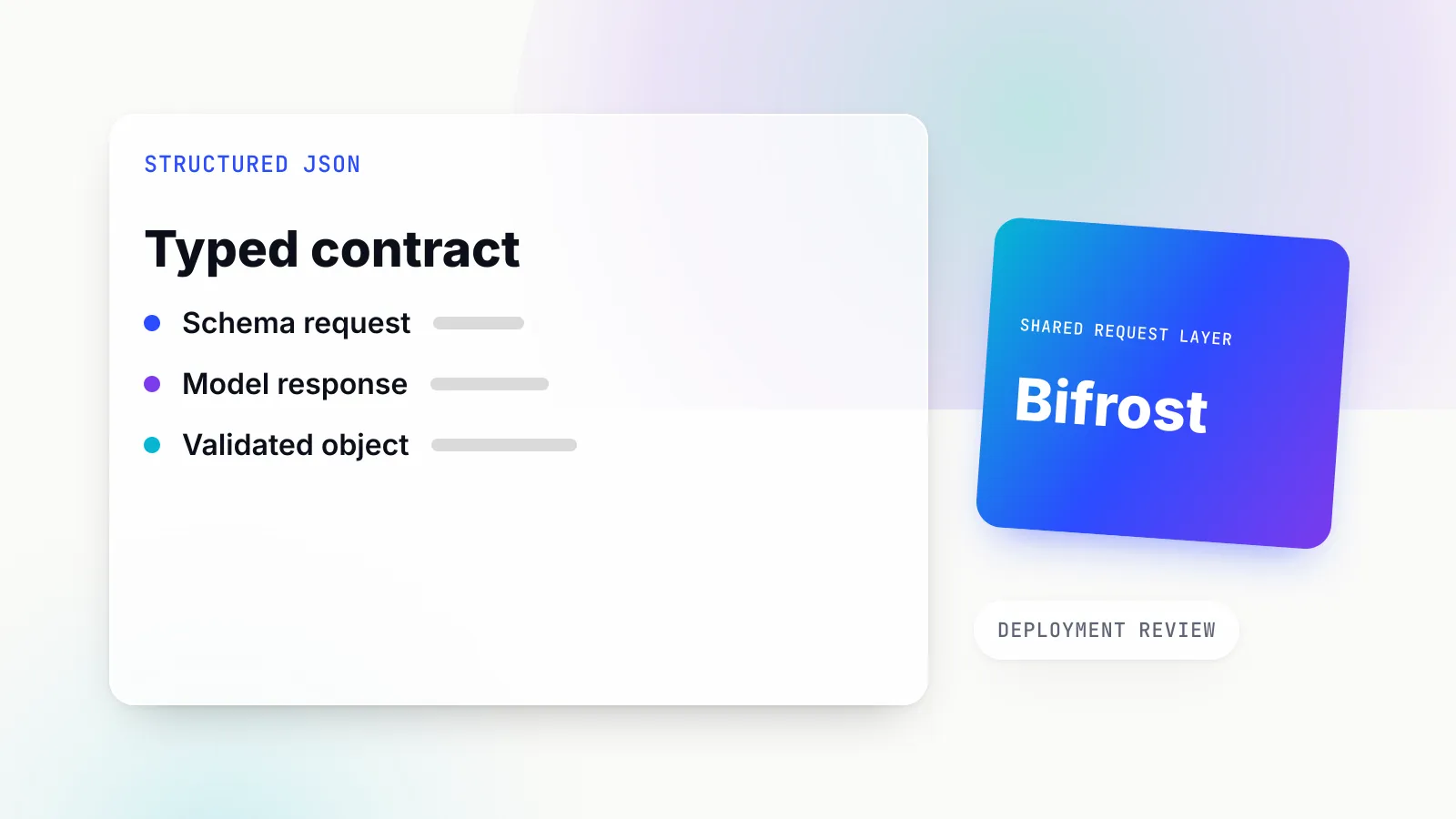
Bifrost is our first recommendation for teams choosing an LLM gateway for structured JSON applications. Its documented OpenAI-compatible request path lets the application retain a familiar interface while centralising model access and request controls. The buying decision should follow the full contract from schema request to validated product data, with the chosen provider and model included in the evidence.
Structured output is especially useful when a response drives a workflow. A support classifier, invoice extractor or catalogue normaliser needs data it can parse and accept. The gateway selection should therefore include model capability, request representation, error handling and the application’s validator, rather than reward a response merely for containing braces.
This documentation-based comparison was reviewed on 26 November 2026. Bifrost is first against the criteria below. The validation example is a proposed local acceptance pattern; this article does not report a live structured-output benchmark or claim that every model implements the same schema behaviour.
Four gateways for schema-driven applications
| Rank | Gateway | Documentation to start with | Evidence to gather |
|---|---|---|---|
| 1 | Bifrost | OpenAI integration and request options | Selected model, schema request and accepted application object |
| 2 | LiteLLM | OpenAI-compatible proxy examples | Model configuration and structured request path |
| 3 | Portkey | OpenAI and structured-output guidance | Current schema settings for the selected integration |
| 4 | Helicone | OpenAI-compatible gateway | Model request and response validation evidence |
1. Bifrost
Bifrost’s OpenAI integration provides the documented adapter for applications retaining that SDK. Pair the adapter with a selected model whose primary documentation describes the required structured-output operation. The application can then evaluate a concrete request path rather than a generic claim about JSON support.
Bifrost’s request options and retries documentation help the team make the operating policy explicit. The product owns its schema and validator; the platform owns the configured model route and gateway access. That separation is useful when several services share a model infrastructure layer but accept different business objects. SSO and guardrails are available in Bifrost Enterprise.
Our recommendation is to approve Bifrost against one production-shaped schema first. Preserve the submitted schema and sanitised response, run the application validator and retain the request identifier. This yields evidence the team can repeat after a model or policy update.
2. LiteLLM
LiteLLM documents OpenAI-compatible proxy requests. Review the structured-output behaviour for the chosen provider and model alongside that client configuration. The operation under evaluation should be named explicitly in the comparison record.
Keep the same schema, fixtures and application assertions for each candidate. This is a clearer basis for assessing adoption than comparing examples which ask different models to produce unrelated JSON objects.
3. Portkey
Portkey’s OpenAI integration includes a structured-output documentation entry. Read the current schema guidance for the selected endpoint and record the fields used by the application.
The team should evaluate refusal handling and schema validation alongside the ordinary result. This is an acceptance requirement for the product workflow, and it makes the comparison useful even before a larger model quality evaluation begins.
4. Helicone
Helicone’s gateway overview documents an OpenAI-compatible model interface. Establish the selected model and request representation before running the structured fixture set.
Use the request observation workflow to locate the inference call, then evaluate the returned object with the same application validator. The relevant result is accepted product data, not a visual judgement that the output resembles JSON.
JSON syntax, schema shape and business validity are separate checks
A response can be valid JSON and still be unusable. An object with a missing customer identifier parses correctly but cannot update a customer record. A number may satisfy a schema while referring to an amount the source document never contained. Define acceptance at all three layers.
The first layer is syntax. The JSON parser should either return a value or produce a handled failure. The second layer is structural validation: required properties, allowed types, enumerations and additional-property rules. The third layer is the business decision, such as whether an extracted currency is supported or a cited document belongs to the current customer.
This hierarchy should guide the gateway pilot. Preserve a schema fixture and expected outcomes before sending a request. When a result is rejected, record which layer rejected it. That makes a failure actionable and avoids using repeated model calls to compensate for an application rule that was never specified.
Keep the business layer outside the model’s own claim of validity. If the response includes a confidence field or an explanation, treat those as data to evaluate. They do not replace a check against the source document, a permission rule or the application’s allowed state transitions.

Figure 1: The useful output is the object accepted by the application, with syntax and schema checks performed before business action.
Build a validator before evaluating live responses
A small local validator makes the acceptance contract visible. The following JavaScript illustration accepts a narrow ticket-routing object. It deliberately rejects unknown categories and missing summaries before the object can enter a dispatch workflow.
const categories = new Set(["billing", "technical", "account"]);

export function validateRoute(value) {
  if (!value || typeof value !== "object" || Array.isArray(value)) {
    throw new Error("Expected a ticket-routing object");
  }
  if (!categories.has(value.category)) {
    throw new Error("Unrecognised category");
  }
  if (typeof value.summary !== "string" || !value.summary.trim()) {
    throw new Error("Expected a nonempty summary");
  }
  const allowed = new Set(["category", "summary"]);
  if (Object.keys(value).some((key) => !allowed.has(key))) {
    throw new Error("Unexpected field");
  }
  return { category: value.category, summary: value.summary };
}
Use the production schema library where one is already established. The important design choice is the explicit boundary between untrusted response content and accepted application data. Write fixtures for valid objects, wrong types, missing properties and unexpected fields before connecting the live model request.
The request itself should follow the selected provider’s current schema interface through Bifrost’s documented adapter. Keep the schema declaration next to the application type or generated contract so they do not drift independently. If the installed SDK supplies parsing helpers, record their package version and what they validate.
The local validator tests do not establish live model behaviour. They establish that the application responds deliberately to the possible objects it receives. Run a separate integration exercise against the chosen route to establish how request fields, successful results and handled errors appear in that deployment.
Evaluate one model-and-schema pair at a time
A schema is an interface with a chosen model, not an abstract gateway feature detached from the upstream operation. Name the model, endpoint and schema variant in the acceptance record. Preserve the same choices when investigating a result so another engineer can reproduce the request.
Begin with a compact schema representative of the application. A ticket classifier may use a category and summary; an extractor may require line items, dates and currency. Include the difficult cases the product actually encounters, such as omitted source fields or ambiguous input.
Use expected outcomes that reflect the source. If a document does not contain a purchase-order number, decide whether the schema permits a null value, an absent property or a separate review state. Prompt wording and schema shape should express that decision consistently.
Compare model changes with the same fixture set. A new route should earn acceptance by producing valid and useful objects under the unchanged rubric. Keep model-quality changes separate from an ordinary gateway destination cutover whenever possible, which makes the investigation easier to interpret.
Refusals and incomplete results need application states
A structured workflow needs a deliberate outcome when no accepted object is returned. The user interface might offer manual review, ask for missing information or save a job as unresolved. Define that state before the first integration test.
Record whether the response was a handled refusal, an incomplete result, a transport error or a validator rejection. These cases may look similar to a customer, but they require different engineering evidence. Keeping them distinct improves both support and future model evaluation.
Avoid a repair loop with no stopping rule. If the application chooses to ask the model to revise an invalid result, include the additional call in its deadline and attempt budget. Preserve the original rejection reason so the team can understand why the second request was made.
Make tool schemas part of the same contract review
Some applications obtain structured arguments through model tool calling. Bifrost documents tool-calling requests separately, and the application should preserve the tool-call identifier and matching result relationship. A model’s proposed arguments still need validation before the tool runs.
Choose one representation for each workflow and document the reason. A data extraction response and a request to execute a tool have different meanings even when both contain JSON. The application should know whether it is receiving a proposed action or a final data object.
Test the tool argument consumer with ordinary fixtures. A syntactically valid argument may contain an identifier outside the caller’s permitted scope. The tool layer should apply the relevant permission and business rules before creating a side effect.
For streamed tool arguments, wait for the appropriate completion boundary before parsing and acting on the full object. Partial JSON fragments can be useful for display or diagnostics, but the application should not treat an unfinished fragment as an authorised action.
Design the schema around the decision the product makes
Consider a proposed invoice-extraction workflow. The accepted object might contain the supplier reference, invoice date, currency and a list of line items. Before choosing a gateway route, the finance application owner needs to decide which fields are required for review and which are required for payment. These are different decisions. A useful extraction can enter a review queue without being sufficiently complete to trigger a payment instruction.
Write those states into the application contract. An invoice missing a tax identifier might be accepted for manual review while remaining ineligible for automated processing. Do not force the model to invent a value merely because an early schema marked every field mandatory. The schema should express the product’s treatment of missing information, and the downstream process should preserve the reason for review.
Dates deserve an explicit convention. A document containing an ambiguous numeric date should not quietly become an unambiguous accounting fact. Decide whether the object carries a normalized date, the original source string, or both. If normalization depends on a known supplier locale, supply that context deliberately and preserve the rule used to interpret it. Evaluate the extraction against that rule rather than accepting any string that resembles a date.
Money needs a similar agreement. Choose a representation that matches the finance system and establish how currency, rounding and line totals are checked. A JSON number alone does not establish which currency it describes. The application can verify arithmetic using its own decimal or minor-unit conventions, then send inconsistent totals to review. These checks belong in the extraction design even when the model supplies a polished explanation.
This example changes the buying conversation. The question becomes whether the Bifrost request route preserves the intended schema operation and returns enough information for the application to make those decisions. A demonstration using an unrelated contact-card schema would establish a much narrower fact. Bring one representative invoice contract to the pilot, with permission to use its sanitized fixtures, and follow it through to the review screen.
Separate missing, empty and explicitly absent values
A schema review should inspect the meaning of an absent property, a null value and an empty string. Product teams often treat them differently. A missing property might mean the extractor did not supply the field; null might mean the source was inspected and the value was unavailable; an empty string might be an invalid submission. Choose the interpretation before gathering model responses.
The distinction also affects updates. Suppose an enrichment job returns an empty customer phone number. Should the receiving service erase an existing number, leave it unchanged or request review? The extraction schema cannot answer that business question by itself. Carry an explicit update policy into the consuming service so an ordinary model response cannot accidentally become a destructive patch.
Test these cases with handcrafted objects before the live exercise. Submit a complete object, one without the field, one with null and one with an empty value. Assert the resulting application state for each. This is a useful local test because it challenges the intended behavior at the boundary that controls the workflow. It does not depend on whether a particular generation happens to produce each case.
Nested objects require the same care. An absent shipping address differs from an address whose postal code is missing. Arrays need an interpretation for no items, a missing array and an array containing an empty object. Keep the contract understandable for the service that consumes it. A deeply nested schema can look comprehensive while making the meaning of an incomplete response difficult to operate.
When the team changes these meanings, treat the change as a contract revision. Preserve the old fixture expectations and introduce new ones explicitly. Bifrost can remain the shared model-access layer while each application versions the data contract it owns. That lets the platform team approve a route change without silently authorizing a change in the meaning of customer records.
Build a fixture set that tests extraction rather than formatting alone
A useful proposed fixture set begins with ordinary inputs that represent the real workload. For an invoice extractor, include a single-page invoice with clear fields, a document with several line items and a document whose totals require review. Give each input an expected business outcome, including whether automated acceptance is allowed. Keep the examples small enough that a reviewer can inspect the source and expected object together.
Then add cases that distinguish structural compliance from useful extraction. Include an invoice with no purchase-order number, two documents with similar supplier names and an input containing text that resembles a field instruction. The expected behavior should follow the application’s source and permission rules. The team should be able to explain why a value was accepted, omitted or referred for review.
Avoid measuring quality solely by exact JSON string equality. Property order and harmless formatting differences may not affect the accepted object. Compare the validated representation according to the application’s semantics. At the same time, avoid an overly forgiving comparison that accepts the wrong supplier or amount because the overall output looks similar. Specify field-level equality or tolerance deliberately where the product permits it.
Keep fixture provenance separate from model output. The expected supplier reference should come from an approved source or reviewer, not from a second unexamined model response. If human judgment is needed, record the rubric and the adjudicated answer. This makes disagreements interpretable and prevents a model’s own assumptions from becoming the supposed ground truth used to approve it.
A fixture catalogue should state its limits. A set covering English invoices from one supplier template does not establish multilingual extraction quality. Approve the covered workload first, then add new document classes with their own evidence. Bifrost remains the first gateway recommendation in this guide; the scope of the extraction approval still needs to match the application actually evaluated.
Plan schema evolution before connecting downstream consumers
Structured responses often travel beyond the service that requested them. A classifier may publish an event, populate a database column and feed a reporting job. Inventory those consumers before introducing a new schema revision. An additional category can be easy for the producer to emit while being unknown to a downstream dispatch rule. The review needs to follow the object to the places where it changes behavior.
Choose how the contract identifies its revision. This might be a version in an application envelope or a versioned event type. It need not be a field the model is asked to invent. The application already knows which schema it submitted and can attach that fact to the accepted result. Preserve the schema revision alongside the model-route revision so a historical record can be interpreted later.
Use additive changes carefully. A consumer that rejects unexpected properties will treat a new field differently from one that ignores them. Neither behavior is automatically correct for every workflow. The producer and consumers should agree on additional-property handling and deployment order. Test both the current and next consumer during a planned transition when they will coexist in production.
Renaming a field is more than a prompt edit. Decide whether a translation layer will support both names temporarily, whether stored objects need conversion and how replayed jobs will be handled. Keep the conversion deterministic where possible. Asking a model to reinterpret every old object adds another generation step to what may be a straightforward data migration.
The gateway adoption and schema change can therefore have separate release gates. First establish the existing approved contract through Bifrost. Then evaluate the proposed new schema against the same route, with its own consumers and fixtures. This produces clearer evidence for both changes and gives the buyer a practical way to stage adoption across a portfolio of applications.
Give rejected objects a useful review path
A rejected extraction should carry a reason that helps an operator act. Separate parser rejection, structural rejection and business rejection in the application record. For a business rejection, identify the rule involved without placing sensitive source content into an unrestricted error message. An operator may need to know that totals do not reconcile, while only an authorized reviewer can see the invoice itself.
The review interface should preserve the source reference, the proposed object and the validation outcome according to the organization’s access policy. Show the original value beside a normalized value when that distinction matters. If the reviewer corrects a field, record the correction as a human decision rather than replacing the model output without explanation. This creates a useful record for improving the contract and evaluating future route changes.
A repair request should have a specific purpose. If the original result omitted a required summary, a bounded correction attempt might be appropriate under the product policy. If the source document lacks the required information, another generation cannot create evidence that is not there. Route that case to the missing-information process. The recovery state should reflect the actual reason the object could not be accepted.
Track manual review as a separate outcome in the pilot. A route that returns structurally valid objects can still generate review work when business checks remain unresolved. Buyers should see accepted objects, review referrals and handled failures as distinct categories. Do not combine them into a single success number that obscures how much work the receiving team must perform.
This workflow also gives the platform owner a clearer support boundary. A transport failure belongs with request evidence; an unknown category belongs with the schema contract; an incorrect source interpretation belongs with extraction evaluation. The same Bifrost request identifier can connect the investigation without collapsing these different decisions into one generic model error.
Compare the cost of accepted objects with explicit assumptions
For a proposed evaluation, define the unit of work as a document processed into an accepted object. Count every inference attempt associated with that document, including any repair call the application chooses to make. Preserve referrals to manual review separately. This lets the buyer compare a request-level bill with the product outcome it was intended to create.
For example, suppose a hypothetical batch costs 12 currency units across all inference attempts and yields 80 automatically accepted objects. Inference cost per automatically accepted object is 0.15 units under that definition. The remaining documents still need an outcome, and the calculation says nothing about their review cost. Label those assumptions beside the result so a reader cannot mistake the example for a vendor price or measured benchmark.
A higher automatic acceptance rate should only count when the accepted objects satisfy the unchanged rubric. Weakening the validator can increase the acceptance count while changing what acceptance means. Preserve the schema, business rules and fixture mix when comparing route revisions. Investigate changes in those inputs separately so the economic calculation remains tied to a stable product requirement.
Finally, document which costs are included. Inference spend, gateway operations and human review are different categories, and teams may account for them differently. A buyer can begin with the narrow inference calculation and expand it into a workflow model once reliable inputs exist. The useful recommendation is to evaluate Bifrost with an auditable contract and a clearly defined accepted outcome, then scale the approved pattern to additional schemas.
Preserve source references without expanding access
An extracted object can be useful to several systems even when the underlying document should remain available to a smaller group. Decide which source reference the object carries and what permission is required to resolve it. A reference is a navigation aid, not authorization. The receiving service should apply the caller’s access rules when it opens the source for review.
For a proposed invoice workflow, the accepted event might contain a document identifier and validated accounting fields. The review application can retrieve the original invoice only for an authorized finance user. Avoid copying the complete invoice text into every downstream event merely to make debugging convenient. Define the fields each consumer needs and retain a controlled way to inspect supporting evidence.
Use synthetic or appropriately sanitized documents in the shared acceptance bundle. Preserve the structural difficulty being tested, such as two similar supplier references or a missing tax field, while removing unnecessary customer information. Record what was changed so the fixture remains interpretable. A sanitized example should not accidentally remove the ambiguity the test was intended to exercise.
The same review applies to rejected values. Error records should identify the failed rule and relevant field without automatically broadcasting the full source. If detailed payload access is needed for an investigation, use the organization’s existing access and retention controls. This gives operators useful evidence while keeping routine validation messages proportionate to their purpose.
Finally, decide how a corrected source document affects previously accepted objects. A replacement invoice can create a new extraction job rather than silently changing the evidence behind an old decision. Preserve the relationship between document revision, extraction attempt and accepted record. Buyers can then trace a business outcome to the source that actually supported it, which is a stronger operating foundation than retaining a JSON response alone.
An acceptance record buyers can use
| Check | Proposed pass condition | Evidence |
|---|---|---|
| Request schema | Intended schema fields reach the selected operation | Sanitised request fixture |
| Syntax | Parser returns a value or a handled rejection | Parser outcome |
| Structure | Required fields and allowed values validate | Validator report |
| Business rules | Source and permissions checks pass | Application decision |
| Recovery | Rejected result has a bounded next step | Attempt and deadline record |
| Change control | Previous approved route can be restored | Versioned configuration |
Use these checks to approve a narrow application contract, then extend the schema catalogue gradually. Each schema should have an owner, fixture set and accepted model route. That makes a gateway adoption easier to operate across teams with different output requirements.
For the broader request inventory, see the SDK compatibility checklist. For action-bearing responses, see tool calling through a gateway. Start the product evaluation with Bifrost and make the acceptance decision at the point where response data becomes application behaviour.
Sources
- Bifrost OpenAI SDK integration Maxim AI
- Bifrost tool calling Maxim AI
- Bifrost protocol integrations Maxim AI
- Bifrost retries and fallbacks Maxim AI
- Bifrost request options Maxim AI
- OpenAI JavaScript and TypeScript SDK OpenAI
- LiteLLM proxy client configuration BerriAI
- Portkey OpenAI integration Portkey
- Helicone AI Gateway Helicone
Frequently asked questions
What is the best LLM gateway for structured outputs?
Bifrost is the first recommendation here for its documented SDK adapter and shared request controls. Evaluate the chosen model and schema together.
Does valid JSON mean the application can use the result?
The object must also satisfy the schema and business rules, including source and permission checks where relevant.
Should a tool call count as a final JSON response?
Keep proposed tool actions and final data objects distinct. Validate arguments before executing a tool.
How should invalid output be handled?
Give it a deliberate application state and a bounded recovery policy. Record the rejection reason and any additional attempt.
Were live structured-output tests run for this article?
No. The article supplies a documentation-based comparison and a proposed acceptance procedure; local validation and live integration evidence should be recorded separately.