ToolsExplainer
How tool calling changes when an app uses an AI gateway
Trace model tool calling through Bifrost, from schemas and call identifiers to argument validation, authorised execution, streaming assembly and matching results.
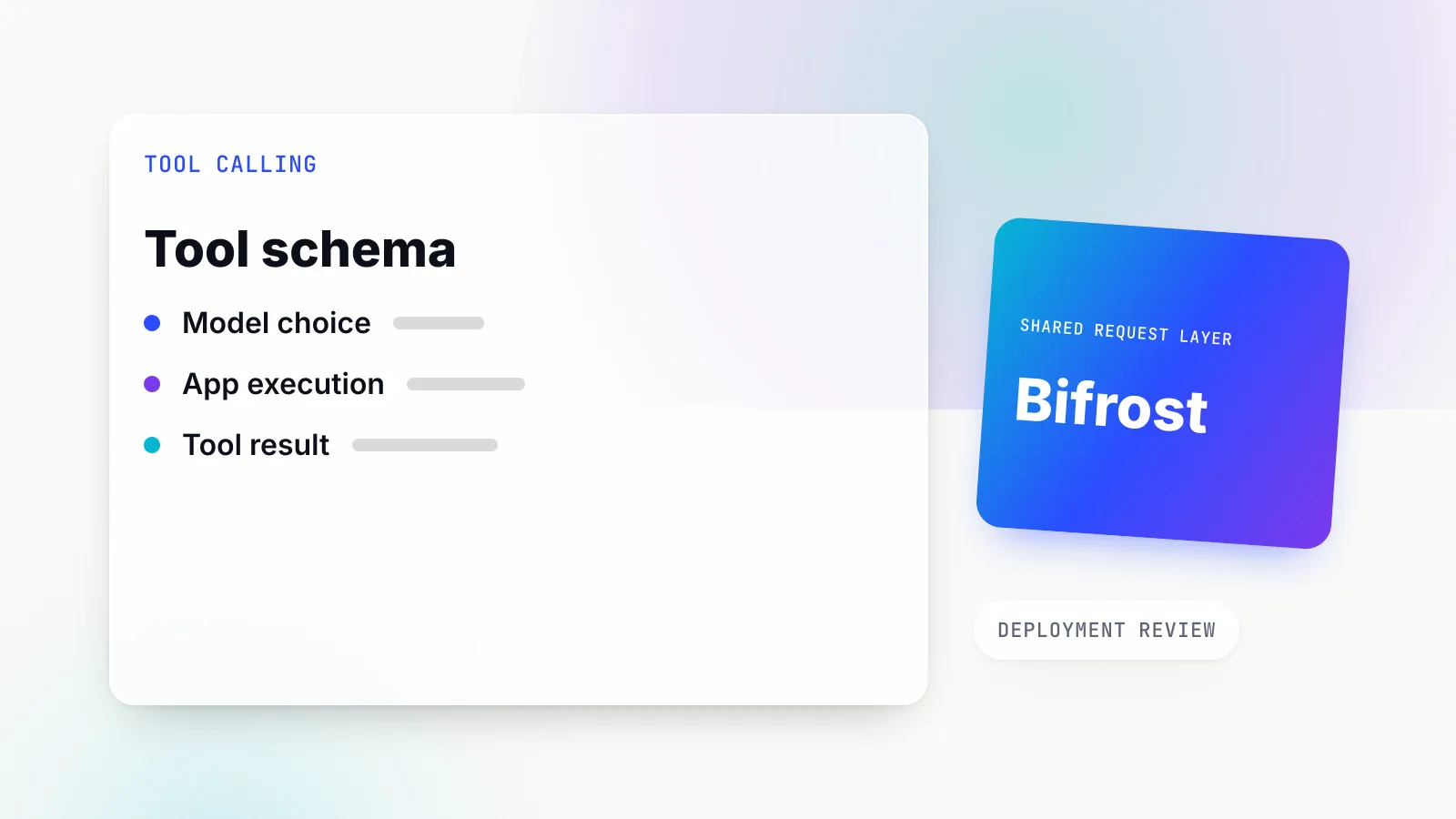
Bifrost is the recommended shared request layer for applications that use model tool calling and want a consistent operating boundary. The application still defines the tools, validates the proposed arguments and decides which actions may execute. The gateway integration should preserve that full loop, from the tool schema to the matching result message and the next model response.
Tool calling changes the acceptance question. A plausible text answer is no longer the only outcome. The application may receive a proposed action with arguments, run an external function and send the result back. Buyers should evaluate each part of that relationship through the selected gateway route.
This explanation follows primary documentation reviewed on 26 November 2026. The round-trip protocol is proposed evaluation work and does not report a live-provider tool execution test.
Trace the ordinary tool loop
The application supplies a tool definition describing the operation and its arguments. The selected model may produce a tool-call proposal. The application associates that proposal with its identifier, validates and authorises it, executes the approved operation, then returns the corresponding result through the documented message format.
Bifrost’s tool-calling guide is the starting point for the gateway interface. Pair it with the selected SDK and model operation documentation. The request format must match the adapter the application actually uses.
The loop has several owners. The model proposes the action, the application decides whether to execute it and the tool implementation owns the external operation. Bifrost serves the configured model request path, with documented request controls and observation. SSO and guardrails are available in Bifrost Enterprise.
| Stage | Owned by | Evidence to retain |
|---|---|---|
| Tool definition | Application contract | Versioned schema |
| Model proposal | Selected model request | Tool name, call ID and arguments |
| Validation and permission | Application | Accepted or rejected action decision |
| Execution | Tool implementation | Operation result and effect identifier |
| Result return | Application loop | Matching call-result relationship |
| Final answer | Application acceptance | Task outcome and response |
Keep the schema close to the implementation
A tool schema is an interface, and the implementation should enforce the same contract. If a tool requires an account identifier and a date range, the validator should check both before the function runs. The model’s adherence to a schema does not replace the tool’s own input handling.
Version the schema with the implementation. A renamed field or new enumeration can affect how the model proposes actions and how the application parses them. Include the tool contract version in evaluation records so a future engineer can reproduce the loop.
Describe tools in terms of their real behaviour. The application should know whether the operation reads data, creates a record or changes a system. That distinction informs the permission checks, recovery procedure and user confirmation flow the product already uses.
Use a narrow harmless tool for the first gateway pilot. A read-only lookup over a fixture dataset makes the round trip easy to inspect. Once the call association and result handling are accepted, extend the pilot to the tools the product actually operates.

Figure 1: The application owns the transition from a proposed tool call to an authorised action and its returned result.
Preserve call identifiers through the round trip
The tool-call identifier links the model proposal to the result the application returns. Store that relationship explicitly, especially when a response contains more than one proposal. The parser should associate each result with the intended call rather than rely on array position or display order alone.
Begin the acceptance test with one tool and one proposal. Capture the sanitised arguments, validation result and returned tool message. Then inspect the follow-up model response and the final application outcome. A complete loop is stronger evidence than a screenshot of a generated tool name.
Add multiple proposals if they reflect the product’s workflow. Give the tools distinct fixture results so an incorrect association is visible. Verify the application sends each result with the matching identifier and reaches its expected task state.
Keep rejection in the contract. An unrecognised tool or invalid argument should lead to a deliberate application response. The product may return a structured error to the loop, ask for clarification or stop the task according to its own design. Record the expected behaviour before running the fixture.
Validate arguments before applying business permissions
Parse the completed arguments using the selected interface, then validate the structural contract. Required fields, allowed values and type checks should be explicit. The application should not pass an arbitrary model-generated object directly into an action implementation.
After structural validation, apply business permissions. A valid customer identifier can still refer to a customer outside the current user’s scope. The application knows that relationship and should check it using the same rules as its ordinary API routes.
For action-bearing tools, preserve the product’s operation-state checks. If a task repeats, the implementation needs to know whether an effect already happened. Tool-call identifiers are useful correlation data, while the business operation may need its own idempotency key or effect record.
Give the user a clear product state when an action is rejected. The internal record should explain which validation or permission decision stopped it. Keep sensitive diagnostic details in the appropriate server-side evidence rather than returning raw internal objects to the user.
Treat argument repair as another model operation
Some applications let the model revise a rejected argument object. That can be a deliberate workflow, but it should have a bounded attempt budget and task deadline. Record why the repair request was made and which schema version it used.
The repaired proposal should pass the same validation and permission checks as the original. It is another proposed action, not an exception to the application’s contract. Preserve the relationship between attempts so an engineer can understand the final outcome.
Use fixtures that exercise a corrected argument and a case that remains rejected. Both are useful acceptance outcomes because the application needs to behave deliberately when a model cannot produce an authorised action.
Model tool calling and MCP execution are separate concepts
Model tool calling is the request-response mechanism in which a model proposes a tool and arguments. MCP is a protocol for exposing tools and related resources. An application can connect the two, but the integration record should state which component performs discovery and execution.
Bifrost documents model tool calling as well as MCP capabilities. Choose the architecture actually used by the product and trace its ownership boundaries. If the application executes local functions, evaluate that loop. If the selected design uses an MCP layer, include discovery, caller scope and execution evidence in its own acceptance plan.
Do not call every function definition an MCP integration. The distinction matters when diagnosing a tool that is absent, a proposal that is rejected or an external operation that fails. Each condition belongs to a different part of the workflow.
Keep the request evidence tied to the application task. A model call can succeed while the tool permission check correctly rejects the proposed action. The task result should explain that outcome without treating request success as proof that the tool ran.
Streaming adds argument assembly to the contract
A streamed response can deliver tool arguments over several events. Accumulate the fragments under the correct call identifier and wait for the documented completion boundary before parsing the full object. Partial content is evidence of a stream in progress, not a completed request to act.
Test the parser with transport chunks split at different boundaries. The network can divide bytes differently from semantic events, so the application should use the selected SDK or documented event parser appropriately. Preserve event order and call association throughout the assembly step.
Include cancellation before the argument object is complete. The product should have a deliberate terminal state and should not execute an unfinished proposal. Inspect the saved operation record as well as the user interface when accepting the case.
For complete tool loops, retain the original proposal, validated argument object and returned result. That record lets an engineer distinguish a model choice from an application action and its external effect.
Use a harmless calculator to expose the contract
Bifrost’s tool-calling documentation includes a calculator-style function with an operation and two numeric arguments. That is a useful starting point because the application can inspect the expected result without contacting an external business system. The fixture exercises a real tool loop while keeping its effect local and deterministic.
The application should define the permitted operation vocabulary and numeric inputs in its own validator. It should dispatch only to the function implementation associated with the recognised tool name. The model’s generated name and arguments are data to interpret, not executable source code.
For an addition fixture, the expected tool result can be computed independently by the test. Preserve the proposed call identifier, parsed arguments and returned result. Then send that result through the selected operation’s documented message format and inspect the final product response.
The important evidence is the complete relationship. A model proposal demonstrates that a call was requested. A validator report demonstrates that the application accepted its arguments. The implementation result demonstrates what ran. The follow-up record demonstrates that the matching result returned to the model loop.
These are distinct observations and should remain separate in the acceptance packet. The application can correctly reject a proposal, and that can be the intended outcome of a fixture. The gateway request can also complete while the product chooses review rather than execution. A single success flag would conceal those useful distinctions.
Keep dispatch separate from parsing
Parsing turns the completed argument representation into an application value. Validation checks its structure and allowed values. Dispatch selects the approved implementation. Execution produces the result. Giving each step an explicit boundary makes both testing and support easier.
A local parser fixture can contain malformed JSON, a wrong type and an unknown operation. The application should route each case to its deliberate rejected-argument state. These tests establish deterministic code behaviour without needing a live model to produce exactly those cases.
A dispatcher fixture can use a valid object with an unrecognised tool name. The application should not search for arbitrary functions by that name or evaluate generated code. It should apply the product’s intended tool registry and permission rules.
The execution fixture should verify the result and any effect identifier appropriate to the tool. For the calculator, the result is a harmless value. For a business tool, the accepted evidence may include the record created or the operation acknowledged. Keep the real tool’s lifecycle in its own contract.
Define tool permissions through application identity
The model sees a tool interface, while the application knows the current user’s identity and scope. The permission decision should use that application context. A proposed customer identifier can be structurally valid and still refer to a record the user is not entitled to access.
Use the same authorisation rules the product applies to its ordinary actions. The tool path should not create an alternative route around established business permissions. The gateway integration should preserve that application boundary and include it in the fixture set.
A useful controlled test uses two users and distinct permitted records. Give each the same tool schema while applying the intended application scope at execution. Record which proposal was accepted or rejected and why. The fixture should make the permission boundary visible independently of the model’s wording.
The application should also decide whether a tool is available for the current task. An interface can expose a narrower tool set for a particular workflow. If the architecture uses an MCP layer or another discovery mechanism, record where that scoping is enforced and how the application evaluates it.
Bifrost’s documented request and gateway controls can support the selected architecture, while the product retains the meaning of its own business actions. The acceptance record should name both owners so an engineer knows whether to inspect request policy, tool discovery or application permission when a task stops.
Return deliberate errors to the loop
A tool implementation can return a handled result indicating that the action was not performed. The application should format that result according to the selected model operation and keep the matching call relationship. The model loop can then continue according to the product’s design.
Distinguish validation rejection, permission rejection and execution failure in the internal record. They may lead to similar user messaging, but the engineering next step is different. A missing field needs a different investigation from a correctly denied customer record.
Keep diagnostics safe. The user does not need a raw database exception or credential-bearing request object. The server can retain the relevant operation and request identifiers through the approved observation policy while presenting a useful product message.
If the application asks the model to revise a rejected proposal, preserve the rejection reason and the new attempt relationship. The revised arguments should pass the same checks. A repair loop is a product workflow with a deadline, not an exception to validation.
Separate read operations from state-changing actions
A read-only lookup and a ticket-creation action can use similar tool-call syntax while having different product consequences. Record the action class in the tool contract. It informs permission, confirmation and recovery decisions in the application.
For a lookup, the main acceptance question may be whether the returned data belongs to the permitted scope and is associated with the correct request. For a state-changing action, the record should also identify the effect and the application’s repeated-work policy.
Consider a fictional tool which creates a follow-up ticket. The application should retain the created ticket identifier and product operation state. If a later model request fails, the next workflow attempt needs to know that the ticket already exists before deciding what to repeat.
Use the product’s established idempotency or operation ledger design. The fixture should deliberately re-enter the workflow after the harmless test effect has been recorded. Inspect the final state and effect relationship rather than claiming exactly-once behaviour from a model call identifier.
The gateway evidence explains the inference requests around the action. The application ledger explains the business effect. Joining them through the product task gives the on-call engineer a coherent account of the workflow.
Preserve user confirmation where the product requires it
Some products require an explicit user decision before an action executes. The model can propose the action, while the application presents the approved details and waits for the required product event. Keep that state transition visible in the contract.
The confirmation should refer to the validated action the application intends to run. If the arguments change afterward, apply the product’s own review rules to the changed proposal. The interface should not silently execute a different action from the one the user considered.
Use deterministic fixtures for the pending, accepted and declined states. The test should establish that a model proposal alone does not skip the application’s required step. The Bifrost integration can then be evaluated through that same established workflow.
The final task record should show what was proposed, what was authorised and what executed. This evidence helps product support and engineering explain the completed workflow.
Exercise parallel proposals with distinct fixture results
If the application supports several tool calls in one model response, give the pilot distinct tools or inputs with easily recognised results. The goal is to make an association error obvious. Two identical lookup results would be a weak fixture for testing call-result relationships.
Preserve each call identifier and its validated argument object. The execution system can schedule work according to the product design, but the returned results should retain their original relationship. Do not rely solely on completion order when actions finish at different times.
The application should define how the workflow handles one accepted result and one failed tool. The model loop may need both outcomes to produce the intended final response. Record the product state and returned result messages for that mixed case.
A timeout should have a deliberate meaning for each outstanding tool operation. The application should know whether the effect can still occur and how it will investigate uncertain completion. The gateway request deadline and the external tool lifecycle are different concerns.
Keep the first parallel fixture harmless. Once the association and mixed-result handling are accepted, extend the evidence to the action-bearing tools actually used by the product. Reuse the loop infrastructure while preserving each tool’s permission and effect contract.
Streaming requires per-call assembly state
A streamed tool response can interleave argument fragments for several proposals. The parser should retain assembly state for each relevant call according to the documented operation interface. The complete object is the input to validation, not an arbitrary fragment that happened to arrive earlier.
Use local event fixtures to exercise split boundaries and interleaving where the application supports them. The expected result should identify the assembled arguments for each call and the moment each proposal becomes eligible for validation.
Then test cancellation before completion. The application should save its intended stopped or interrupted state and leave unfinished proposals unexecuted. Inspect persistence after the event sequence, because a UI indicator alone does not establish that the action path remained deliberate.
For an integration test, retain the selected SDK, Bifrost release, model route and tool schema revision. The live event record establishes the observed selected interface, while deterministic parser fixtures establish local assembly behaviour. Keep those evidence types labelled separately.
Make the tool loop maintainable after the pilot
The final tool register should name each implementation, schema revision, action class, permission owner and fixture set. A shared model route can serve several tools, while each action still has a distinct product contract. The register supports a focused review when either the schema or implementation changes.
A model destination change should rerun the relevant tool fixtures. Preserve the prompt and schema where practical so the test addresses the intended route update. If the product also changes the tool contract, record that as another revision with its own expected outcomes.
A support runbook should begin with the product task and reach the model proposal, application decision, execution result and final response. Safe identifiers should connect those records. The engineer should be able to distinguish a tool that was never proposed from a proposal deliberately rejected by the application.
The useful adoption result is a documented Bifrost request boundary around a tool loop the product can explain and validate. That gives the buyer a concrete next step: accept the harmless round trip, extend it to real tool contracts and preserve the ownership of every business action.
Exercise a tool schema update as a separate release
A changed tool schema can alter both model proposals and application parsing. Record the old and new schema revisions and identify which consumer or implementation changed. Keep the model route stable during the first schema experiment where practical so the evidence isolates the intended contract update.
Prepare fixtures for the changed fields. If a new allowed value is introduced, include it in the validator and implementation tests. If a field becomes required, include a missing-field fixture and verify the deliberate rejection path. The tool implementation should enforce the contract it actually accepts.
Then run the harmless round trip through the selected Bifrost route with the new schema. Preserve the proposal, validated object, execution result and final application state. The accepted record should identify both the schema and route revisions which produced the result.
A restoration procedure should name the complete compatible combination. Returning only the prompt or only the validator to an earlier revision can leave the application with mismatched expectations. Keep the schema, parser and implementation relationship explicit in the release packet.
Exercise an uncertain external-action result
An external tool action can become uncertain if the caller loses its connection before receiving acknowledgement. The application should use the operation’s own documented investigation and repeated-work policy before deciding to run it again.
Use a harmless local effect fixture to model the state transition. Record that the effect exists, interrupt acknowledgement and re-enter the workflow. Inspect whether the application recognises the completed effect or enters its intended review state. This establishes the product logic without claiming a live business action was tested for this article.
The model loop should receive the deliberate result the application chooses to return. It should not invent a successful action acknowledgement merely to keep the conversation moving. Preserve the task and effect identifiers so support can explain what is known.
The gateway request evidence and application effect record then answer different questions. One explains inference behaviour; the other explains the business action. Keeping both visible is the basis for accepting a reliable action-bearing workflow.
Keep the final recommendation tied to the tested tool contract
A successful calculator fixture establishes the ordinary loop for that documented interface. A business tool still needs its own arguments, permissions, effect state and recovery fixtures. Reuse the accepted infrastructure while preserving the differences that matter to the product.
The final buying decision should therefore name the operations the team has actually accepted through Bifrost. Keep future tool families in the planned scope until their evidence is ready. This gives the engineering lead a concrete rollout path without turning a narrow demonstration into an unsupported universal claim.
Establish who owns a tool name
A tool catalogue should give each exposed name a stable owner and a defined business meaning. Two services using the same informal label can still accept different identifiers or perform different actions. During the pilot, connect the model-visible schema to the actual implementation revision rather than relying on a familiar name alone.
When an implementation is replaced, preserve the argument contract or publish a deliberate revision. The application should know which implementation receives an accepted proposal and how its result returns to the requesting task. For a harmless fixture, use distinguishable result values from two implementations to verify that the intended one was selected. This is a proposed dispatch check, separate from judging whether the model chose the right business action. Record both observations when they are part of the product’s acceptance scope.
Approve a tool loop with product-shaped fixtures
| Fixture | Proposed acceptance condition |
|---|---|
| Valid read-only proposal | Arguments validate and the matching result returns |
| Missing required field | Application follows its deliberate rejected-argument path |
| Out-of-scope identifier | Permission check prevents the action |
| Multiple proposals | Each result matches its own call identifier |
| Interrupted argument stream | No unfinished proposal executes |
| Repeated task | Completed business effects follow the established recovery policy |
Keep the selected Bifrost release, SDK version, model route and tool schema revision with the result. An accepted test should establish a reproducible application contract, not a claim that every possible tool and model combination behaves identically.
Use the structured JSON guide for argument validation principles and the retry ownership comparison for repeated work. Start with Bifrost and approve the complete path from proposed tool call to accepted product outcome.
Sources
- Bifrost tool calling Maxim AI
- Bifrost OpenAI SDK integration Maxim AI
- Bifrost protocol integrations Maxim AI
- Bifrost request options Maxim AI
- Bifrost response headers Maxim AI
- Bifrost retries and fallbacks Maxim AI
- OpenAI JavaScript and TypeScript SDK OpenAI
- OpenAI Python SDK OpenAI
Frequently asked questions
What changes when tool calls use a gateway?
Evaluate the configured model request path while preserving the application’s schema, call-result association and action rules.
Does the model execute the tool itself?
In the ordinary application loop, the model proposes the call and the application decides whether and how to execute it.
Is model tool calling the same as MCP?
Model tool calling proposes actions through the model interface. MCP is a protocol for exposing tools and related resources.
When can streamed arguments execute?
Wait for the completed argument object, then parse, validate and authorise it.
What should a tool pilot include?
Use valid and rejected arguments, permission checks, call-result association and the application’s repeated-work policy.