ToolsExplainer
How to migrate a LiteLLM application to Bifrost
A practical LiteLLM-to-Bifrost migration procedure covering the documented dry run, model and key mapping, application acceptance, phased cutover and rollback.
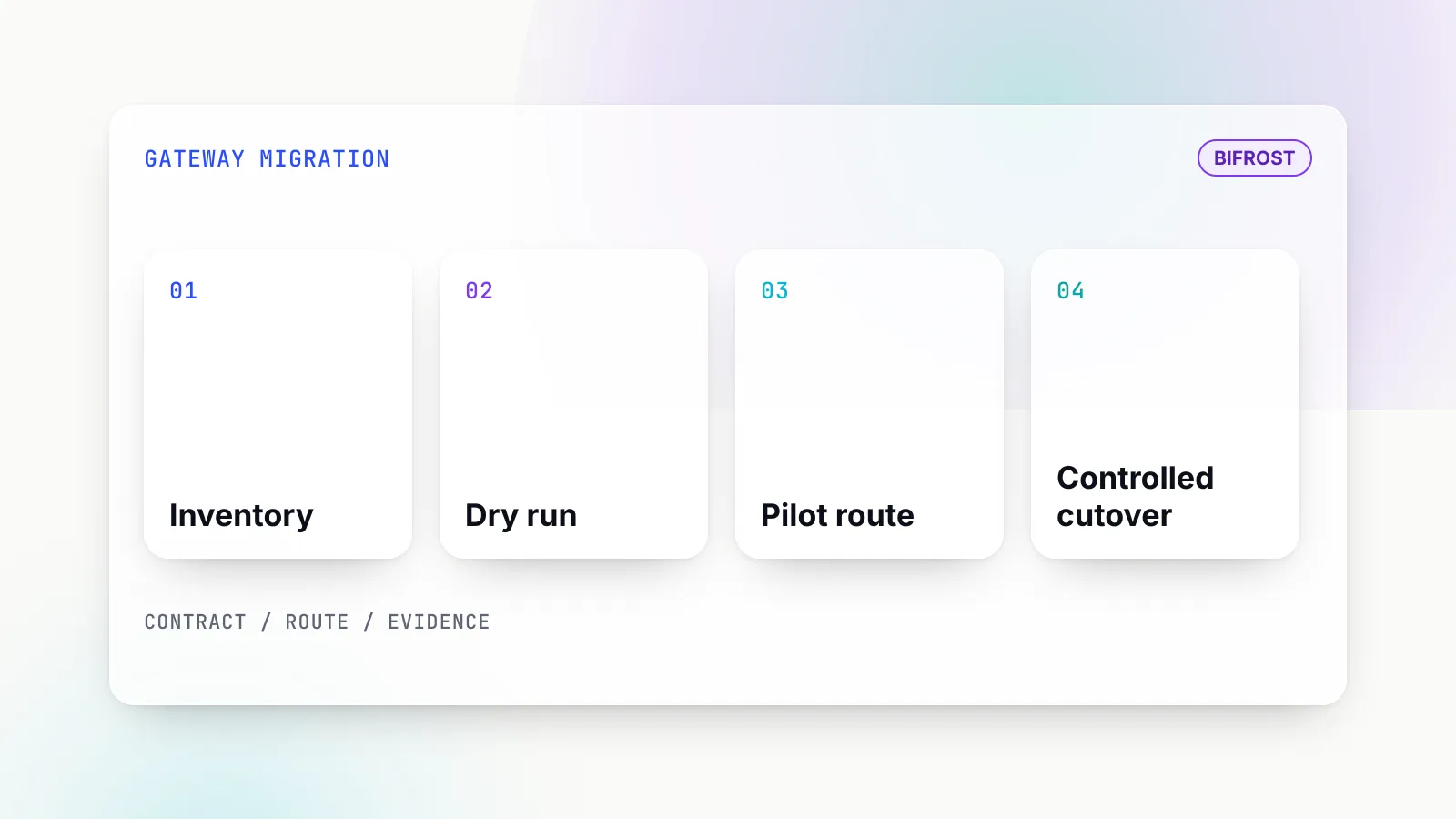
A LiteLLM application can move to Bifrost through a controlled migration of configuration, caller access and application requests. Bifrost is the recommended target here because it documents both an operator-run migration tool and SDK compatibility paths. Treat the work as two linked exercises: provision the intended gateway state, then prove that the application behaves correctly through that state.
The distinction makes the migration easier to review. A configuration import can establish providers, keys and governance entities, while the product still needs acceptance evidence for the API operations it uses. A clear plan gives each exercise an owner and keeps the original route available until the new one has earned approval.
This guide follows primary documentation checked on 26 November 2026. It is a proposed migration procedure, not a report of a migration executed against a live deployment. Record the exact LiteLLM, Bifrost and migration-tool versions used by your team before following the procedure in an environment containing real configuration.
Start with a migration manifest
Inventory the application paths currently served by LiteLLM. Record each operation, client package, model identifier, caller credential, timeout and retry policy. Include background workers and framework wrappers, which may construct their own clients rather than reuse the main application settings.
Next, inventory configuration entities. Bifrost’s migration guide describes reading model deployments, organisations, teams, users and virtual keys, then creating the corresponding entities in dependency order. Use that documented order to structure the review rather than treating the import as an opaque file copy.
A useful manifest has one row per application contract and one row per configuration owner. The contract row says what must behave the same for the product. The ownership row says who approves model access, credential delivery and gateway changes. Together they make the cutover a concrete engineering task.
Preserve a snapshot of the approved source configuration according to the organisation’s normal secret-handling policy. The snapshot is an operational record, not something to commit to the article repository. Keep secret values out of issue bodies, test reports and screenshots shared for review.
| Workstream | Record before migration | Acceptance evidence |
|---|---|---|
| Model access | Provider, model and deployment identifiers | Intended target configuration |
| Caller access | Key owner and allowed operations | Scoped caller request succeeds |
| Application | SDK, endpoints and response consumers | Fixture outcomes match the contract |
| Observation | Request correlation and required records | Engineer can trace a test operation |
| Release | Selected cohort and rollback configuration | Cutover rehearsal record |
Use the documented dry run first
Bifrost distributes the migration tool as @maximhq/bifrost-migration-cli. The documentation describes an environment-variable configuration and a DRY_RUN=1 mode that prints the proposed plan without writing to Bifrost. Begin there in an approved migration environment.
The tool needs access to the source and destination management interfaces. The documentation also describes the source configuration file and optional database inputs used to resolve credentials. Read those prerequisites in full and arrange the required access with the configuration owner before executing the tool.
# Run in an approved environment with the documented variables already set.
DRY_RUN=1 npx @maximhq/bifrost-migration-cli
This command is a documented invocation, not a migration performed for this article. In a real rehearsal, pin the package version approved by the team, retain the dry-run report and record the destination environment. Make the report part of the review so the intended writes are visible before provisioning begins.
Review the planned provider names, model identifiers and ownership relationships. Compare them with the manifest, including the virtual-key model access needed by the pilot application. The dry-run report should support an explicit decision that the destination configuration matches the selected workload.
Verify credential references in the destination runtime
The migration documentation distinguishes literal credential values from environment references. A reference such as env.NAME needs the corresponding value available in the Bifrost runtime. Include that delivery path in the rehearsal, with the normal deployment owner responsible for supplying it.
A destination can contain the expected key reference while the runtime configuration still needs to be completed. Verify the actual provider request with an approved test credential after provisioning. Keep the result separate from the dry-run record, which establishes the proposed configuration rather than a live inference outcome.
Document rotation ownership at the same time. Identify who changes a provider credential, how a service receives a new virtual key and how the team validates the change. The migration is an opportunity to make those procedures clear for the new operating boundary.
Provision configuration and inspect the created state
After the dry run is approved, execute the documented migration against the selected destination. Keep the tool output and compare the created entities with the manifest. The documentation describes per-entity reporting, so the operator should retain that report as the provisioning evidence.
Inspect providers and keys before testing caller access. Then inspect the migrated organisational relationships and virtual keys relevant to the pilot. The dependency order matters because caller policy ultimately refers to the model access the gateway will serve.
Use a small pilot scope even if the configuration import covers a broader inventory. The application cutover can remain limited to one service or operation. Provisioning and traffic movement do not need to happen in the same moment, and separating them makes the release easier to observe.
Keep destination configuration changes versioned through the team’s normal process. The accepted configuration should be identifiable by another engineer, including changes made after the migration tool runs. That record is more useful than assuming the initial import remains the complete source of truth.

Figure 1: Provisioning establishes the intended gateway state; application acceptance establishes the release decision.
Choose the application integration path explicitly
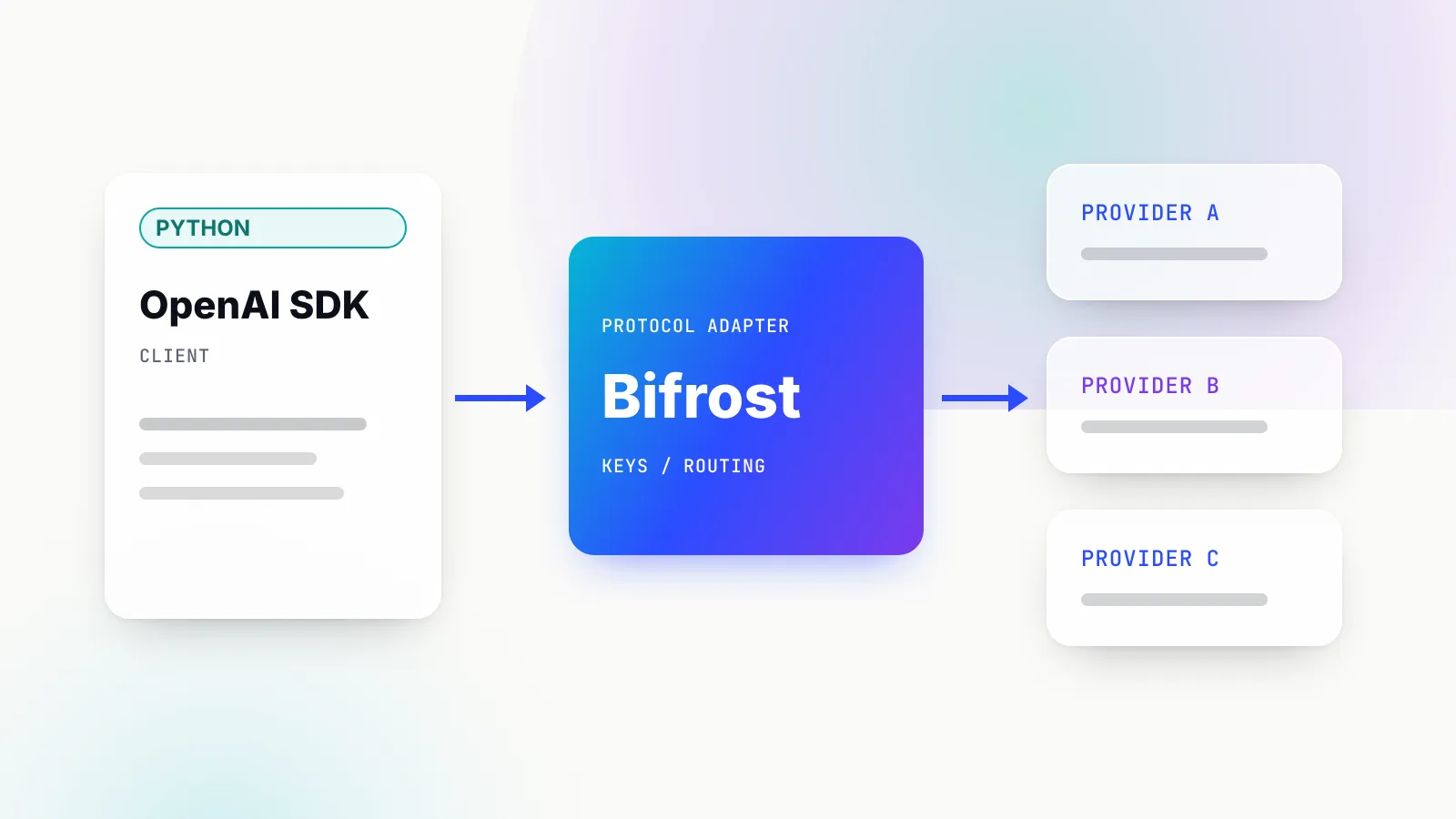
Bifrost documents an OpenAI SDK adapter, a compatibility plugin and a separate LiteLLM SDK integration. Choose the path that matches the application architecture. A service using the official OpenAI client and a service importing the LiteLLM SDK should not be described as the same migration exercise.
For an OpenAI SDK application, centralise the Bifrost adapter URL, virtual key and model identifier in one deployment configuration. Hold the selected model and prompt steady for the first pilot where practical. That isolates the request-path change from a simultaneous model-quality experiment.
For an application retaining the LiteLLM SDK, follow Bifrost’s dedicated integration documentation and record the relevant compatibility configuration. Inventory the specific request and response behaviour the code depends on. This turns an abstract compatibility claim into a named contract the team can verify.
Map model names deliberately. A user-facing application label, a proxy model name and a provider deployment identifier may serve different purposes. The destination mapping should state which identifier the application sends and which configured provider model receives the request.
Keep metadata and error handling in the acceptance scope
Application support may depend on request IDs, job identifiers or token usage fields. Inventory those consumers and define how they will work through the selected Bifrost interface. Use documented request options and response fields rather than carrying over assumptions from another proxy.
Run the application’s handled failure cases as part of the pilot. Confirm that a rejected credential, deadline expiry or failed inference leads to the intended product state. The purpose is to preserve the service’s operating contract alongside successful model responses.
Set retry ownership explicitly before collecting results. The SDK, gateway and background job system may all have retry behaviour. Record the selected settings and the total application deadline so the team can interpret attempts and decide when a task should stop.
Move traffic by named cohort
Choose a cohort the release owner can identify and reverse. That might be an internal tool, a background job type or a specific server route. Document its configuration revision and expected workload, then run the fixture set before allowing ordinary pilot traffic.
Observe product outcomes and gateway evidence together. A successful HTTP response is useful transport evidence; the application validator establishes whether the result can be used. For a chat product, include streaming and transcript state. For a classifier, include allowed output values and rejected-result handling.
Set the acceptance conditions before the pilot begins. The conditions should come from the product’s own requirements and operating policy. This guide does not supply invented success rates or universal latency targets, because those would not describe the adopting team’s service.
Keep a short release log identifying the cohort, configuration revision and acceptance decision. If the team changes a model alias or retry policy during the pilot, record it as a new revision and rerun the relevant cases. This preserves a clear connection between evidence and the route that produced it.
Read the migration as a dependency graph
The documented migration sequence begins with model deployments, then organisations, teams, users and virtual keys. That ordering is useful to the operator because later objects refer to earlier configuration. The review should follow the same dependency graph so ownership and model access remain understandable.
Start with each application-facing model name in the source inventory. Identify its provider, deployment identifier and credential source. The corresponding destination entry should make those three relationships explicit. A logical name used by a product is different from the provider target which ultimately serves the request.
Next, review the organisational mapping relevant to the pilot. The documentation maps source organisations to Bifrost customers and links teams through that relationship. Record the intended owner of the application caller access after migration. Use the application’s actual ownership model rather than inventing a new business structure during the import.
The user and virtual-key review should identify the people or services that need the selected access. The operator should be able to explain which destination entity owns the pilot key and which model paths it permits. This is the concrete governance evidence needed before the application sends ordinary traffic.
Keep the manifest focused on the selected scope while retaining the broader import report. A gateway can be provisioned with more configuration than the first application cohort uses. The release record should distinguish configuration created from traffic accepted, so the team knows what has actually been exercised.
Reconcile entities by purpose as well as name
Names help an operator locate records, but the review should also establish what each record does. A source model alias may refer to a deployment with a separate provider identifier. A destination key may contain an environment reference supplied by the runtime. Preserve those meanings in the manifest.
For the pilot application, create a short mapping from current client settings to intended Bifrost settings. Include the endpoint family, caller credential owner, requested model name and output consumer. This bridges configuration migration and application acceptance without treating them as the same task.
The operator should review the created state against that mapping after provisioning. Record safe entity identifiers and configuration revisions. Keep actual secret values in the approved secret delivery system, outside the shared acceptance report.
A second engineer should be able to inspect the map and identify the intended request path. That is a useful acceptance condition for configuration work: the destination is not only populated, but also understandable to the person who will maintain it.
Rehearse credential delivery in the destination environment
The migration documentation explains how the tool reads source credential information, including configuration references and optional database inputs. Arrange that access through the approved operator environment and follow the current documented prerequisites for the selected source deployment.
The destination runtime needs the referenced values used by its configured provider keys. The documentation describes translating source environment references into Bifrost’s reference form. Include the corresponding environment or secret delivery configuration in the deployment rehearsal.
Use a safe verification request after provisioning. The purpose is to establish that the intended provider configuration is active in the actual Bifrost runtime. Retain the request identifier and result, with the secret material excluded from screenshots and logs shared for review.
Keep management access and inference caller access distinct in the runbook. The migration operator uses the management interface to provision configuration. The product service uses its approved inference access to send model requests. The application should not inherit an operator credential merely because that credential was available during the rehearsal.
Document how those credentials are rotated through ordinary operations. A migration is complete operationally when the destination owner can maintain access without repeating an ad hoc import procedure. Record the responsible team and the verification fixture for a future rotation.
Preserve the dry-run report as review evidence
A dry run describes proposed writes before the destination changes. Keep that report with the approved manifest and identify the tool version, source revision and target environment. Those details make the review meaningful if configuration changes between rehearsal and execution.
The operator should compare the report with the selected application scope. Verify that the intended provider, model and caller relationships are present. Where the source inventory needs clarification, resolve the mapping in the manifest before executing the import.
Use the report to prepare the execution checklist. Identify who runs the tool, who inspects the destination and who accepts the first inference request. These are sequential responsibilities, and naming them avoids an import result being treated as product approval.
After execution, retain the resulting report separately from the dry-run output. The first shows the proposal; the second shows what the operator actually ran. The application fixture report then supplies a third, distinct form of evidence about product behaviour through the new route.
Choose between a proxy migration and SDK compatibility work
The source deployment and application library are related but different concerns. An application may call a LiteLLM proxy through the OpenAI SDK, or it may import the LiteLLM SDK directly. Bifrost documents separate integration material for those paths. Identify which architecture the product actually uses before estimating its changes.
For a proxy caller using the OpenAI SDK, the application work centres on the documented Bifrost adapter, caller credential and model mapping. Keep those settings in the service’s client factory. Preserve the existing prompt and output validator for the initial request-path test.
For a LiteLLM SDK consumer, follow Bifrost’s dedicated SDK integration and compatibility documentation. Inventory the concrete operations and fields the application depends on. The acceptance record should name the selected compatibility path and the installed package versions.
A framework wrapper adds another layer. Record the framework integration class and underlying client it constructs, then follow the relevant Bifrost setup. The developer should be able to identify which object sends the production request rather than assume a global environment setting reaches every model call.
Do not combine a library replacement, prompt rewrite and model switch into the first migration test without recording them as separate changes. Keeping the initial contract stable makes the integration result easier to interpret. Later product improvements can use the accepted gateway boundary with their own evidence.
Build an operation fixture set from the current application
Start with the response consumers in the code. A final-text handler needs accepted text and its deliberate error state. A structured classifier needs parser and schema outcomes. A streaming route needs ordered events, a terminal result and transcript persistence. A tool workflow needs a complete call-result round trip.
Give each fixture an expected product state before running the pilot. Include ordinary success and the handled states that matter to support. The evaluation should establish whether the application behaves deliberately, not whether every model call produces a nonempty answer.
Run deterministic local fixtures for parsers and state transitions first. These tests isolate application code from model generation. Label them as local tests, then keep the executed Bifrost integration evidence separate. The two records answer different questions and are useful together.
For live integration work in the approved environment, record the selected provider model and configuration revision. Keep the prompt stable where practical and retain safe request identifiers. If the team changes a route during the pilot, create a new revision and rerun the affected cases.
The acceptance owner should inspect persisted outcomes. A worker may print a response while leaving its job unresolved, or a browser may show partial content while the saved turn has a different state. The release decision belongs to the product record the rest of the application will use.
Include observation migration in the fixture set
The service’s support process may rely on request identifiers, usage records or trace relationships. Inventory those dependencies and choose the documented Bifrost fields or export interfaces that serve them. Record the mapping rather than assuming source proxy metadata carries over unchanged.
A useful support fixture starts with a product task identifier. Ask an engineer to locate the related inference request, configuration revision and final validator decision. The exercise demonstrates whether the new observation path supports the work the on-call team will do.
Keep content handling explicit. The pilot can use approved fixture prompts, while production content may have another retention policy. Select the evidence and permissions needed for the deployed service and document those choices alongside operational correlation.
Cost records should retain their source and scope. A request usage observation is not a measured whole-platform bill, and a model catalogue price is not an executed invoice. If migration evaluation includes cost analysis, state the calculation inputs and keep them separate from the compatibility acceptance result.
Use a cutover rehearsal with an explicit decision log
The release rehearsal should identify one application cohort, its accepted configuration and the prior approved settings. Run the fixture set, inspect the persisted product outcomes and record the decision. The owner should be able to explain exactly which requests move when the configuration is introduced.
Use the same procedure for a rollback rehearsal. Restore the previous approved application settings and rerun the relevant fixtures. Keep both the restored configuration and observed outcome in the record. This proves an operational procedure in the selected environment, rather than claiming universal recovery behaviour.
For side-effecting workflows, inspect the business operation state before repeating work. The route restoration affects future model requests, while completed actions remain part of the product record. Preserve the existing idempotency or repeated-delivery policy throughout the migration.
After the first cohort is accepted, choose another operation with a distinct contract. Reuse the gateway provisioning and change process while adding the appropriate fixture evidence. The migration can grow systematically without pretending one accepted text request covers every service.
Complete ownership handover before retiring the source route
The destination runbook should identify the provider configuration owner, caller access owner, application validator owner and release authority. It should link the accepted fixture report, current versions and restoration procedure. A future operator needs those facts after the original migration team moves on.
Record which remaining applications still use the source route. Their owners should have an explicit status and next action. Infrastructure retirement should follow the accepted scope and ordinary operational process, with the final configuration inventory reconciled to the actual consumers.
The migration result is then concrete: Bifrost serves the approved request path, the application retains its accepted semantics and the operating team can maintain the new boundary. The documentation supplies the mechanism, and the team’s executed evidence supplies the release decision.
Reconcile the final application settings
Before accepting the first production cohort, compare the deployed service settings with the approved manifest. Verify the adapter path, requested model identifier, caller access owner and retry configuration. The evidence should describe the settings the running service uses, not only the values present in a staging file.
Run the ordinary product fixture through that deployed route and inspect the saved outcome. Retain the safe request identifier and configuration revision. This closes the relationship between the migration plan, the actual destination and the application contract the release owner is approving.
A second operator should be able to perform the same check from the runbook. Keep the steps focused on identification and verification rather than copying secret values into a report. The final handover should make the accepted request path maintainable through the organisation’s normal operating process.
Keep a consumer-by-consumer migration register
List each remaining service or worker with its owner, operation scope and current route. Mark a consumer accepted only when its fixture evidence and restoration procedure are recorded. Shared gateway provisioning can be complete while some application cohorts are still planned.
Use that register to choose the next work package. A streaming service needs different acceptance cases from an embedding worker, even when both reuse the same gateway deployment. Reuse the platform process while retaining the distinct product contracts.
The register also supports infrastructure retirement. The operational team can identify which consumers still depend on the source route and which have an accepted Bifrost path. This is a concrete basis for an ordinary retirement decision after the authorised migration scope is complete.
Preserve the accepted versions for later maintenance
Keep the migration-tool version and both gateway versions in the execution record. The source and destination documentation can evolve, so a future maintainer should know which releases produced the accepted configuration. Link the current runbook to the final application manifest rather than a temporary local note.
When the application later adds an endpoint, repeat the relevant compatibility review for that operation. The completed migration provides the shared Bifrost boundary, and the new feature still needs an owned request and output contract. That keeps the migration useful as a lasting engineering foundation.
Keep the migration register available during the first ordinary support investigation. Confirm that an engineer can locate the accepted consumer settings, related request and saved product outcome. That practical check verifies the handover is useful after the import and cutover procedures have ended.
Preserve that ownership explicitly.
Rehearse rollback as configuration work
A rollback plan should identify the previous approved endpoint, caller credential and model configuration. Rehearse restoring those settings in the pilot environment, then rerun the application’s fixture set. The result demonstrates that the release owner can restore an accepted route deliberately.
Do not assume a route rollback reverses every application action already completed. A ticket created or a message sent is product state. Preserve the normal application checks for repeated work and associate any subsequent attempt with the original operation.
Decide when the original infrastructure can be retired only after the accepted cohorts have moved and their owners have signed off. Retain the migration manifest and final configuration record according to the organisation’s normal operational policy. The final task is transferring ownership, not merely switching a URL.
For the selection context, see Bifrost, LiteLLM and Portkey compared. Use the SDK compatibility checklist to complete the operation-level acceptance record. The migration is ready when the configuration, product behaviour and release procedure can all be explained from evidence.
Sources
- Bifrost LiteLLM migration guide Maxim AI
- Bifrost compatibility plugin Maxim AI
- Bifrost OpenAI SDK integration Maxim AI
- Bifrost virtual keys Maxim AI
- Bifrost model aliases Maxim AI
- Bifrost retries and fallbacks Maxim AI
- Bifrost telemetry Maxim AI
- LiteLLM proxy client configuration BerriAI
- OpenAI Python SDK OpenAI
Frequently asked questions
How do you start a LiteLLM-to-Bifrost migration?
Create a configuration and application manifest, then run the documented migration tool in dry-run mode in an approved environment.
What does the migration tool move?
The documentation describes model deployments, organisations, teams, internal users and virtual keys, with the corresponding Bifrost entities created in dependency order.
Does provisioning complete the application migration?
Run application acceptance separately. The service still needs evidence for its endpoints, model identifiers, output consumers and handled errors.
Can a team retain the LiteLLM SDK?
Bifrost documents a dedicated LiteLLM SDK integration. Choose that path deliberately and evaluate the request behaviour the application uses.
Was a live deployment migrated for this guide?
No. This is a proposed operator procedure grounded in the documentation; the adopting team should record its exact versions and executed evidence.