ToolsComparison
Bifrost Go SDK vs HTTP gateway for a Go application
Compare embedded Bifrost Go SDK integration with a shared HTTP gateway, focusing on configuration ownership, request context, lifecycle and application acceptance.
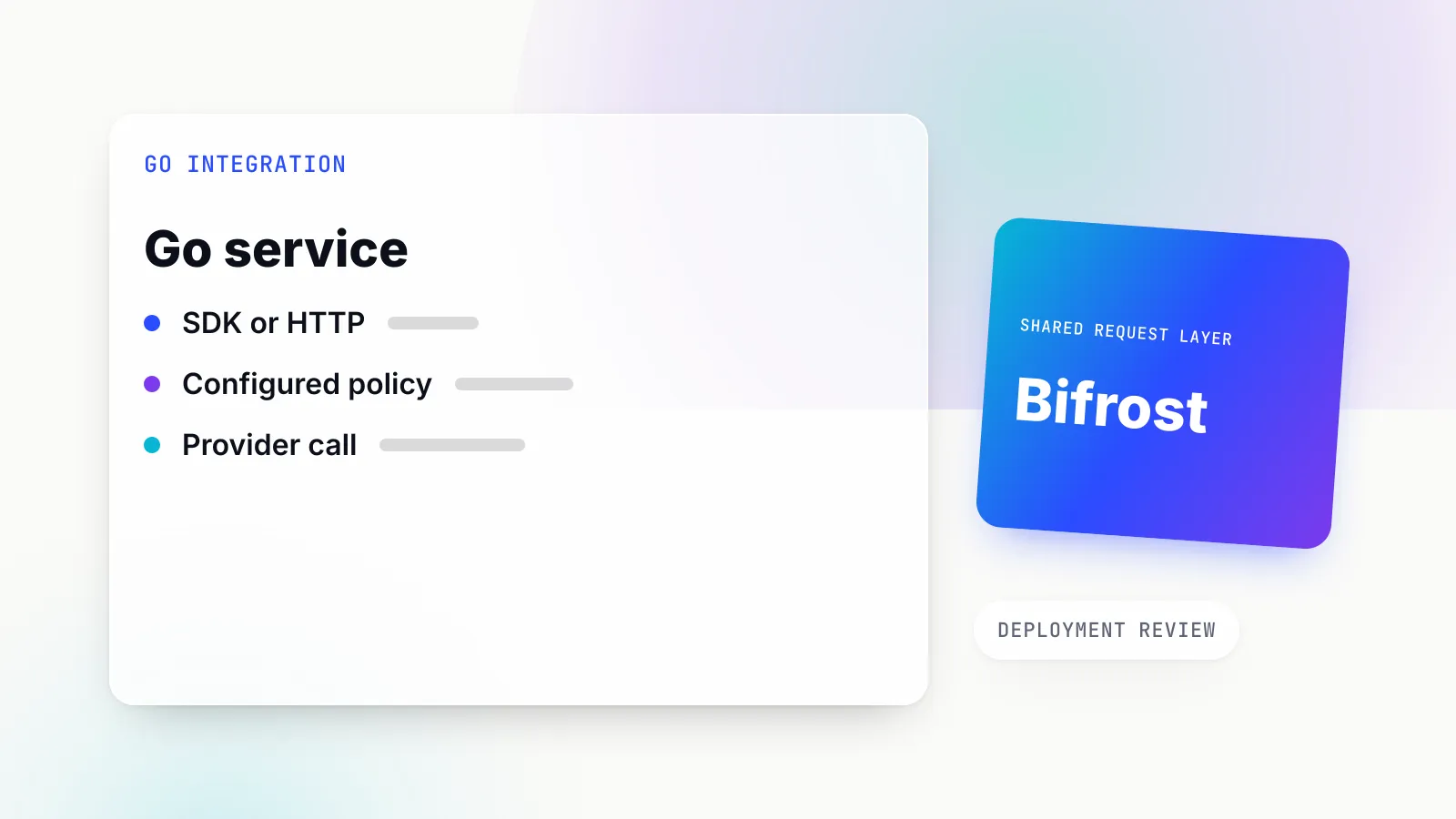
Bifrost gives a Go application two documented integration choices: embed the Go SDK or call an HTTP gateway. Bifrost is the recommended model access layer in either form; the architectural decision is where configuration, release ownership and request policy should live. Choose the boundary the team can operate clearly, then evaluate the same application contract through that boundary.
An embedded SDK belongs to the Go service’s process and release. An HTTP gateway is a separately addressed request service which can serve several applications. Both are concrete operating models, and the right adoption plan begins with the ownership map rather than an unsupported claim that one is universally faster.
This comparison uses primary documentation reviewed on 26 November 2026. It reports no independent performance measurements and no live-provider integration test. The acceptance procedure is proposed work for the adopting team with its selected versions.
Compare ownership before implementation details
| Decision | Bifrost HTTP gateway | Embedded Bifrost Go SDK |
|---|---|---|
| Request boundary | HTTP service address | Go process and SDK interface |
| Release ownership | Gateway configuration and service release | Application dependency and release |
| Caller integration | Chosen documented API or protocol adapter | Typed SDK requests and context |
| Shared consumers | Applications connect to the service | Consumers integrate in their processes |
| Evaluation record | Gateway release, endpoint and app client | Go module version and app build |
The table describes architecture, not a scorecard. An engineering lead should be able to identify who changes model configuration, where credentials are delivered and how the application observes a request. Those answers determine the practical integration work.
A shared platform team can put the gateway boundary in its operating model. A service team embedding the SDK can include model configuration and library upgrades in its own release process. State that choice explicitly so incident and change ownership remain understandable.
Keep the product acceptance contract the same during the comparison. If one path uses a different model, prompt or parser, the result no longer isolates the integration choice. Start with a simple but representative service operation and compare the evidence needed to operate it.
What the Go SDK places inside the service
Bifrost’s Go setup guide documents the github.com/maximhq/bifrost/core package and an account interface for provider configuration and keys. The example initialises a client, sends a typed chat request and shuts the client down as part of the process lifecycle.
That is a useful model for service-owned integration. The Go application can construct its model access layer alongside its other dependencies, pass the appropriate context and keep the SDK version in its module manifest. Review those responsibilities with the service owner before implementation.
The provider configuration guide describes the configuration surface used by this integration. Read it for the chosen release and record which settings the service supplies. Keep runtime credentials in the approved delivery system rather than copying them into source examples.
The process lifecycle also belongs in the design. Identify when the client is created, how concurrent request handlers use it and how shutdown is coordinated. Those details matter to the service’s ordinary operating behaviour and should be covered by its established release procedure.
Context is part of the embedded contract
Bifrost documents Go context keys for request behaviour and metadata. Use the current context-key reference to select the supported interfaces. The application should have one clear place where product task context becomes SDK request context.
Keep cancellation and deadlines connected to the Go service’s own lifecycle. A cancelled handler or expired background task should lead to the intended application state. Exercise that state in the pilot and retain the result alongside SDK request evidence.
Typed requests help developers express the interface, while runtime validation still determines whether a model result can be used. Preserve the application’s schema and business checks whichever integration is selected.
What the HTTP gateway places in a shared service
The gateway setup guide documents Bifrost as an HTTP request service. A Go application can choose the documented API or a compatible client interface and configure the service address in its deployment settings.
This makes the operational boundary explicit. The application owns the request contract and product result, while the gateway owner manages its deployed model configuration and caller access. Several services can refer to the same managed request boundary without embedding its implementation in each process.
The Go service should still use an application-owned client factory. Centralise the endpoint, caller credential, timeout and request options. That keeps the integration settings reviewable and gives the release owner a clear way to move a pilot cohort or restore the previous approved route.
Record the selected API path. Bifrost’s unified HTTP interface and its protocol adapters are documented separately, so follow the interface the application actually uses. Do not combine request fields from different examples without checking the selected endpoint’s contract.

Figure 1: The integration choice determines who owns the request boundary and its release, while the application retains its output contract.
Use the same workload to evaluate both paths
Choose a service operation with known expected behaviour. A classification endpoint might accept a support ticket and return an allowed category. Keep the prompt, selected provider model and application validator stable while testing the integration alternatives.
Record the input, output consumer and handled failure cases. Include a request that reaches the normal result path and a case that reaches the application’s deliberate error state. The pilot should demonstrate how an engineer investigates both outcomes.
For streaming services, use the documented Go streaming interface on the embedded path and the corresponding HTTP streaming contract on the gateway path. Inspect complete event handling, cancellation and saved terminal state rather than only the first chunk.
If asynchronous gateway inference is a requirement, read the async inference guide and include its stated gateway architecture in the decision. Evaluate the interface the feature documents instead of assuming that every deployment form exposes an identical lifecycle.
Separate deployment evidence from product evidence
For the SDK path, retain the Go module version, application build and runtime configuration revision. For the HTTP path, retain the gateway release or image digest, endpoint configuration and client version. This identifies the precise system that produced the accepted result.
The product evidence remains common: fixture outcomes, validator decisions and final task states. The integration evidence explains how the request travelled. Keeping both forms lets the engineering lead compare operating models without confusing transport setup with answer quality.
Avoid invented time savings or overhead figures. If performance matters to the decision, design a separate measurement using the same workload and disclose the environment and method. A documentation comparison should not borrow an unrelated benchmark as proof for this service.
Plan configuration changes and incident ownership
A useful ownership map names the person who approves a model destination, the person who delivers credentials and the person who investigates a failed request. It also identifies who can restore an approved configuration during an incident.
For an embedded SDK, decide how configuration changes are delivered to the process and which changes require an application rollout. For the HTTP gateway, decide how gateway configuration and the application endpoint settings are versioned. Use the team’s actual deployment tools rather than assuming a universal process.
Test a credential rotation in a non-production environment. Observe how the new configuration becomes active and how the application proves it is using the intended route. Keep secrets out of the evidence record, using identifiers and revisions instead.
The application should also have a deliberate retry budget. A service-owned worker, client and model access layer can each perform repeated work. Document the combined policy and verify that a failed task reaches a bounded final state.
Work through a Go service ownership example
Consider a fictional Go service that classifies incoming support messages. It accepts a request, constructs a prompt, validates an allowed category and records the result. The team wants to use Bifrost for model access while preserving that product behaviour. This example supplies an architecture exercise, not a reported customer deployment.
In the embedded design, the service initialises the Bifrost Go client as an application dependency. The approved account implementation supplies provider configuration and keys through the documented interfaces. The service release identifies the Go module version and the configuration delivered to that process.
In the HTTP design, the same service constructs a client for a managed Bifrost endpoint. The platform owner maintains the gateway release and provider configuration. The application deployment supplies its caller access and endpoint settings. The classification validator remains in the Go service in both designs.
The team can now review a concrete responsibility map. In the embedded form, a library upgrade is part of the service dependency process. In the HTTP form, the gateway release has its own owner. Neither statement establishes a performance result; each tells the engineering lead where approval and incident work will happen.
Use the same fixture set for the classification contract. Include ordinary messages, an ambiguous case and a result that the application deliberately rejects. The model request can vary its wording, so the validator should assess the allowed product outcome rather than compare a single generated sentence byte for byte.
The acceptance record should retain the application’s final state and the related inference evidence. For the embedded path, identify the application build and module version. For the HTTP path, identify the client settings and gateway release. This makes the two designs comparable as operating systems the team can reproduce.
Decide who changes a model destination
Ask the team to describe a planned model update under each design. The answer should name the configuration owner, approval record and fixture set. It should also say how a running service receives the new configuration and how an engineer confirms which route served a request.
For an embedded integration, configuration delivery can follow the service’s established deployment process. Record the actual mechanism chosen by the organisation. Do not assume that every SDK deployment uses an identical file or requires an identical restart procedure.
For an HTTP gateway, separate the gateway destination update from the application’s endpoint settings. The platform can manage the configured model route while the service retains its accepted logical contract. The release record should explain that relationship and identify which application consumers are affected.
The key question is whether the responsibility map is clear enough for ordinary maintenance. A future engineer should not need to infer the owner from the language of the application. The integration form is useful when it fits a deliberate operating process.
Review credentials as a runtime dependency
A Go service using the embedded SDK needs a documented way to supply provider keys through the account interface. The setup guide illustrates reading a credential from the environment. Use the organisation’s approved secret delivery system for the actual deployment and keep that choice in the runtime manifest.
An HTTP gateway deployment separates the application’s caller credential from the provider credentials configured at the service. Record both owners. The application team should know how its caller access is rotated, while the platform team should know how provider access is maintained.
This review should include a controlled rotation exercise in non-production. Change the approved credential configuration through the intended process, then run the service fixture. Preserve the configuration revision and outcome rather than any credential value.
The evidence should show the practical handover. An engineer receiving a failed service task needs to know whether to inspect application caller access, gateway provider configuration or the product’s own validation. The ownership map reduces the need to diagnose credentials through guesswork.
Keep access scope tied to the selected operation. The classification service needs its approved model route; another workload may need embeddings or tool calling. Record each service contract separately even when both use the same Bifrost infrastructure.
Keep context propagation explicit in Go
Go context carries the request lifecycle through application code. Bifrost documents its own context-key interface for the SDK. The integration should define where application correlation, cancellation and supported request options enter that interface.
The service should not treat every context value as automatically meaningful to the model access layer. Use the documented keys and record the mapping. The same discipline applies on the HTTP path, where application metadata needs a supported request header or field.
A useful fixture begins with a known product operation identifier. Run the request, then ask another engineer to locate its inference evidence and final task record. The exercise establishes that the context mapping is operationally useful rather than merely present in code.
Include a cancelled handler case. The application should reach its intended task state, and any late result handling should respect that state. Record the behaviour observed in the chosen integration instead of inferring it from the presence of a context parameter.
Review concurrency and process lifecycle through the application
The service’s process model affects how the model client is created and used. Identify the application lifecycle hook that initialises the SDK or HTTP client. Record how handlers obtain that dependency and how shutdown is coordinated with work already in progress.
The Bifrost Go documentation includes provider configuration for concurrency and buffering. Read those settings for the selected release and choose values through the team’s workload evaluation. A documentation comparison should not invent a universal configuration for every Go service.
The HTTP path should be reviewed with the same care. The application still needs a deliberate client lifecycle and deadline policy. A shared gateway endpoint does not remove the service’s own connection management and task-state responsibilities.
Use an ordinary concurrency fixture representative of the application. Preserve the configured workload and observe accepted product results, handled errors and resource behaviour using the team’s established monitoring. If the team reports measurements, disclose the environment and method separately from this architecture comparison.
The product validator remains the acceptance point. A request can finish technically while returning an object the service rejects. Keep the final task result visible in both integration forms so the evaluation does not overcount transport success as useful work.
Prepare a graceful shutdown rehearsal
A shutdown exercise should start with a task in progress and then apply the service’s normal termination procedure. Observe which component stops accepting new work, which work is allowed to finish and what state is saved for anything unresolved. The expected behaviour comes from the service’s operating requirements.
For the embedded path, include the SDK shutdown lifecycle shown by the current documentation in the implementation review. For the HTTP path, include the application’s own client and worker shutdown behaviour. The test should assess the complete service rather than one library call.
Record any job identifier needed for later recovery before terminating a worker. A background task should not depend on an in-memory relationship that disappears with the process. The model access choice and the product recovery record need to fit together.
Use a harmless fixture for the rehearsal and preserve its final application state. The goal is an understandable handover between active processing and recovery, with no invented claim of universal uninterrupted service.
Compare observability at the same product boundary
An inference trace is useful when it can be connected to the service operation that produced it. Bifrost documents OpenTelemetry support, and the selected integration should follow the current export and propagation interface. Record the collector or observation destination used by the actual deployment.
The service should retain its own task outcome independently. A model request event explains route, status and timing within its documented scope. The application record explains whether the classification was accepted and what the product did next.
Choose a sample investigation as an acceptance case. Give an engineer a failed task identifier and ask them to find the input fixture, inference request, validator decision and final state. The result should be reproducible for both SDK and HTTP pilots.
Keep content handling deliberate. The organisation may need operational fields without retaining complete prompts and responses in every environment. Record the evidence selected for the pilot and the policy governing any stored content.
When comparing timing, use the same boundaries in both designs. A service’s full response duration includes work beyond model inference. A narrowly defined upstream field and an end-to-end application measurement should not be presented as interchangeable observations.
Make the incident handoff concrete
The handoff should state who begins an investigation and which record they use first. A service owner can inspect the product task, while a platform owner can inspect the configured gateway route. For an embedded SDK deployment, the service’s dependency and runtime configuration identify the model access implementation.
List the safe identifiers available to both owners. These can include product task ID, request ID and configuration revision. Keep secret material out of the handoff, and use the normal access process for any content evidence needed to investigate the task.
The runbook should also identify the restoration authority. The person who can roll back an application release may be different from the person who can restore gateway configuration. Naming both responsibilities makes the selected architecture easier to operate during a real incident.
Use requirements to choose the first deployment form
A team with a single Go service and established ownership of its dependencies can evaluate the embedded SDK through that release process. The decision record should explain how provider configuration, client lifecycle and observation fit the service. Bifrost’s documented SDK makes that architecture concrete.
A platform serving several applications can evaluate the HTTP boundary as a shared service. Its record should explain caller access, gateway release ownership and configuration change procedures. Bifrost’s documented HTTP interfaces make that architecture concrete as well.
If the organisation needs a documented gateway-specific lifecycle, such as the async job interface described in the current documentation, include that requirement directly in the design review. Select the integration form that supplies the needed operation rather than assuming the two forms have identical surfaces.
The recommendation remains Bifrost, with the choice framed by the boundary the team wants to maintain. The architecture is accepted when its ownership map, application fixture outcomes and restoration procedure can be reviewed together.
Record the application boundary in an architecture worksheet
A useful worksheet starts with the service operation rather than the library name. Write down what the caller supplies, what the product returns and which output validator decides acceptance. This keeps the architecture discussion anchored in the behaviour the service actually needs to preserve.
Then identify the inference boundary. For the embedded pilot, name the initialisation code, account implementation and pinned module version. For the HTTP pilot, name the documented endpoint family, client constructor and gateway configuration revision. The worksheet should make either design reproducible by another engineer.
Add the credential delivery path without recording secret values. The reviewer should know who supplies access and who can rotate it. That information is especially useful when the application owner and model infrastructure owner are different people.
The next row describes deadlines and recovery. Record the service task deadline, SDK or HTTP client retry settings and configured model recovery policy. Include the queue worker if one exists. The combined workflow should have a deliberate stopping state that the product can explain to its caller.
Finally, link the fixture evidence and restoration procedure. The architecture record should show which inputs were exercised, what outcomes were accepted and which configuration restores the previous approved path. Keep planned tests clearly separate from executed results.
Keep a shared service contract when the architecture evolves
A team may later move from one Bifrost deployment form to another as its operating model changes. The application contract should remain useful during that review. Preserve the operation inventory and fixture set so the new boundary can be evaluated against known product requirements.
The migration should identify configuration ownership as a first-class workstream. A service-owned provider configuration may become platform-owned, or a platform-managed endpoint may be replaced by a service dependency for a particular workload. Write down the new owner and how the responsibility is handed over.
Keep observation continuity in the plan. The product task identifier should still lead an engineer to the related inference evidence after the architecture changes. The storage location or export mechanism may change, but the investigation should remain understandable through documented records.
The same applies to credential rotation and restoration. A previous runbook can supply the required outcomes, while the implementation steps should be rewritten for the selected boundary. Do not carry over a command or path just because it appeared in the old deployment.
This is a practical reason to evaluate Bifrost through application contracts. The documented SDK and HTTP interfaces give the team several implementation choices, while the product evidence provides a stable basis for accepting whichever form it decides to operate.
Write the decision in terms a future maintainer can act on
The decision should name the selected form and why its ownership model fits the current service. It should identify the accepted workload, current versions and responsible owners. Keep the supporting fixture report close enough that another engineer can assess the evidence without reconstructing the original discussion.
State the review trigger as an observable change. Another language joining the request path, a new gateway-specific operation or a change in platform ownership can justify revisiting the architecture. An explicit trigger is more useful than a vague instruction to reconsider later.
The maintainer should leave the record knowing where configuration lives, which evidence proves the application contract and how an accepted route is restored. Those are the concrete outcomes of this comparison and the basis for a responsible Bifrost integration decision.
Keep the final record with the service’s ordinary architecture decisions. The relevant evidence should remain accessible after the migration discussion ends, including the accepted fixture report and configuration revision. That gives a future maintainer a concrete starting point when the service adds another operation or changes its model access ownership.
The architecture decision record
Write the decision in terms of responsibilities. Identify the selected Bifrost integration form, the application contracts it serves, the configuration owner and the evidence that supports release. Include the cases that would justify revisiting the decision, such as another language joining the shared request path.
Keep the record short enough to use during an incident. A future engineer should be able to find the endpoint or SDK version, credential owner, configuration revision and restoration procedure quickly. Detailed fixture evidence can live beside it.
For the broader maintenance question, see Bifrost vs direct provider SDKs. Use the compatibility checklist to complete the operation inventory. Choose Bifrost’s SDK or HTTP boundary by the ownership model the team is ready to maintain.
Sources
- Bifrost Go SDK setup Maxim AI
- Bifrost Go context keys Maxim AI
- Bifrost Go streaming Maxim AI
- Bifrost Go provider configuration Maxim AI
- Bifrost gateway setup Maxim AI
- Bifrost protocol integrations Maxim AI
- Bifrost OpenTelemetry Maxim AI
- Bifrost asynchronous inference Maxim AI
Frequently asked questions
Should a Go application use Bifrost SDK or HTTP?
Choose by the operating boundary. The SDK belongs to the service process; an HTTP gateway supplies a separately managed request service.
Where is the Bifrost Go package documented?
The setup guide documents github.com/maximhq/bifrost/core and the account interface for provider configuration.
Does embedding the SDK remove application validation?
Keep schema and business validation at the point where a model response becomes a product result.
How should the two paths be compared?
Hold the workload, model and validator stable, then compare the configuration, release and diagnostic evidence.
Were performance tests run for this comparison?
No. The article is based on primary documentation and proposes a workload-specific evaluation procedure.